


Finding the right product to sell has always been one of the biggest challenges in ecommerce. A great idea can turn into a successful business, while the wrong product can lead to wasted time, inventory problems, and financial losses.
For years, entrepreneurs and ecommerce sellers relied on manual research methods to discover profitable opportunities. They analyzed competitor products, studied customer reviews, checked market trends, and spent countless hours trying to understand what shoppers actually wanted.
While these methods are still valuable, the process has become much more complex. Online marketplaces now contain millions of products, customer expectations change faster than ever, and competition continues to increase across almost every category.
This is where AI product research is changing the way businesses discover and validate new opportunities.
Modern AI tools can analyze large amounts of market data, identify emerging trends, study customer feedback, compare competitors, and help sellers make better decisions before investing in a new product.
Instead of asking “What product should I sell?”, businesses can now use AI to answer more important questions:
- Is there real demand for this product?
- Who are the main competitors?
- What problems do customers have with existing products?
- How can a new product offer something better?
AI does not replace human creativity or business judgment, but it can dramatically reduce the time and uncertainty involved in product research.
From Amazon sellers searching for profitable niches to Shopify brands looking for the next trending product, AI-powered research tools are becoming an essential part of modern ecommerce strategies.
In this guide, we will explore how AI product research evolved, how these tools work, which platforms are worth considering in 2026, and how businesses can use artificial intelligence to find better product opportunities.
What Is AI Product Research?
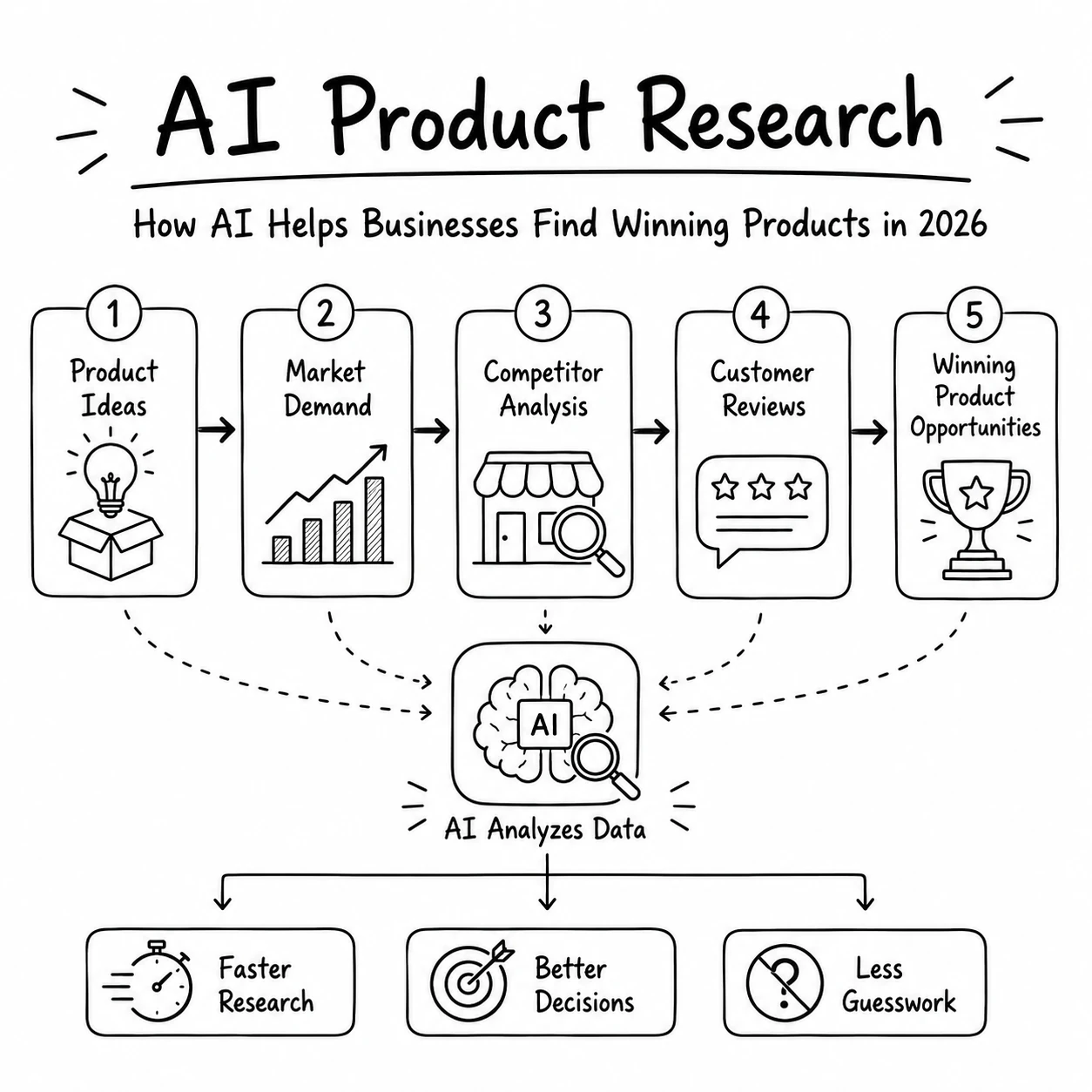
AI product research is the process of using artificial intelligence to analyze markets, products, competitors, and customer behavior in order to identify better ecommerce opportunities.
Traditional product research often requires sellers to manually collect information from multiple sources, compare competitors, analyze reviews, and estimate whether a product has enough demand to be profitable.
AI changes this process by helping businesses analyze large amounts of information faster and identify patterns that would be difficult to discover manually.
Instead of looking only at individual products, AI product research tools can evaluate entire markets and provide insights about demand, competition, customer needs, and potential opportunities.
The Main Areas of AI Product Research
Modern AI product research tools usually focus on several important areas:
1. Product Discovery
AI can help businesses discover new product ideas by analyzing market trends, customer interests, and emerging categories.
This helps sellers identify opportunities before markets become too competitive.
2. Market Demand Analysis
Understanding demand is one of the most important parts of product research. AI tools can analyze search trends, customer behavior, and sales signals to help estimate whether a product has market potential.
3. Competitor Analysis
AI can analyze competing products, pricing strategies, customer reviews, and product positioning to help businesses understand what already exists in the market.
This allows sellers to identify gaps and create products that solve problems existing products do not address.
4. Customer Review Analysis
One of the most valuable uses of AI product research is understanding customer feedback.
Instead of manually reading thousands of reviews, AI can identify common complaints, frequently mentioned features, and areas where customers feel products could be improved.
5. Profitability Evaluation
AI can also help estimate whether a product opportunity makes business sense by analyzing factors such as competition level, pricing, demand, and potential margins.
However, AI should be viewed as a decision-support tool rather than a guarantee of success. A profitable product still requires strong execution, quality, branding, and understanding of the target customer.
For sellers interested specifically in Amazon research, our guide on the best AI product research tools for Amazon sellers explores dedicated platforms and workflows used in marketplace research.
As ecommerce becomes more competitive, AI product research is becoming less of a competitive advantage and more of a necessary tool for businesses that want to make smarter product decisions.
The Early Stage of Product Research Before AI (2015–2019)
Before AI became a major part of ecommerce, product research was mostly a manual process. Sellers and businesses had to collect information from multiple sources, analyze competitors, and make decisions based on limited data.
During this period, successful product research depended heavily on experience, intuition, and the ability to identify market opportunities before competitors did.
Many ecommerce sellers relied on tools that provided basic information, but these platforms did not automatically understand customer behavior or predict future opportunities.
Manual Market Research
One of the most common approaches was manually analyzing marketplaces such as Amazon, eBay, and Shopify stores.
Sellers would research:
- Best-selling products
- Competitor pricing
- Customer reviews
- Product rankings
- Market trends
This process could reveal valuable insights, but it was time-consuming and difficult to scale.
Keyword-Based Product Discovery
Keyword research also played a major role in finding product opportunities. Sellers used search volume and keyword popularity to understand what customers were looking for.
However, these methods had limitations because they focused mostly on what people searched for, rather than understanding why customers wanted certain products.
Early Ecommerce Analytics Tools
Analytics platforms helped businesses understand basic performance metrics such as traffic, sales, and customer behavior.
However, most tools were descriptive rather than predictive. They could show what happened, but they could not effectively explain what might happen next.
The Biggest Limitation: Too Much Data, Not Enough Intelligence
The biggest challenge before AI was not the lack of information. Ecommerce businesses already had access to huge amounts of data.
The problem was analyzing that information quickly enough to make better decisions.
Sellers could see customer reviews, competitor products, and market trends, but connecting all these signals together required significant manual effort.
This limitation created the perfect opportunity for the next generation of ecommerce tools, where machine learning started transforming product research from a manual activity into a data-driven process.
The Rise of AI Product Research (2020–2026)
Between 2020 and 2026, product research changed dramatically. Ecommerce businesses moved from simply collecting data to using artificial intelligence to analyze, interpret, and predict market opportunities.
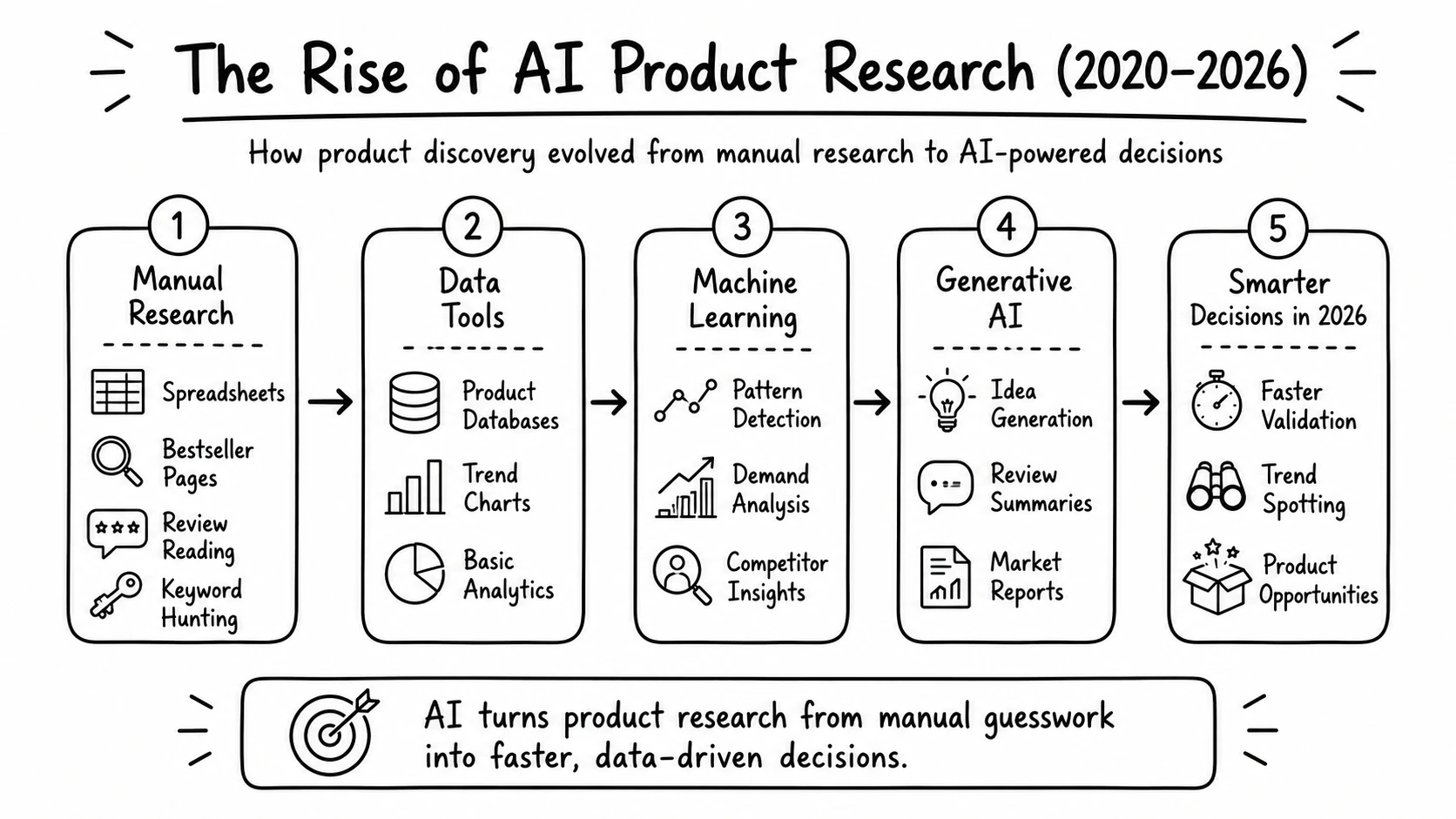
The biggest difference was that AI could now process enormous amounts of information much faster than traditional research methods. Instead of manually checking hundreds of products, sellers could use AI-powered tools to identify patterns, opportunities, and potential risks.
The Shift From Data Collection to Data Intelligence
Before AI, sellers mainly used tools to gather information. They could see sales rankings, keyword data, competitors, and reviews, but they still had to manually interpret what those signals meant.
Modern AI product research tools changed this by adding intelligence on top of existing data.
AI systems can now help answer questions such as:
- Which product categories are growing?
- What problems are customers complaining about?
- Which competitors are gaining attention?
- What features could make a new product stand out?
Machine Learning Improves Product Discovery
Machine learning allowed product research platforms to identify patterns that are difficult for humans to notice.
By analyzing customer behavior, search trends, product performance, and market signals, AI tools can help businesses discover opportunities earlier and make more informed decisions.
Generative AI Changes the Research Process
The arrival of generative AI introduced another major change. Instead of only analyzing existing data, AI assistants can now help entrepreneurs brainstorm product ideas, summarize market information, analyze customer feedback, and create research reports.
This made product research more accessible, especially for smaller businesses that previously could not afford large research teams.
AI Product Research Becomes More Accessible
Another important change was the availability of AI-powered ecommerce tools for different types of businesses.
Amazon sellers, Shopify brands, and direct-to-consumer companies can now access specialized platforms that help with:
- Product opportunity discovery
- Keyword analysis
- Competitor monitoring
- Customer sentiment analysis
- Market trend identification
However, AI does not remove the need for human judgment. The best results come from combining AI insights with product knowledge, market understanding, and strong business strategy.
To see how AI is already helping sellers research products more efficiently, you can explore our guide on AI product research tools for Amazon sellers.
The evolution of AI product research shows a clear transition: businesses are no longer just collecting information — they are using AI to understand markets and make smarter decisions.
What Can AI Product Research Tools Analyze?
One of the biggest advantages of AI product research tools is their ability to analyze multiple types of ecommerce data at the same time. Instead of looking at isolated information points, AI can combine different signals to create a more complete picture of a potential product opportunity.
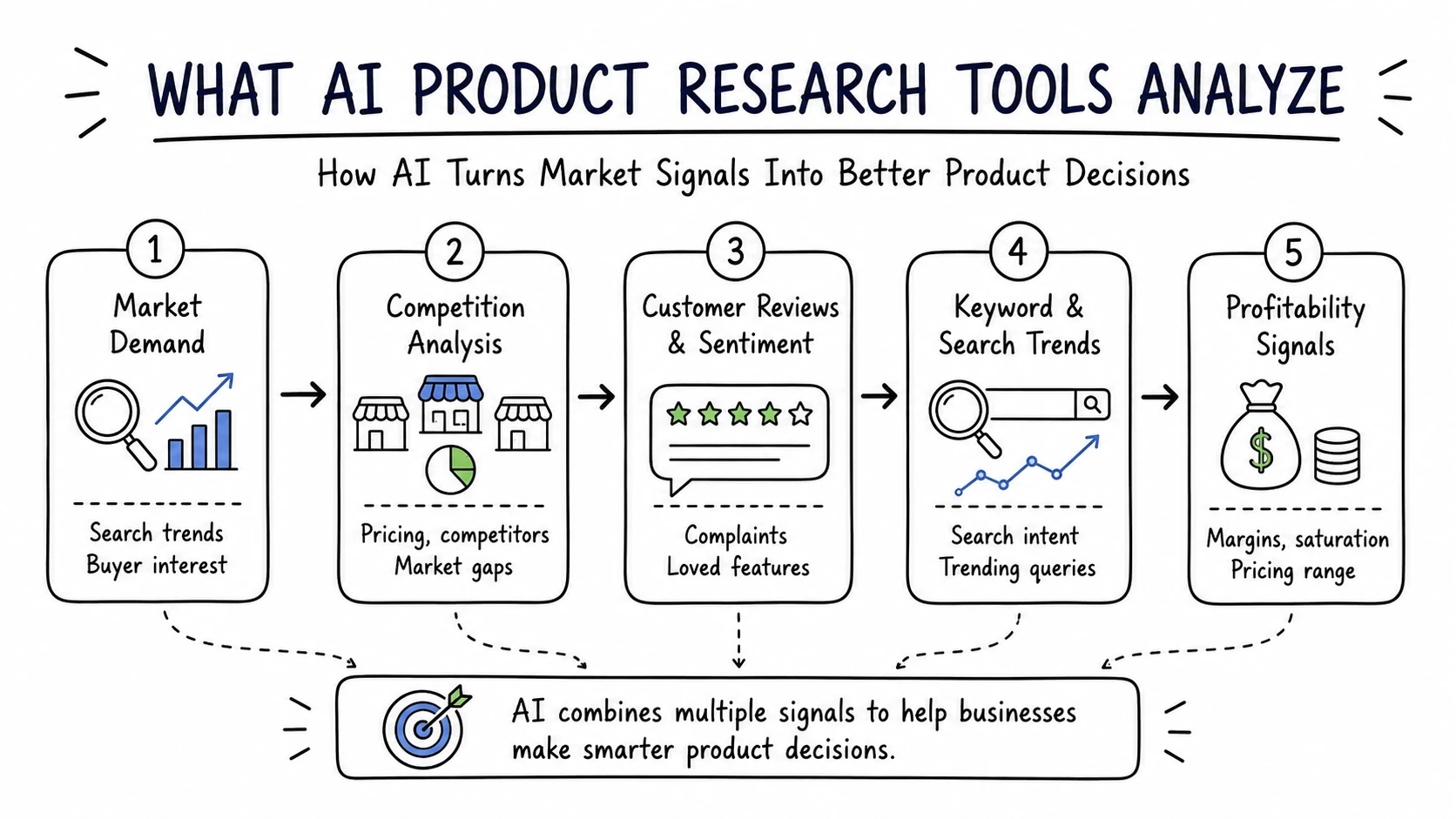
This allows businesses to make decisions based on data rather than relying only on intuition or assumptions.
1. Market Demand
Understanding demand is one of the first steps in product research. AI tools can analyze search trends, customer behavior, and market signals to help identify products that attract interest from potential buyers.
Instead of simply looking at what is popular today, AI can help businesses understand whether a market is growing, stable, or becoming too competitive.
2. Competition Analysis
Competition is one of the biggest factors that determines whether a product opportunity is worth pursuing.
AI product research tools can analyze competing products, pricing strategies, product positioning, and customer feedback to help businesses understand what they are competing against.
This can reveal important opportunities, such as:
- Products with strong demand but poor customer experience
- Categories with limited competition
- Features missing from existing products
- Areas where a new brand could differentiate itself
3. Customer Reviews and Sentiment
Customer reviews contain some of the most valuable information available to ecommerce businesses. However, manually analyzing thousands of reviews is extremely time-consuming.
AI can identify common patterns in customer feedback, including:
- Frequently mentioned complaints
- Most appreciated features
- Product weaknesses
- Customer expectations
This allows businesses to understand not only what customers buy, but also why they are satisfied or disappointed.
4. Keyword and Search Trends
Search behavior provides important clues about customer demand. AI tools can analyze keywords, search patterns, and emerging topics to help businesses discover new opportunities.
This is especially useful for Amazon sellers and ecommerce brands that need to understand what customers are actively searching for.
For sellers interested in Amazon-focused research workflows, you can also explore our guide on the best AI product research tools for Amazon sellers.
5. Profitability Signals
Finding a product with demand is not enough. Businesses also need to understand whether that opportunity can become profitable.
AI tools can help analyze factors such as:
- Market saturation
- Price ranges
- Competition levels
- Potential customer demand
- Product differentiation opportunities
The most effective AI product research process combines all these signals together, helping businesses move from random product ideas to data-driven decisions.
Best AI Product Research Tools in 2026
As AI product research becomes more important, businesses now have access to a wide range of specialized tools designed to discover opportunities, analyze markets, and validate product ideas.
However, different tools solve different problems. Some are built specifically for Amazon sellers, while others focus on ecommerce brands, trend discovery, competitor analysis, or customer insights.
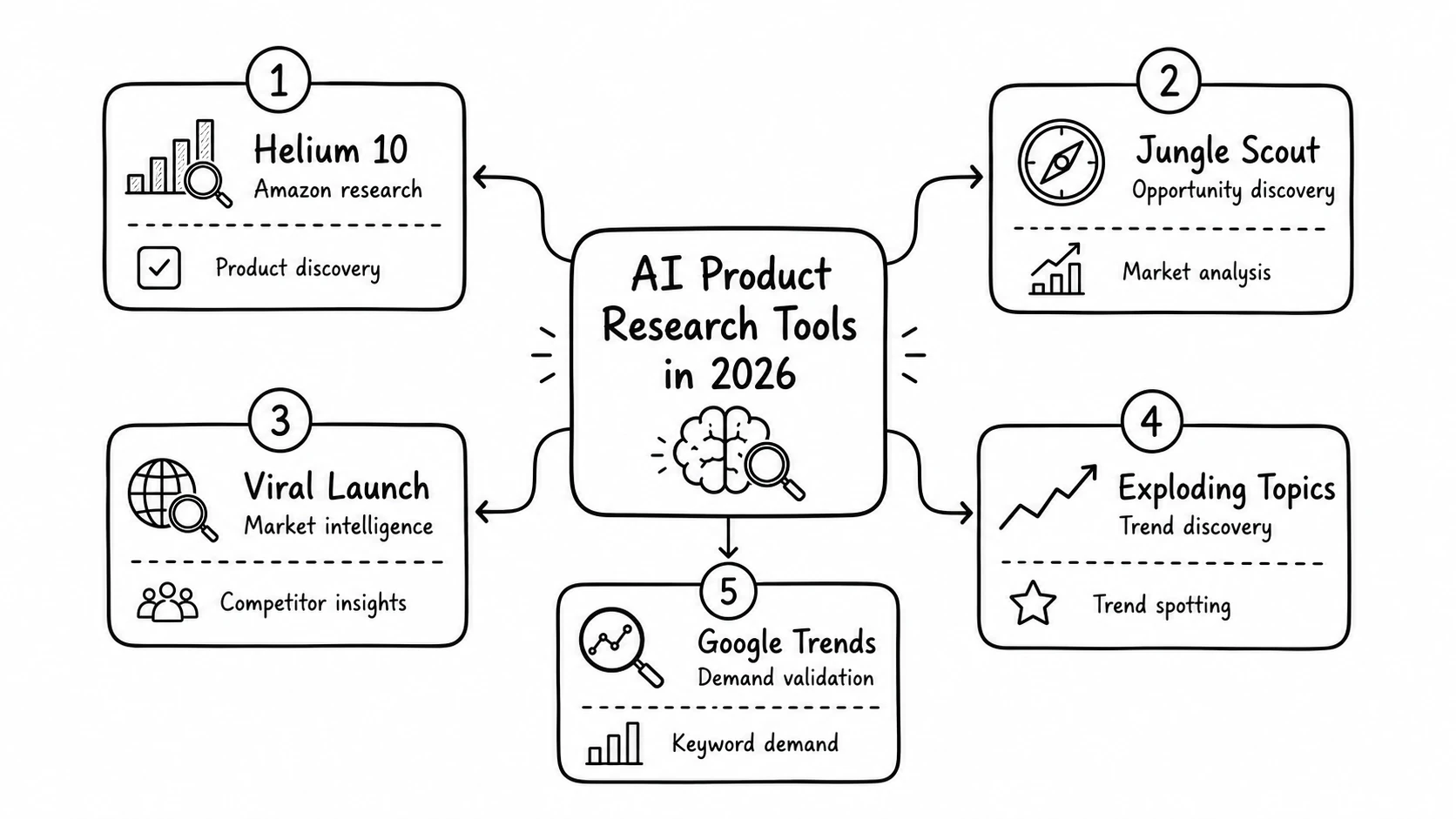
The best choice depends on the business model, marketplace, and research goals.
| Tool | Best For | Main Capabilities | Ideal User |
|---|---|---|---|
| Helium 10 | Amazon product research | Product discovery, keyword research, competitor analysis, listing optimization | Amazon sellers |
| Jungle Scout | Amazon opportunity research | Product database, demand estimation, market analysis | New and experienced Amazon sellers |
| Viral Launch | Product validation | Market intelligence, competitor tracking, launch insights | Amazon entrepreneurs |
| Exploding Topics | Trend discovery | Identifies emerging markets and growing product categories | Entrepreneurs and brands |
| Google Trends | Demand validation | Search interest analysis and market trend research | Any ecommerce business |
Helium 10: A Complete Research Platform for Amazon Sellers
Helium 10 is one of the most recognized platforms in the Amazon seller ecosystem. It combines multiple research functions, including product discovery, keyword analysis, competitor monitoring, and listing optimization.
Its main advantage is that sellers can analyze multiple aspects of a product opportunity inside one platform instead of using separate tools for each task.
Jungle Scout: Product Opportunity Discovery
Jungle Scout focuses heavily on helping sellers identify potential products by analyzing demand, competition, and market trends.
It is especially popular among entrepreneurs who are searching for new Amazon product ideas and want data before investing in inventory.
Exploding Topics: Finding Emerging Opportunities
Not every successful product starts as a bestseller. Many opportunities begin as small trends that grow over time.
Trend research platforms help businesses discover categories that are gaining attention before they become highly competitive.
AI Tools Are Most Powerful When Combined
One common mistake is searching for a single “perfect” AI product research tool. In reality, many successful sellers combine multiple platforms.
For example:
- A trend tool can identify growing categories
- An Amazon research tool can validate demand
- AI analysis can summarize customer feedback
- Human expertise can evaluate branding and profitability
To explore more Amazon-focused AI research solutions, you can also read our guide on the best AI product research tools for Amazon sellers.
The most effective businesses do not rely on AI tools alone. They use AI to speed up research, reduce uncertainty, and make better product decisions.
AI Product Research for Amazon Sellers
Amazon remains one of the most competitive ecommerce marketplaces in the world. With millions of products competing for visibility, finding the right opportunity requires more than simply looking at bestseller lists or copying what competitors are already selling.
This is where AI product research tools have become increasingly valuable for Amazon sellers. Instead of manually analyzing thousands of products, sellers can use AI-powered platforms to identify trends, evaluate competition, and discover potential opportunities faster.
AI does not guarantee that a product will become successful, but it can help sellers make more informed decisions before investing time and money into inventory.
Finding Profitable Product Opportunities
One of the biggest challenges for Amazon sellers is discovering products that have strong demand but are not already dominated by large competitors.
AI research tools can analyze factors such as:
- Sales performance indicators
- Competition levels
- Keyword demand
- Customer review patterns
- Product differentiation opportunities
This allows sellers to identify categories where improvements or better positioning could create an advantage.
Analyzing Competitors
Successful Amazon sellers do not only look at what products sell well. They also study why those products succeed.
AI tools can help analyze competitor listings, pricing strategies, customer feedback, and product features to reveal opportunities for improvement.
For example, customer reviews may reveal that buyers like a product but complain about a missing feature, poor packaging, or weak instructions. These insights can help sellers create a better alternative.
Understanding Customer Feedback at Scale
Reading hundreds or thousands of reviews manually is almost impossible for most sellers. AI can analyze large amounts of customer feedback and identify recurring themes.
This can help answer important questions:
- What do customers love about existing products?
- What problems appear repeatedly?
- What features could create differentiation?
- What improvements could justify a higher price?
AI Helps With Validation, Not Guarantees
One of the biggest misconceptions about AI product research is that it can automatically find a guaranteed winning product.
In reality, AI is a decision-support tool. It helps sellers reduce uncertainty, but factors such as branding, quality, supply chain, pricing, and customer experience still determine success.
For a deeper look at dedicated platforms used by Amazon sellers, check our guide on the best AI product research tools for Amazon sellers.
When combined with human judgment, AI product research can transform Amazon selling from a guessing process into a more strategic and data-driven approach.
AI Product Research for Shopify & DTC Brands
While Amazon sellers often focus on rankings, keywords, and marketplace competition, Shopify and direct-to-consumer (DTC) brands face a different challenge: creating products that match customer needs and building a strong connection with their audience.
For these businesses, AI product research is less about finding a product that already sells and more about discovering opportunities for differentiation, improving customer understanding, and creating better shopping experiences.
AI helps Shopify and DTC brands analyze customer behavior, market trends, competitor positioning, and product feedback to make smarter decisions before launching new products.
Finding Emerging Product Trends
One of the biggest advantages of AI product research for DTC brands is the ability to identify emerging trends before they become highly competitive.
AI tools can analyze signals from different sources, such as:
- Search trends
- Customer discussions
- Social media activity
- Market movements
- Competitor launches
This allows brands to discover new opportunities and adapt their product strategy faster.
Understanding Customer Needs
DTC brands often compete through better positioning, branding, and customer experience. Because of this, understanding customer expectations is extremely important.
AI can analyze reviews, surveys, support conversations, and customer feedback to identify:
- Common customer problems
- Desired product improvements
- Features customers value most
- Reasons behind purchase decisions
Improving Product Validation
Launching a new product always involves risk. AI product research helps reduce that risk by providing additional insights before businesses invest in inventory, marketing, and development.
For example, a Shopify brand considering a new product line can use AI to compare similar products, analyze competitors, and understand whether there is enough customer interest.
Connecting Product Research With Personalization
For DTC brands, product research does not end when a product launches. AI can continue helping businesses understand customer behavior and improve recommendations after purchase.
This creates a continuous cycle:
- Discover customer needs
- Create better products
- Analyze customer response
- Improve future decisions
For businesses using Shopify, AI tools can support not only product research but also marketing automation, personalization, and customer engagement. You can explore more solutions in our guide on the best AI tools for Shopify store owners.
Ultimately, AI product research gives Shopify and DTC brands a way to understand customers better and build products based on real market signals instead of assumptions.
How AI Analyzes Customer Reviews to Find Product Opportunities
Customer reviews are one of the most valuable sources of information for ecommerce businesses. They reveal what customers like, what frustrates them, and what improvements they expect from existing products.
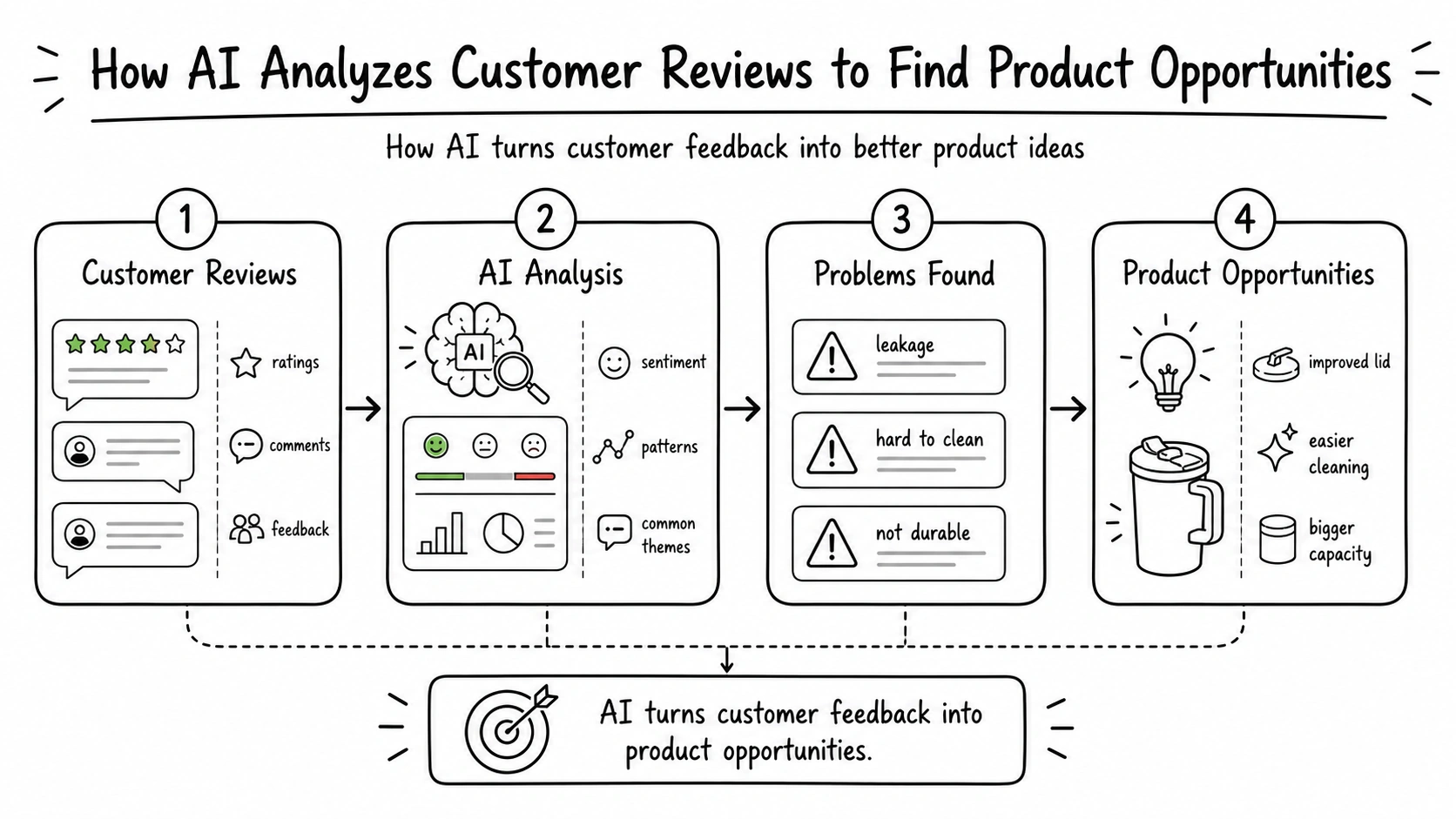
However, analyzing hundreds or thousands of reviews manually is extremely difficult. Important patterns can easily be missed, especially when businesses are researching multiple competitors or product categories.
AI product research tools solve this problem by analyzing large volumes of customer feedback and transforming unstructured reviews into useful insights.
Finding Customer Problems
One of the most powerful uses of AI review analysis is identifying recurring customer complaints.
AI can detect patterns such as:
- Products breaking too quickly
- Missing features customers expect
- Poor user experience
- Problems with sizing, quality, or usability
These insights can reveal opportunities for businesses to create better products or improve existing ones.
Discovering What Customers Actually Value
Reviews do not only show problems. They also reveal the features customers appreciate most.
AI can identify recurring positive feedback around:
- Product quality
- Ease of use
- Design
- Performance
- Unique features
This helps businesses understand which elements should be highlighted in product development and marketing campaigns.
Identifying Market Gaps
A product category can appear competitive while still having opportunities. The difference often comes from understanding what current products are missing.
For example, AI review analysis may reveal that customers consistently like a product category but are unhappy with a specific issue. That problem can become an opportunity for a new brand to create a better solution.
AI Turns Reviews Into Product Ideas
Instead of simply asking “What products are selling?”, businesses can now ask more valuable questions:
- What are customers unhappy about?
- What improvements would make them switch brands?
- What features are missing from current products?
- Where is there room for innovation?
This approach changes product research from copying existing winners into creating products that solve real customer problems.
For ecommerce businesses, combining AI review analysis with market research and competitor analysis creates a much stronger product discovery process.
Can AI Predict Winning Products?
One of the biggest questions entrepreneurs have about AI product research is whether artificial intelligence can actually predict which products will become successful.
The short answer is: AI can improve the decision-making process, but it cannot guarantee that a product will become a winner.
Successful products depend on many factors that go beyond data analysis, including product quality, branding, pricing, timing, customer experience, and market conditions.
What AI Can Predict
AI is extremely useful for identifying patterns and signals that may indicate a product opportunity.
For example, AI can help analyze:
- Growing search interest
- Customer demand patterns
- Competitor activity
- Market saturation
- Customer complaints and unmet needs
These insights can help businesses make better decisions before investing in product development or inventory.
What AI Cannot Predict Perfectly
Even the most advanced AI systems cannot fully predict human behavior or unexpected market changes.
A product can have strong data signals and still fail because of factors such as:
- Poor product quality
- Weak branding
- Incorrect pricing strategy
- Supply chain problems
- Changing customer preferences
This is why AI should be used as a research assistant rather than a replacement for business judgment.
The Best Approach: AI + Human Decision Making
The most successful ecommerce businesses combine AI insights with human expertise.
AI can quickly analyze thousands of data points, but entrepreneurs still need to understand their customers, evaluate product quality, and make strategic decisions.
A strong product research process usually combines:
- AI-powered market analysis
- Competitor research
- Customer feedback analysis
- Supplier evaluation
- Brand strategy
Instead of asking AI to find a guaranteed winning product, businesses should use AI to reduce uncertainty and discover better opportunities.
This approach transforms product research from a guessing game into a more structured, data-driven process.
Common Mistakes When Using AI Product Research Tools
AI product research tools can save businesses significant time and provide valuable insights, but they are not a shortcut to guaranteed success.
Many entrepreneurs make the mistake of relying too heavily on AI recommendations without understanding the market, customers, and business fundamentals behind those insights.
Using AI effectively requires a balance between technology, strategy, and human decision-making.
1. Trusting AI Scores Without Doing Additional Research
Many product research platforms provide opportunity scores, rankings, or predictions. While these metrics can be useful, they should not be treated as absolute answers.
A high score does not automatically mean a product will succeed. Businesses still need to analyze competition, customer expectations, costs, and long-term market potential.
2. Ignoring Customer Feedback
Some sellers focus only on sales numbers and keyword data while ignoring what customers actually say about existing products.
Reviews often reveal the biggest opportunities because they show real problems that businesses can solve.
3. Choosing Products Based Only on Trends
A growing trend can create opportunities, but trends alone do not guarantee profitability.
Businesses should also evaluate:
- Competition level
- Product margins
- Customer loyalty potential
- Market sustainability
4. Using Too Many Tools Without a Clear Strategy
Another common mistake is collecting too much data from too many platforms without knowing how to use it.
Using five different AI tools does not automatically create better results. The most effective approach is choosing tools that solve specific research problems and integrating their insights into a clear decision process.
5. Forgetting the Human Element
AI can analyze data, but it cannot fully replace creativity, product intuition, and understanding of customer emotions.
The strongest ecommerce businesses use AI as a powerful assistant while keeping human expertise involved in important decisions.
Ultimately, AI product research works best when it helps businesses ask better questions, not when it replaces the thinking process behind product decisions.
The Future of AI Product Research (2026–2030)
AI product research is moving from simple data analysis toward more advanced systems that can actively discover opportunities, analyze markets, and assist businesses throughout the entire product lifecycle.
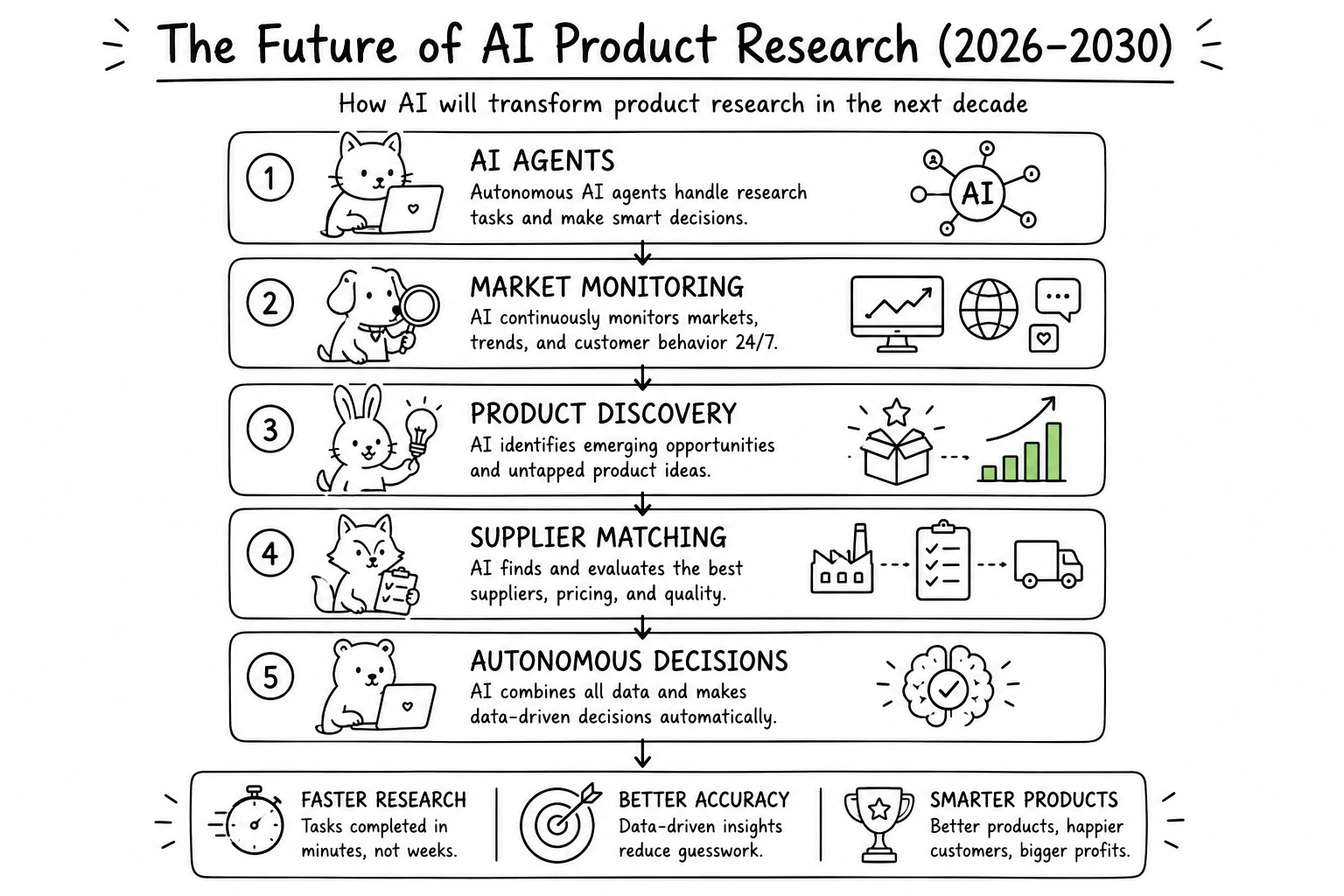
In the next few years, AI will not only help businesses find products faster. It will become a strategic partner capable of monitoring markets, identifying changes in customer behavior, and suggesting new opportunities before they become obvious.
1. AI Product Research Agents
One of the biggest developments will be the rise of AI agents designed specifically for ecommerce research.
Instead of manually searching through multiple platforms, businesses will be able to use AI agents that can:
- Monitor emerging trends
- Analyze competitor movements
- Track customer feedback
- Generate product opportunity reports
- Suggest improvements based on market data
This will allow entrepreneurs to spend less time collecting information and more time making strategic decisions.
2. Real-Time Market Intelligence
Future AI systems will become better at analyzing real-time market changes.
Instead of looking at historical data only, businesses will be able to monitor changing customer interests, new competitors, pricing movements, and emerging product categories as they happen.
3. AI-Powered Product Development
AI product research will increasingly influence not only what businesses sell, but also how products are created.
By analyzing customer complaints, reviews, and market gaps, AI can help companies understand what features customers want and what improvements could create a stronger product.
4. Automated Supplier and Market Matching
Another possible evolution is AI helping businesses connect product opportunities with suppliers, manufacturing options, and market requirements.
This could make product creation faster by reducing the distance between discovering an opportunity and bringing it to market.
5. From Product Research to Autonomous Ecommerce Decisions
The biggest shift will be moving from AI-assisted research to AI-supported decision systems.
Future ecommerce platforms may combine product research, marketing, personalization, pricing, and inventory decisions into connected AI ecosystems.
However, even as AI becomes more powerful, successful businesses will still need human creativity, brand strategy, and customer understanding.
The future of AI product research is not about replacing entrepreneurs. It is about giving them better information, faster insights, and more confidence when making important business decisions.
Conclusion: How AI Changes the Way Businesses Discover Products
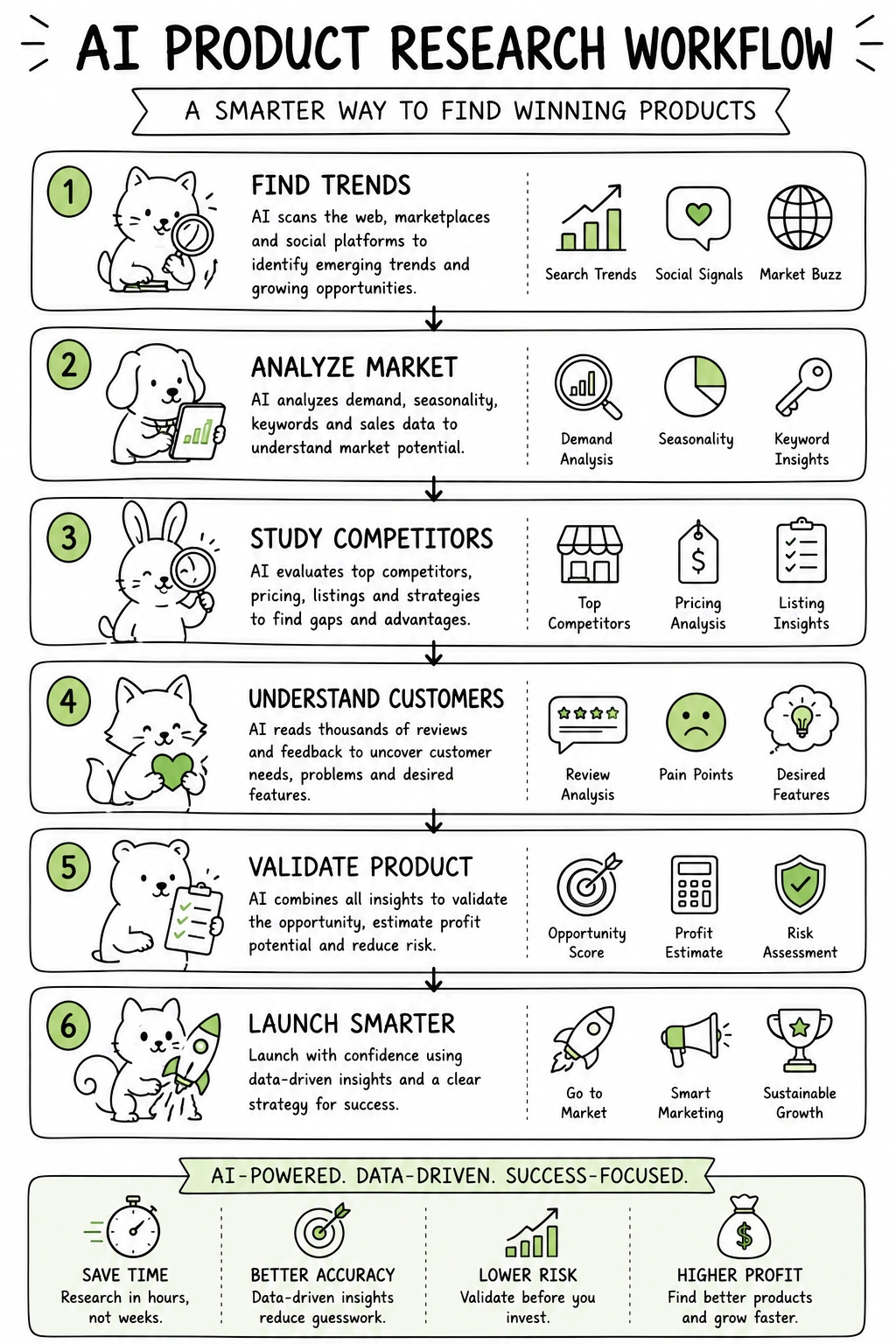
AI product research has completely changed the way businesses discover and evaluate new opportunities. What was once a slow, manual process based on spreadsheets, competitor research, and intuition has evolved into a data-driven approach powered by artificial intelligence.
Today, businesses can analyze market trends, understand customer needs, study competitors, and identify product opportunities much faster than ever before.
However, the biggest advantage of AI is not that it can magically find the next successful product. The real value comes from helping businesses make better decisions with better information.
AI can reveal patterns that would be difficult to discover manually, but successful products still require strong execution, quality, branding, pricing strategy, and a deep understanding of customers.
The companies that will benefit the most from AI product research are not necessarily the ones using the most tools. They are the ones that know how to combine AI insights with human creativity and business experience.
As ecommerce becomes more competitive, AI product research will continue to move from being a competitive advantage to becoming an essential part of how businesses discover, validate, and launch products.
For more insights about how artificial intelligence is transforming online shopping, explore more guides on AI Shopping Assistant.
Frequently Asked Questions
What is AI product research?
AI product research is the process of using artificial intelligence to analyze markets, customer behavior, competitors, and product opportunities in order to make better ecommerce decisions.
Can AI find profitable products?
AI can help identify potential opportunities by analyzing demand, competition, trends, and customer feedback. However, it cannot guarantee that a product will become profitable because success also depends on execution, branding, pricing, and market conditions.
What are the best AI product research tools in 2026?
The best tool depends on the business model. Amazon sellers often use platforms like Helium 10 and Jungle Scout, while ecommerce brands may use trend research, personalization, and analytics tools to discover opportunities.
Is AI product research better than manual research?
AI product research does not completely replace manual research, but it can make the process much faster by analyzing large amounts of information and identifying patterns that humans may miss.
Can AI predict the next trending product?
AI can identify emerging trends and market signals, but it cannot perfectly predict future customer behavior. The best results come from combining AI insights with human business judgment.
Are AI product research tools worth it for ecommerce sellers?
For many sellers, AI product research tools are valuable because they reduce research time, improve decision-making, and help validate ideas before investing significant resources.
How does AI analyze customer reviews for product research?
AI can analyze large volumes of customer reviews to identify common complaints, popular features, customer expectations, and opportunities for improving existing products.
Can AI help Shopify brands find new products?
Yes. Shopify and DTC brands can use AI product research to discover trends, understand customers, analyze competitors, and create products that better match market demand.