


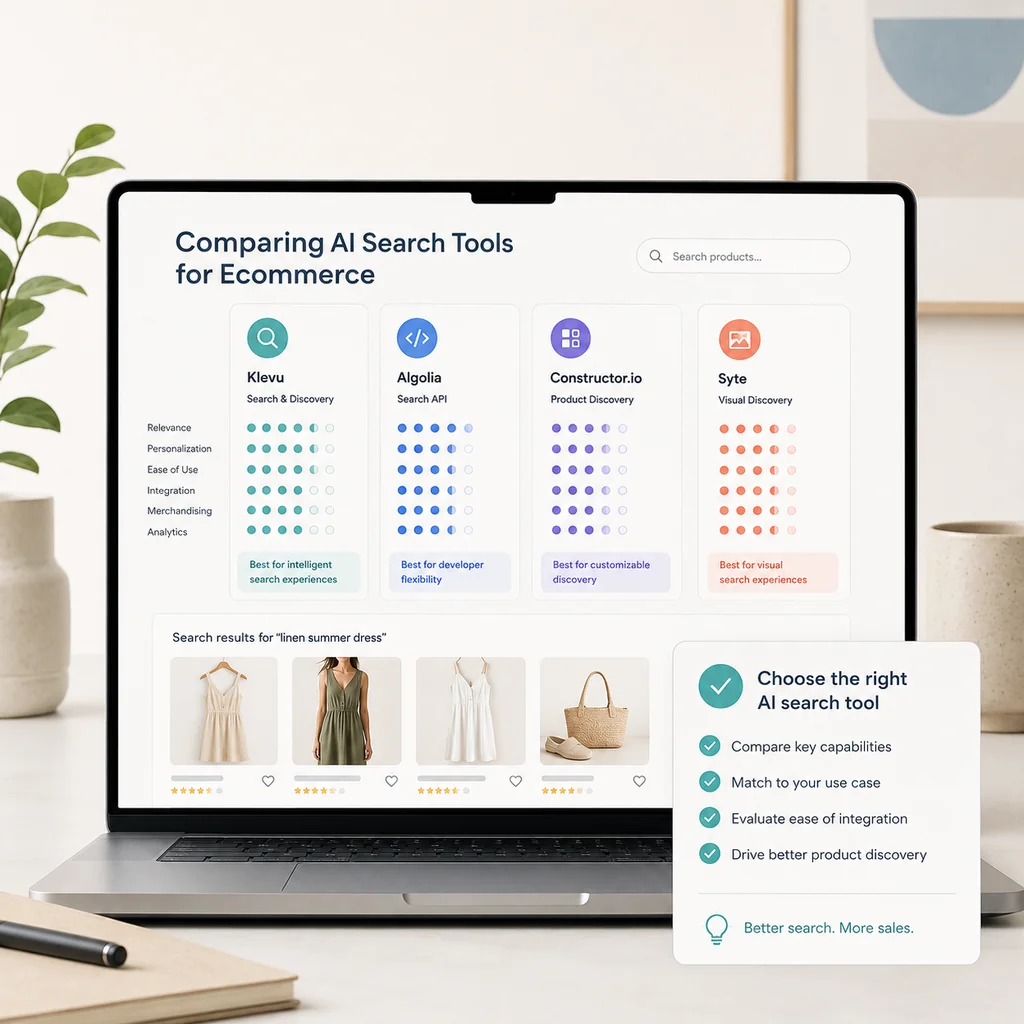
Ecommerce product discovery is undergoing a major transformation. For years, online stores have relied on traditional keyword-based search, where customers type what they think a product is called and hope the system understands their intent. However, this approach is becoming increasingly outdated in a world where shopping behavior is more visual, contextual, and intent-driven.
Modern shoppers do not always know the exact product name or category they are looking for. Instead, they think in terms of problems, styles, inspiration, or even images they have seen online. This is where AI search engines are changing the game for ecommerce businesses.
AI-powered search systems use technologies such as natural language processing and semantic understanding to interpret user intent more accurately. Instead of matching exact keywords, they focus on meaning, context, and relevance to deliver better product results.
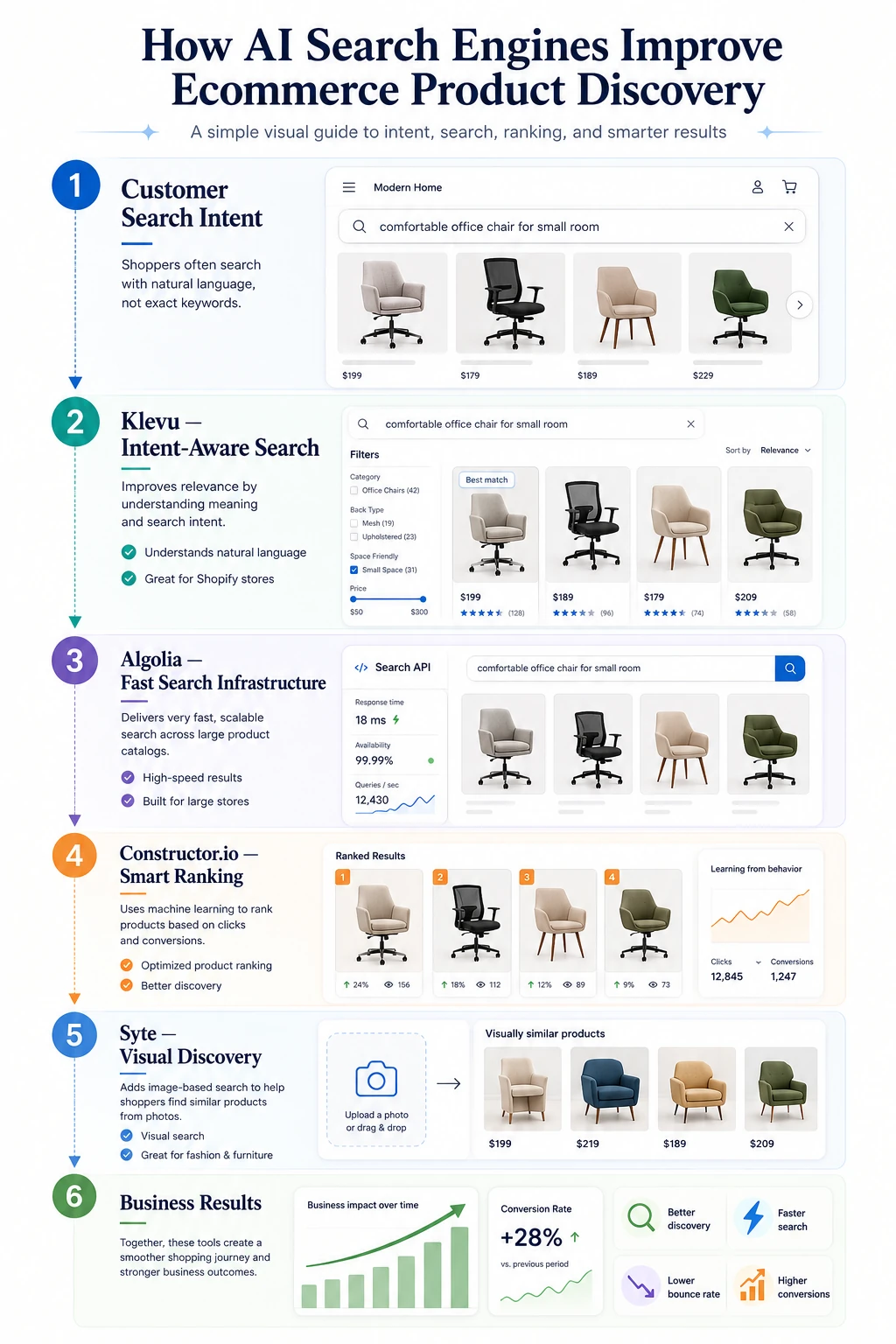
Platforms like Klevu are already helping ecommerce stores improve search accuracy and product discovery, while solutions like Algolia and Constructor.io are pushing the boundaries of intelligent search experiences at scale.
In this article, we will explore how AI search engines are changing ecommerce product discovery, why traditional search systems are failing, and how businesses can leverage these technologies to increase conversions, improve user experience, and drive more sales.
We will also look at real-world use cases, key features of modern AI search systems, and the future direction of product discovery in ecommerce.
What Are AI Search Engines in Ecommerce
AI search engines in ecommerce are advanced systems that go beyond traditional keyword matching. Instead of simply looking for exact words in a product database, they use artificial intelligence to understand the meaning, context, and intent behind a user’s search query.
These systems combine technologies such as natural language processing (NLP), machine learning, and semantic search to interpret what a customer actually wants, even if their search query is vague, incomplete, or conversational in nature.
For example, if a user searches for “comfortable shoes for long walking trips,” an AI search engine does not rely only on exact product titles. Instead, it analyzes the intent behind the query and returns products that match comfort, durability, and walking suitability.
This is a major improvement over traditional ecommerce search systems, which often fail when users do not use exact keywords or when product catalogs are large and complex.
Modern platforms such as Klevu, Algolia, and Constructor.io are leading this transformation by enabling retailers to build smarter, intent-based search experiences.
These AI systems continuously learn from user behavior, improving results over time based on clicks, purchases, and engagement patterns.
As a result, ecommerce stores can deliver a more natural and intuitive shopping experience, where customers find relevant products faster and with less effort.
Why Traditional Ecommerce Search Is Broken
Traditional ecommerce search systems were designed for a time when users knew exactly what they were looking for and how to describe it. Customers would type precise product names or model numbers, and the system would return matching results based on keyword alignment.
However, modern shopping behavior has changed significantly. Today’s users are more exploratory, less precise, and often influenced by visual inspiration, social media, and lifestyle content rather than exact product knowledge.
This creates a major problem for traditional search engines: they rely too heavily on exact keyword matching. If a customer does not use the “right” words, the system often fails to deliver relevant results or shows incomplete product lists.
One of the most common issues is the “zero results” problem, where users receive no products simply because their query does not match the exact structure of the product database. This leads to frustration, higher bounce rates, and lost sales opportunities.
Even when results are returned, they are often not truly relevant to the user’s intent. For example, a search for “modern cozy chair for reading” might return generic chairs without considering comfort, style, or use case.
AI search engines like Klevu, Algolia, and Constructor.io solve these issues by understanding intent instead of relying solely on keywords, making product discovery much more accurate and user-friendly.
As ecommerce catalogs continue to grow, relying on traditional search systems becomes increasingly inefficient, making AI-powered search a necessary upgrade rather than a luxury.
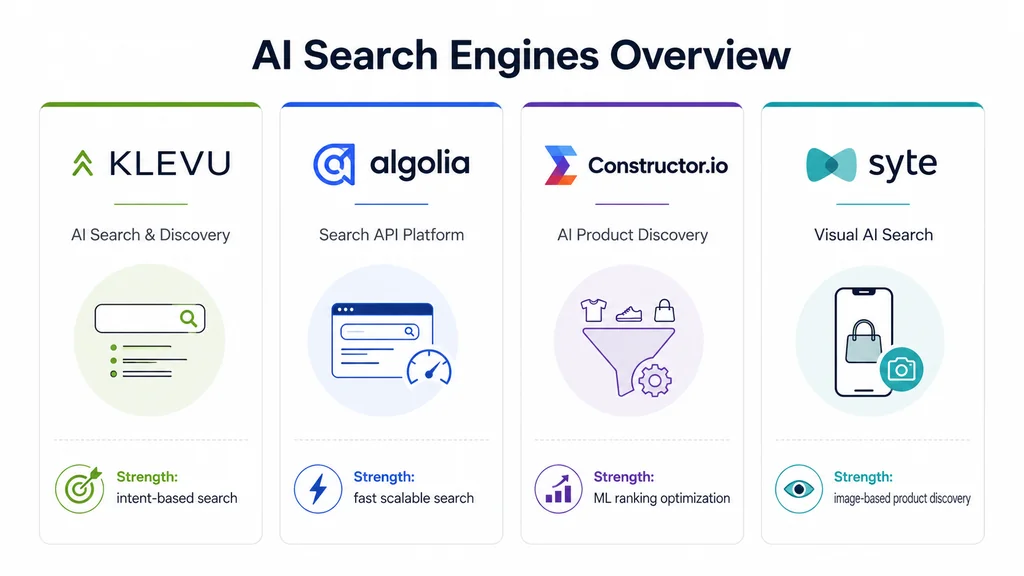
Best AI Search Engines for Ecommerce (Detailed Comparison)
| Platform | Focus | Best For | Strength | Rating | CTA |
|---|---|---|---|---|---|
| Klevu | AI Search & Discovery | Shopify & mid-size ecommerce stores | Intent-based search + fast integration | ★★★★★ | Explore |
| Algolia | Search Infrastructure API | Large ecommerce platforms & marketplaces | Ultra-fast search + scalability | ★★★★★ | Explore |
| Constructor.io | AI Product Discovery | Enterprise ecommerce brands | ML-based ranking optimization | ★★★★☆ | Explore |
| Syte | Visual AI Search | Fashion & visual-first ecommerce | Image-based product discovery | ★★★★★ | Explore |
Pro Insight: Each AI search engine focuses on a different part of the ecommerce funnel. The best-performing stores often combine multiple solutions to cover search, discovery, and personalization together.
How AI Search Engines Work
AI search engines in ecommerce work by combining multiple layers of artificial intelligence to understand user intent and deliver highly relevant product results. Instead of relying on simple keyword matching, these systems analyze meaning, context, and behavioral signals.
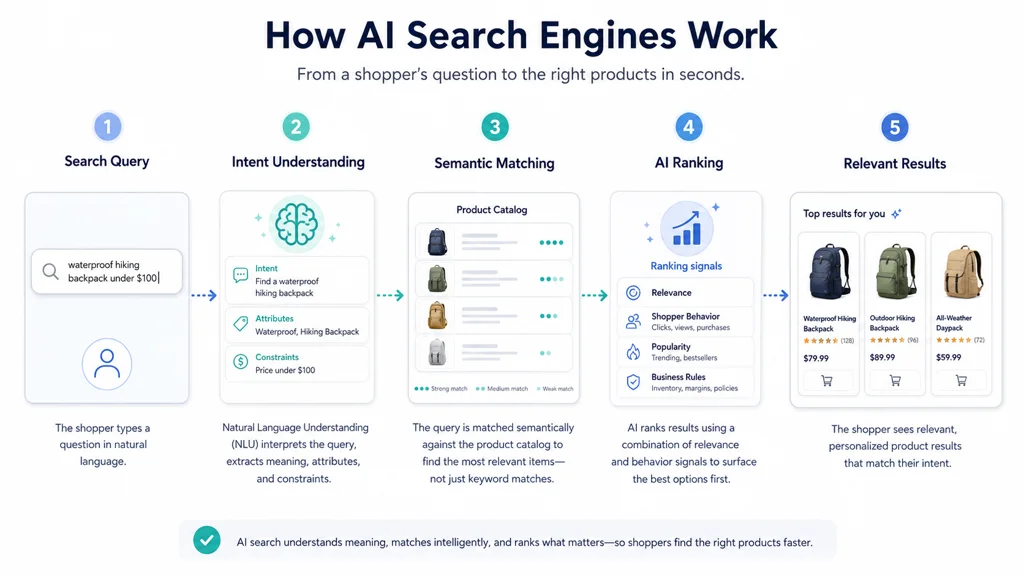
The process typically starts when a user enters a search query. Unlike traditional systems, AI search engines first interpret the intent behind the query using natural language processing (NLP). This allows the system to understand what the user actually means, not just what they typed.
Next, the system converts both the query and product data into semantic representations, often called embeddings. These embeddings allow the AI to compare meaning rather than exact words, making it possible to match products even when descriptions differ.
After that, the search engine ranks products based on relevance, user behavior, and contextual signals such as popularity, past clicks, conversions, and product attributes.
For example, a query like “affordable minimalist desk for small room” can be broken down into intent signals such as price sensitivity, design style, and spatial constraints. The AI then uses these signals to return the most relevant products, even if those exact words do not appear in product titles.
Modern platforms such as Klevu, Algolia, and Constructor.io use these techniques to continuously improve search relevance and adapt results based on real user behavior.
Over time, these systems learn from interactions such as clicks, add-to-cart actions, and purchases, allowing them to refine rankings and improve accuracy automatically without manual adjustments.
This makes AI search engines significantly more powerful than traditional keyword-based systems, especially for large ecommerce catalogs where product discovery is critical for conversion.
Key Features of Modern AI Search Engines
Modern AI search engines in ecommerce are built with a set of advanced features that significantly improve how users discover products and how retailers optimize their catalogs. These features go far beyond traditional keyword-based search systems.
1. Natural Language Understanding
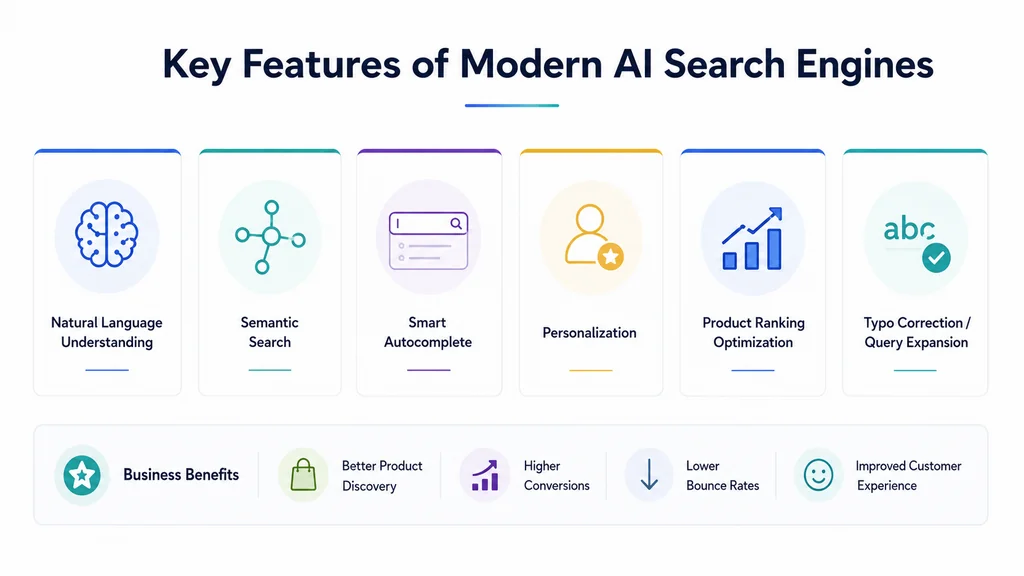
AI search engines can interpret conversational queries such as “comfortable shoes for long walks” or “modern desk for small apartment,” understanding intent instead of relying on exact keywords.
2. Semantic Search
Instead of matching words, semantic search focuses on meaning. This allows the system to return relevant products even when descriptions differ from the user’s query.
3. Smart Autocomplete
AI-powered autocomplete suggests relevant products, categories, and queries in real time, helping users find what they need faster and with fewer mistakes.
4. Personalization
Search results are adapted based on user behavior, including past clicks, purchases, and browsing history, creating a more personalized shopping experience.
5. Product Ranking Optimization
AI search engines continuously optimize product ranking based on performance data such as conversion rates, engagement, and popularity signals.
6. Typo Correction and Query Expansion
Even if users make spelling mistakes or use incomplete queries, AI systems can correct and expand them to deliver accurate results.
Platforms like Klevu, Algolia, and Constructor.io integrate these features to create highly optimized ecommerce search experiences that improve both user satisfaction and conversion rates.
Top AI Search Engines for Ecommerce
Several AI search engines are currently leading the transformation of ecommerce product discovery. These platforms help online stores move beyond traditional keyword-based search and deliver more accurate, intent-driven results.
Below are some of the most widely used AI search solutions for ecommerce businesses today.
1. Klevu
Klevu is one of the most popular AI search and discovery platforms for ecommerce, especially for Shopify and mid-to-large online stores. It focuses on improving search relevance, understanding user intent, and increasing product discoverability.
2. Algolia
Algolia is a powerful search API platform that enables fast, scalable, and highly customizable search experiences. It is widely used by large ecommerce platforms and marketplaces.
3. Constructor.io
Constructor.io focuses on AI-driven product discovery and merchandising. It uses machine learning to optimize search results based on user behavior and conversion data.
4. Syte (Visual + Search Hybrid)
Syte is primarily known for visual AI search, but it also integrates product discovery features that connect visual input with ecommerce search systems, making it especially useful for fashion and furniture retailers.
Each of these platforms addresses different aspects of ecommerce search. Some focus on speed and scalability, while others prioritize intent understanding or visual discovery. Many ecommerce businesses use a combination of these tools to build a complete AI-powered search experience.
AI Search Engines Comparison
| Platform | Main Focus | Best For | Key Strength |
|---|---|---|---|
| Klevu | AI Search & Discovery | Shopify & mid-size ecommerce stores | Strong intent-based search optimization |
| Algolia | Search API Platform | Large ecommerce platforms & marketplaces | High-speed, scalable search infrastructure |
| Constructor.io | AI Product Discovery | Enterprise ecommerce & retail brands | Machine learning-based ranking optimization |
| Syte | Visual AI Search | Fashion, furniture, visual-first ecommerce | Image-based product discovery |
This comparison shows that each AI search engine plays a different role in ecommerce product discovery. While Klevu and Algolia focus on traditional search optimization, Constructor.io enhances ranking through machine learning, and Syte adds a visual layer to product discovery.
Many ecommerce businesses combine multiple tools to create a full AI-powered discovery stack that covers text search, visual search, and personalized recommendations.
Business Impact of AI Search Engines
AI search engines are not just a technical upgrade for ecommerce platforms. They have a direct and measurable impact on business performance, customer experience, and overall revenue growth.
One of the most significant benefits is improved product discovery. When customers can find relevant products faster and more accurately, they are more likely to complete a purchase instead of abandoning the site.
AI search engines also help reduce bounce rates by eliminating the frustration caused by irrelevant results or zero-result pages. This leads to longer browsing sessions and higher engagement across product pages.
Another major impact is increased conversion rates. By understanding user intent and delivering more relevant results, AI search systems reduce friction in the buying process and guide customers more effectively toward purchase decisions.
In addition, these systems often contribute to higher average order value (AOV) by recommending complementary or higher-value products based on user behavior and search context.
Platforms such as Klevu, Algolia, and Constructor.io are widely used by ecommerce brands to optimize these key performance metrics at scale.
Overall, AI search engines transform product discovery from a static search function into a dynamic revenue-driving system that continuously improves based on user behavior and data.
Conclusion
AI search engines are fundamentally changing how ecommerce product discovery works. Instead of relying on traditional keyword-based search, online stores are now shifting toward intent-based and AI-driven systems that understand what customers actually want.
This shift leads to faster product discovery, more relevant search results, and significantly improved user experience. As a result, ecommerce businesses benefit from higher conversion rates, lower bounce rates, and increased average order value.
Platforms like Klevu, Algolia, Constructor.io, and Syte demonstrate how different approaches to AI search and discovery can significantly improve ecommerce performance.
However, the real advantage comes from early adoption. Businesses that integrate AI search engines now are positioning themselves ahead of competitors who still rely on outdated search systems.
To better understand how AI is reshaping ecommerce beyond search, you can also explore our guide on AI visual search for shopping, which explains how image-based discovery is transforming online retail.
As ecommerce continues to evolve, AI search engines will become a standard layer of every modern online store, not just a competitive advantage but a necessity for growth.
Frequently Asked Questions
What is an AI search engine in ecommerce?
An AI search engine in ecommerce is a system that uses artificial intelligence to understand user intent and deliver more relevant product results than traditional keyword-based search systems.
How do AI search engines improve ecommerce sales?
AI search engines improve sales by helping customers find products faster, reducing zero-result searches, and increasing conversion rates through more accurate and intent-based product recommendations.
What are the best AI search engines for ecommerce?
Some of the most popular AI search engines for ecommerce include Klevu, Algolia, Constructor.io, and Syte, each offering different capabilities such as search optimization, personalization, or visual discovery.
What is the difference between AI search and traditional search?
Traditional search relies on exact keyword matching, while AI search understands meaning, context, and intent, allowing it to return more relevant and personalized product results.
Can small ecommerce stores use AI search engines?
Yes, many AI search platforms offer scalable solutions that can be integrated into small and medium ecommerce stores, especially Shopify-based businesses.