

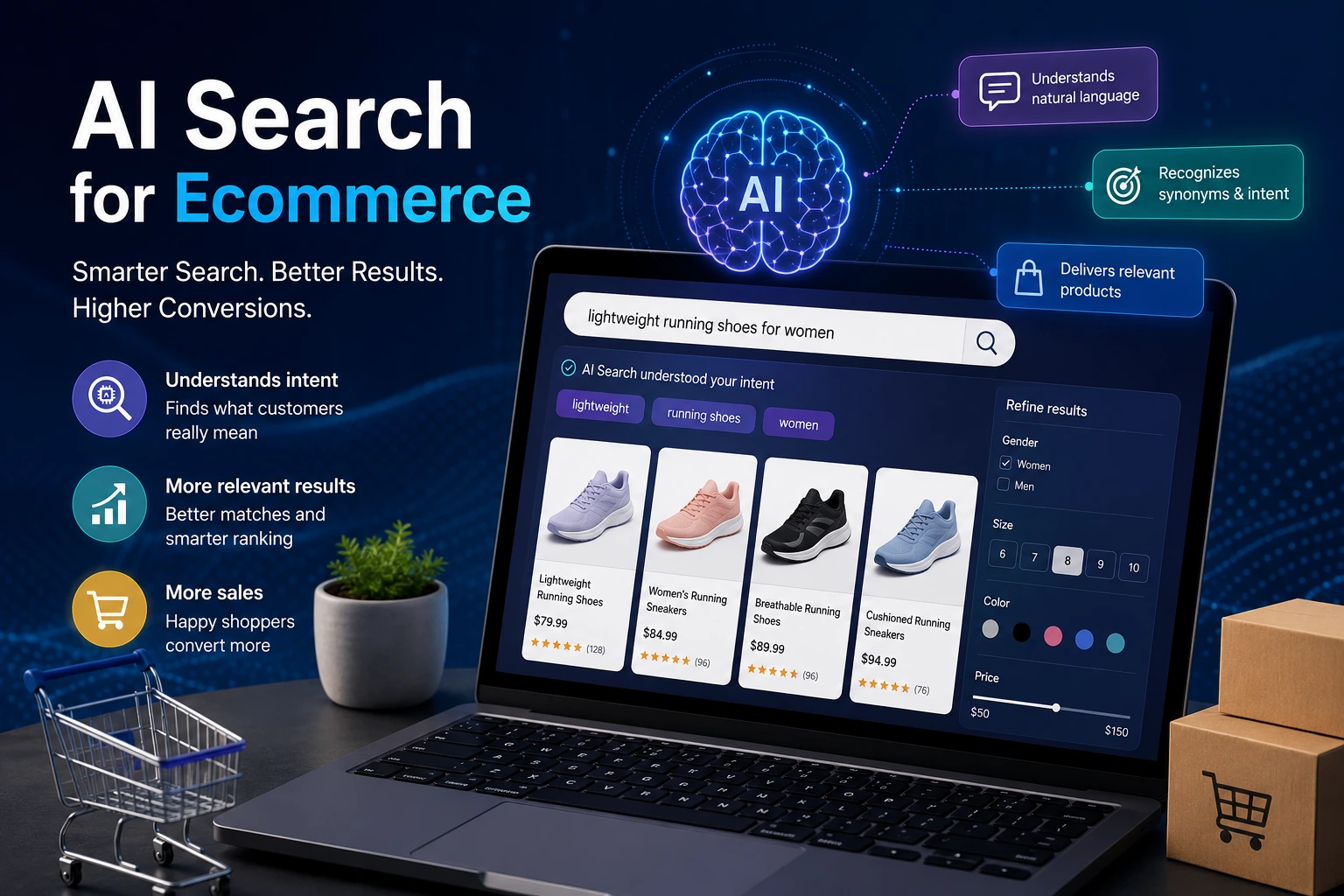
Finding products online should be simple, but ecommerce search often creates more friction than shoppers expect. Customers may misspell a product name, use a synonym that does not appear in the catalog, describe a problem instead of naming a product, or combine several requirements in one sentence. A traditional search engine that depends heavily on exact keywords may return irrelevant products or no useful results at all.
Consider a shopper searching for:
“Comfortable shoes for standing all day under $150.”
The request is not just about shoes. It also suggests cushioning, support, durability, extended wear, and a strict budget. A basic search system may match only individual words. An AI-powered search engine can attempt to understand the complete shopping intent and rank products according to how well they satisfy those needs.
AI search for ecommerce uses technologies such as natural language processing, semantic search, machine learning, vector search, and personalized ranking to connect customer queries with relevant products. Instead of relying only on identical words, it can analyze meaning, context, spelling variations, product attributes, and sometimes the shopper’s current or previous behavior.
Google Cloud describes AI Commerce Search as an AI-first system for delivering personalized product results and AI-driven rankings across ecommerce experiences. Its documentation also explains that search systems can use catalog data and user events to improve product discovery across websites and mobile applications.
AI search may appear inside a familiar search bar, an autocomplete menu, a retailer’s mobile app, a visual search feature, or a conversational AI shopping assistant. Depending on the platform, shoppers may be able to enter complete sentences, upload images, ask follow-up questions, compare products, or refine results without restarting the search.
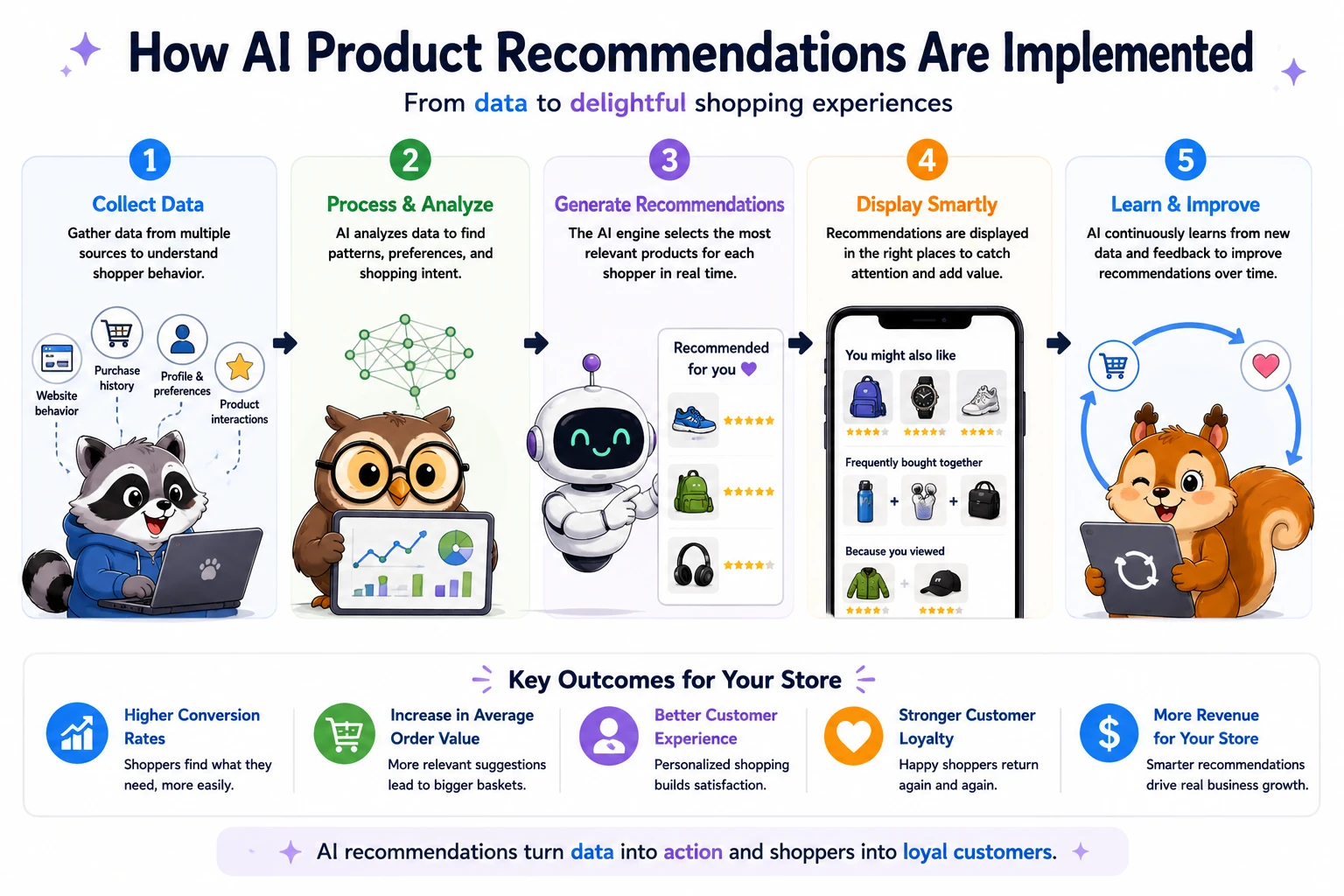
The technology can also work alongside AI product recommendations. Search responds to an active request from the shopper, while recommendations can suggest alternatives, accessories, or related products before and after a search.
However, AI does not automatically fix a poor ecommerce experience. Search quality still depends on accurate product titles, complete attributes, current prices, reliable inventory data, and clear compatibility information. When the underlying catalog is incomplete, even an advanced AI system may recommend the wrong item or fail to surface a suitable product.
In this guide from AI Shopping Assistant, we will explain what AI search for ecommerce is, how it works, how it differs from traditional product search, and which technologies make it possible. We will also examine its benefits for shoppers and retailers, its limitations, the features stores should look for, and the future of AI-powered product discovery.
AI Search for Ecommerce: Quick Overview
| Topic | Quick Explanation |
|---|---|
| What it is | AI search for ecommerce uses artificial intelligence to understand shopper intent, natural language, context, and product attributes. |
| How it works | The system interprets the query, retrieves matching products, scores them, and ranks the most relevant results. |
| Main technologies | Natural language processing, semantic search, vector search, machine learning, keyword search, personalization, and computer vision. |
| Best for | Stores with large catalogs, complex products, many variations, or shoppers who use descriptive and problem-based queries. |
| Main shopper benefits | Faster product discovery, better relevance, fewer zero-result searches, easier comparisons, and more natural search experiences. |
| Main retailer benefits | Higher search engagement, better product visibility, improved search conversion, stronger analytics, and reduced dependence on manual synonym rules. |
| Main limitations | Poor product data, ambiguous queries, over-personalization, ranking bias, privacy concerns, and inaccurate generated explanations. |
| Important metrics | No-results rate, no-click rate, search click-through rate, query reformulation rate, add-to-cart rate, and search conversion rate. |
| Best approach | A hybrid system that combines AI understanding with exact keyword matching, filters, structured product data, and human oversight. |
| Overall verdict | AI search is most valuable when it solves a measurable product-discovery problem and is supported by accurate catalog data. |
What Is AI Search for Ecommerce?
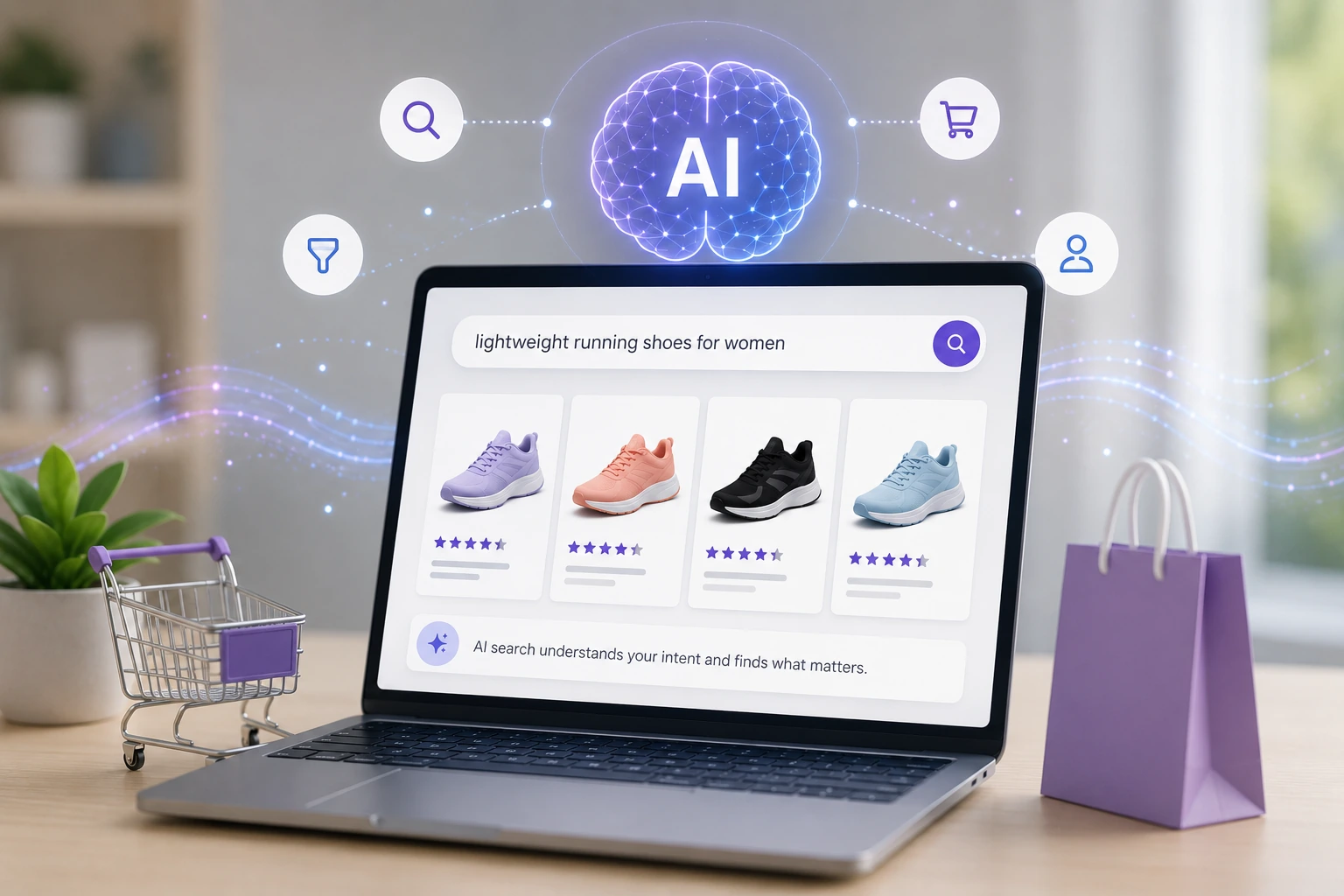
AI search for ecommerce is a product-search system that uses artificial intelligence to understand what shoppers mean, not only the exact words they type. It connects natural-language queries with relevant products by analyzing intent, context, product attributes, synonyms, and other search signals.
A traditional search engine may work well when the shopper enters an exact product name, model number, or category. It can struggle when the customer describes a situation or desired outcome instead.
For example, a shopper might search for:
“Something warm to wear while walking in light rain.”
A keyword-based engine may search separately for words such as “warm,” “walking,” and “rain.” AI search can interpret the complete request and retrieve products associated with insulation, water resistance, outdoor use, and comfortable movement.
Shopify explains that its AI-powered Semantic Search goes beyond keyword matching by understanding buyer intent. This allows shoppers to use everyday expressions, such as searching for “something to wear in the summer” rather than naming a specific item such as shorts.
AI Search Understands Meaning and Shopping Intent
The shopper’s intent includes more than the product category. It may also contain information about:
- How the product will be used
- The shopper’s maximum budget
- Required sizes, colors, or materials
- Compatibility with another product
- Features that are essential or unwanted
- Delivery or availability requirements
Consider this query:
“Find a quiet fan under $100 for sleeping in a small bedroom.”
An AI search system may identify:
- Product: fan
- Maximum price: $100
- Primary requirement: low operating noise
- Intended use: sleeping
- Room type: small bedroom
It can then prioritize products with quiet modes, adjustable speeds, timers, compact dimensions, and displays that can be dimmed at night.
AI Search Can Connect Different Words With the Same Product
Customers do not always use the terminology found in a retailer’s catalog. Depending on their location or personal vocabulary, shoppers may use different words for the same product.
AI search can recognize relationships such as:
- “Couch” and “sofa”
- “Sneakers” and “trainers”
- “USB stick” and “flash drive”
- “Nightstand” and “bedside table”
- “Cellphone” and “smartphone”
It may also connect problem-based searches with suitable product categories. A query for “something to organize cables under my desk” could retrieve cable trays, clips, sleeves, and cable-management boxes.
AI Search Can Use Multiple Technologies
Depending on the platform, an ecommerce AI search engine may combine:
- Natural language processing to interpret the query
- Semantic search to match products by meaning
- Keyword search for exact names and model numbers
- Vector search to identify semantically similar products
- Machine learning to rank the strongest matches
- Computer vision for image-based product searches
- Personalization to adjust results using shopper preferences
Microsoft’s documentation explains that semantic ranking uses language-understanding models to rerank initial search results according to their semantic relevance. This means AI does not always replace traditional search. It can also improve the ordering of products retrieved through ordinary keyword methods.
AI Search Is the Product-Discovery Layer
AI search primarily finds and ranks products. It may appear inside a search bar, autocomplete menu, mobile app, visual search tool, or conversational chatbot.
An AI personal shopper can use this search technology as the foundation for a broader experience. After retrieving relevant products, the personal shopper may ask follow-up questions, compare options, explain trade-offs, and help the customer make a final decision.
In simple terms, AI search answers the question, “Which products match this request?” A personal shopper goes further by helping answer, “Which of these products is the right choice for me?”
AI Search Still Depends on Good Product Data
Artificial intelligence cannot reliably find information that is missing from the product catalog. If dimensions, materials, compatibility details, colors, prices, or inventory are incomplete, the search engine may overlook suitable products or rank them incorrectly.
Effective AI search therefore requires:
- Clear product titles
- Complete and consistent attributes
- Accurate prices and availability
- Useful product descriptions
- Structured size and compatibility data
- Regular catalog updates
AI improves the way shoppers communicate with a catalog. It does not remove the retailer’s responsibility to maintain accurate and useful product information.
How Does AI Search for Ecommerce Work?
AI search for ecommerce transforms a shopper’s query into a ranked list of relevant products. Although the experience may look like a normal search bar, the system can analyze language, product attributes, catalog data, availability, and shopper behavior before deciding which products should appear first.
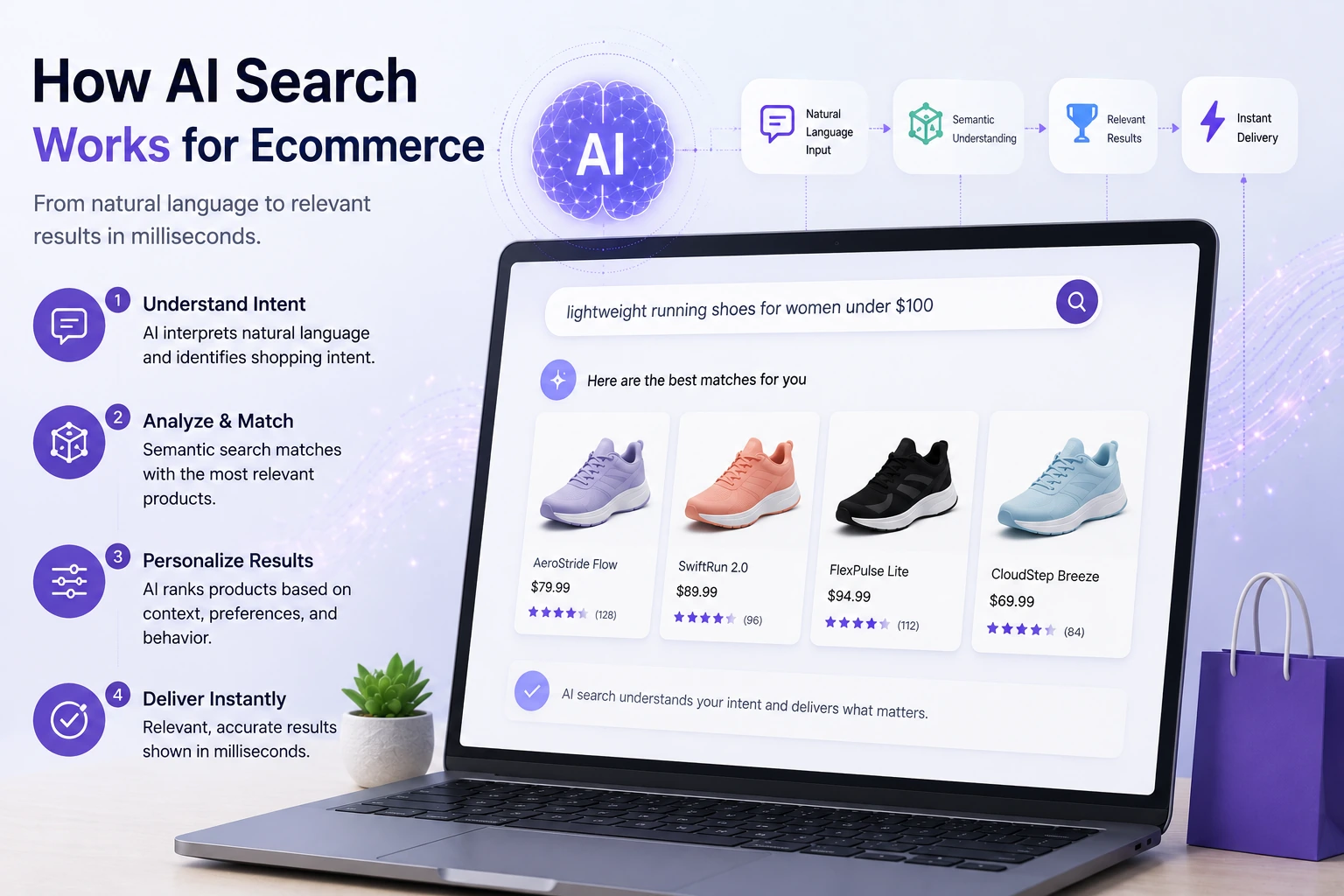
The exact process varies between platforms, but most AI-powered ecommerce search systems follow five main stages.
1. The Shopper Enters a Query
The search begins when the shopper describes what they want. The request may be a short keyword phrase, a complete sentence, a voice command, or an uploaded image.
For example:
“Find a lightweight waterproof jacket under $180 for hiking in cold weather.”
This request contains several types of information:
- Product category: jacket
- Maximum price: $180
- Required feature: waterproof construction
- Preferred feature: lightweight design
- Intended use: hiking in cold weather
A traditional search engine may look for pages containing the same words. AI search attempts to understand how the requirements relate to one another.
2. The System Interprets the Query
The AI processes the shopper’s language and identifies important entities, attributes, restrictions, and intentions.
This may involve:
- Correcting likely spelling mistakes
- Recognizing synonyms and regional language
- Identifying brands and product categories
- Extracting colors, sizes, materials, and prices
- Separating required conditions from preferences
- Understanding how the product will be used
For example, a search for “quiet fan for sleeping” may be connected with low noise levels, sleep modes, timers, compact dimensions, and displays that can be dimmed at night.
The AI should not assume that every related attribute is mandatory. It may still need filters or follow-up questions to clarify what matters most.
3. The Search Engine Retrieves Matching Products
After interpreting the request, the system searches the retailer’s catalog for possible matches.
It may evaluate:
- Product titles and descriptions
- Categories and attributes
- Technical specifications
- Sizes, colors, and materials
- Prices and discounts
- Stock availability
- Compatibility information
- Ratings and customer-review data
Modern search platforms often combine exact keyword retrieval with semantic matching. Exact search remains important for model numbers, product codes, and compatibility. Semantic search helps retrieve relevant products when the shopper and retailer use different words.
For instance, the request “something to keep drinks cold while hiking” may retrieve insulated bottles and hydration containers even if that full phrase does not appear in the product titles.
4. Products Are Scored and Ranked
The system may retrieve many possible matches, but it must still determine which products deserve the highest positions.
Ranking factors can include:
- Relevance to the query
- Exact attribute matches
- Price and budget limits
- Availability
- Compatibility
- Historical clicks and purchases
- Current session behavior
- Customer ratings
- Retailer merchandising rules
Google Cloud’s documentation explains that AI Commerce Search can use real-time user events, including searches, product-detail views, add-to-cart actions, and purchases, when generating search results and recommendations.
These signals can help the search system learn which products shoppers find useful. However, popularity should not override the current request. A bestselling product should not rank first when it fails a required size, price, or compatibility condition.
5. The Shopper Receives and Refines the Results
The ranked products may appear in a search-results page, autocomplete menu, mobile app, visual-search interface, or conversational chatbot.
The shopper can then refine the results using filters or follow-up instructions such as:
- “Show me cheaper options.”
- “Only include products available in black.”
- “Remove products that require a subscription.”
- “Which option is best for beginners?”
- “Only show products that can arrive this week.”
A conversational system can retain the original context while applying the new condition. This avoids forcing the shopper to restart the search every time a preference changes.
This type of guided refinement can also be built into the conversational tools discussed in our article about how AI chatbots help ecommerce stores sell more. The search engine retrieves relevant products, while the chatbot provides questions, explanations, and additional support.
AI Search Improves Through Feedback
Retailers can analyze how shoppers interact with search results to identify weaknesses in the catalog or ranking system.
Important signals include:
- Queries that produce no results
- Searches that are repeatedly rewritten
- Products shown frequently but rarely clicked
- Searches followed by an immediate exit
- Products added to the cart after a search
- Searches that lead to completed purchases
If customers repeatedly search for “small-space furniture” but ignore the first results, the retailer may need better product attributes, synonyms, dimensions, or ranking rules.
AI search therefore works as a continuous process: the shopper enters a request, the system interprets and ranks products, the customer interacts with the results, and the retailer uses that behavior to improve future searches.
AI Search vs. Traditional Ecommerce Search
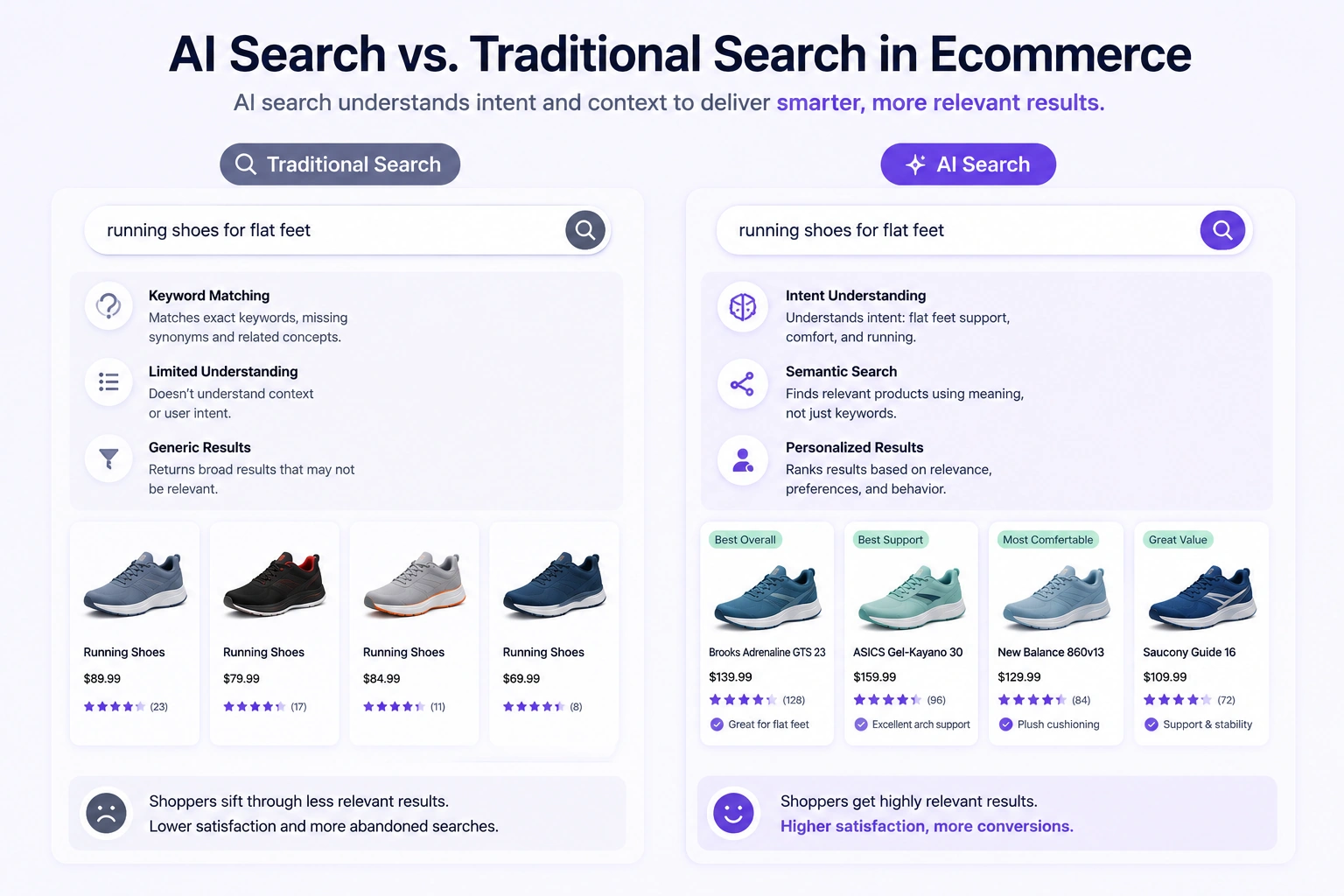
Traditional ecommerce search and AI-powered search both help shoppers find products, but they interpret requests differently. Traditional search generally depends on keywords, filters, manually configured synonyms, and fixed ranking rules. AI search adds semantic understanding, machine learning, and contextual ranking to identify products that match the shopper’s wider intent.
The difference is most visible when a customer describes a need rather than entering an exact product name.
For example, traditional search may handle this query well:
“Black waterproof hiking boots, size 10, under $150.”
The product category and attributes are clearly stated. The system can match the terms and apply strict filters.
A more descriptive search is harder:
“Comfortable boots for walking in cold and wet weather.”
An AI-powered engine can interpret that request as a need for insulation, water resistance, comfort, traction, and durability, even though the shopper did not list those attributes individually.
| Traditional Ecommerce Search | AI Search for Ecommerce |
|---|---|
| Primarily matches keywords and configured synonyms | Can analyze meaning, context, and shopping intent |
| Works best with exact product terminology | Can support everyday language and problem-based queries |
| Often relies on manual filters for refinement | Can extract several requirements from one sentence |
| May return no results when wording differs from the catalog | Can identify related terms, alternatives, and semantic matches |
| Usually applies similar ranking rules to every shopper | May consider context, behavior, and personal preferences |
| Usually treats every query as a separate search | Can retain context during conversational refinement |
| Typically focuses on text queries | May support text, voice, and image-based product search |
Traditional Search Is Strongest for Exact Queries
Keyword search remains valuable when the shopper already knows what they need. It is often the most reliable approach for:
- Model numbers
- Product codes
- Replacement parts
- Known brands and product names
- Exact sizes, colors, or compatibility requirements
Someone searching for a specific printer cartridge or laptop charger expects exact results. A semantic system that interprets the query too broadly could display similar but incompatible products.
This is why effective ecommerce search should preserve exact matching rather than replacing it completely.
AI Search Is Better for Descriptive Queries
AI search becomes more useful when customers describe how they intend to use the product.
Examples include:
- “Shoes for standing all day”
- “A quiet fan for sleeping”
- “A small desk that supports two monitors”
- “A camera for hiking and travel”
- “A gift for a child who likes science”
These requests contain meaning that goes beyond literal words. The system needs to connect the shopper’s situation with the appropriate product attributes.
Google Cloud explains that semantic search focuses on the contextual meaning and intent behind a query rather than relying only on literal keyword matches.
Hybrid Search Combines Precision and Meaning
In practice, retailers do not need to choose between keyword search and semantic search. Many platforms use a hybrid approach.
Microsoft’s documentation for hybrid search in Azure AI Search explains that full-text and vector queries can run in parallel before their results are merged into one ranked list.
This approach is useful for a query such as:
“Black waterproof hiking boots under $150 in size 10.”
The system can use:
- Semantic understanding for the hiking use case
- Keyword and attribute matching for waterproof construction
- Strict filters for color, size, and price
- Machine learning to rank the most relevant products
Hybrid search preserves precision while still understanding the broader meaning of the request.
AI Search Can Reduce Zero-Result Pages
Traditional search may produce no results when a query contains a spelling error, unfamiliar synonym, or description not found in the catalog.
AI search can respond by:
- Correcting a likely typo
- Recognizing an alternative term
- Suggesting a related product category
- Relaxing one nonessential condition
- Showing similar products
- Asking the shopper to clarify the request
Instead of ending the session with “No products found,” the search experience can offer a useful next step.
AI Search Can Personalize Ranking
Traditional search often applies the same ranking rules to every user. AI-powered systems may also consider the current session or previous behavior, when the shopper has permitted personalization.
Possible signals include:
- Previously viewed products
- Past purchases
- Preferred brands
- Selected sizes
- Typical spending range
- Products already in the cart
Personalization should not override an explicit query. If a shopper searches for a premium leather briefcase, the engine should not continue prioritizing inexpensive fabric bags simply because of previous purchases.
Traditional Filters Still Matter
AI search can extract multiple requirements from a sentence, but shoppers should still be able to use familiar filters and sorting tools.
Filters provide direct control over:
- Price
- Brand
- Size
- Color
- Availability
- Customer rating
- Delivery date
The strongest experience allows the shopper to begin with natural language and then refine the results manually.
AI Search Can Explain Why Products Match
A traditional product grid usually shows results without explaining why they appear in a particular order.
An AI-powered interface may add a short explanation:
“These shoes match your request because they are available in wide sizes, include cushioning designed for extended walking, and cost less than $150.”
This can make the results easier to evaluate, but the explanation must be grounded in verified product data. Generative AI should not invent specifications, compatibility details, prices, or inventory.
The Best Ecommerce Search Uses Both Approaches
Traditional search remains useful for exact and simple purchases. AI search provides the most value when the request is descriptive, complex, or difficult to express through standard filters.
The strongest ecommerce search experience usually combines:
- Exact keyword matching
- Semantic understanding
- Strict product filters
- Machine-learning ranking
- Conversational refinement
This combination gives shoppers the flexibility of AI while preserving the precision and control of familiar ecommerce tools. It also supports the broader product-discovery experience described in our guide to what an AI personal shopper is and how it works.
Benefits of AI Search for Shoppers and Ecommerce Stores
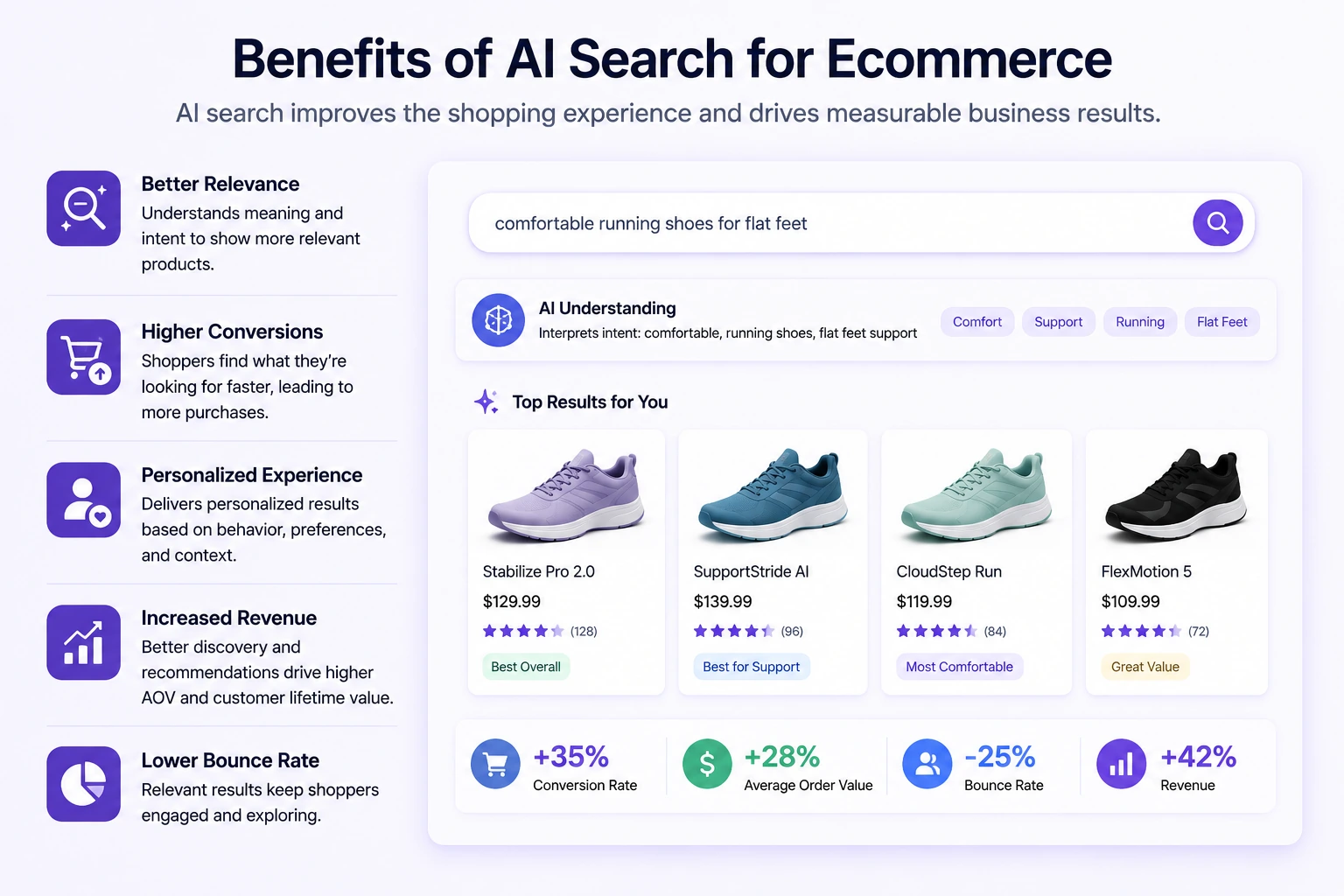
AI search can improve ecommerce for both sides of the transaction. Shoppers can reach suitable products with less effort, while retailers can reduce failed searches, learn more from customer behavior, and guide more visitors toward products they are likely to buy.
The biggest advantage is not that AI produces more results. It is that the search experience can become more relevant, more flexible, and easier to use.
Benefits for Shoppers
For customers, AI search reduces the need to understand the retailer’s catalog structure or use exact product terminology.
Faster Product Discovery
A shopper can describe several requirements in one query instead of repeatedly changing keywords and filters.
For example:
“Find a compact espresso machine under $500 that is easy to clean and suitable for a beginner.”
The system can use the category, budget, size, experience level, and maintenance preference to create a more focused set of results.
More Relevant Results
AI search can evaluate the meaning behind the complete request rather than matching only isolated words. This helps prevent popular but unsuitable products from taking the highest positions.
A shopper looking for “lightweight luggage for international carry-on travel” should see products that fit common cabin-size restrictions and portability needs, not simply the store’s bestselling suitcases.
Fewer Dead Ends
Spelling mistakes, uncommon wording, and missing exact matches do not always have to produce an empty results page.
AI search may instead:
- Correct the likely typo
- Recognize a synonym
- Suggest a related category
- Show a close alternative
- Explain which requirement could not be satisfied
This gives the shopper a practical next step instead of forcing them to leave the store or restart the search.
Easier Product Comparison
Conversational AI search can help customers narrow large result sets and compare products using the criteria that matter most.
A shopper could ask:
“Compare the three best options by weight, battery life, warranty, and total price.”
This can reduce the time spent opening multiple product pages and manually extracting specifications.
Better Accessibility
AI search can support several input methods, including natural-language text, voice, and images. This can help shoppers who find complex menus, filters, or technical vocabulary difficult to use.
For example, a customer may upload a photo of a lamp and ask for a similar product in a different color or price range.
Benefits for Ecommerce Stores
For retailers, better search can affect more than the search-results page. It can improve product visibility, customer understanding, merchandising decisions, and the overall path to purchase.
Higher Search Engagement
When the first results are relevant, shoppers are more likely to click products, apply filters, compare options, and continue browsing.
Google Cloud states that AI Commerce Search can use customer behavior, context, product data, and user events to optimize results. Its documentation notes that this may improve search click-through rate and search conversion while reducing the rate of searches that return no results. Google Cloud’s explanation of how AI Commerce Search works also shows how retailers can use this information for analytics and performance monitoring.
More Products Can Be Discovered
Traditional ranking often favors bestselling products and items with perfectly optimized titles. AI search can surface relevant products that use different wording or belong to less obvious categories.
This can help retailers expose more of their catalog instead of repeatedly sending traffic to the same small group of products.
Reduced Dependence on Manual Synonym Rules
Retailers using traditional search may need to build large lists connecting customer language with catalog terminology.
For example, they may manually connect:
- “Couch” with “sofa”
- “Trainers” with “sneakers”
- “Cellphone” with “smartphone”
- “Flash drive” with “USB storage”
Semantic search can recognize many of these relationships automatically. Manual rules are still useful for brand-specific language, technical terms, and business priorities, but the retailer may need fewer of them.
Better Insights Into Customer Demand
Search queries reveal what shoppers want in their own words. Retailers can analyze this information to identify:
- Frequently requested features
- Products customers cannot find
- New terminology and trends
- Missing sizes, colors, or price points
- Catalog information that needs improvement
- Demand for products the store does not yet offer
If many visitors search for “small sectional sofa for apartments” but few products receive clicks, the issue may be weak product data, unsuitable inventory, or poor ranking.
Improved Merchandising Control
AI ranking does not mean the retailer loses control of the results. Stores can still apply business rules to promote seasonal items, prioritize in-stock products, reduce the visibility of unavailable inventory, or support a campaign.
The strongest systems balance:
- Relevance to the shopper’s query
- Availability and delivery
- Retailer merchandising priorities
- Product quality and customer satisfaction
Commercial rules should not make the results misleading. Promoted products that do not satisfy the query can weaken trust in the entire search experience.
Support for Larger Catalogs
As an ecommerce catalog grows, shoppers may have difficulty navigating categories and filters. AI search gives customers another way to reach the right part of the catalog without understanding its complete structure.
This is especially useful for stores with:
- Thousands of products
- Many technical specifications
- Frequent inventory changes
- Complex compatibility requirements
- Several brands and product variations
Potentially Fewer Abandoned Shopping Sessions
Search frustration can cause visitors to leave before reaching a relevant product page. Better query understanding, clearer alternatives, and improved ranking can keep more shoppers moving through the purchase journey.
This does not mean AI search alone can solve abandonment. Pricing, shipping costs, checkout complexity, trust, and delivery times still matter. However, better product discovery can remove one important source of friction, as discussed in our guide to how AI helps reduce cart abandonment in ecommerce.
AI Search Benefits Depend on Implementation Quality
The benefits are not automatic. A poorly implemented AI search system may produce vague results, over-personalize rankings, display unavailable products, or generate explanations that are not supported by the catalog.
Retailers need:
- Accurate and structured product data
- Reliable inventory and pricing updates
- Clear relevance rules
- Ongoing search analytics
- Human review of important queries
- Privacy and personalization controls
AI search creates the most value when it combines strong technology with a well-maintained catalog and a clear understanding of what customers are trying to accomplish.
Limitations, Risks, and Common AI Search Mistakes
AI search can improve product discovery, but it is not automatically accurate, unbiased, or useful. Its performance depends on the quality of the product catalog, the data used to rank results, the rules applied by the retailer, and the way the customer interface is designed.
When these foundations are weak, an AI-powered search engine may produce results that sound intelligent while still being incomplete, misleading, or commercially unhelpful.
Poor Product Data Produces Poor Search Results
AI cannot reliably identify product characteristics that are missing, inconsistent, or incorrectly structured in the catalog.
For example, a retailer may sell a jacket that is ideal for cold and wet weather. However, if the product page does not clearly include information about insulation, water resistance, weight, and intended use, the search engine may fail to retrieve it for a relevant query.
Common product-data problems include:
- Missing sizes, colors, or materials
- Inconsistent attribute names
- Incomplete compatibility information
- Outdated prices or stock levels
- Vague product descriptions
- Duplicate product records
- Important specifications stored only inside images or PDFs
Google Cloud’s guidance on AI Commerce Search data quality explains that catalog and user-event data affect which search performance capabilities are available. This reinforces a basic rule: advanced search technology cannot compensate for unreliable source data.
AI Can Misinterpret Ambiguous Queries
Natural-language requests are not always precise. A shopper searching for “lightweight shoes for work” may mean office shoes, safety footwear, nursing shoes, or comfortable shoes for standing all day.
Instead of making an unsupported assumption, the system may need to ask a clarifying question such as:
“Will you mainly wear them in an office, a hospital, or an industrial workplace?”
Without clarification, the engine may return products that are technically related to the words but unsuitable for the shopper’s real situation.
Generated Explanations May Contain Incorrect Claims
Some AI search systems use generative AI to summarize product differences or explain why an item matches the query.
This can be useful, but the generated text must remain grounded in verified catalog information. Otherwise, the assistant may invent or incorrectly infer:
- Product compatibility
- Materials or dimensions
- Warranty conditions
- Delivery times
- Customer-review conclusions
- Health, safety, or performance claims
A convincing explanation is not necessarily an accurate one. Retailers should restrict generated answers to trusted data sources and give shoppers direct access to the original specifications.
The NIST AI Risk Management Framework emphasizes ongoing risk identification, measurement, monitoring, and governance rather than treating AI reliability as a one-time technical decision.
Over-Personalization Can Reduce Relevance
Personalization can help place suitable products higher in the results, but it can also trap shoppers inside assumptions based on their previous behavior.
For example, a customer who normally buys inexpensive products may occasionally want a premium item. The search engine should not hide higher-quality options simply because the shopper’s purchase history suggests a lower typical budget.
Explicit requirements in the current query should generally take priority over inferred preferences from past behavior.
Popularity Can Overpower True Relevance
Machine-learning systems often use clicks, purchases, and add-to-cart activity as ranking signals. These signals can improve search, but they may also create a feedback loop.
Popular products receive more visibility, which produces more clicks and purchases, which then makes them appear even more popular. New, niche, or specialized products may struggle to rank even when they are a better match.
Retailers should balance behavioral data with:
- Query relevance
- Exact attribute matches
- Product freshness
- Catalog diversity
- Availability
- Customer satisfaction signals
Commercial Rules Can Damage Trust
Retailers may use merchandising rules to promote high-margin items, sponsored products, seasonal inventory, or private-label brands.
These rules are not necessarily harmful, but they become a problem when commercial priorities push unsuitable products above genuinely relevant results.
A shopper searching for a product under $100 should not see a page dominated by $300 alternatives simply because those items are more profitable.
Sponsored results should be clearly identified, and merchandising rules should operate within the boundaries of the shopper’s stated requirements.
AI Search Can Create Privacy Concerns
Personalized search may use previous searches, purchases, location, browsing behavior, device information, or current cart activity.
Retailers should be transparent about:
- Which information is collected
- How it affects product ranking
- How long the information is retained
- Whether it is shared with third parties
- How customers can limit or disable personalization
Collecting more data does not automatically create better search. The system should use only information that has a clear purpose and appropriate customer permission.
Voice and Visual Search Can Be Inaccurate
Voice search may misunderstand accents, brand names, technical terms, or noisy environments. Visual search may focus on color and shape while overlooking material, dimensions, function, or compatibility.
A photograph of a chair may help identify similar designs, but it cannot always reveal:
- Exact measurements
- Weight capacity
- Construction quality
- Material durability
- Assembly requirements
Image and voice input should therefore be used as discovery tools rather than treated as complete evidence that a product is suitable.
Common Implementation Mistakes
Many AI search problems are caused by implementation decisions rather than the underlying technology.
Common mistakes include:
- Launching AI search before cleaning the product catalog
- Removing familiar filters and sorting controls
- Ignoring exact model-number and SKU searches
- Displaying unavailable products too prominently
- Using personalization without clear controls
- Failing to monitor zero-result and low-click queries
- Allowing generated text to invent product details
- Prioritizing sponsored products over relevance
- Assuming the system will improve without human review
AI Search Still Needs Human Oversight
Retail teams should regularly review important and unsuccessful searches, especially those involving expensive products, compatibility, safety, or technical specifications.
Human review can identify:
- Unexpected ranking behavior
- Missing synonyms and attributes
- Misleading product explanations
- Bias toward popular products
- Queries that require clarification
- Inventory gaps and unmet demand
AI search should be treated as an evolving ecommerce system, not a feature that is installed once and then left unattended.
As explained in our article about the future of AI in ecommerce, shopping experiences are likely to become more conversational and personalized. That progress will make reliable data, transparency, customer control, and human oversight even more important.
How to Implement, Improve, and Measure AI Search
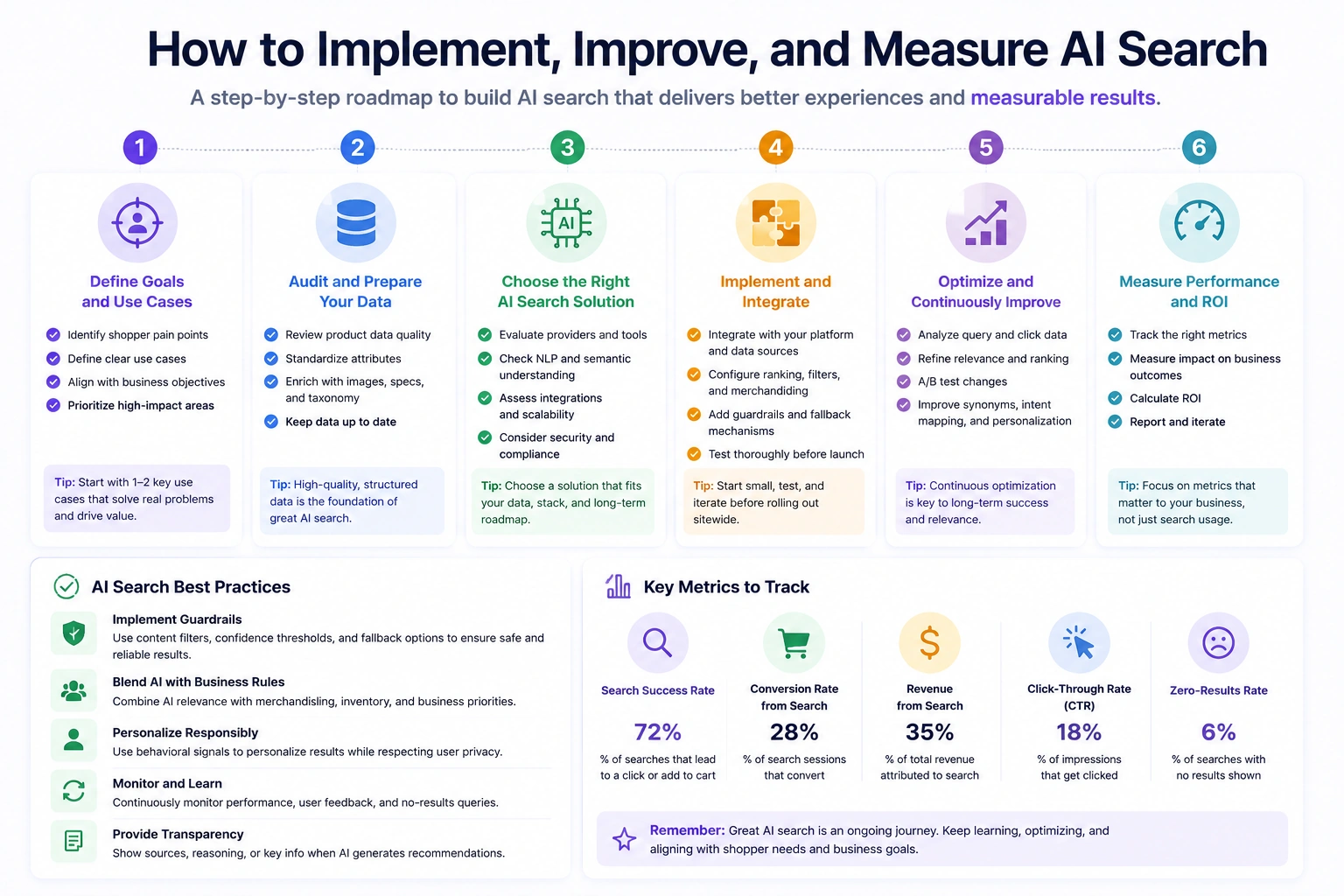
Successful AI search implementation begins before a retailer selects a search platform. The store first needs reliable product data, a clear understanding of customer search behavior, and measurable goals for improvement.
Installing an AI search tool without preparing the catalog may produce a more advanced interface without creating meaningfully better results.
Start With Search Analytics
Retailers should examine how their current search experience performs before replacing or upgrading it.
Useful questions include:
- Which queries are used most frequently?
- Which searches return no products?
- Which queries produce results but no clicks?
- How often do shoppers rewrite their searches?
- Which searches lead to cart additions or purchases?
- Which products appear frequently but receive little engagement?
This information helps identify whether the main problem involves vocabulary, ranking, missing products, weak catalog data, or the user interface.
Improve the Product Catalog
AI search works best when products contain complete and consistently structured information.
Retailers should review:
- Product titles and descriptions
- Categories and subcategories
- Sizes, colors, and materials
- Technical specifications
- Compatibility information
- Prices and availability
- Use cases and intended audiences
- Images and alternative text
Important attributes should be stored as structured data rather than appearing only inside long descriptions or product images.
For example, a search engine can more reliably process waterproof ratings, dimensions, weight, and battery life when each detail has a defined field.
Preserve Exact Search and Familiar Controls
AI search should improve traditional ecommerce tools rather than remove them.
Shoppers should still be able to use:
- Exact product names and model numbers
- Filters for price, size, brand, and availability
- Sorting controls
- Category navigation
- Product-comparison tools
Natural-language search is useful for complex requests, but exact matching remains essential for replacement parts, accessories, technical products, and known items.
Choose Features That Match the Store
Not every ecommerce business needs conversational search, image recognition, voice input, and extensive personalization from the beginning.
A useful AI search platform may include:
- Semantic and keyword search
- Typo tolerance
- Synonym recognition
- Autocomplete and query suggestions
- Attribute extraction from natural language
- Product filters and merchandising controls
- Real-time inventory integration
- Search analytics
- A/B testing
- Privacy and personalization controls
Visual search may be particularly useful for fashion, furniture, and home decor. Conversational search may provide more value for technical products or categories requiring detailed comparisons.
Smaller retailers using Shopify can also compare practical entry points in our guide to the best AI tools for Shopify store owners.
Test Important Customer Queries
Before launch, the retailer should create a test set based on real customer language.
The test set should include:
- Exact product searches
- Misspelled queries
- Synonyms and regional terms
- Natural-language requests
- Budget-based searches
- Compatibility questions
- Queries with no exact match
- Long requests containing several conditions
For each query, the team should check whether suitable products appear near the top and whether strict requirements are respected.
A search for “red running shoes under $100 in size 9” should not rank unavailable sizes or products above the stated budget merely because they are popular.
Use Clarifying Questions Carefully
Conversational search can ask questions when a request is ambiguous, but too many questions create additional friction.
A clarifying question is useful when the answer can materially change the results.
For example:
“Do you need this laptop mainly for office work, gaming, or video editing?”
The system should avoid asking for information that can already be inferred from the query or handled through a simple filter.
Track the Right Search Metrics
Search quality should be measured using both engagement and business outcomes.
| Metric | What It Shows |
|---|---|
| No-results rate | The percentage of searches that return no products |
| No-click rate | How often shoppers receive results but select none |
| Search click-through rate | How often a search leads to a product click |
| Query reformulation rate | How often shoppers rewrite a query before finding a useful result |
| Add-to-cart rate after search | How often searched products are added to the cart |
| Search conversion rate | The percentage of search sessions that produce a purchase |
| Revenue per search visit | The revenue associated with sessions that use search |
| Average order value | Whether improved discovery affects the value of completed orders |
Algolia’s official search analytics documentation includes metrics such as click-through rate, conversion rate, no-results rate, and revenue. These measurements help retailers distinguish between searches that technically return products and searches that genuinely support customer decisions.
Compare AI Search Against a Control
Retailers should not assume that a new AI system performs better simply because it uses more advanced technology.
An A/B test can compare:
- Traditional search against AI-enhanced search
- Different ranking models
- Alternative autocomplete designs
- Different levels of personalization
- Search results with and without generated explanations
Tests should run long enough to capture meaningful behavior and should be analyzed separately for mobile and desktop shoppers when their experiences differ.
Review Search Results Continuously
Search behavior changes as the catalog, customer vocabulary, trends, seasons, and inventory change.
Retailers should regularly review:
- New zero-result searches
- Queries with declining click rates
- Seasonal search patterns
- New products receiving little visibility
- Unexpected ranking changes
- Generated answers that may be inaccurate
Improvement may involve updating attributes, adding a synonym, changing a ranking rule, adjusting merchandising priorities, or adding products that customers repeatedly request.
AI search should therefore be managed as an ongoing ecommerce program. The strongest results come from combining automation with reliable catalog management, performance testing, and regular human review.
Is AI Search for Ecommerce Worth It?
AI search can be a worthwhile investment when a store has a large or complex catalog, customers frequently use the search bar, and traditional keyword matching fails to produce relevant results. It is less valuable when the catalog is small, products are easy to browse, or the retailer has not yet organized its basic product data.
The decision should therefore be based on a real product-discovery problem, not simply on the desire to add another AI feature.
When AI Search Is Most Valuable
AI search tends to provide the greatest value for stores that have:
- Hundreds or thousands of products
- Many product attributes and variations
- Complex technical or compatibility requirements
- Shoppers who use descriptive, problem-based queries
- High numbers of zero-result or low-click searches
- Customers who need help comparing similar products
- Frequent changes in prices, inventory, and availability
Categories such as electronics, fashion, furniture, beauty, automotive parts, home improvement, and sporting goods can benefit because customers often combine several requirements in one search.
For example:
“Find a lightweight laptop under $1,200 with long battery life for travel and video calls.”
A store with hundreds of laptops may benefit from AI interpreting the complete request. A retailer selling only six laptop models may be able to create an equally useful experience with clear categories, filters, and comparison tables.
When a Simpler Search System May Be Enough
AI search is not necessary for every ecommerce business. Traditional search may be sufficient when:
- The store has a small and straightforward catalog.
- Customers usually search for exact product names.
- Products have few attributes or variations.
- Search traffic represents a small part of total store activity.
- The retailer does not have enough clean data to train or configure the system.
- The expected improvement would not justify the ongoing cost.
A small store should usually improve product titles, categories, filters, navigation, mobile usability, and search analytics before purchasing a more advanced platform.
Start With the Business Problem
Retailers should identify what they expect AI search to improve.
Possible goals include:
- Reducing the no-results rate
- Increasing search-result clicks
- Helping shoppers find products through everyday language
- Improving mobile product discovery
- Supporting image or voice searches
- Increasing add-to-cart and conversion rates after search
- Reducing the manual work required to manage synonyms
A clear goal makes it easier to choose the right technology and measure whether the investment is producing a useful return.
For example, a retailer with many unsuccessful descriptive queries may prioritize semantic search. A fashion store may gain more value from visual search, while a technical equipment supplier may need stronger compatibility filters and exact model-number matching.
Consider the Full Cost of AI Search
The cost extends beyond the monthly price of the search platform.
Retailers may also need to budget for:
- Technical implementation
- Catalog cleaning and attribute enrichment
- Integration with inventory and pricing systems
- Search interface design
- Analytics configuration
- Employee training
- Ongoing testing and optimization
- Human review of generated answers and rankings
A low-cost tool can become expensive if it requires extensive custom development. A more expensive platform may produce better value when it includes reliable integrations, analytics, merchandising controls, and support.
Small Stores Can Introduce AI Search Gradually
Smaller ecommerce stores do not need to begin with a fully conversational shopping assistant.
A gradual implementation could follow these stages:
- Improve titles, categories, and structured product attributes.
- Add typo tolerance, synonyms, autocomplete, and better filters.
- Introduce semantic search for descriptive queries.
- Test personalized ranking where it provides clear value.
- Add conversational, visual, or voice search only when customer behavior supports it.
This approach allows the retailer to measure each improvement before committing to a larger and more expensive system.
The Future Is Hybrid and Conversational
Ecommerce search is likely to become less dependent on isolated keywords and more capable of understanding complete shopping goals. However, exact keyword matching and traditional filters will remain important.
Algolia’s official documentation for NeuralSearch describes a hybrid approach that combines keyword and vector search before merging and ranking the results. This reflects the likely direction of ecommerce search: AI will strengthen familiar search tools rather than eliminate them.
Future product-discovery experiences are also likely to combine:
- Natural-language search
- Traditional filters and exact matching
- Conversational follow-up questions
- Product comparisons and summaries
- Visual and voice input
- Personalized ranking
- Real-time inventory, pricing, and delivery information
A shopper may begin with a broad request, refine it through conversation, compare a shortlist, confirm availability, and complete the purchase without repeatedly navigating different pages.
Agentic Commerce May Expand the Role of Search
The next stage of AI shopping may involve agents that do more than retrieve products. They may help customers research, compare, configure, and eventually purchase products across connected retail systems.
In January 2026, Google announced new tools and an open standard intended to support agentic commerce. This suggests that product data may increasingly need to be structured not only for human shoppers and conventional search engines, but also for AI agents acting on a shopper’s behalf.
For retailers, this makes accurate information about price, inventory, variants, compatibility, delivery, and returns even more important. An AI agent cannot reliably recommend or purchase a product when these details are incomplete or outdated.
AI Search Should Support, Not Control, the Shopper
As ecommerce search becomes more intelligent, customers should still be able to understand and control the experience.
They should be able to:
- Edit the query and filters
- See why products were recommended
- Verify information on the product page
- Disable or limit personalization
- Distinguish organic results from sponsored placements
- Return to a standard product grid when preferred
The purpose of AI search is not to make decisions for every customer. It is to reduce the effort required to find relevant products while leaving the final choice with the shopper.
The Final Verdict
AI search is worth considering when customers struggle to find products, the catalog is too complex for basic keyword matching, and the retailer has the data and resources required to maintain the system.
It should not be treated as a shortcut around poor product information, confusing navigation, or weak merchandising. A store with clean catalog data and a well-designed traditional search experience may outperform a store using advanced AI on top of unreliable information.
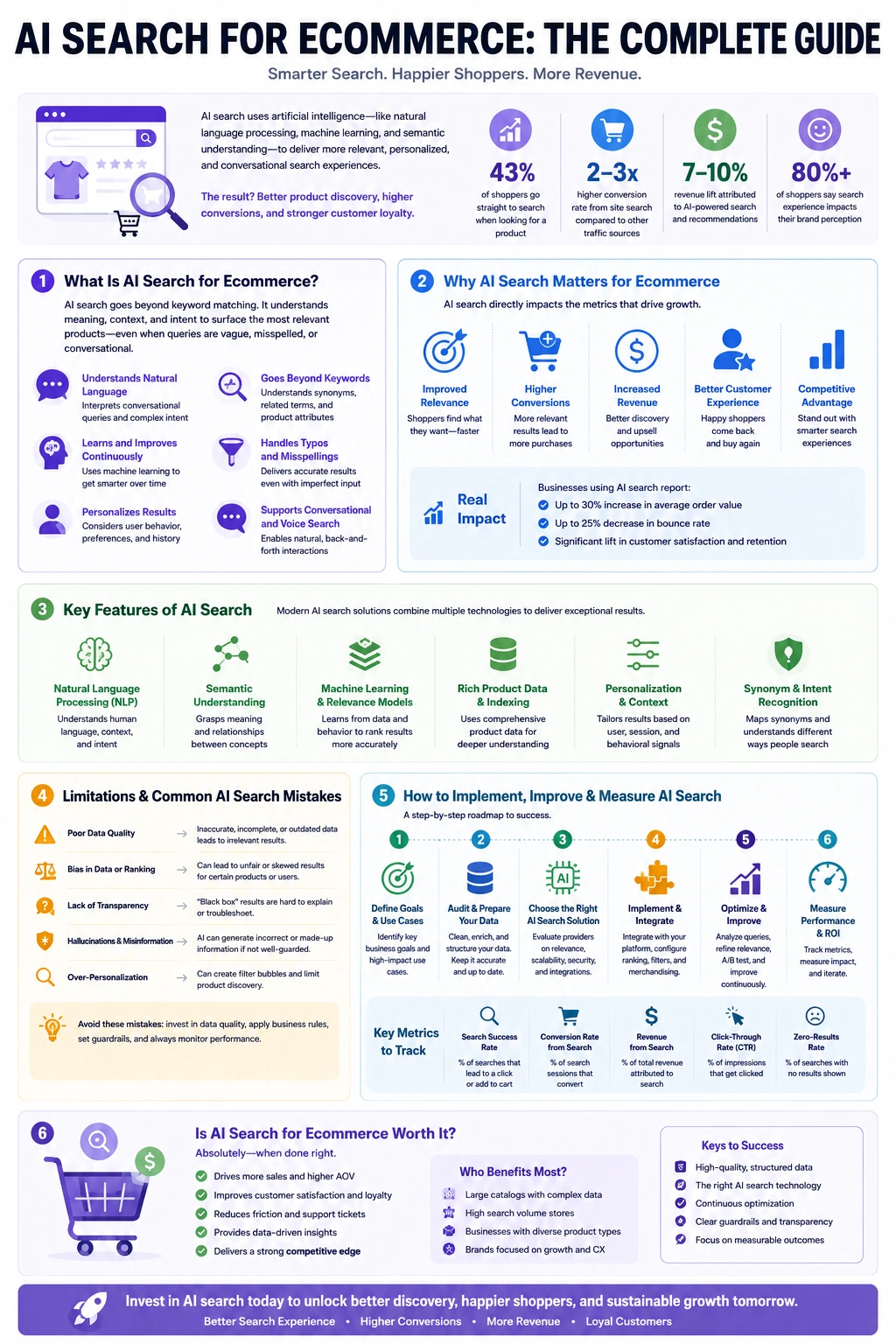
The best approach is usually hybrid: preserve exact search, filters, and customer control while adding semantic understanding, intelligent ranking, and conversational assistance where they solve measurable problems.
Conclusion
AI search for ecommerce improves product discovery by helping search engines understand shopper intent, context, and everyday language. Instead of relying only on exact keywords, it can connect descriptive requests with relevant products, recognize synonyms, correct spelling errors, and rank results according to multiple requirements.
Its greatest value appears when a store has a large or complex catalog and customers frequently search by need, budget, intended use, or product attributes. In these situations, semantic understanding, hybrid search, machine-learning ranking, and conversational refinement can reduce the effort required to reach a useful shortlist.
However, AI search is not a replacement for strong ecommerce foundations. Accurate product data, reliable inventory information, clear filters, exact model-number matching, transparent merchandising rules, and regular performance monitoring remain essential. An advanced search platform cannot reliably interpret product characteristics that are missing or incorrect in the catalog.
The strongest approach is usually a hybrid one. Traditional keyword search provides precision for exact products and technical identifiers, while AI adds flexibility for complex and descriptive queries. Shoppers should still be able to use familiar filters, verify product details, understand why results were shown, and control personalization.
Retailers should begin with measurable problems rather than adding AI simply because it is available. By tracking no-result searches, click-through rates, query reformulations, cart additions, and conversions, stores can determine whether AI search is genuinely improving the shopping experience.
When implemented carefully, AI search can create a faster and more natural path from a customer’s first question to the right product. It does not need to make the final decision for the shopper. Its purpose is to remove unnecessary friction, present more relevant choices, and make even a complicated ecommerce catalog easier to explore.
Frequently Asked Questions
What is AI search for ecommerce?
AI search for ecommerce is a product-discovery system that uses artificial intelligence to understand shopper intent, context, and natural language. It can match descriptive queries with relevant products even when the shopper does not use the exact words found in the product catalog.
How is AI search different from traditional ecommerce search?
Traditional ecommerce search mainly relies on exact keywords, predefined synonyms, filters, and fixed ranking rules. AI search can also analyze meaning, intent, product relationships, shopper context, and behavioral signals. The strongest systems usually combine both approaches through hybrid search.
How does AI search for ecommerce work?
The system interprets the shopper’s query, extracts important requirements, retrieves possible products, and ranks them according to relevance. It may use natural language processing, semantic search, vector search, keyword matching, machine learning, personalization, and product catalog data.
What is semantic search in ecommerce?
Semantic search attempts to understand the meaning behind a query rather than matching only identical words. For example, it may connect “shoes for standing all day” with products described as supportive, cushioned, comfortable, or suitable for extended wear.
Can AI search understand complete sentences?
Yes. Many AI-powered search systems can process natural-language requests containing several conditions, such as product type, budget, size, intended use, color, and required features.
For example:
“Find a lightweight laptop under $1,000 with long battery life for remote work and travel.”
Can AI search correct spelling mistakes?
AI search can often recognize common spelling mistakes, incomplete words, and alternative terminology. However, retailers should be careful when correcting exact model numbers, product codes, and technical identifiers because a small change could produce incompatible results.
Can AI search understand synonyms?
Yes. AI search may recognize that shoppers use different words for the same product, such as “couch” and “sofa,” “sneakers” and “trainers,” or “flash drive” and “USB stick.” This reduces the retailer’s dependence on manually configured synonym lists.
Can AI search personalize product results?
AI search can personalize rankings using information such as previous purchases, recently viewed products, preferred brands, selected sizes, and current cart activity. Personalization should remain transparent and should not override clear requirements in the shopper’s current query.
What is the difference between AI search and product recommendations?
AI search responds to an active shopper query. Product recommendations predict items the shopper may find useful based on behavior, product similarity, or context. Search helps customers find what they are actively requesting, while recommendations help them discover alternatives and related products.
What is the difference between AI search and an AI personal shopper?
AI search primarily retrieves and ranks relevant products. An AI personal shopper provides broader guidance by asking follow-up questions, comparing options, explaining trade-offs, and helping the customer make a final decision.
What types of ecommerce stores benefit most from AI search?
AI search is especially useful for stores with large catalogs, many product variations, complex specifications, compatibility requirements, or customers who frequently use descriptive queries. Electronics, fashion, furniture, beauty, automotive parts, sporting goods, and home improvement are common examples.
Is AI search useful for small ecommerce stores?
It can be, but small stores should first improve product titles, categories, attributes, filters, and standard search analytics. A store with a simple catalog may receive more value from typo correction, autocomplete, and better filters than from a fully conversational AI search platform.
Can AI search reduce zero-result searches?
Yes. AI search can reduce zero-result pages by correcting spelling mistakes, recognizing synonyms, identifying semantic alternatives, suggesting related categories, or relaxing nonessential conditions. It should also explain when no suitable product is available rather than presenting irrelevant results.
Does AI search improve ecommerce conversion rates?
AI search may improve conversion by helping shoppers find relevant products faster. However, conversion also depends on pricing, product quality, shipping costs, trust, mobile usability, and checkout design. Retailers should measure performance through controlled testing rather than assuming that adding AI will automatically increase sales.
What metrics should ecommerce stores use to measure AI search?
Useful metrics include no-results rate, no-click rate, search click-through rate, query reformulation rate, add-to-cart rate after search, search conversion rate, revenue per search session, and average order value.
What are the main limitations of AI search?
AI search can misinterpret ambiguous requests, over-personalize results, favor popular products, or generate incorrect explanations. It also depends heavily on accurate product data, inventory information, pricing, specifications, and compatibility details.
Can AI search invent product information?
Generative AI can produce incorrect or unsupported claims when it is not properly grounded in verified catalog data. Retailers should prevent the system from inventing specifications, compatibility, warranty conditions, delivery dates, or customer-review conclusions.
Does AI search replace filters and keyword search?
No. Exact keyword matching and traditional filters remain important for product codes, replacement parts, sizes, prices, colors, and compatibility. The best ecommerce search experience usually combines AI understanding with familiar filters and precise keyword retrieval.
What should an ecommerce store look for in an AI search tool?
Important features include semantic and keyword search, typo tolerance, synonym recognition, autocomplete, natural-language attribute extraction, real-time inventory integration, merchandising controls, analytics, A/B testing, privacy controls, and support for exact model or SKU searches.
Is AI search for ecommerce worth using?
AI search is worth considering when customers struggle to find products, the catalog is too complex for basic keyword matching, and the retailer can maintain accurate product data. It provides the most value when it solves a measurable product-discovery problem rather than being added only as a marketing feature.