

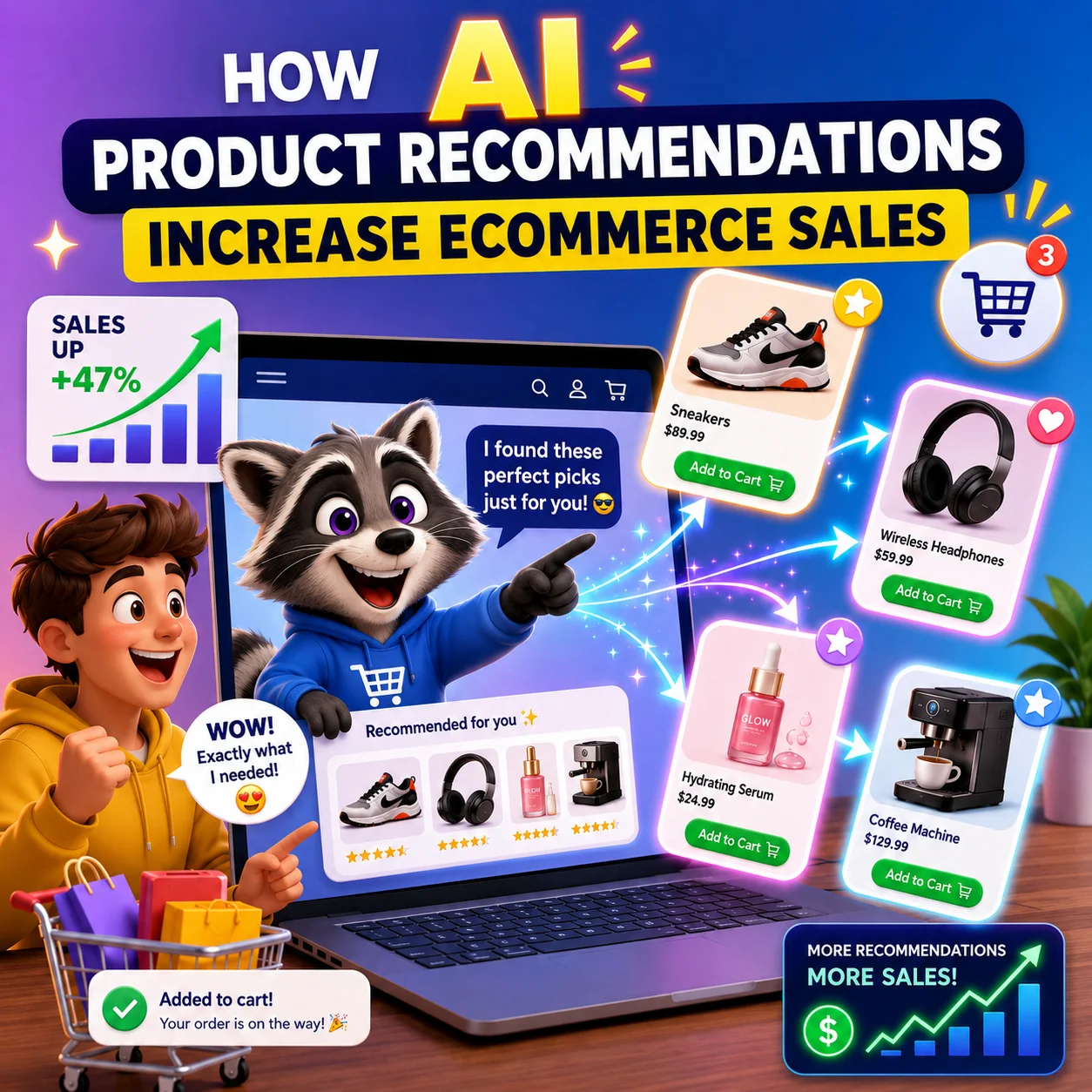
Online shoppers rarely struggle because ecommerce stores have too few products. More often, the problem is the opposite. There are too many options, too many similar products, and not enough guidance to help customers decide what is right for them.
A shopper may open several product pages, compare prices, read reviews, adjust filters, and still leave without buying. When the differences between products are difficult to understand, the shopping process can quickly become frustrating.
AI product recommendations can make that experience easier.
Instead of showing every visitor the same popular products, an AI recommendation system can analyze signals such as browsing behavior, search activity, cart contents, previous purchases, product preferences, and interactions with similar items.
It can then suggest products that are more relevant to the individual shopper.
These recommendations may appear on the homepage, category pages, search results, product pages, shopping cart, checkout, emails, or post-purchase screens. They can help customers discover products faster, compare better options, and find useful accessories or alternatives they may not have noticed on their own.
Shopify’s guide to AI recommendation systems explains how ecommerce businesses can use customer and product data to create more personalized product suggestions throughout the shopping journey.
For ecommerce stores, the potential business value is significant. Relevant recommendations can help increase conversion rates, improve average order value, support upselling and cross-selling, and encourage customers to return for future purchases.
AI product recommendations can support several important ecommerce goals:
- helping shoppers find relevant products faster
- reducing decision fatigue
- increasing add-to-cart activity
- improving conversion rates
- raising average order value
- supporting upselling and cross-selling
- encouraging repeat purchases
- creating a more personalized shopping experience
This type of technology is becoming an important part of the broader AI shopping assistant experience, where online stores use artificial intelligence to guide customers instead of expecting them to navigate large catalogs alone.
However, simply displaying more products does not guarantee better results.
Recommendations must be relevant, timely, and connected to what the shopper is actually trying to accomplish. Irrelevant suggestions, repeated products, unavailable items, or aggressive upsells can create more friction instead of increasing sales.
The goal is not to show customers as many products as possible. It is to show the right products to the right shopper at the right moment.
In this guide, we’ll explain how AI product recommendations work, how they can increase ecommerce sales, where stores can display them, what mistakes to avoid, and how to measure whether a recommendation strategy is producing real business results.
Quick Overview: How AI Product Recommendations Increase Ecommerce Sales
AI product recommendations can support several parts of the ecommerce journey, from product discovery to repeat purchases. The table below summarizes the main ways they can help shoppers and increase sales.
| AI Recommendation Use Case | What It Does | How It Helps Shoppers | How It Can Increase Sales |
|---|---|---|---|
| Personalized product discovery | Shows products based on browsing behavior, searches, preferences, cart activity, and previous purchases. | Helps customers find relevant products without searching through the entire catalog. | Can improve add-to-cart activity and conversion rates. |
| Similar product recommendations | Suggests alternatives with similar features, prices, styles, or uses. | Makes product comparison easier and gives shoppers more suitable options. | Can recover sales when the original product is unavailable, too expensive, or not the right fit. |
| Frequently bought together | Recommends products that customers commonly purchase together. | Helps shoppers remember useful accessories, refills, or complementary items. | Can increase average order value through relevant cross-selling. |
| AI-powered upselling | Suggests a higher-value option with better features, performance, capacity, or warranty. | Helps customers compare whether an upgrade provides better value. | Can increase order value when the upgrade is relevant and reasonably priced. |
| Cart recommendations | Displays accessories, bundles, or small add-ons connected to products already in the cart. | Helps shoppers complete their order with products they may genuinely need. | Can raise average order value without sending the shopper back through the catalog. |
| Abandoned cart alternatives | Suggests lower-priced, better-rated, faster-shipping, or more suitable alternatives after cart abandonment. | Gives the shopper another path to purchase when the original product caused hesitation. | Can help recover sales that might otherwise be lost. |
| Reorder and replenishment recommendations | Predicts when customers may need to repurchase consumable or replacement products. | Makes repeat shopping faster and more convenient. | Can increase repeat purchase rate and customer lifetime value. |
| Post-purchase recommendations | Suggests compatible products, accessories, upgrades, or future purchases after an order is completed. | Adds value without interrupting the original checkout process. | Can generate additional revenue and encourage customers to return. |
Quick takeaway: AI product recommendations increase ecommerce sales when they reduce the effort required to find the right product. The strongest results usually come from relevant personalization, useful alternatives, compatible add-ons, well-timed upsells, and recommendations that match the shopper’s current intent.
What Are AI Product Recommendations?
AI product recommendations are personalized product suggestions generated by artificial intelligence or machine learning systems.
Instead of showing every shopper the same bestselling items, these systems analyze available data to decide which products are most relevant to a specific visitor.
The recommendations may be based on signals such as:
- products the shopper viewed
- search terms they used
- items added to the cart
- previous purchases
- products they compared
- preferred brands, categories, sizes, or price ranges
- behavior from shoppers with similar interests
- current activity during the shopping session
For example, if a shopper views several beginner-friendly cameras, the recommendation system may suggest similar models, a starter bundle, or useful accessories such as a memory card and camera bag.
If another shopper regularly buys skincare products for sensitive skin, the store may recommend a compatible cleanser, moisturizer, or sunscreen rather than displaying the same generic products shown to everyone else.
Google Cloud describes its commerce recommendation technology as a way to deliver personalized product recommendations at scale using machine learning and real-time shopper activity. :contentReference[oaicite:0]{index=0}
AI product recommendations can be displayed in several familiar formats, including:
- Recommended for You
- Similar Products
- Frequently Bought Together
- Customers Also Viewed
- You May Also Like
- Complete the Look
- Based on Your Recent Activity
Some recommendations are personalized to an individual shopper. Others are based on broader patterns, such as products commonly purchased together or items that are currently popular.
The main difference between traditional product recommendations and AI-powered recommendations is adaptability.
A basic recommendation widget may use fixed rules, such as always showing the same accessories with a product. An AI system can adjust recommendations as shopper behavior changes, new products are added, inventory changes, or more customer data becomes available.
That makes AI recommendations more dynamic and potentially more relevant.
However, the quality of the suggestions depends heavily on the quality of the data. If product information is incomplete, customer behavior is limited, or the catalog is poorly organized, even an advanced recommendation system may produce weak results.
In simple terms, AI product recommendations act like a digital store associate. They observe what the shopper appears to want and then suggest products that may help them make a better buying decision.
How AI Product Recommendations Work
AI product recommendation systems work by collecting signals about products, shoppers, and interactions, then using those signals to predict which items are most likely to be relevant.
The process may sound complicated, but the basic idea is simple. The system observes what shoppers do, identifies patterns, and uses those patterns to rank products for each visitor.
A typical recommendation process includes five main steps.
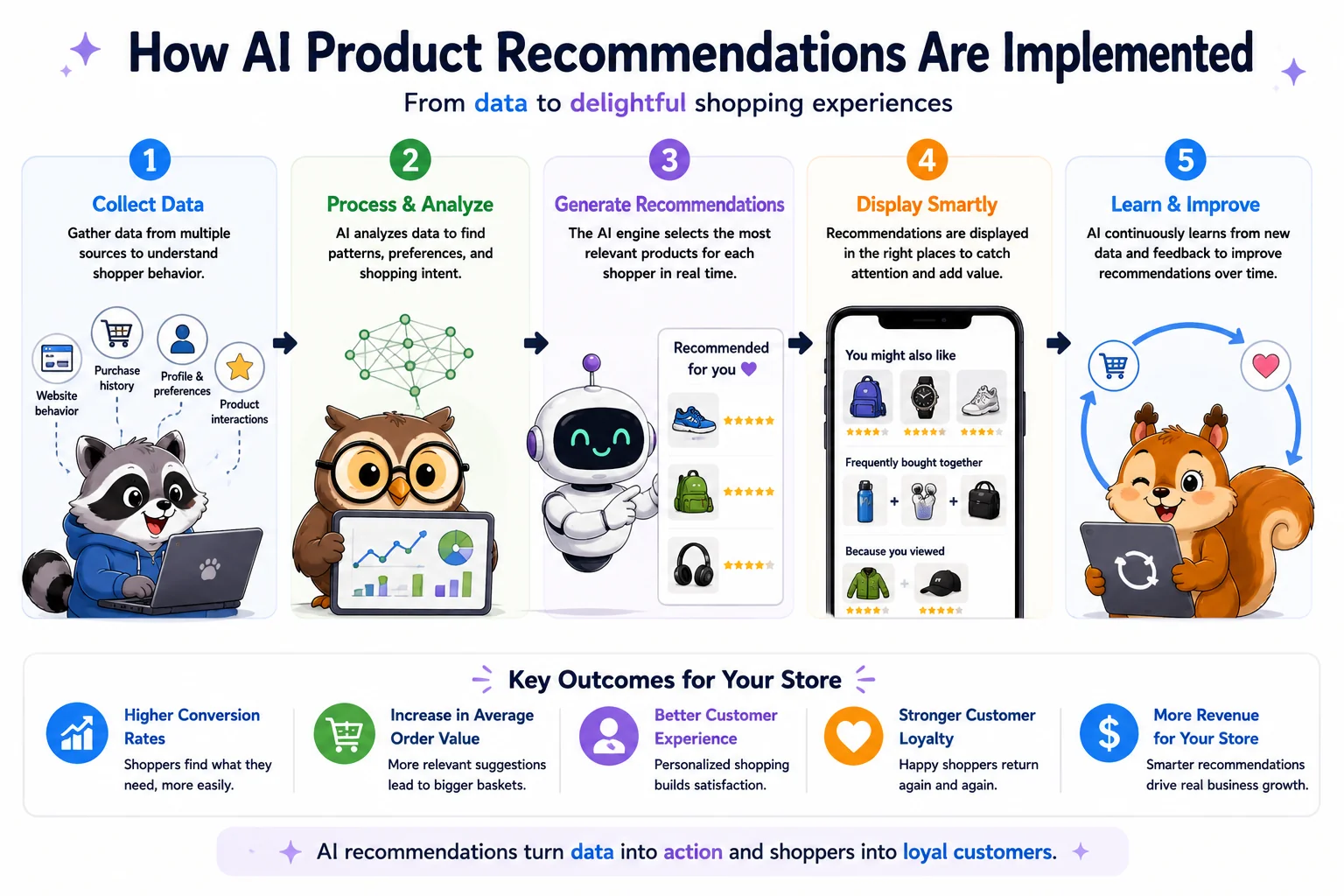
1. The System Collects Shopper and Product Data
The recommendation system begins with available data about how customers interact with the store.
This may include:
- product page views
- search queries
- products added to or removed from the cart
- completed purchases
- recently viewed products
- category and brand preferences
- product ratings or reviews
- items displayed but not clicked
- the time and order of customer interactions
The system may also use product information such as category, brand, price, size, color, material, features, availability, and compatibility.
For example, if a shopper repeatedly views waterproof hiking shoes under $150, those interactions help the system understand the type of product that may be relevant.
2. AI Identifies Patterns and Preferences
After collecting the data, the system looks for relationships between shoppers, products, and behavior.
It may notice that customers who buy a particular coffee machine often purchase specific filters. It may learn that people who view one skincare product frequently compare it with two similar alternatives. It may also detect that a shopper usually chooses products from a particular brand or price range.
These patterns help the system move beyond generic bestseller lists.
Instead of asking only, “What products are popular?”, it can ask, “What products are most likely to be useful to this shopper right now?”
3. The System Generates and Ranks Recommendations
The AI system creates a list of possible products and ranks them according to predicted relevance.
A higher-ranking product may closely match the shopper’s recent behavior, previous purchases, preferences, or current cart. A lower-ranking product may have a weaker connection to what the customer appears to need.
Amazon Personalize, for example, can generate personalized recommendations for individual users, recommend related items, and provide real-time results based on interaction data.
You can read more about these ecommerce recommendation use cases in the official Amazon Personalize documentation.
4. Recommendations Appear During the Shopping Journey
Once the products are ranked, the store can display them in different locations.
For example, the shopper may see:
- personalized products on the homepage
- similar items on a product page
- accessories on the cart page
- alternative products in search results
- recommendations inside an AI chatbot
- personalized products in an email
- reorder suggestions after a previous purchase
The best placement depends on what the recommendation is trying to achieve.
A product-page recommendation may help the shopper compare alternatives. A cart-page recommendation may increase average order value. A post-purchase recommendation may encourage a repeat order or help the customer complete a product setup.
5. The System Learns From New Interactions
AI recommendations can improve as customers continue interacting with the store.
If shoppers repeatedly click certain recommendations, add them to the cart, and purchase them, the system receives a positive signal. If recommendations are frequently ignored, removed, or followed by an exit, the system can use that behavior to adjust future results.
This creates a feedback loop:
- The system displays a recommendation.
- The shopper clicks, ignores, or purchases the product.
- The system records the interaction.
- Future recommendations are adjusted using the new information.
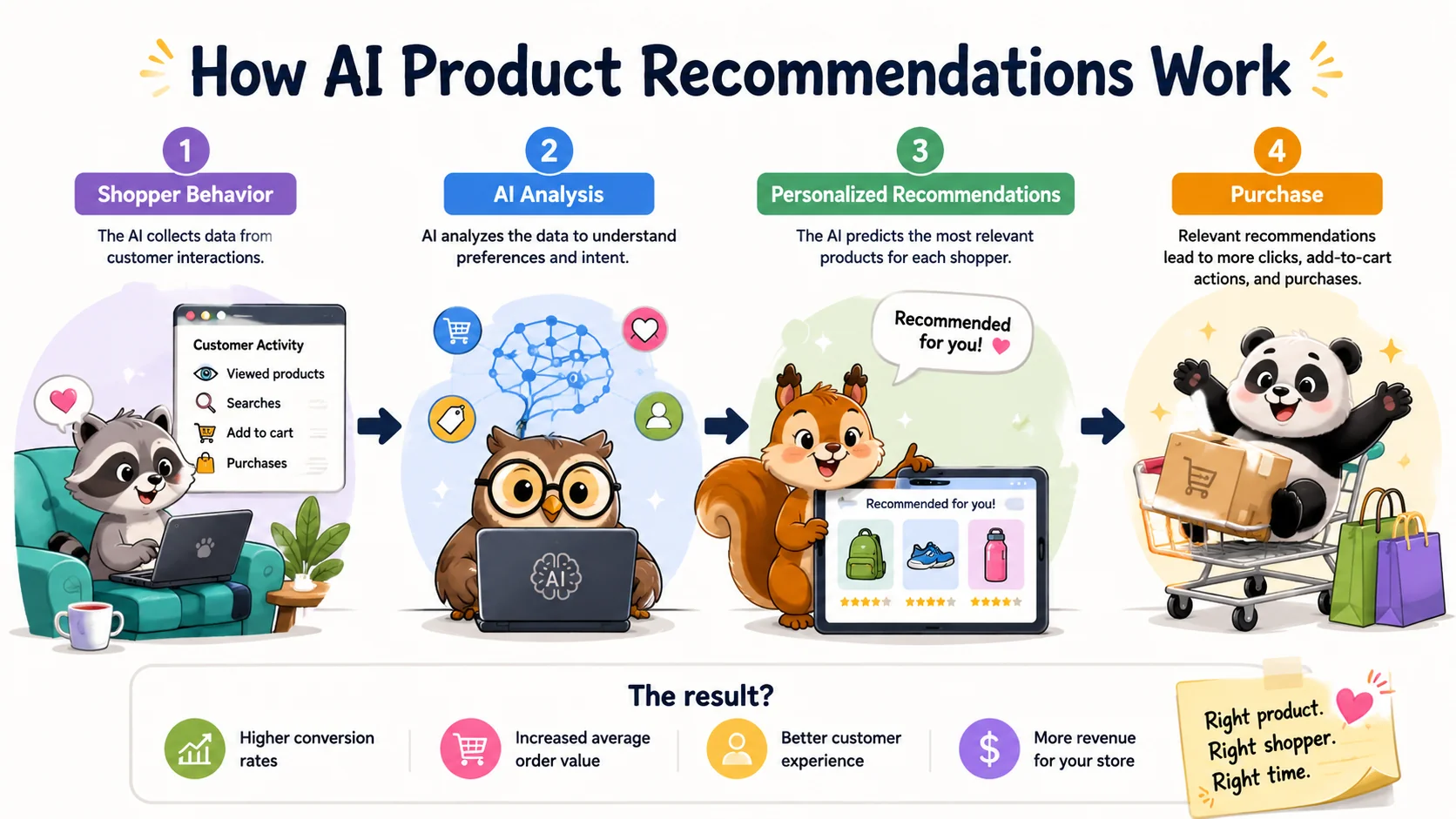
Recommendations may also change during a single shopping session.
A visitor may begin by browsing laptops generally. After viewing several lightweight models and searching for “best laptop for travel,” the system may start prioritizing smaller laptops with longer battery life instead of gaming models or desktop replacements.
Common Recommendation Methods
Different systems may use different methods, and many tools combine several approaches.
- Collaborative filtering recommends products based on the behavior of shoppers with similar interests.
- Content-based recommendations suggest products with attributes similar to items the shopper already viewed or purchased.
- Behavioral recommendations use actions such as searches, clicks, cart additions, and purchases.
- Contextual recommendations consider factors such as location, device, season, or the current page.
- Hybrid systems combine multiple methods to create more balanced recommendations.
- Real-time recommendations adjust suggestions as the shopper interacts with the store.
No single method is automatically best for every ecommerce business.
A large marketplace may have enough customer activity to identify complex behavioral patterns. A smaller store may depend more heavily on product attributes, category relationships, manually defined rules, and real-time session behavior.
The goal is not to make the recommendation system as technically complicated as possible. The goal is to use available data to make product discovery easier and show shoppers options that genuinely match what they are trying to buy.
Why Product Discovery Is Difficult in Ecommerce
Product discovery sounds simple, but in practice it is one of the hardest parts of ecommerce.
A shopper may know exactly what they want, or they may only have a general idea. They may be looking for “a good laptop for travel,” “a gift under $50,” “a moisturizer for sensitive skin,” or “a sofa that fits a small apartment.” The problem is that many online stores still expect customers to navigate large catalogs using categories, filters, and search terms that may not match how people naturally think.
The larger the catalog becomes, the harder this can get.
Shoppers may face:
- too many products with similar names
- unclear category structures
- weak or confusing filters
- poor search results
- products that are difficult to compare
- missing information about size, compatibility, or use case
- too many choices without enough guidance
Baymard Institute’s research on ecommerce findability and discoverability explains that shoppers need both strong search and navigation tools to find products they already know about and discover useful options they did not know existed.
This distinction is important.
Findability is about helping customers locate something specific. Discoverability is about helping them notice products that may be relevant, even if they did not search for them directly.
Traditional ecommerce tools often struggle with both.
A shopper may type “comfortable shoes for standing all day,” but the search engine may only match exact keywords. Another customer may browse a category with hundreds of products and receive little guidance beyond price, color, and brand filters.
That creates decision fatigue.
When customers see too many similar options, they may delay the purchase, open multiple tabs, compare competitors, or leave the site completely. The problem is not always a lack of interest. Sometimes the shopper simply cannot identify the best choice with confidence.
Product discovery becomes even more difficult when the store sells technical or highly personal products.
For example:
- electronics shoppers may need help with compatibility and specifications
- fashion customers may need guidance on size, fit, style, and occasion
- beauty shoppers may need products matched to skin type or concern
- furniture customers may care about room size, materials, and delivery
- gift shoppers may need ideas based on age, budget, and interests
In these cases, filters alone may not be enough.
AI product recommendations can help by interpreting shopper behavior and narrowing the catalog to a smaller set of relevant options. Instead of asking the customer to understand the entire store structure, the system can guide them toward products that match their likely needs.
This is also where recommendations connect with the broader role of an AI shopping assistant. Both technologies aim to reduce the effort required to find, compare, and choose products online.
The easier it is for shoppers to discover relevant products, the less likely they are to feel overwhelmed or leave without buying.
AI Helps Shoppers Find Relevant Products Faster
One of the biggest advantages of AI product recommendations is speed.
Online shoppers do not always want to browse dozens of categories, open multiple product pages, and compare every option manually. In many cases, they want the store to understand what they are looking for and help them narrow down the choices.
AI recommendations can shorten that process.
Instead of asking shoppers to explore the entire catalog, the system can highlight products that are more likely to match their interests, budget, behavior, or current intent.
For example, a shopper looking at several beginner-friendly cameras may start seeing:
- similar cameras in the same price range
- starter bundles with useful accessories
- popular models for new photographers
- alternatives with stronger reviews
- products with faster shipping or better availability
This can reduce the amount of effort required to make a decision.
Google Cloud’s Vertex AI Search for commerce documentation describes how machine learning can support personalized search and recommendation experiences across ecommerce websites and mobile applications.
AI recommendations can also adjust as the shopper provides more signals.
A visitor may begin by viewing several different types of running shoes. After clicking lightweight models, filtering for a specific size, and choosing a lower price range, the recommendation system can begin prioritizing products that match those preferences more closely.
The recommendations become more useful because they respond to what the shopper is doing now, not only to what is generally popular.
This can help in several parts of the shopping journey:
- On the homepage: AI can highlight categories or products based on previous activity.
- On category pages: it can move more relevant products closer to the top.
- In search results: it can prioritize items that better match the shopper’s intent.
- On product pages: it can suggest similar or better-fit alternatives.
- In the cart: it can recommend useful accessories or complementary products.
- In email: it can bring shoppers back with products connected to their browsing or purchase history.
This does not mean shoppers should lose control of the experience.
Good AI recommendations should support browsing, not trap customers inside a narrow set of choices. Shoppers should still be able to search, filter, compare, and explore products outside the recommendation system.
The best recommendations act like shortcuts.
They help customers reach relevant products faster while still allowing them to make the final decision themselves.
For ecommerce stores, this can improve more than convenience. When shoppers find suitable products faster, they are less likely to become frustrated, leave the site, or delay the purchase.
That creates a clearer path from product discovery to add-to-cart and, eventually, to a completed order.
AI Product Recommendations Can Increase Conversion Rates
AI product recommendations can increase conversion rates by helping shoppers find products that better match what they want.
A visitor is more likely to buy when the store quickly presents relevant options instead of making them search through a large catalog alone. The recommendation does not create buying intent from nothing, but it can make the path from interest to purchase much clearer.
For example, imagine that a shopper visits an electronics store looking for a laptop for travel. They may not know the exact model they want, but their behavior provides useful clues. They view lightweight laptops, compare battery life, ignore gaming models, and stay within a specific price range.
An AI recommendation system can use those signals to prioritize products that match the shopper’s likely needs.
Instead of showing random bestsellers, it may recommend:
- lightweight laptops within the shopper’s budget
- models with longer battery life
- similar laptops with stronger customer ratings
- products currently available for fast delivery
- alternatives with better value for the same features
This reduces the effort required to compare products and gives the shopper a smaller, more useful selection.
The same principle can work across many ecommerce categories.
- A beauty store can recommend products based on skin type or concern.
- A fashion store can suggest items based on size, style, season, or occasion.
- A pet store can recommend products based on the animal’s type, size, or age.
- A gift store can suggest products based on budget, recipient, and occasion.
- An electronics store can recommend compatible devices and accessories.
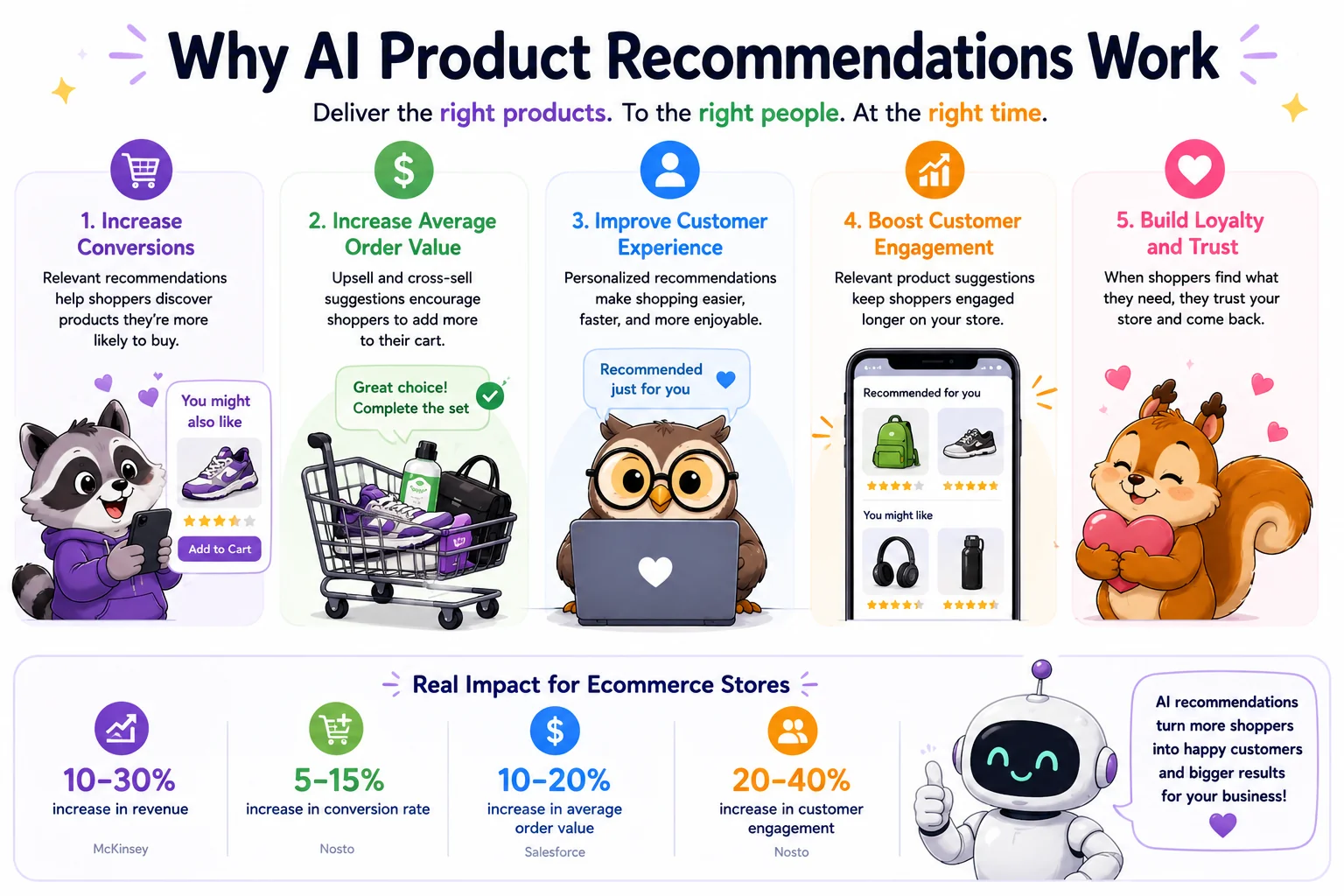
Relevant recommendations can also help shoppers who are interested but uncertain.
A customer may like a product but hesitate because it feels too expensive, has limited reviews, or does not include a feature they need. The recommendation system can show alternatives that solve those concerns before the shopper leaves the store.
Shopify includes a product recommendation conversions report that allows eligible merchants to evaluate how product-page recommendations contribute to clicks, add-to-cart actions, and completed purchases.
This type of measurement is important because not every recommendation improves conversion.
A recommendation may receive many impressions but very few clicks. Another may generate clicks but fail to produce add-to-cart actions. A third may help customers discover products that regularly lead to completed orders.
Store owners should therefore evaluate the full recommendation journey:
- Did the shopper see the recommendation?
- Did they click the recommended product?
- Did they add it to the cart?
- Did they complete the purchase?
Placement also affects conversion performance.
Recommendations on a product page can help customers compare alternatives before making a decision. Recommendations in search results can make product discovery faster. Cart-page recommendations can introduce useful add-ons, although they should not distract the shopper from completing checkout.
The recommendation itself must also match the shopper’s current intent.
If someone is searching for an affordable beginner product, recommending only premium alternatives may create frustration. If a shopper needs an item quickly, suggesting unavailable products or products with long delivery times may reduce confidence.
Good AI recommendations increase conversions by reducing uncertainty, not by applying more pressure.
They help shoppers understand their options, find a better match, and feel more confident about the decision. When recommendations are relevant and placed at the right moment, more visitors can move from browsing to adding a product to the cart and completing the purchase.
AI Recommendations Can Increase Average Order Value
AI product recommendations can increase average order value by helping shoppers discover additional products that make sense with what they are already buying.
Average order value, often shortened to AOV, is the average amount customers spend each time they place an order. Ecommerce stores can increase it by encouraging shoppers to choose a higher-value option, add complementary products, or purchase a useful bundle.
AI makes this process more relevant because it can recommend products based on the shopper’s current cart, browsing behavior, previous purchases, budget, and product preferences.
For example, if a shopper adds a coffee machine to the cart, the recommendation system may suggest:
- coffee beans
- replacement filters
- cleaning tablets
- a milk frother
- a starter bundle with several accessories
These suggestions can increase the total order value while also making the original purchase more useful.
The same strategy can work across many ecommerce categories:
- A laptop can be paired with a mouse, sleeve, docking station, or external drive.
- A camera can be paired with a memory card, tripod, battery, or carrying case.
- A dress can be paired with shoes, jewelry, or a matching bag.
- A skincare product can be paired with a cleanser, sunscreen, or complementary treatment.
- A pet bed can be paired with a blanket, toy, or cleaning product.
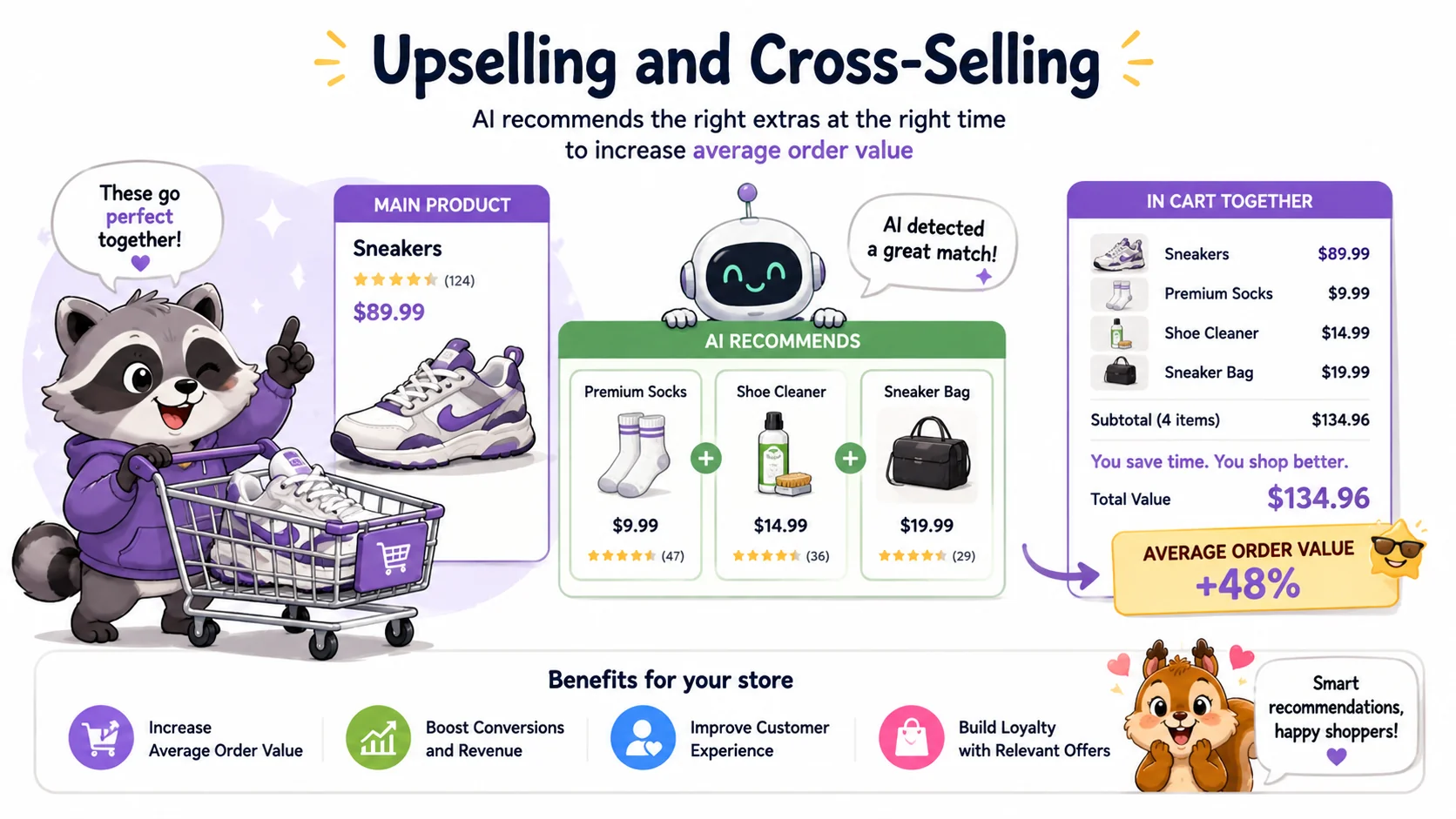
BigCommerce explains that upselling and cross-selling can increase average order value when the offers are relevant and provide real value to the customer.
AI recommendations can support both strategies.
AI-Powered Cross-Selling
Cross-selling means recommending products that complement the item the shopper is already considering.
For example, if the shopper is buying a smartphone, the store may recommend a case, screen protector, or charger. The goal is not to replace the main product but to help the customer complete the purchase with useful additions.
AI can improve cross-selling by identifying which products are frequently purchased together and which combinations are most relevant to a specific shopper.
AI-Powered Upselling
Upselling means recommending a higher-value version of the product the shopper is considering.
For example, a customer viewing a basic laptop may see a model with more storage, better battery life, or a faster processor. A shopper looking at a small skincare set may see a larger bundle with a lower cost per item.
The upsell should have a clear reason behind it.
Simply showing the most expensive option is not enough. The recommendation should explain why the upgraded product may be a better fit, such as better performance, longer durability, additional features, or stronger overall value.
Bundles Can Make Recommendations Feel More Useful
AI can also identify products that work well together and present them as a bundle.
A useful bundle can make the decision easier because the shopper does not have to search for every item separately. It can also make the overall purchase feel like better value.
For example:
- a beginner camera kit with a lens, memory card, and bag
- a home office package with a monitor, keyboard, and webcam
- a complete skincare routine for a specific skin concern
- a travel set with luggage, packing cubes, and a luggage scale
Bundles work best when every item has a clear connection to the shopper’s main goal.
Random add-ons can create distraction and reduce trust. A customer buying running shoes may appreciate socks or a running belt, but an unrelated kitchen product would make little sense.
AI can reduce this problem by ranking recommendations according to compatibility, purchase history, customer behavior, and product relationships.
Timing also matters.
Product-page recommendations can introduce alternatives or upgrades while the shopper is still deciding. Cart-page recommendations can add useful accessories, but they should not interrupt checkout. Post-purchase recommendations can encourage another order without adding friction to the original purchase.
The best AI recommendations increase average order value by helping shoppers build a better order, not by pressuring them to spend more.
When the recommendations are relevant, customers may feel that the store is helping them remember something useful or choose a better solution. That can increase revenue while still improving the shopping experience.
AI Can Personalize Recommendations for Different Shoppers
One of the biggest strengths of AI product recommendations is that they do not have to treat every shopper the same way.
Two customers can visit the same online store, view the same category, and still need completely different recommendations.
One shopper may be looking for the cheapest option. Another may care more about quality, premium features, or fast delivery. A first-time customer may need simple guidance, while a returning customer may already know the brand and want products connected to previous purchases.
AI can use these differences to create more relevant recommendations.
IBM defines AI personalization as the use of artificial intelligence to tailor messages, product recommendations, and services to individual users based on data and behavior.
In ecommerce, personalization may use signals such as:
- previous purchases
- recently viewed products
- search history
- cart contents
- preferred brands
- usual price range
- size or color preferences
- location
- device type
- season or local weather
- customer loyalty status
- current browsing behavior
For example, a shopper who regularly buys affordable skincare products may see recommendations within a similar price range. A different shopper who usually buys premium beauty brands may see higher-end options, bundles, or newly released products.
The same idea applies to fashion.
A customer who repeatedly views neutral colors and minimalist styles should not receive the same recommendations as someone who prefers bright colors, streetwear, or formal clothing. AI can use previous interactions to move more relevant products closer to the shopper.
Personalization can also adapt to the shopper’s level of experience.
A beginner looking for a camera may need a simple model, a starter kit, and clear accessories. An experienced photographer may be more interested in technical specifications, professional lenses, and higher-performance equipment.
Both shoppers are interested in cameras, but their needs are very different.
AI can also personalize recommendations according to buying intent.
Someone browsing casually may see popular products or broad category suggestions. A shopper who repeatedly views the same product, compares alternatives, and adds items to the cart may receive more specific recommendations, such as compatible accessories, better-value bundles, or similar products with stronger reviews.
Location can also affect what is relevant.
A shopper in a cold climate may need different clothing recommendations than someone in a warm region. Product availability, delivery time, regional trends, and local preferences may also influence which products should be shown.
Real-time behavior is especially useful.
A shopper may have purchased premium products in the past but currently search for a budget-friendly gift. The recommendation system should respond to the current session instead of relying only on historical data.
This prevents personalization from becoming too rigid.
However, stores should use customer data carefully.
Personalization should feel useful, not invasive. Customers may appreciate relevant suggestions, but they may feel uncomfortable if the store appears to know too much or uses sensitive information without clear permission.
Good personalization focuses on helping the shopper make a better decision. It uses relevant shopping signals, avoids unnecessary assumptions, and gives customers control over their experience.
When AI recommendations reflect real needs, preferences, and context, the store can feel easier to navigate and more helpful. That can improve customer confidence, increase engagement, and create more opportunities for conversion.
AI Product Recommendations Can Reduce Cart Abandonment
AI product recommendations can also help reduce cart abandonment when shoppers are interested in buying but feel unsure about the product currently in their cart.
A customer may add an item and then hesitate because the price feels too high, the delivery time is too long, the size is unavailable, or the product does not seem like the perfect fit.
In situations like these, repeating the same product may not be enough to recover the sale.
AI can help by showing alternatives that better match the shopper’s needs.
For example, a recommendation system may suggest:
- a lower-priced alternative
- a similar product with stronger reviews
- an item available in the shopper’s preferred size or color
- a product with faster shipping
- a bundle that offers better overall value
- a compatible alternative with the features the shopper needs
This gives the customer another path to purchase.
Instead of treating the abandoned product as the only option, the store can help the shopper find something more suitable before they leave completely.
For example, someone may add a premium pair of headphones to the cart but stop after seeing the final price. AI could recommend a more affordable model with similar features or a bundle that makes the original product feel like better value.
A fashion shopper may abandon a jacket because their size is unavailable. The recommendation system could show similar jackets in stock, products with a comparable fit, or another color that is available for immediate delivery.
A furniture shopper may hesitate because an item will take several weeks to arrive. AI could recommend a similar product with faster delivery or one that is available locally.
BigCommerce notes that relevant product recommendations can support abandoned cart recovery by introducing complementary products, bundles, and upgraded alternatives without overwhelming the shopper. Its guide to abandoned cart emails also emphasizes keeping recommendations useful and limited rather than filling recovery messages with unrelated products.
AI recommendations can be used before and after abandonment.
Before the Shopper Leaves
On the cart page, the store may display a similar product, a lower-priced option, or an alternative that is currently in stock.
This can help when the shopper is still actively deciding and may prevent the cart from being abandoned in the first place.
After the Cart Is Abandoned
In an abandoned cart email, SMS message, or chatbot follow-up, the store can remind the customer about the original item while also showing a small number of relevant alternatives.
This is especially useful when the shopper may have left because the first product was not quite right.
The message could highlight:
- a similar option at a lower price
- a product with better availability
- a bestseller in the same category
- a product that matches the shopper’s recent searches
- a bundle that offers more value
The recommendations should remain focused.
Showing too many products can create more decision fatigue and make the recovery message feel like another catalog page. In most cases, a few carefully selected options are more useful than a long list of suggestions.
AI recommendations should also reflect the likely reason for abandonment.
If price appears to be the concern, a lower-priced alternative may help. If availability is the issue, the store should prioritize products that are in stock. If the shopper appears uncertain about quality, products with strong reviews or better warranties may be more relevant.
This section connects directly with our guide on how AI helps reduce cart abandonment in ecommerce, where we explain how online stores can use AI across checkout support, recovery messaging, timing, and customer behavior analysis.
AI product recommendations cannot recover every abandoned cart. Some shoppers leave because they are not ready to buy, find a better price elsewhere, or become distracted.
However, when the original product is the main source of hesitation, showing a more suitable option can keep the purchase opportunity alive.
Instead of asking the shopper to return to the exact same decision, AI gives them a better reason to continue.
AI Can Improve Upselling Without Being Pushy
Upselling can increase ecommerce revenue, but it can also frustrate shoppers when it feels aggressive or irrelevant.
A customer who is ready to buy a $60 product may not appreciate being pushed toward a $300 alternative without a clear reason. Too many popups, expensive upgrades, and last-minute offers can create pressure and make checkout feel more complicated.
AI can make upselling more useful by recommending upgrades that match the shopper’s actual needs, preferences, and budget.
Instead of automatically displaying the most expensive product, an AI recommendation system can consider signals such as:
- the product currently being viewed
- the shopper’s usual price range
- features they previously compared
- products already added to the cart
- past purchases
- current search behavior
- which upgrades similar customers selected
For example, a shopper viewing a basic laptop may receive a recommendation for a slightly more expensive model with longer battery life and additional storage.
That recommendation can feel helpful if the shopper has already searched for travel laptops, compared storage capacity, or viewed products with stronger battery performance.
The upgrade has a clear purpose.
By comparison, recommending a high-end gaming laptop to the same shopper would probably feel irrelevant, even if it generated more revenue for the store.
Shopify’s guide to ecommerce upselling emphasizes that effective upsells should provide additional value and remain relevant to what the customer is already considering.
Show a Clear Benefit
A good AI-powered upsell should explain why the upgraded product may be worth considering.
The benefit might include:
- better performance
- more storage or capacity
- longer durability
- additional features
- a better warranty
- lower long-term cost
- better value as part of a bundle
For example, a shopper considering a small bottle of a frequently used product may benefit from seeing a larger version with a lower cost per ounce. Someone buying a basic appliance may appreciate an upgraded model with a longer warranty and lower energy use.
The recommendation should make the difference easy to understand.
Keep the Price Increase Reasonable
An upsell is more likely to work when the recommended upgrade remains reasonably close to the shopper’s original budget.
If a customer is looking at a $50 product, suggesting a $65 version with useful additional features may feel realistic. Suggesting a $250 alternative may feel disconnected from their intent.
AI can help estimate price sensitivity by looking at the products the shopper viewed, filters they used, previous purchases, and how they responded to earlier recommendations.
This allows the store to present upgrades that feel achievable rather than excessive.
Use the Right Moment
Timing also affects whether an upsell feels helpful or annoying.
On a product page, an upgrade can help shoppers compare options before making a decision. In the cart, a small and relevant suggestion may increase order value. During checkout, however, too many new choices can distract customers and create unnecessary hesitation.
Post-purchase recommendations can be another useful option.
After the original order is complete, the store may offer an upgrade, complementary service, refill, accessory, or future purchase recommendation without interfering with checkout.
Limit the Number of Recommendations
Showing too many upsells can create decision fatigue.
A shopper who has already chosen a product should not have to compare ten more options before buying. In many cases, one or two carefully selected recommendations are more effective than a large carousel of upgrades.
AI can help rank the available options and display only the suggestions with the strongest connection to the shopper’s needs.
Let the Shopper Say No Easily
Customers should always be able to ignore an upsell and continue with the original purchase.
The recommendation should not block checkout, hide the original option, automatically add products to the cart, or make the shopper feel that the lower-priced choice is inadequate.
A useful upsell gives the customer more information. It does not take away control.
The best AI-powered upselling feels like guidance rather than pressure. It introduces a better option when there is a clear reason, explains the value, respects the shopper’s budget, and allows them to continue without interruption.
When stores follow that approach, upselling can increase average order value while still creating a positive shopping experience.
AI Recommendations Can Improve Customer Experience
AI product recommendations do more than increase sales. When they are relevant and well placed, they can also make an online store easier and more enjoyable to use.
Shopping online can become tiring when customers have to search through hundreds of products, compare many similar options, and repeatedly adjust filters. A good recommendation system reduces some of that effort by guiding shoppers toward products that better match their needs.
This can improve the customer experience in several ways:
- shoppers find relevant products faster
- they see fewer unrelated items
- product comparison becomes easier
- they receive useful alternatives when an item is unsuitable
- they discover accessories or complementary products they may need
- returning customers receive suggestions connected to previous purchases
Salesforce’s guide to ecommerce personalization explains that personalized product recommendations can act like a digital sales assistant by helping customers discover relevant products, complementary items, and useful upgrades.
This digital guidance can make a large ecommerce store feel easier to navigate.
For example, a shopper looking for a gift may not know which product to choose. Instead of forcing the customer to explore every category, the recommendation system could suggest products based on the recipient, occasion, budget, or products viewed during the session.
A returning customer may have a different experience.
If someone previously purchased a coffee machine, the store may later recommend compatible filters, cleaning products, coffee beans, or replacement parts. These suggestions save the customer time because they do not have to search for compatibility manually.
AI recommendations can also help customers compare alternatives.
A shopper viewing an unavailable product may see similar items that are currently in stock. Someone looking at an expensive option may receive a lower-priced alternative with comparable features. A customer viewing a product with a long delivery time may see another option that can arrive sooner.
These recommendations solve practical shopping problems.
They can also make the experience feel more personal without requiring every customer to speak with a human sales representative.
AI chatbots can add another layer of guidance by asking shoppers questions and presenting recommendations through conversation. We explain this broader sales and support role in our guide on how AI chatbots help ecommerce stores sell more.
However, personalization does not automatically create a better experience.
Recommendations can become annoying when they:
- repeat products the shopper has already rejected
- show unavailable items
- ignore the customer’s budget
- recommend incompatible products
- display too many suggestions at once
- interrupt checkout with aggressive popups
- rely on outdated purchase behavior
For example, a customer who purchased a product as a one-time gift should not necessarily receive months of recommendations based on that purchase. The system should pay attention to current behavior instead of assuming that every previous interaction represents a permanent preference.
Stores should also give shoppers control.
Customers should still be able to browse categories, change filters, search freely, and ignore recommendations. AI should make the journey easier, not limit the products customers are allowed to discover.
The most useful recommendations feel like assistance rather than advertising.
They help customers make decisions, reduce unnecessary effort, and provide relevant options at moments when the shopper may need guidance.
When AI recommendations consistently make shopping easier, customers may be more likely to stay on the site, complete their purchase, and return to the store in the future.
Where Ecommerce Stores Can Display AI Recommendations
AI product recommendations can appear throughout the ecommerce journey, not only on product pages.
The best placement depends on what the shopper is doing at that moment. A customer arriving on the homepage needs different guidance from someone comparing a product, reviewing their cart, or returning after a previous purchase.
Recommendations should support the shopper’s next decision without distracting them from the action they are already trying to complete.
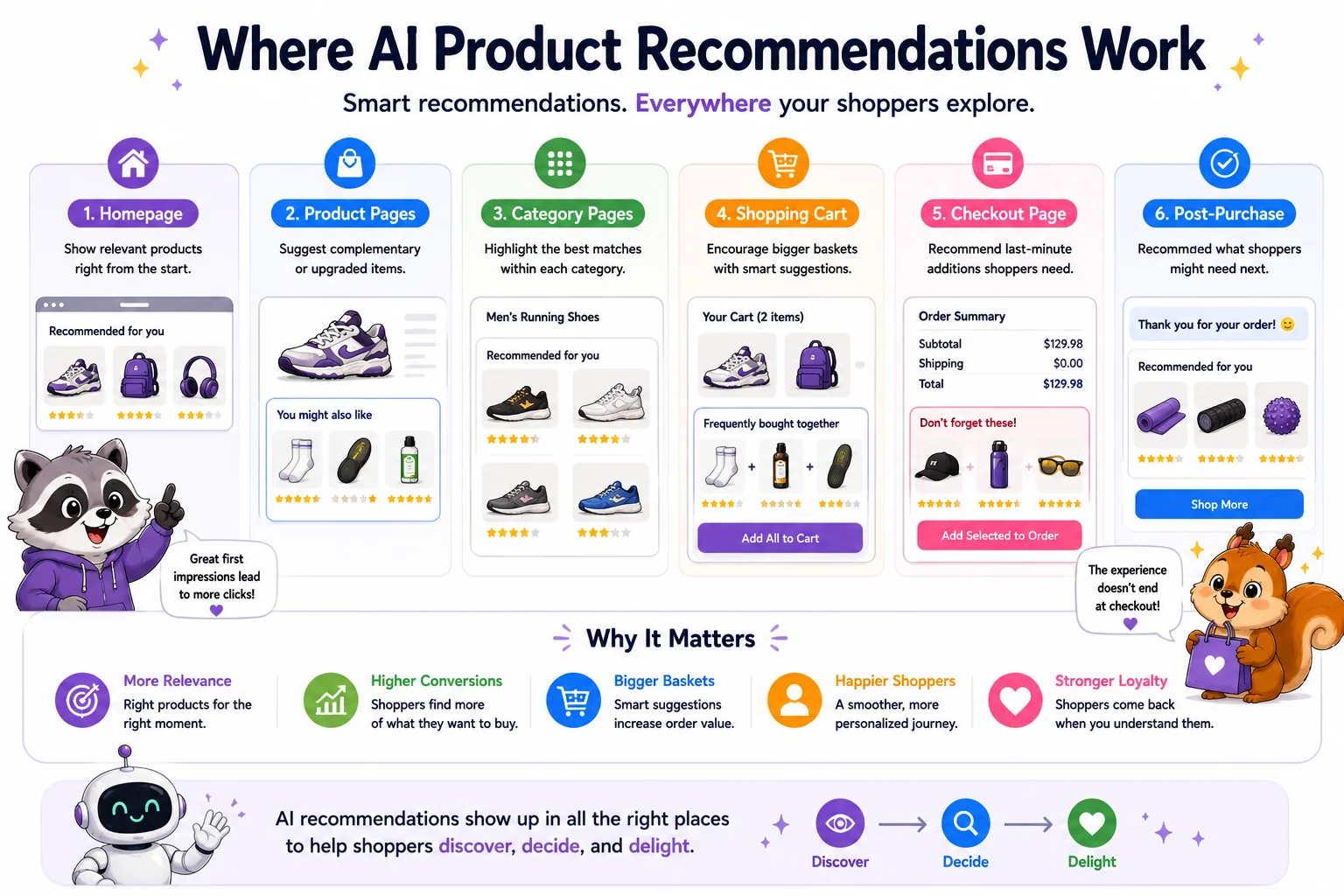
Homepage
The homepage is a useful place for broad, personalized recommendations.
Returning visitors may see products connected to previous browsing or purchases, while new visitors may see bestsellers, trending categories, seasonal products, or recommendations based on their location and referral source.
Examples include:
- Recommended for You
- Continue Shopping
- Popular in Your Area
- New Arrivals You May Like
- Based on Your Recent Activity
Homepage recommendations should remain flexible because shoppers may still be exploring. The goal is to create useful starting points, not immediately narrow the catalog too aggressively.
Category and Collection Pages
AI can personalize the order in which products appear on category or collection pages.
For example, a shopper browsing running shoes may see products ranked according to their preferred size, price range, brand, previous clicks, or intended use.
This can make a large category easier to navigate without removing access to filters and sorting tools.
Useful recommendation formats include:
- Top Picks for You
- Popular in This Category
- Products Matching Your Preferences
- Best Options Within Your Budget
Search Results
Search results are an important recommendation opportunity because they reveal what the shopper is actively trying to find.
AI can use the search query together with browsing behavior, product attributes, availability, and previous interactions to rank more relevant products.
If a shopper searches for “lightweight waterproof jacket,” the system can prioritize products that match those characteristics instead of relying only on exact keyword matches.
Recommendations can also help when a search produces few or no results by showing similar categories, alternative terms, or related products.
Product Pages
Product pages are one of the most common places to display recommendations.
At this stage, the shopper has already shown interest in a specific item. The store can use that context to suggest relevant alternatives, upgrades, accessories, or complementary products.
Common product-page sections include:
- Similar Products
- You May Also Like
- Customers Also Viewed
- Frequently Bought Together
- Complete the Look
- Compare With Similar Items
Shopify allows merchants to add automatically generated or manually selected related product recommendations to product pages through compatible themes and the Shopify Search & Discovery app.
These recommendations should help the shopper make a decision without pulling attention away from the main product.
Shopping Cart
The cart is a strong location for complementary recommendations.
Because the shopper has already selected a product, the store can suggest small additions that improve or complete the order.
Examples include:
- accessories compatible with the main product
- refills or replacement items
- protective cases or warranties
- products that help the shopper qualify for free shipping
- small bundles related to the cart contents
Cart recommendations should be limited and highly relevant. Too many suggestions can distract shoppers and create new hesitation when they are already close to checkout.
Checkout
Checkout recommendations require extra care.
At this stage, the main goal should be helping the customer complete the purchase. Large product carousels, aggressive popups, and complicated upsells may increase friction.
A small, simple offer may still work when it is directly connected to the order. For example, the store might offer gift wrapping, shipping protection, an extended warranty, or one compatible accessory.
The customer should always be able to ignore the recommendation and complete checkout without additional steps.
AI Chatbots and Shopping Assistants
AI chatbots can present recommendations through conversation.
Instead of showing a fixed carousel, the chatbot can ask questions such as:
- What is your budget?
- Who are you buying this for?
- Which features matter most?
- Do you prefer a basic or premium option?
- When do you need the product delivered?
The answers can help the chatbot narrow the catalog and recommend a smaller group of suitable products.
This format can be especially useful for gifts, technical products, beauty routines, fashion, furniture, electronics, and other categories where shoppers need guidance.
Email and SMS
Recommendations can also appear outside the website.
Email recommendations may be based on recent browsing, previous purchases, abandoned carts, seasonal interests, or products that are ready to be reordered.
Examples include:
- products related to a recent purchase
- alternatives to an abandoned item
- personalized new arrivals
- replenishment reminders
- price-drop recommendations
SMS recommendations should be shorter and more selective because customers usually expect text messages to be concise and timely.
Post-Purchase and Thank-You Pages
The shopping journey does not end immediately after payment.
A thank-you page can recommend products that complement the completed order without creating checkout friction.
For example, someone who purchases a camera may see compatible accessories, while a customer buying skincare may receive suggestions for the next step in the routine.
Post-purchase recommendations can also encourage future purchases, subscriptions, refills, or loyalty program participation.
Customer Account Pages
Account dashboards can provide recommendations based on the customer’s purchase history and saved preferences.
This is a useful location for:
- reorder suggestions
- replacement products
- compatible accessories
- recently viewed items
- personalized offers
- subscription upgrades
Because the customer is already logged in, the store may have more reliable data for creating relevant suggestions.
The best recommendation strategy does not display the same products in every location.
Homepage recommendations should support exploration. Product-page recommendations should help comparison. Cart recommendations should complete the order. Post-purchase recommendations should support the next useful action.
Shopify merchants who want to compare recommendation, personalization, automation, and support options can also review our guide to the best AI tools for Shopify store owners.
When recommendations match the shopper’s current stage, they are more likely to feel helpful and less likely to interrupt the buying journey.
Common Types of AI Product Recommendations
AI product recommendations can appear in many different formats.
Some are designed to help shoppers discover products. Others support comparison, cross-selling, repeat purchases, or cart expansion. The best recommendation type depends on where the shopper is in the buying journey and what decision they need to make next.
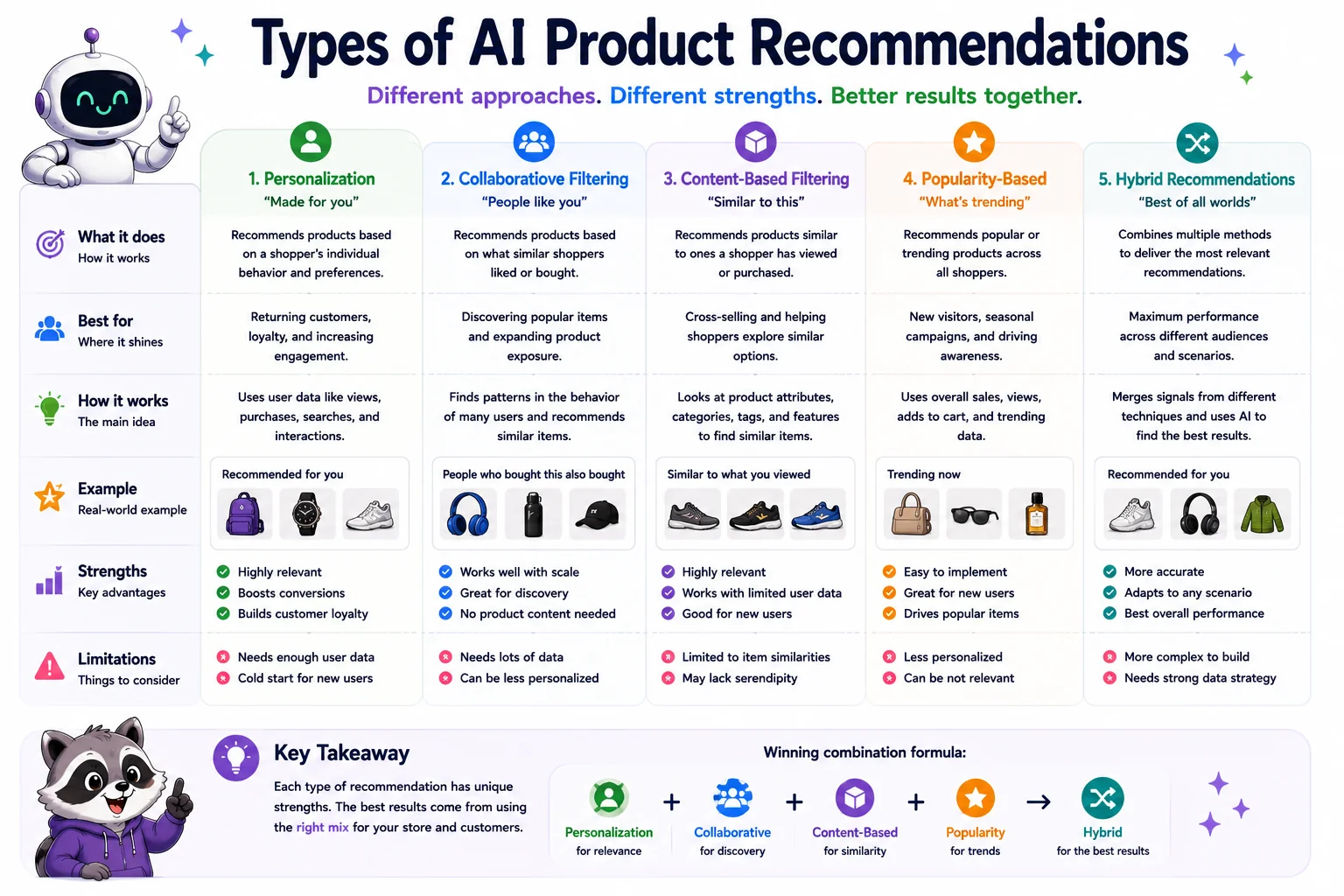
Google Cloud’s documentation for Vertex AI recommendation models includes formats such as Recommended for You, Similar Items, Frequently Bought Together, Buy It Again, and Others You May Like.
Recommended for You
“Recommended for You” sections use customer behavior and preferences to create personalized suggestions.
The system may consider products the shopper viewed, searches they performed, previous purchases, cart activity, favorite categories, and interactions from the current session.
For example, a returning customer who regularly shops for hiking equipment may see waterproof jackets, trail shoes, backpacks, or new products from brands they previously viewed.
This type of recommendation often works well on:
- homepages
- customer account pages
- mobile app home screens
- personalized emails
Similar Products
Similar product recommendations show alternatives related to the item the shopper is currently viewing.
The system may compare characteristics such as category, price, brand, color, material, features, style, size, or customer behavior.
For example, someone viewing a blue upholstered sofa may see other sofas with similar dimensions, materials, colors, and price ranges.
Similar product recommendations are useful when:
- the current product is unavailable
- the shopper wants to compare options
- another product offers better value
- the current item lacks a needed feature
- the shopper may prefer a different style or price
Frequently Bought Together
“Frequently Bought Together” recommendations suggest products that customers commonly purchase in the same order or shopping session.
For example:
- a camera with a memory card and carrying case
- a smartphone with a case and screen protector
- a coffee machine with filters and coffee beans
- a printer with paper and replacement ink
This format is especially useful for cross-selling because it helps shoppers identify accessories or complementary products they may need.
However, the recommendations should be genuinely compatible. A product may be commonly viewed with another item without actually working with it, so stores should still use product data and business rules to prevent incorrect suggestions.
Customers Also Viewed
“Customers Also Viewed” recommendations use browsing patterns from other shoppers.
If many customers who view one product also visit several related products, the system can display those alternatives to future shoppers.
This type of recommendation can support comparison and discovery, especially when customers are still exploring a category.
However, viewed products are not always purchased products. The recommendation may show what people considered, not necessarily what they eventually chose.
Customers Also Bought
“Customers Also Bought” recommendations are based on completed purchases rather than product views.
They can help shoppers discover complementary items, alternatives, refills, accessories, or products popular with similar customers.
For example, customers buying a particular dog food may also purchase treats, storage containers, or supplements. Someone buying a gaming console may also purchase an additional controller or compatible game.
Purchase-based recommendations can be powerful, but stores should avoid assuming that every common combination is appropriate for every customer.
Complete the Look
“Complete the Look” recommendations are common in fashion, beauty, furniture, and home decor.
The system suggests products that work visually or functionally with the main item.
For example:
- a dress with matching shoes and jewelry
- a sofa with a rug, table, and cushions
- a skincare product with other steps in the same routine
- a jacket with trousers and accessories
This format can increase order value while helping shoppers imagine a complete result rather than evaluating each product separately.
Complete the Setup
“Complete the Setup” recommendations are similar to “Complete the Look,” but they are more common for electronics, appliances, tools, and technical products.
The goal is to help customers assemble everything needed to use the main product.
For example, a home office setup may include:
- a laptop
- a monitor
- a keyboard
- a webcam
- a docking station
This can reduce the risk that customers forget an essential accessory or buy an incompatible item elsewhere.
Trending Products
Trending product recommendations highlight items that are currently receiving increased attention, clicks, cart additions, or purchases.
They may be influenced by:
- seasonal demand
- social media activity
- recent sales growth
- regional interest
- current events
- new product launches
Trending recommendations can create discovery and social proof, but they are less personalized than recommendations based on individual shopper behavior.
Recently Viewed
Recently viewed recommendations help shoppers return to products they already explored.
This is useful when customers compare several options, leave the store temporarily, or move between categories during the same session.
Although this format does not always require advanced AI, it can be combined with AI to rank recently viewed products, suggest related alternatives, or highlight items that became more relevant based on later behavior.
Buy It Again
“Buy It Again” recommendations focus on products that customers may need to reorder.
This format is useful for:
- groceries
- pet food
- beauty products
- supplements
- cleaning products
- office supplies
- replacement filters
AI can estimate when the customer may need the product again based on purchase timing, typical usage, package size, and previous reorder behavior.
These recommendations can support repeat purchases and customer retention.
Because You Bought
“Because You Bought” recommendations use a previous purchase as the starting point for new suggestions.
For example, after purchasing a camera, the customer may see lenses, batteries, tripods, editing tools, or photography courses.
This type of recommendation can appear in emails, account pages, post-purchase screens, and future store visits.
On-Sale Recommendations
AI can also recommend discounted products that match the shopper’s interests.
Instead of showing the same sale items to everyone, the system can prioritize discounted products connected to the customer’s preferred categories, brands, sizes, or price range.
This makes promotional recommendations more relevant and may reduce the need for broad, untargeted discount campaigns.
Replenishment Recommendations
Replenishment recommendations predict when a consumable product may be running low.
For example, a store may remind a customer to reorder coffee beans, skincare, pet food, printer ink, or water filters based on previous purchase timing.
This can make repeat shopping more convenient and create predictable revenue for the store.
Each recommendation type serves a different purpose.
“Similar Products” supports comparison. “Frequently Bought Together” supports cross-selling. “Recommended for You” supports personalization. “Buy It Again” supports retention. “Complete the Look” or “Complete the Setup” helps shoppers create a more complete order.
The strongest ecommerce recommendation strategies use the right format for the right moment instead of showing the same carousel everywhere.
Best Ecommerce Stores for AI Product Recommendations
AI product recommendations can benefit many online stores, but they are especially valuable when shoppers have a large number of products to choose from or need help deciding what fits their needs.
The strongest use cases usually appear in stores where customers compare options, return for repeat purchases, buy complementary products, or need guidance before making a decision.
Google Cloud’s Vertex AI Search for commerce documentation explains that recommendation systems can use retail product data and shopper behavior to create use cases such as “Frequently Bought Together” and “Recommended for You.”
Stores With Large Product Catalogs
Large catalogs create more opportunities for personalization, but they also create more confusion.
When a store has hundreds or thousands of products, shoppers may struggle to understand which option is best. AI can narrow the catalog by prioritizing products that match the customer’s behavior, budget, preferences, and current intent.
This is useful for:
- large fashion retailers
- electronics stores
- home and furniture stores
- marketplaces
- multi-brand beauty stores
- large pet supply stores
Fashion and Apparel Stores
Fashion stores are a strong fit because customers often need help with size, fit, color, style, season, and occasion.
AI can recommend:
- similar styles
- matching accessories
- complete outfits
- products in the shopper’s preferred size
- lower-priced alternatives
- items based on previous purchases
Recommendations can also help when a product is out of stock by showing visually or functionally similar alternatives.
Beauty and Skincare Stores
Beauty shoppers often need personalized guidance.
A customer may care about skin type, ingredients, product concerns, routine steps, brand preferences, or sensitivity. AI can use these signals to recommend products that fit a specific routine instead of showing the same bestsellers to everyone.
For example, the system may recommend:
- a cleanser for sensitive skin
- a moisturizer that complements a serum
- a sunscreen for a specific skin type
- a complete routine based on the shopper’s concern
- replenishment products based on purchase timing
Electronics Stores
Electronics stores benefit because shoppers often compare technical specifications, compatibility, performance, price, and accessories.
AI can help recommend:
- compatible accessories
- similar devices within a budget
- better-value alternatives
- starter bundles
- upgraded models with clear additional benefits
- replacement products for unavailable items
Compatibility is especially important. Recommendations should use accurate product data so the store does not suggest accessories that do not work with the main item.
Furniture and Home Decor Stores
Furniture and home decor purchases often involve style, dimensions, color, room type, material, and delivery considerations.
AI can recommend products that complete a room or match the item the customer is already viewing.
For example, someone viewing a sofa may receive suggestions for:
- matching rugs
- coffee tables
- lamps
- cushions
- similar sofas in a smaller size
- products with faster delivery
Pet Stores
Pet stores can personalize recommendations according to animal type, breed, size, age, diet, and previous purchases.
A shopper buying dog food may also need treats, bowls, storage containers, supplements, or grooming products. A customer buying a cat bed may appreciate recommendations based on size, material, or cleaning needs.
Repeat purchasing also makes this category suitable for reorder and replenishment recommendations.
Grocery and Consumable Product Stores
Stores selling products that customers buy repeatedly can use AI to support convenient reordering.
This may include:
- groceries
- coffee
- cleaning products
- office supplies
- personal care products
- replacement filters
AI can estimate when a product may need to be reordered and recommend related items based on previous baskets.
Subscription Stores
Subscription businesses can use recommendations to improve plan selection, add-ons, upgrades, and retention.
For example, AI may recommend:
- a more suitable subscription tier
- additional products in the next box
- refill frequency changes
- products based on customer feedback
- alternatives when a customer skips an item
Gift Stores
Gift shopping often begins with a vague goal rather than a specific product.
A customer may know the recipient, occasion, and budget but still need help choosing. AI can recommend products based on:
- age
- interests
- occasion
- relationship
- budget
- delivery deadline
This can make a large gift catalog feel more like a guided shopping experience.
Marketplaces
Marketplaces have some of the strongest recommendation opportunities because they contain large, diverse catalogs and significant shopper activity.
AI can help customers move between categories, discover related products, compare sellers, and find alternatives that match price, delivery, and review preferences.
However, marketplaces also require strong product data and quality controls. Weak listings, duplicate products, inconsistent categories, and inaccurate attributes can reduce recommendation quality.
Stores With High Repeat Purchase Potential
AI recommendations are particularly useful when customers return regularly.
Past purchases can help the system suggest:
- reorders
- refills
- replacement products
- new products from preferred brands
- accessories for products already owned
- seasonal variations
Stores With Only a Few Products
Very small stores may benefit less from advanced AI recommendation systems.
If a store sells only five or ten simple products, customers may already be able to understand the full catalog quickly. In that situation, manually selected bundles, related products, and clear product comparisons may be enough.
That does not mean recommendations are useless. A small store may still use cross-sells, bundles, or replenishment reminders. However, an expensive AI system may not provide enough additional value to justify the cost.
The best candidates for AI product recommendations are stores where shoppers face meaningful choice.
When customers need help discovering, comparing, combining, or reordering products, AI can make the shopping process faster and more relevant while creating more opportunities for conversion and higher order value.
Features to Look for in an AI Recommendation Tool
Not every AI product recommendation tool offers the same level of personalization, control, or reporting.
Some tools provide only basic “Related Products” widgets. Others can personalize recommendations in real time, support upselling and cross-selling, connect recommendations to email campaigns, and show how much revenue the suggested products generate.
The right option depends on the store’s platform, catalog size, traffic, technical resources, and sales goals.
Before choosing a tool, ecommerce store owners should look closely at the following features.
Real-Time Personalization
A strong recommendation tool should be able to respond to what the shopper is doing during the current session.
For example, if a visitor starts browsing affordable running shoes, selects a specific size, and repeatedly views lightweight models, the recommendations should adapt to those signals.
The system should not rely only on old purchase history or generic bestseller lists.
Real-time personalization can make recommendations more relevant for:
- first-time visitors
- shoppers whose current needs differ from previous purchases
- customers comparing several products
- visitors showing strong interest in a particular category
- shoppers with specific price, size, color, or feature preferences
Product Catalog Integration
The recommendation engine should connect directly to the store’s product catalog.
It should understand important product information such as:
- category
- brand
- price
- size and color
- features and specifications
- inventory status
- compatibility
- product relationships
Without accurate catalog data, the system may recommend irrelevant, unavailable, or incompatible products.
For example, an electronics store should not recommend a charger that does not work with the device in the shopper’s cart. A fashion store should avoid recommending an unavailable size. A furniture store should not suggest products that do not match the shopper’s dimensions or delivery requirements.
Related and Complementary Product Support
The tool should support both related and complementary recommendations.
Related products help shoppers compare alternatives. Complementary products help them complete the purchase with useful accessories, refills, or add-ons.
Shopify’s official documentation explains that merchants can customize related and complementary product recommendations through the Shopify Search & Discovery app.
A useful tool should allow the store to control which recommendation type appears in each part of the shopping journey.
Upselling and Cross-Selling Features
The tool should make it easy to create relevant upsells and cross-sells.
Useful capabilities may include:
- premium product alternatives
- frequently bought together recommendations
- product bundles
- compatible accessories
- volume discounts
- subscription upgrades
- post-purchase offers
The store should also be able to limit how large an upsell can be compared with the shopper’s original product or cart value.
This helps prevent recommendations from becoming unrealistic or overly aggressive.
Manual Rules and Business Controls
AI automation is useful, but store owners should still have control over what is recommended.
The tool should allow merchants to create rules such as:
- exclude out-of-stock products
- exclude low-margin items
- promote specific collections
- prevent incompatible combinations
- limit recommendations to certain price ranges
- prioritize products with faster delivery
- exclude products already in the cart
These rules can prevent the AI system from making recommendations that may be technically related but commercially or practically unsuitable.
Customer Segmentation
A good recommendation tool should support different strategies for different customer groups.
Stores may want to personalize recommendations according to:
- new versus returning customers
- first-time versus repeat buyers
- customer lifetime value
- location
- loyalty status
- purchase history
- preferred category
- average order value
For example, a new customer may receive popular beginner-friendly products, while a loyal customer may see new releases, premium upgrades, or products related to earlier purchases.
Recommendation Widgets and Placement Options
The tool should provide flexible ways to display recommendations across the store.
Useful placement options include:
- homepage
- category pages
- search results
- product pages
- cart page
- checkout
- thank-you page
- customer account pages
- email campaigns
The widgets should also match the design of the store and work properly on mobile devices.
Mobile Optimization
Recommendations that look good on desktop may create problems on a smaller screen.
The tool should use responsive widgets that load quickly, remain easy to scroll, and do not block important buttons or checkout steps.
On mobile, fewer recommendations may work better than a large carousel. Product names, prices, images, and calls to action should remain readable without requiring excessive scrolling.
A/B Testing
Store owners should be able to test different recommendation strategies.
For example, they may compare:
- similar products versus complementary products
- one recommendation versus four recommendations
- recommendations near the product description versus below the reviews
- bundles versus individual accessories
- personalized suggestions versus bestsellers
A/B testing helps determine what actually increases clicks, add-to-cart actions, conversions, and order value.
Without testing, store owners may assume that a recommendation widget is performing well simply because it looks useful.
Analytics and Revenue Attribution
A recommendation tool should show more than impressions and clicks.
Useful reporting may include:
- recommendation click-through rate
- add-to-cart rate from recommended products
- conversion rate
- revenue influenced by recommendations
- average order value
- upsell and cross-sell performance
- performance by recommendation type
- performance by page or placement
Revenue attribution is especially important because it helps store owners understand whether the tool is generating enough additional sales to justify its cost.
Email and Marketing Integration
Recommendations should not necessarily stop when the shopper leaves the website.
A strong tool may connect with email, SMS, customer relationship management, or marketing automation platforms.
This can support:
- personalized promotional emails
- abandoned cart recommendations
- post-purchase cross-sells
- replenishment reminders
- new product recommendations
- win-back campaigns
The recommendations should update automatically when inventory, pricing, or product availability changes.
Platform Compatibility
The recommendation tool should work reliably with the store’s ecommerce platform.
This may include Shopify, WooCommerce, BigCommerce, Adobe Commerce, or a custom ecommerce platform.
Store owners should check:
- how difficult installation is
- whether developer support is required
- how often product data is synchronized
- whether the tool works with the current theme
- whether it supports headless commerce
- whether it integrates with existing analytics and marketing tools
Page Speed and Performance
A recommendation system should not noticeably slow down the website.
Heavy scripts, slow widgets, and delayed product images can damage the shopping experience and reduce conversions.
Store owners should test performance on product pages, category pages, mobile devices, and slower internet connections before launching recommendations across the entire store.
Privacy and Data Controls
AI recommendations often depend on customer behavior and purchase information, so privacy controls matter.
The tool should provide clear information about:
- what customer data it collects
- where data is stored
- how long data is retained
- whether information is shared with third parties
- how customers can manage consent or preferences
- how the tool supports relevant privacy requirements
Personalization should improve the shopping experience without making customers feel watched or uncomfortable.
Pricing That Matches the Store’s Size
Recommendation tools may charge according to traffic, orders, recommendation impressions, revenue, or the number of products in the catalog.
Store owners should compare the total cost with the expected business value.
A powerful enterprise recommendation system may be unnecessary for a small store with limited traffic. At the same time, a very basic tool may not provide enough control or reporting for a large catalog.
The best AI recommendation tool is not necessarily the one with the longest feature list.
It is the one that connects accurately to the store’s catalog, produces relevant suggestions, gives the merchant enough control, works smoothly on mobile, and clearly shows whether recommendations are increasing profitable sales.
Common Mistakes Ecommerce Stores Make With Product Recommendations
AI product recommendations can improve product discovery and increase sales, but poorly configured recommendations can create the opposite result.
Irrelevant products, aggressive upsells, repeated suggestions, and incompatible accessories can make the store feel confusing rather than helpful. The goal is not to fill every available space with another product carousel. The goal is to support the customer’s next decision.
Here are some of the most common mistakes ecommerce stores should avoid.
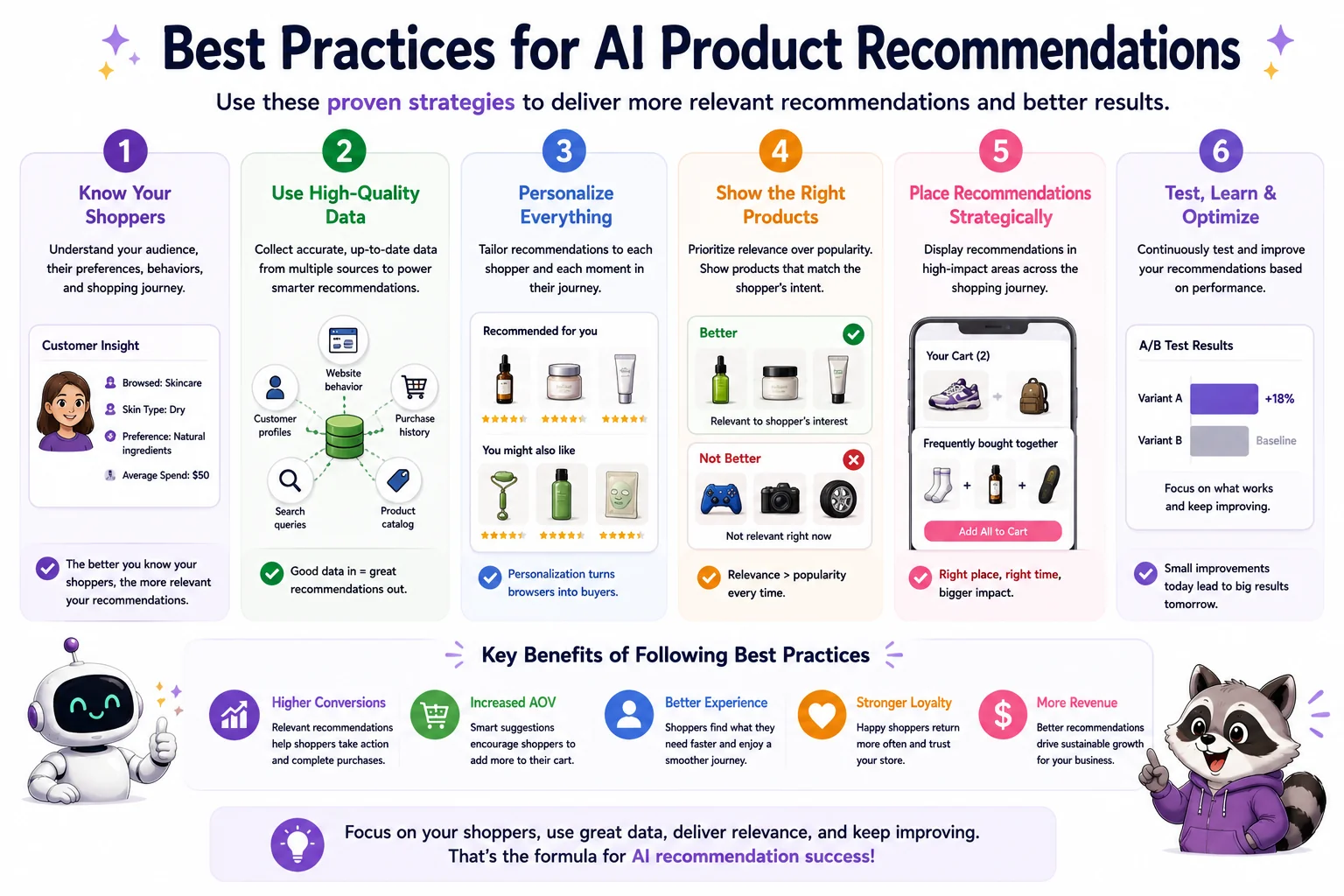
Showing Irrelevant Recommendations
The biggest mistake is recommending products that have little connection to what the shopper is viewing or trying to buy.
For example, someone shopping for running shoes should not receive suggestions for unrelated kitchen appliances. A customer viewing an entry-level laptop may not benefit from recommendations for expensive professional equipment.
Irrelevant recommendations can happen when the system relies too heavily on general popularity instead of considering:
- the product currently being viewed
- the shopper’s recent searches
- their preferred price range
- cart contents
- product compatibility
- inventory availability
- current session behavior
Recommendations should have a clear reason for appearing.
Displaying Too Many Recommended Products
More recommendations do not automatically create more sales.
A long carousel with twenty products can recreate the same problem the recommendation system is supposed to solve: too much choice.
Baymard Institute’s research on cross-selling recommendations in the cart advises stores to focus on relevance and context instead of filling recommendation areas with a fixed number of products.
In many cases, a few carefully selected suggestions are more useful than a large list.
The store should prioritize the products with the strongest connection to the shopper’s needs and allow customers to continue without unnecessary distraction.
Showing the Same Recommendations to Everyone
A recommendation section may use AI technology and still provide a generic experience.
If every visitor sees the same bestsellers, the system is not making much use of individual intent or behavior.
New visitors, returning customers, loyal buyers, gift shoppers, and price-sensitive customers may all need different suggestions.
Even basic personalization can improve relevance by considering:
- recently viewed products
- current category
- purchase history
- preferred brands
- usual budget
- location
- current cart
Recommending Out-of-Stock Products
Shoppers should not be guided toward products they cannot purchase.
If a recommendation repeatedly leads to an unavailable item, it wastes the customer’s time and reduces confidence in the store.
The recommendation tool should receive updated inventory information and automatically remove or deprioritize unavailable products.
When an out-of-stock product is relevant, the store may instead recommend:
- a similar item currently available
- another size or color
- a product with comparable features
- an option with faster delivery
- a restock notification
Recommending Incompatible Products
Compatibility mistakes are particularly damaging for electronics, auto parts, appliances, tools, furniture components, and replacement products.
A recommendation may look related but still be unusable with the main product.
For example, a store should not recommend:
- a phone case made for a different model
- a charger with the wrong connector
- a replacement part with incorrect dimensions
- a lens that does not fit the selected camera
- a filter designed for another appliance
Stores selling compatibility-dependent products should combine AI recommendations with accurate product attributes and merchant-defined rules.
Ignoring the Shopper’s Budget
Recommendations should respect the customer’s likely price range.
If someone repeatedly views products under $100, showing only $500 alternatives may feel disconnected from their needs.
An upsell can cost more than the original product, but the price increase should be reasonable and supported by a clear benefit.
The store can also offer several paths:
- a similar option at the same price
- a cheaper alternative
- a modest upgrade
- a bundle with better overall value
Using Aggressive Popups and Interruptions
Recommendations should not block the customer from reading product information or completing checkout.
Repeated popups, countdown timers, forced bundles, and full-screen upsells can make the store feel pushy.
This is especially risky on mobile devices, where recommendation widgets can cover important content or buttons.
A shopper who has already chosen a product should be able to continue without being forced to reject several additional offers.
Automatically Adding Recommended Items to the Cart
Products should not be added to the customer’s cart without clear permission.
Automatic additions can create confusion about the total price and damage trust. Even when an accessory is useful, the shopper should actively choose to add it.
Recommended products should have clear prices, descriptions, and add-to-cart buttons so the customer remains in control.
Repeating Products the Shopper Already Rejected
If a shopper repeatedly ignores, removes, or dismisses a recommendation, the system should learn from that behavior.
Continuing to show the same product can make personalization feel inaccurate.
The recommendation engine should consider negative signals such as:
- removing a product from the cart
- repeatedly ignoring a recommendation
- returning a previously purchased product
- selecting a different price range
- choosing another brand or product type
However, stores should interpret these signals carefully. Removing an item once does not always mean the customer never wants to see it again.
Using Outdated Customer Behavior
Past purchases can be useful, but they do not always represent the shopper’s current needs.
A customer may purchase a baby product as a gift, furniture for a temporary project, or electronics for another person. The store should not assume that one purchase defines the customer permanently.
Real-time activity should help balance historical data.
If current behavior clearly points toward a new category, budget, or use case, the recommendations should adapt.
Placing Recommendations at the Wrong Moment
A useful recommendation can still perform poorly when it appears in the wrong location.
For example:
- similar products may help on a product page
- small accessories may work in the cart
- large alternative purchases may distract during checkout
- replenishment reminders may work better after purchase
The recommendation should match the decision the shopper is making at that stage.
Ignoring Mobile Experience
Recommendation widgets should be tested carefully on smartphones.
A carousel that looks clean on desktop may be difficult to swipe, slow to load, or too large on mobile.
Store owners should check:
- whether product images load quickly
- whether titles and prices remain readable
- whether buttons are easy to tap
- whether the widget covers important page content
- whether shoppers can dismiss recommendations easily
Failing to Explain the Recommendation
Labels help shoppers understand why products are being shown.
A vague section titled “You May Like” may be less useful than a specific label such as:
- Compatible With Your Camera
- Similar Options Under $100
- Frequently Bought With This Product
- Complete Your Skincare Routine
- Available in Your Size
A clear explanation gives the recommendation context and can make it easier for customers to evaluate.
Not Testing Recommendation Performance
Store owners should not assume that a recommendation is effective just because customers can see it.
Different formats, placements, labels, and product combinations should be tested.
A store may discover that:
- three recommendations perform better than eight
- compatible accessories outperform premium upgrades
- personalized products perform better than general bestsellers
- post-purchase offers work better than checkout upsells
- recommendations improve desktop sales but create mobile friction
Measuring Clicks Without Measuring Sales
High recommendation click-through rates do not necessarily mean the tool is increasing revenue.
Customers may click products without adding them to the cart or completing a purchase.
Stores should connect recommendation activity to:
- add-to-cart actions
- conversion rate
- average order value
- revenue from recommended products
- profit margin
- repeat purchases
The best recommendation strategy is not the one that displays the most products or generates the most clicks.
It is the one that helps shoppers make better decisions while contributing to profitable sales.
When stores focus on relevance, compatibility, timing, customer control, and measurement, AI recommendations are more likely to feel like useful shopping assistance instead of another form of advertising.
How to Measure Whether AI Recommendations Increase Sales
AI product recommendations should be measured like any other ecommerce investment.
A recommendation widget may look impressive and receive many views, but that does not automatically mean it is increasing sales. Store owners need to track what happens after shoppers see and interact with the recommended products.
The goal is not simply to generate more clicks.
The real goal is to help shoppers find better products, add more relevant items to the cart, complete purchases, and create profitable revenue for the store.
Google Analytics explains that ecommerce reporting can track product views, add-to-cart activity, purchases, and item revenue. Its guide to ecommerce metrics shows how store owners can evaluate product performance across different stages of the shopping journey.
Recommendation Impressions
Recommendation impressions show how many times shoppers were shown a recommended product or recommendation widget.
This is a useful starting point because it tells the store how much exposure the recommendations receive.
However, impressions alone do not show whether the recommendations are useful. A widget may receive thousands of impressions simply because it appears on a popular product page.
Recommendation Click-Through Rate
Recommendation click-through rate measures how often shoppers click a recommended product after seeing it.
The basic formula is:
Recommendation clicks ÷ recommendation impressions × 100
A higher click-through rate may suggest that the products, placement, and labels are relevant to shoppers.
A low rate may indicate problems such as:
- irrelevant recommendations
- poor placement
- weak product images
- unclear recommendation labels
- too many products displayed
- slow-loading widgets
Click-through rate is useful, but it should not be evaluated alone. A recommendation may attract curiosity without producing a sale.
Add-to-Cart Rate From Recommendations
This metric shows how many shoppers add a recommended product to their cart after clicking or viewing it.
It provides a stronger buying signal than a click.
If shoppers regularly click recommendations but rarely add the products to their carts, the recommendation may look interesting but fail to match their real needs, budget, or expectations.
Conversion Rate From Recommended Products
Conversion rate measures how many shoppers purchase a product after interacting with a recommendation.
Stores can compare:
- the conversion rate of shoppers who use recommendations
- the conversion rate of shoppers who do not interact with recommendations
- conversion rates for different recommendation types
- conversion rates by page placement
For example, “Frequently Bought Together” recommendations may perform better in the cart, while “Similar Products” may generate more conversions on product pages.
These comparisons can help the store understand which recommendation strategy works best at each stage of the journey.
Revenue From Recommended Products
Store owners should track how much revenue comes directly or indirectly from recommended products.
This may include:
- revenue from products clicked through a recommendation widget
- revenue from recommended accessories
- revenue from upsells
- revenue from bundles
- revenue influenced by personalized emails
- post-purchase recommendation revenue
Revenue attribution rules should be clear.
Some tools may count an order as recommendation-influenced even when the shopper interacted with the recommendation long before purchasing. Store owners should understand how the platform defines attributed revenue before comparing results.
Average Order Value
Average order value shows how much customers spend per completed order.
The basic formula is:
Total revenue ÷ number of orders
If recommendations are successfully supporting upselling, cross-selling, and bundles, the average order value may increase.
However, the store should also check whether the recommendations are improving profit, not only order totals.
A higher order value created through large discounts or low-margin products may not be as valuable as it appears.
Revenue Per Visitor
Revenue per visitor combines traffic and revenue into one useful metric.
The basic formula is:
Total revenue ÷ number of visitors
This can help store owners understand whether recommendations are generating more value from the traffic they already have.
If average order value increases but conversion rate falls, revenue per visitor may reveal whether the overall result is still positive.
Upsell Conversion Rate
Upsell conversion rate measures how often shoppers accept a recommended upgrade.
For example, a store may show a premium version of a product to 1,000 shoppers. If 50 choose the upgraded option, the upsell conversion rate is 5%.
Stores should compare the additional revenue with any effect on overall conversion.
An aggressive upsell may increase the value of some orders while causing other shoppers to leave.
Cross-Sell Conversion Rate
Cross-sell conversion rate measures how often shoppers purchase a complementary recommended product.
This is useful for evaluating accessories, refills, bundles, and “Frequently Bought Together” sections.
Stores can also compare which complementary products generate the most revenue and which are frequently ignored.
Cart Abandonment Rate
Recommendations can sometimes reduce cart abandonment by helping shoppers find a more suitable product, a lower-priced alternative, or a useful bundle.
However, recommendations can also increase abandonment if they create distraction near checkout.
Store owners should compare cart abandonment before and after adding recommendation widgets, especially on cart and checkout pages.
If abandonment rises, the store may need to reduce the number of recommendations, change the placement, or move the offers to a post-purchase page.
Repeat Purchase Rate
AI recommendations may also influence long-term customer behavior.
Repeat purchase rate shows how many customers return and buy again during a defined period.
Reorder suggestions, replenishment reminders, compatible accessories, and personalized new arrivals may encourage customers to return.
This is especially important for stores selling consumable products, subscriptions, beauty products, pet supplies, groceries, and replacement items.
Customer Lifetime Value
Customer lifetime value estimates how much revenue or profit a customer may generate over the full relationship with the store.
AI recommendations can potentially improve lifetime value by supporting:
- repeat purchases
- larger orders
- replenishment
- subscription upgrades
- cross-category discovery
- customer retention
This metric takes longer to evaluate than clicks or conversions, but it can reveal whether personalization is creating stronger customer relationships.
Return and Refund Rate
More sales do not always mean better recommendations.
If recommended products have a high return or refund rate, the system may be encouraging purchases that do not fit the customer’s needs.
Stores should monitor whether recommended products are returned more often than products customers discover independently.
This is particularly important for fashion, electronics, furniture, compatibility-dependent accessories, and products with personal fit requirements.
Profit Margin
Recommendation performance should be measured using profit as well as revenue.
A recommendation engine may generate large sales numbers by promoting discounted or low-margin products. The store should examine:
- gross profit from recommended products
- discount costs
- shipping costs
- return costs
- software fees
- implementation and management costs
This helps determine whether the recommendation strategy is producing profitable growth.
A/B Test Results
A/B testing is one of the best ways to understand whether AI recommendations are improving performance.
For example, the store can compare:
- pages with recommendations versus pages without them
- personalized recommendations versus bestsellers
- three products versus eight products
- similar items versus complementary items
- cart recommendations versus post-purchase recommendations
The test should run long enough to collect meaningful data and should avoid changing several unrelated elements at the same time.
Performance by Device
Recommendation results may differ between desktop and mobile shoppers.
A widget that performs well on a large screen may create too much scrolling or load too slowly on a smartphone.
Store owners should compare:
- click-through rate by device
- add-to-cart rate by device
- conversion rate by device
- page speed
- cart abandonment
Performance by Placement
The same recommendation may perform differently depending on where it appears.
Store owners should evaluate homepage, category, search, product page, cart, checkout, email, and post-purchase recommendations separately.
This can reveal where recommendations help and where they create friction.
Customer Feedback
Quantitative metrics should be combined with customer feedback.
Store owners can review:
- customer surveys
- chat transcripts
- product reviews
- support tickets
- complaints about irrelevant suggestions
- feedback about product compatibility
Customers may identify recommendation problems that are not obvious in analytics alone.
The best way to measure AI product recommendations is to look at the full picture.
Clicks show interest. Add-to-cart actions show stronger intent. Purchases show conversion. Average order value and revenue show financial impact. Returns, margins, and customer feedback show whether those sales are actually healthy for the business.
A successful recommendation system should make it easier for shoppers to find and buy suitable products while generating measurable, profitable value for the store.
What AI Product Recommendations Cannot Fix
AI product recommendations can improve product discovery, personalization, conversion rates, and average order value. However, they cannot repair every problem inside an ecommerce store.
This is important because some businesses expect recommendation software to compensate for weak product pages, poor pricing, low traffic, or a difficult checkout experience.
AI can help shoppers find products, but it cannot make a bad product more appealing or a confusing store easier to trust.
Poor Product Quality
A recommendation system can bring more attention to a product, but it cannot fix weak quality.
If customers regularly complain, return the item, or leave negative reviews, increasing product visibility may create more sales temporarily but also more refunds and dissatisfaction.
The store still needs products that meet customer expectations.
Weak Product Pages
AI recommendations cannot replace clear product information.
Customers still need accurate descriptions, useful images, specifications, sizing information, compatibility details, delivery estimates, and return policies before they can make a confident decision.
Baymard Institute’s research on ecommerce product-page usability shows that shoppers may abandon otherwise suitable products because of product-page UX problems that could have been resolved.
If a recommended product has poor images or an incomplete description, the customer may click it but still leave without buying.
Uncompetitive Pricing
AI can recommend a product that matches the shopper’s interests, but it cannot make an obviously uncompetitive price attractive.
The system may highlight value, suggest a bundle, or show a lower-priced alternative. However, if the same item is widely available elsewhere at a much better price, many customers will continue comparing stores.
Recommendation technology should support a sensible pricing strategy, not replace one.
Low Website Traffic
AI recommendations cannot create meaningful sales if the store has almost no visitors.
A recommendation engine can help make better use of existing traffic, but it cannot replace customer acquisition, search visibility, advertising, partnerships, or brand awareness.
Stores with limited traffic may also have less behavioral data available for personalization.
In that situation, manually selected related products, bundles, and category-based recommendations may be more practical until the store grows.
A Poorly Organized Product Catalog
Recommendation quality depends heavily on product data.
If categories are inconsistent, attributes are missing, product titles are unclear, or compatibility information is incorrect, the system may struggle to understand how products relate to one another.
This can lead to recommendations that are:
- irrelevant
- incompatible
- poorly matched by price
- out of stock
- based on incomplete product information
Before investing heavily in AI recommendations, stores should clean and organize their catalog data.
A Slow Website
Recommendations cannot compensate for poor site performance.
If product pages load slowly, buttons do not respond, or recommendation widgets add heavy scripts, shoppers may leave before interacting with the suggested products.
The recommendation system itself should also be tested for speed, especially on mobile devices and slower connections.
A Confusing Checkout Process
AI may help shoppers add more relevant products to the cart, but it cannot guarantee that they will complete checkout.
If checkout requires too many steps, forces account creation, hides shipping costs, or produces payment errors, the store may still lose the sale.
Recommendations should work alongside a clear and reliable checkout process.
Lack of Customer Trust
Personalized recommendations may make a store feel more helpful, but they cannot fully repair a lack of trust.
Customers may still hesitate if the store has:
- few or suspicious reviews
- unclear contact information
- hidden return policies
- weak payment security signals
- unrealistic product claims
- poor customer service
The store must build trust through transparency, reliable service, clear policies, and consistent customer experiences.
Weak Demand for the Product
AI cannot create strong demand for a product that customers do not want.
If shoppers consistently ignore a product, the issue may be weak demand, poor positioning, the wrong audience, or an unattractive offer.
Recommending that product more frequently may not solve the underlying problem.
In fact, it may reduce recommendation quality by showing shoppers items they repeatedly reject.
Insufficient Data
Advanced recommendation systems usually improve when they receive enough product and customer interaction data.
A new or very small store may not have enough purchases, clicks, searches, and cart activity to identify reliable patterns.
This is sometimes called the cold-start problem.
Stores with limited data can begin with:
- product attribute matching
- manually selected related products
- category-based recommendations
- popular products
- simple bundles
- current-session behavior
The recommendation strategy can become more sophisticated as more customer activity becomes available.
Bad Business Decisions
AI recommendations should not be allowed to make every merchandising decision automatically.
The system may identify patterns, but store owners still need to consider margins, inventory, brand positioning, seasonality, supplier relationships, and customer expectations.
For example, the tool may repeatedly promote a popular product with very low margins or recommend inventory the business does not want to prioritize.
Merchant controls and business rules remain important.
Privacy Problems
AI cannot fix weak privacy practices.
If a store collects customer data without clear consent, uses it in unexpected ways, or fails to protect it properly, personalization may damage trust.
Customers should understand how their data is being used, and recommendation tools should support appropriate privacy and consent controls.
Poor Customer Service
A customer may buy a recommended product and still need help after the purchase.
If support is slow, returns are difficult, or problems are handled poorly, a good recommendation experience will not create long-term loyalty.
Recommendations are only one part of the customer journey.
The store still needs reliable order fulfillment, communication, returns, and support.
AI product recommendations work best as an optimization layer.
They can help shoppers discover relevant products, compare options, build better carts, and return for future purchases. But they cannot replace good products, clear information, competitive pricing, a fast website, smooth checkout, or trustworthy customer service.
When the ecommerce foundation is strong, AI recommendations can improve it. When the foundation is weak, the store should fix those problems before expecting recommendation technology to deliver major results.
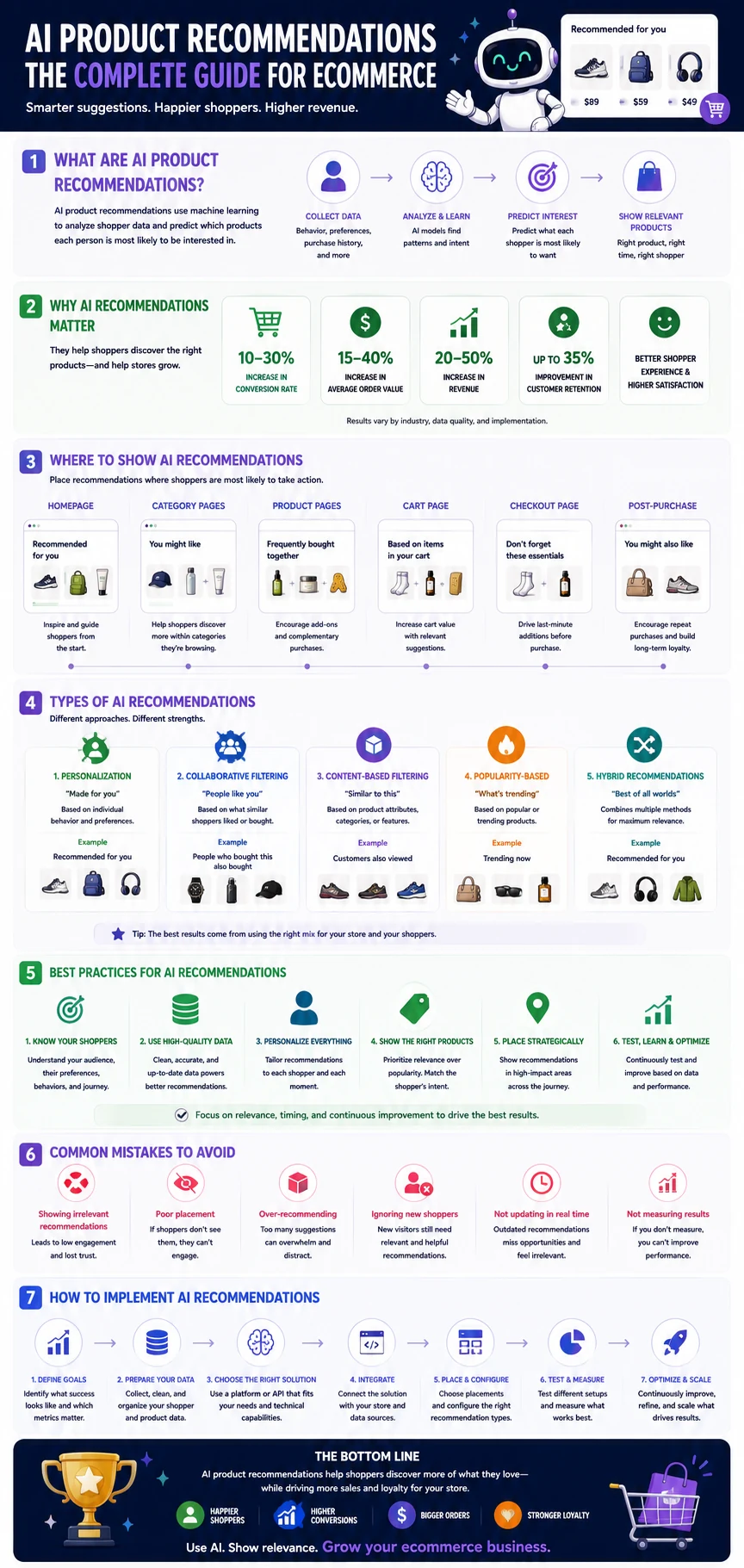
Are AI Product Recommendations Worth It?
AI product recommendations can be worth using when they solve a real product discovery problem and generate enough additional value to justify their cost.
They are not automatically useful for every ecommerce store.
A store with thousands of products, steady traffic, repeat customers, and strong opportunities for cross-selling may gain significant value from personalized recommendations. A small store with eight simple products and limited traffic may not need an advanced recommendation engine yet.
The decision should depend on the store’s catalog, customer behavior, available data, and business goals.
When AI Recommendations Are Usually Worth Testing
AI product recommendations are often worth testing when the store has:
- a medium or large product catalog
- steady website traffic
- customers who compare several products before buying
- frequent repeat purchases
- opportunities for upselling and cross-selling
- products that require accessories or compatible items
- enough customer activity to support personalization
- a clear way to measure recommendation-generated revenue
In these situations, recommendations can help shoppers navigate the catalog, discover suitable products, build more complete orders, and return for future purchases.
Shopify’s guide to AI recommendation systems recommends starting with focused placements, such as product or cart pages, and measuring performance through metrics such as click-through rate, conversion rate, and average order value.
Large Catalogs Create More Recommendation Opportunities
The larger the product catalog, the more difficult it becomes for shoppers to evaluate every option manually.
AI can help narrow the selection based on product attributes, shopper behavior, current intent, availability, and price preferences.
For example, a fashion store with thousands of products can recommend items according to size, color, preferred style, season, and purchase history. An electronics retailer can prioritize compatible accessories and comparable models within the customer’s budget.
When customers face meaningful choice, AI can make product discovery faster and easier.
Repeat Purchases Can Increase the Value of AI
Stores with repeat purchase behavior may benefit from recommendations based on previous orders.
This can include:
- reorder reminders
- replacement products
- refills and replenishment
- compatible accessories
- new products from preferred brands
- upgrades connected to earlier purchases
A pet store, beauty retailer, grocery business, subscription store, or office supply shop may have more opportunities for this type of personalization than a business selling products customers purchase only once.
AI Can Be Valuable When Average Order Value Matters
Recommendation tools can also be useful when the store has strong opportunities to increase average order value.
If customers frequently need accessories, bundles, upgrades, warranties, or complementary products, AI can help identify which additions are most relevant.
For example, someone purchasing a camera may also need a memory card and carrying case. A customer buying a coffee machine may need filters, beans, and cleaning supplies.
Relevant additions can increase the order value while also making the purchase more complete.
AI May Not Be Worth It for Very Small Stores
A small catalog does not always require advanced personalization.
If customers can understand the entire product range quickly, manually selected related products and bundles may work just as well.
For example, a store selling six handmade products may be able to define useful relationships manually:
- pair one product with a matching accessory
- create a starter bundle
- recommend a refill
- show a premium version
In this situation, an expensive AI platform may add unnecessary complexity.
Low Traffic Can Limit Recommendation Quality
Recommendation systems usually improve when they receive enough interaction data.
A store with very little traffic may not have enough searches, product views, cart additions, and purchases to identify reliable behavioral patterns.
That does not make recommendations impossible. The store can begin with product attributes, manually selected relationships, bestsellers, category-based suggestions, and current-session behavior.
More advanced personalization can be added as traffic and customer data grow.
The Store Should Fix Basic Problems First
AI recommendations should not be the first priority when the store has serious foundational problems.
Before investing in advanced recommendation technology, store owners should make sure they have:
- clear product descriptions
- high-quality product images
- accurate product attributes
- competitive pricing
- a fast mobile experience
- a reliable checkout process
- clear shipping and return information
- enough traffic to measure results
A recommendation system may bring shoppers to a product page, but it cannot complete the sale if the page does not provide enough information or the checkout process creates friction.
Start With One Clear Use Case
Stores do not need to launch personalized recommendations across every page at once.
A better approach is to start with one specific goal.
For example:
- Use similar product recommendations to improve product comparison.
- Use complementary products to increase average order value.
- Use alternatives to support out-of-stock product pages.
- Use reorder recommendations to encourage repeat purchases.
- Use personalized emails to bring previous customers back.
Starting with one use case makes performance easier to measure.
If the first test produces useful results, the store can gradually expand recommendations to additional pages, channels, and customer segments.
Measure Profit, Not Only Revenue
The value of an AI recommendation tool should be measured against its total cost.
Store owners should consider:
- software subscription fees
- implementation costs
- developer or agency work
- staff time
- discount costs
- additional return costs
- profit generated by recommended products
A tool that reports substantial influenced revenue may still provide limited value if it promotes low-margin products, depends on heavy discounts, or increases returns.
The most useful question is not simply, “How much revenue did the recommendations touch?”
The better question is, “How much additional profitable revenue did the recommendations create?”
Use a Controlled Test
Before committing to a long contract or expensive implementation, stores should run a limited test where possible.
The test can compare:
- pages with recommendations against pages without them
- personalized products against general bestsellers
- different recommendation formats
- different page placements
- performance on mobile and desktop
The store should track clicks, add-to-cart actions, conversion rate, average order value, profit margin, returns, and customer feedback.
This helps separate real business value from attractive dashboards and marketing claims.
The Final Decision
AI product recommendations are usually worth considering when shoppers need help navigating the catalog and the store has enough activity to measure the result.
They can increase sales by helping customers find suitable products, compare alternatives, add complementary items, and return for repeat purchases.
However, the technology should match the size and maturity of the business.
Small stores may begin with simple manually controlled recommendations. Growing stores can test personalized widgets and automated campaigns. Large retailers may benefit from advanced real-time systems across websites, apps, email, and customer accounts.
The best approach is to start with a clear goal, test the recommendation strategy, and expand only when the results show measurable and profitable improvement.
Conclusion
AI product recommendations can help ecommerce stores increase sales by making product discovery faster, more relevant, and less overwhelming.
Online shoppers often face large catalogs, similar products, unclear differences, and too many choices. Even when customers are interested in buying, they may leave because they cannot confidently decide which product is right for them.
AI recommendations can reduce that friction.
By analyzing signals such as browsing behavior, searches, cart activity, previous purchases, product preferences, and real-time interactions, recommendation systems can show shoppers products that better match their needs.
When used well, AI product recommendations can help ecommerce stores:
- improve product discovery
- increase conversion rates
- raise average order value
- support relevant upselling and cross-selling
- reduce decision fatigue
- encourage repeat purchases
- create a more personalized customer experience
The value of AI recommendations does not come from displaying more products. It comes from displaying better products at the right moment.
A shopper viewing a camera may need a compatible memory card. A customer comparing laptops may need a lower-priced alternative with similar specifications. A returning skincare customer may need a refill reminder. A fashion shopper may want accessories that complete an outfit.
These recommendations can improve sales because they solve real shopping problems.
However, recommendation systems must be used carefully.
Irrelevant products, unavailable items, incompatible accessories, aggressive upsells, and excessive recommendation carousels can create more friction instead of reducing it. Stores should also avoid relying too heavily on outdated behavior or assuming that every previous purchase represents a permanent customer preference.
Good recommendations should feel like assistance, not pressure.
Customers should remain in control of the shopping experience. They should be able to ignore suggestions, explore other categories, compare products, and complete checkout without unnecessary interruptions.
Store owners should also remember that AI cannot fix weak ecommerce fundamentals.
A recommendation tool cannot compensate for poor product quality, incomplete descriptions, slow pages, inaccurate catalog data, uncompetitive pricing, or a confusing checkout process. AI works best when it is added to a store that already provides a clear, reliable, and trustworthy shopping experience.
The most practical approach is to begin with one clear use case.
A store may start by displaying similar products on product pages, complementary accessories in the cart, replenishment reminders after purchase, or personalized recommendations in email campaigns.
Then the store should measure the results.
Important metrics include recommendation click-through rate, add-to-cart activity, conversion rate, average order value, revenue from recommended products, profit margin, repeat purchase rate, and product returns.
If recommendations help shoppers make better decisions and create additional profitable revenue, the strategy can gradually be expanded to more pages, channels, and customer segments.
AI product recommendations are also part of the broader transformation of online retail. Our guide to the future of AI in ecommerce explains how personalization, conversational search, automation, and intelligent shopping assistants may continue changing the way customers discover and purchase products online.
For ecommerce stores with enough traffic, a meaningful product catalog, and clear opportunities for personalization, AI recommendations can become a valuable sales tool.
The goal is simple: help each shopper find the products that genuinely fit their needs, make the buying decision easier, and create a better experience for both the customer and the business.
Next, store owners may want to compare the best AI product recommendation tools for ecommerce and choose a solution that fits their platform, catalog size, budget, and personalization goals.
Frequently Asked Questions About AI Product Recommendations
What are AI product recommendations?
AI product recommendations are personalized product suggestions generated by artificial intelligence or machine learning systems.
They use signals such as browsing behavior, searches, cart activity, previous purchases, product attributes, and interactions from similar shoppers to decide which products may be most relevant to a customer.
Common examples include “Recommended for You,” “Similar Products,” “Frequently Bought Together,” “Customers Also Viewed,” and “Buy It Again.”
How do AI product recommendations work?
AI product recommendations work by collecting information about shopper behavior and product characteristics, identifying patterns, and ranking products according to predicted relevance.
For example, if a shopper repeatedly views lightweight laptops within a specific price range, the system may prioritize similar models with strong battery life, good reviews, and available inventory.
The recommendations can improve over time as the system learns which suggestions shoppers click, add to the cart, ignore, or purchase.
Can AI recommendations increase ecommerce sales?
Yes, AI recommendations can increase ecommerce sales when they help shoppers find suitable products faster and make confident buying decisions.
They can improve conversion rates by reducing product discovery friction, showing relevant alternatives, and helping customers compare options. They can also increase average order value by recommending accessories, bundles, upgrades, and complementary products.
However, results depend on recommendation quality, product data, placement, traffic, customer intent, and how well the system is measured and optimized.
Do AI recommendations increase average order value?
AI recommendations can increase average order value by suggesting products that complement or improve the shopper’s original purchase.
For example, a customer buying a camera may also need a memory card, tripod, or carrying case. Someone buying a coffee machine may need filters, beans, or cleaning supplies.
The recommendations should remain relevant and reasonably priced. Random or aggressive suggestions may distract the shopper and reduce trust.
Can AI product recommendations reduce cart abandonment?
AI product recommendations can help reduce cart abandonment when the product currently in the cart does not fully match the shopper’s needs.
The system may suggest a lower-priced alternative, an option with faster delivery, a product available in the correct size, a better-rated item, or a bundle that offers stronger value.
This gives the shopper another path to purchase instead of asking them to reconsider the exact same product that caused hesitation.
What is the difference between upselling and cross-selling?
Upselling means recommending a higher-value version of the product the shopper is considering.
For example, a store may suggest a laptop with more storage, a better processor, or a longer warranty.
Cross-selling means recommending complementary products that work with the original item. Examples include a laptop sleeve, mouse, docking station, or external drive.
Both strategies can increase order value, but the recommendations should provide clear value and remain connected to the shopper’s needs.
Can Shopify stores use AI product recommendations?
Yes, Shopify stores can use AI product recommendations through Shopify features, compatible themes, the Shopify Search & Discovery app, and third-party recommendation tools.
These tools may support related products, complementary products, personalized widgets, upselling, cross-selling, bundles, email recommendations, and post-purchase offers.
Shopify’s official guidance on product recommendations explains how merchants can manage related and complementary product suggestions.
What data do AI recommendation systems use?
AI recommendation systems may use several types of data, including:
- product views
- search queries
- cart additions and removals
- completed purchases
- previous orders
- product attributes
- category and brand preferences
- price range
- device and location context
- behavior from similar shoppers
The exact data depends on the recommendation tool, store setup, customer consent, and available integrations.
Are AI product recommendations worth it for small stores?
AI product recommendations can be useful for small stores, but advanced systems are not always necessary.
A small store with only a few products may get good results from manually selected related products, simple bundles, and complementary product suggestions.
AI becomes more valuable when the store has steady traffic, a larger catalog, enough customer activity, repeat purchases, or strong opportunities for upselling and cross-selling.
The best approach for a small store is usually to begin with one simple use case and measure whether it improves conversion rate, average order value, or repeat purchases.
How do you measure AI recommendation performance?
AI recommendation performance can be measured using metrics such as:
- recommendation impressions
- click-through rate
- add-to-cart rate
- conversion rate
- revenue from recommended products
- average order value
- upsell conversion rate
- cross-sell conversion rate
- repeat purchase rate
- return and refund rate
- profit margin
Store owners should not measure only clicks. The strongest recommendation strategy is one that helps shoppers make better decisions and generates additional profitable revenue without increasing returns, checkout friction, or customer frustration.