

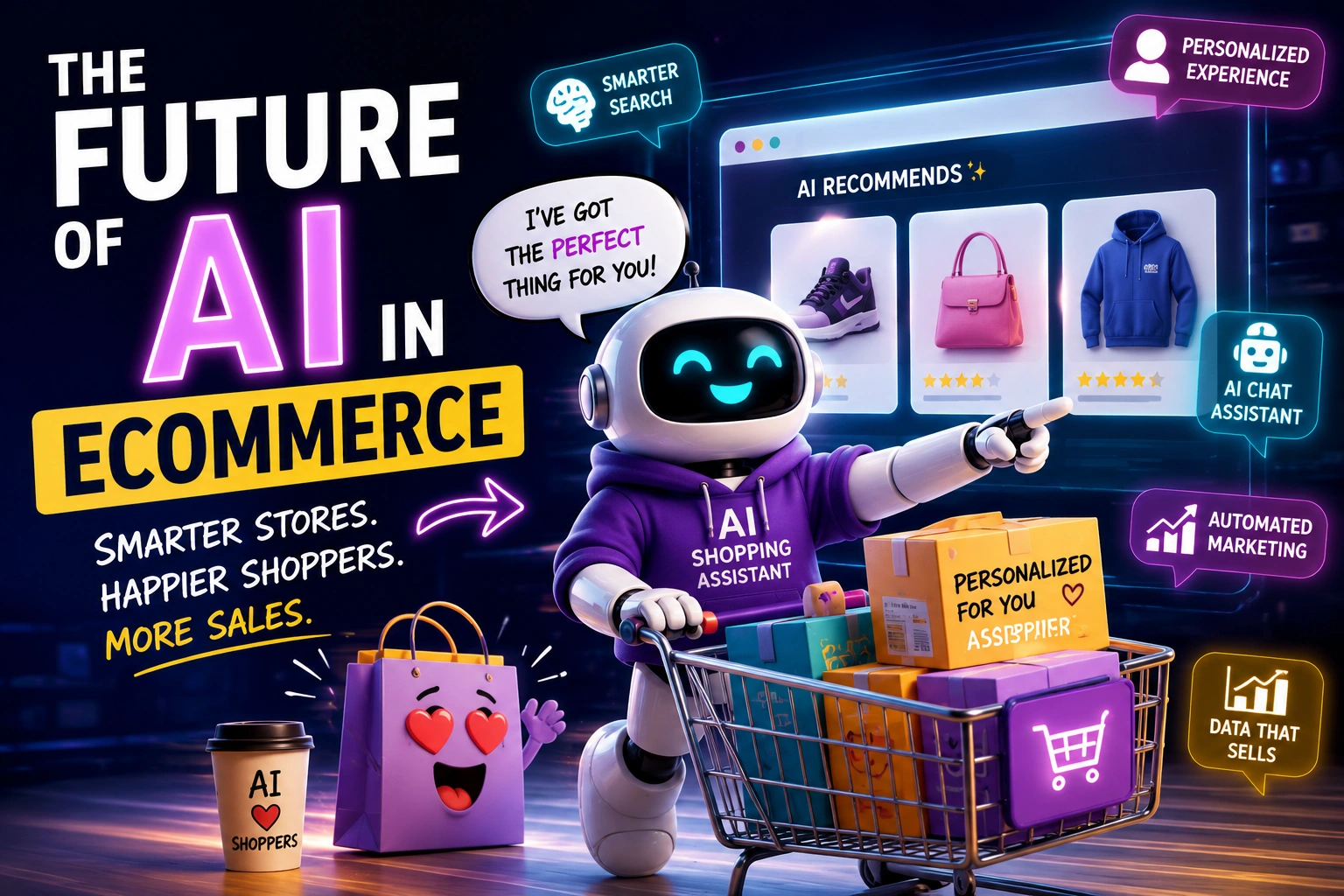
The future of ecommerce will not be built only around more products, faster checkout, or better ads. It will be built around smarter shopping experiences.
For years, online stores have relied on the same basic structure: product pages, category pages, filters, search bars, reviews, and checkout buttons. That system still works, but it often leaves shoppers doing most of the work alone.
A customer has to search, compare, read descriptions, check reviews, understand sizes, look for shipping information, and decide whether the product is actually right for them. In a small store, that may be simple. In a large ecommerce store with hundreds or thousands of products, it can quickly become overwhelming.
This is where artificial intelligence is starting to change ecommerce.
AI can help online stores understand customer intent, recommend better products, answer questions faster, personalize shopping experiences, automate marketing, and support customers before and after purchase. Instead of giving every shopper the same experience, ecommerce brands can use AI to create journeys that feel more relevant, guided, and useful.
AI will not replace every part of ecommerce. Store owners still need good products, clear branding, fair pricing, strong logistics, and real customer trust. But AI will become a major layer on top of the ecommerce experience.
In this guide, we’ll look at the future of AI in ecommerce, how it may change online shopping, and what store owners should do now to prepare.
AI Will Make Online Shopping More Personalized
One of the biggest changes AI will bring to ecommerce is deeper personalization.
Quick Overview: The Future of AI in Ecommerce
AI is changing ecommerce in several important ways. The table below gives a quick overview of the biggest trends and why they matter for online stores.
| AI Trend | What It Means for Ecommerce | Why It Matters |
|---|---|---|
| AI personalization | Online stores can show more relevant products, offers, and content based on shopper behavior and intent. | Personalized experiences can make shopping feel faster, easier, and more useful. |
| AI shopping assistants | Shoppers can ask questions, compare products, get recommendations, and receive guided buying help. | They can reduce confusion and help customers make better purchase decisions. |
| Conversational search | Customers can search in natural language instead of typing exact product keywords. | This helps shoppers find the right products faster, especially in large catalogs. |
| Smarter product recommendations | AI can suggest products based on browsing behavior, cart items, budget, preferences, season, and use case. | Better recommendations can improve product discovery and increase average order value. |
| AI chatbots | Chatbots will move beyond basic support and help with product questions, checkout concerns, and post-purchase support. | They can reduce repetitive support work and help shoppers get answers faster. |
| AI-generated product pages | AI can help create product descriptions, FAQs, comparison tables, meta descriptions, and review summaries. | This can save time and help stores improve product content faster. |
| AI marketing automation | AI can support email, SMS, ad copy, customer segmentation, abandoned cart campaigns, and creative testing. | Marketing teams can move faster and create more personalized campaigns. |
| Data-driven ecommerce | AI can analyze customer questions, searches, reviews, behavior, and purchase patterns. | Store owners can better understand what customers want and where the shopping journey needs improvement. |
Key takeaway: AI will not replace ecommerce strategy, but it will become part of how online stores personalize shopping, recommend products, support customers, improve search, and automate marketing.
Many online stores already use basic personalization. They may show “related products,” “customers also bought,” or “recommended for you” sections. Those features are useful, but they are often limited. They may be based mostly on product categories, purchase history, or simple browsing behavior.
The future of ecommerce personalization will go much further.
AI can help stores personalize:
- homepage content
- product recommendations
- search results
- email offers
- SMS campaigns
- discounts and bundles
- customer support answers
- post-purchase recommendations
- product discovery experiences
Instead of showing every customer the same product grid, AI can help online stores understand what each shopper is trying to do.
For example, one customer may search for:
“comfortable shoes for standing all day.”
Another may search for:
“stylish sneakers for weekend outfits.”
Both customers may be looking at shoes, but their needs are very different. One cares about comfort and support. The other cares about style and casual outfits. A smarter ecommerce experience should treat those shoppers differently.
That is the real promise of AI personalization. It is not just about showing more products. It is about showing better products based on intent, context, behavior, and customer preferences.
For ecommerce stores, this can make the shopping journey feel less generic. For customers, it can make online shopping feel faster and more helpful.
AI Shopping Assistants Will Become More Common
AI shopping assistants are likely to become one of the most visible AI features in ecommerce.
An AI shopping assistant is a virtual assistant that helps customers find products, ask questions, compare options, and make buying decisions. It can work through chat, product search, guided recommendations, quizzes, or a combination of several features.
In a physical store, a good sales associate can ask what the customer needs, understand the situation, recommend a few options, and explain the differences. Ecommerce has often lacked that kind of guided experience.
AI shopping assistants can help bring part of that experience online.
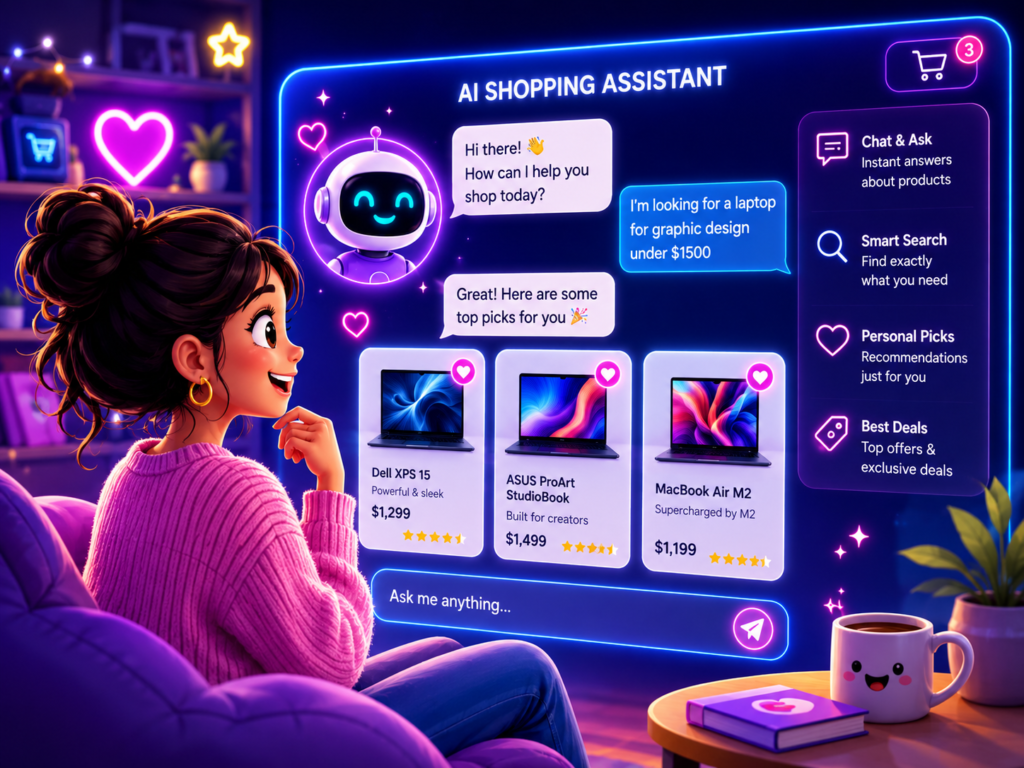
They can help shoppers:
- describe what they are looking for
- find products based on budget, style, or use case
- compare similar products
- choose the right size, model, or variant
- ask product questions before buying
- discover bundles or complementary products
- move toward checkout with more confidence
For example, a shopper might ask:
“I need a gift under $100 for someone who likes cooking.”
A traditional search bar may not handle that very well. An AI shopping assistant can ask follow-up questions or suggest relevant products based on budget, occasion, category, and customer intent.
This will be especially useful for Shopify stores, DTC brands, fashion stores, beauty brands, electronics stores, furniture stores, gift shops, and any online store with a large or complex product catalog.
Internal link suggestion: What Is an AI Shopping Assistant and How Does It Work?
Search Will Become More Conversational
Traditional ecommerce search depends heavily on keywords.
If a customer knows exactly what to type, it can work well. But many customers do not search in perfect product keywords. They search based on needs, problems, situations, and preferences.
For example, a traditional search might look like this:
“black running shoes men size 10.”
A more natural search might look like this:
“I need comfortable black shoes for running and walking under $120.”
The second search contains much more useful information. It includes the product type, color, activity, comfort need, and budget. AI-powered ecommerce search can use that context to return better results.
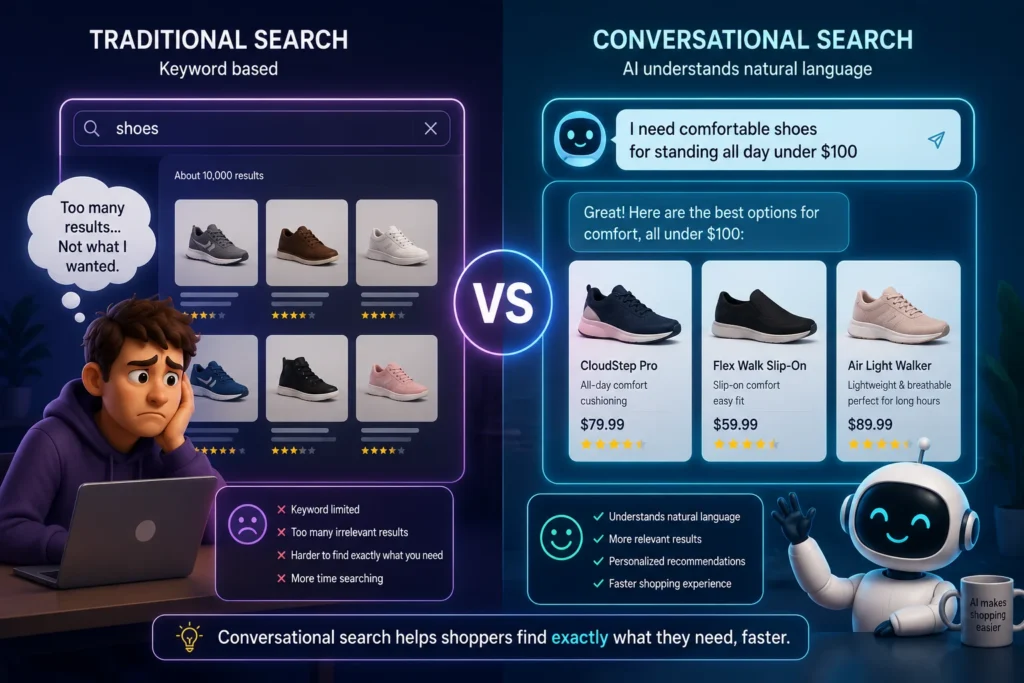
In the future, ecommerce search will become less about matching exact keywords and more about understanding intent.
AI search can help understand:
- natural language searches
- synonyms and related terms
- misspellings and typos
- product attributes
- customer intent
- use cases
- budget limits
- style preferences
This matters because poor search can cost ecommerce stores sales. If customers cannot find what they want quickly, they often leave.
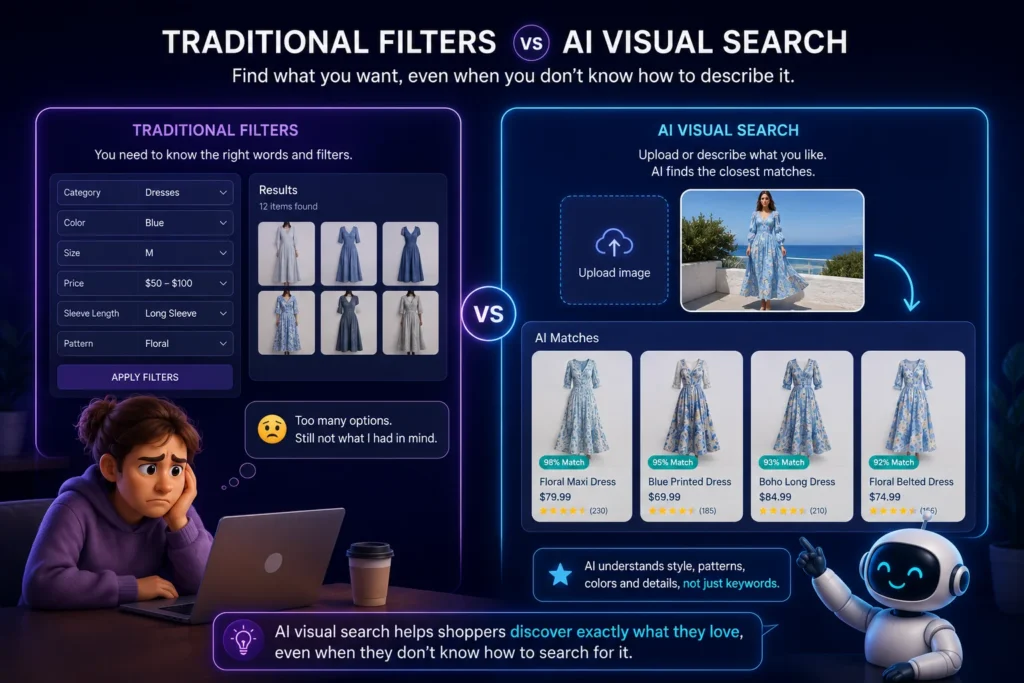
AI search can make product discovery smoother, especially for stores with large catalogs. Instead of forcing shoppers to adjust their language to match the store’s product database, the store can understand the shopper’s natural language.
Internal link suggestion: What Is AI-Powered Ecommerce Search?
Product Recommendations Will Become Smarter
Product recommendations are already a major part of ecommerce, but AI will make them much more useful.
Today, many recommendation sections are simple. They may show related products, bestsellers, or items that other customers bought. These can help, but they do not always understand why a customer is shopping.
The future of AI product recommendations will be more contextual.
AI can recommend products based on:
- browsing behavior
- purchase history
- products in the cart
- declared customer intent
- budget
- season
- occasion
- product reviews
- customer preferences
- similar shoppers
For example, a beauty store may recommend a full skincare routine instead of one isolated product. A fashion store may recommend a complete outfit. An electronics store may suggest compatible accessories. A home office store may suggest a bundle with a desk, chair, monitor stand, and lighting.
This is important because good recommendations help both the shopper and the store.
The shopper gets products that make sense. The store can increase average order value, improve product discovery, and create a more personalized experience.
The key is relevance. AI recommendations should not feel random or pushy. They should feel like helpful suggestions that match what the shopper is already trying to do.
Internal link suggestion: How AI Product Recommendations Work in Ecommerce
AI Chatbots Will Move Beyond Basic Support
For a long time, ecommerce chatbots were mostly support tools.
They answered basic questions like:
- Where is my order?
- What is your return policy?
- How long does shipping take?
- Do you ship internationally?
- How can I contact support?
That type of automation is still useful, but the next generation of AI chatbots will do more.
AI chatbots will become a mix of customer support, sales assistance, and product discovery. They will not just answer questions after a customer has a problem. They will help customers before the purchase, during the purchase, and after the purchase.
Future AI chatbots may help ecommerce stores:
- answer product questions
- recommend products
- compare options
- help with checkout concerns
- recover abandoned carts
- provide order updates
- handle return questions
- transfer complex issues to human support
This is a major shift.
Instead of being only a support tool, an AI chatbot can become a conversion tool. It can help reduce hesitation while the customer is still browsing.
For example, if a shopper is looking at a jacket and asks whether it is waterproof, the chatbot can answer instantly. If the shopper asks whether there is a warmer option, the chatbot can suggest one. If the shopper asks whether it will arrive before the weekend, the chatbot may help check shipping information.
That kind of real-time assistance can make online shopping feel more responsive.
Internal link suggestion: How AI Chatbots Help Ecommerce Stores Support Customers
AI Will Help Stores Create Better Product Pages
Product pages are one of the most important parts of any ecommerce store.
A product page has to explain what the item is, who it is for, why it matters, what makes it different, and why the customer should trust it. It also needs images, specifications, reviews, shipping details, return information, and clear calls to action.
AI can help store owners create and improve product pages faster.
AI tools can help with:
- product descriptions
- SEO titles
- meta descriptions
- bullet points
- FAQs
- comparison tables
- review summaries
- size guides
- use-case sections
- benefits-focused copy
This can be very useful for Shopify stores, WooCommerce stores, dropshipping stores, print-on-demand brands, and retailers with many SKUs.
However, AI-generated content should not be published blindly.
Product pages need accuracy. If an AI tool invents a feature, exaggerates a benefit, or gives unclear sizing information, it can create customer confusion and increase returns.
The best approach is to use AI as a first draft, not as the final decision-maker.
AI can speed up content creation. Humans should still review the details, improve the tone, check accuracy, and make sure the page fits the brand.
In the future, the best ecommerce product pages will likely combine AI efficiency with human editing and real customer insight.
AI Will Improve Customer Support and Post-Purchase Experience
The ecommerce journey does not end at checkout.
After a customer buys, they may still need help. They may want to track an order, change an address, understand how to use a product, request a return, ask about a warranty, or buy a refill or accessory.
AI can improve the post-purchase experience by making support faster and more proactive.
AI can help with:
- order tracking
- return requests
- refund questions
- product setup
- care instructions
- warranty support
- repeat purchase recommendations
- review requests
- post-purchase education
For example, if a customer buys a coffee machine, AI could help send setup instructions, recommend compatible filters, suggest cleaning tablets, and remind the customer when it may be time to reorder supplies.
If a customer buys skincare products, AI could help explain the order of use and recommend when to add another product later.
This matters because post-purchase experience affects customer retention.
A store that supports customers after the sale has a better chance of earning repeat purchases, reviews, referrals, and long-term loyalty.
In the future, AI will not only help stores get the first sale. It will also help stores build stronger customer relationships after the sale.
AI Will Make Ecommerce Marketing More Automated
Marketing is another area where AI will continue to change ecommerce.
Online stores need constant marketing work. They need emails, SMS campaigns, ad copy, product creatives, landing pages, offers, audience testing, and customer segmentation. For small teams, this is a lot to manage.
AI can help speed up marketing execution.
AI tools can support:
- abandoned cart emails
- welcome flows
- win-back campaigns
- personalized offers
- customer segmentation
- email subject lines
- ad copy
- creative variations
- landing page copy
- audience insights
- campaign testing
This does not mean AI will replace marketing strategy. A store still needs a clear offer, strong positioning, useful products, and a real understanding of its customers.
But AI can make execution faster.
Instead of writing one email subject line, a marketer can generate ten options and test the best ones. Instead of creating one ad angle, a store can test multiple hooks. Instead of sending the same email to every customer, AI can help segment audiences based on behavior and purchase history.
For ecommerce brands, this can make marketing more personalized and more efficient.
Internal link suggestion: Best AI Marketing Tools for Ecommerce Brands
AI Will Help Small Ecommerce Stores Compete
One of the most interesting parts of AI in ecommerce is how it can help smaller stores look and operate more professionally.
In the past, many advanced ecommerce features required larger teams, expensive software, or custom development. Small stores often could not afford the same level of personalization, automation, customer support, and analytics as bigger brands.
AI is starting to change that.
A small Shopify store can now use AI tools for:
- product descriptions
- customer support
- email automation
- product recommendations
- AI search
- shopping assistance
- ad copy
- review summaries
- basic analytics
This can help small teams save time and create a better customer experience without hiring a large staff.
For example, a small beauty brand may use AI to recommend skincare routines. A small clothing store may use AI to help shoppers choose outfits. A small electronics store may use AI to explain technical differences between products.
But AI is not a shortcut for everything.
It will not fix a bad product, poor branding, unclear pricing, weak photos, slow shipping, or no traffic. Small ecommerce stores still need the basics.
AI works best when it supports a store that already has real customer demand and a clear reason to exist.
Internal link suggestion: How AI Helps Small Online Stores Compete With Bigger Brands
AI Will Make Ecommerce More Data-Driven
Ecommerce stores already collect a lot of data, but many store owners do not know what to do with it.
They may have data from website visits, search terms, product clicks, abandoned carts, customer questions, reviews, email campaigns, and purchase history. The problem is that this information is often scattered across different tools.
AI can help turn customer behavior into useful insights.
AI can help store owners understand:
- what customers search for
- what questions customers ask before buying
- where shoppers get stuck
- which products customers compare
- why carts may be abandoned
- which products are recommended most often
- what objections appear before checkout
- which product pages need better information
For example, if many shoppers ask whether a jacket is waterproof, the store may need to make that detail clearer on the product page.
If many customers search for “gifts under $50,” the store may need a gift guide or collection page.
If shoppers often ask which product is best for beginners, the store may need a comparison table or buying guide.
This is one of the less obvious benefits of AI in ecommerce. AI is not only useful for direct customer interaction. It can also help store owners learn what customers actually need.
In the future, the best ecommerce brands will use AI not just to automate tasks, but to understand customers better.
The Risks and Limits of AI in Ecommerce
AI has a lot of potential in ecommerce, but it also has limits.
Store owners should not treat AI as a magic solution. A poorly configured AI tool can create confusion, damage trust, or waste money.
Some common risks include:
- wrong product recommendations
- AI-generated answers that sound confident but are inaccurate
- incomplete product data
- lack of human support when customers need help
- privacy concerns
- too many popups, chat widgets, or automated messages
- generic product content
- expensive tools with unclear ROI
- poor integration with the ecommerce platform
AI is only useful when it improves the customer experience. If it makes shopping more confusing, it becomes another problem.
This is especially important for stores that sell products where accuracy matters.
Examples include electronics, skincare, supplements, baby products, fitness equipment, medical-adjacent products, and high-ticket items. In these categories, wrong or exaggerated answers can create real customer frustration.
That is why human oversight still matters.
Store owners should test AI tools, review conversations, check recommendations, monitor customer complaints, and make sure the tool is helping rather than hurting.
The future of AI in ecommerce will not be about replacing judgment. It will be about using AI carefully to support better decisions.
How Ecommerce Store Owners Should Prepare
Ecommerce store owners do not need to install every AI tool immediately. The better approach is to prepare the store so AI can actually work well.
The first step is product data.
AI tools need clear, accurate, and structured product information. If product titles are confusing, descriptions are thin, categories are messy, and variants are inconsistent, AI will struggle to give good results.
Store owners should prepare by improving:
- product titles
- product descriptions
- categories and collections
- tags and attributes
- size guides
- FAQs
- shipping information
- return policies
- product specifications
- customer support documentation
After that, store owners should choose one AI use case at a time.
For example:
- If customers ask too many questions, test an AI chatbot.
- If shoppers cannot find products, test AI search.
- If product discovery is weak, test an AI shopping assistant.
- If average order value is low, test product recommendations.
- If product pages are weak, test AI product description tools.
- If repeat purchases are low, test email and SMS automation.
The mistake is trying to automate everything at once.
A better strategy is to start with one problem, test one tool, measure the results, and then decide whether to expand.
Store owners should also watch for:
- site speed impact
- customer complaints
- wrong AI answers
- poor recommendations
- monthly app costs
- conversion changes
- average order value changes
- support ticket volume
The future of ecommerce AI does not mean installing 20 apps. It means using AI where it solves a real business problem.
Is AI the Future of Ecommerce?
Yes, AI is part of the future of ecommerce. But that does not mean ecommerce will become completely AI-run.
The more realistic future is AI-assisted ecommerce.
AI will become a major layer across:
- personalization
- product discovery
- search
- shopping assistance
- customer support
- email marketing
- product recommendations
- analytics
- automation
But humans will still matter.
Store owners, marketers, designers, and operators will still be needed for:
- brand strategy
- product quality
- creative direction
- customer trust
- pricing decisions
- partnerships
- community building
- long-term business strategy
AI can help make ecommerce smarter, faster, and more personalized. But it cannot replace the need for a strong brand, useful products, and a good customer experience.
The ecommerce brands that benefit most from AI will be the ones that use it with purpose.
They will not add AI just because it sounds modern. They will use AI to make shopping easier, support customers faster, recommend better products, and understand their audience more clearly.
Conclusion
The future of AI in ecommerce is not about replacing online stores with robots. It is about making the shopping experience more intelligent, more personal, and more helpful.
AI will change how customers search for products, how stores recommend items, how chatbots support shoppers, how marketing campaigns are created, and how store owners understand customer behavior.
For shoppers, this can mean less confusion and faster decisions. For ecommerce brands, it can mean better product discovery, stronger personalization, fewer repetitive support tasks, and more opportunities to turn browsers into buyers.
But AI should be used carefully.
The best ecommerce brands will not treat AI as a shortcut. They will treat it as a tool. They will improve their product data, test one use case at a time, measure results, and make sure AI actually improves the customer experience.
AI will not fix weak products, bad branding, poor pricing, or slow shipping. But for stores that already have solid products and real customer demand, AI can become a powerful advantage.
The future of AI in ecommerce will belong to stores that use AI to make shopping easier, not just stores that add AI because it sounds modern.
Next, you may want to compare specific AI tools for ecommerce, including AI shopping assistants, AI chatbots, AI product recommendation tools, and AI search platforms.
Frequently Asked Questions About the Future of AI in Ecommerce
What is the future of AI in ecommerce?
The future of AI in ecommerce will focus on more personalized shopping experiences, smarter product recommendations, conversational search, AI shopping assistants, automated support, and more data-driven marketing. AI will help stores guide customers more effectively and make online shopping feel less generic.
Will AI replace ecommerce store owners?
No, AI is unlikely to replace ecommerce store owners completely. AI can help with tasks like product descriptions, customer support, recommendations, marketing, and analytics, but store owners still need to make decisions about branding, products, pricing, customer trust, and business strategy.
How will AI change online shopping?
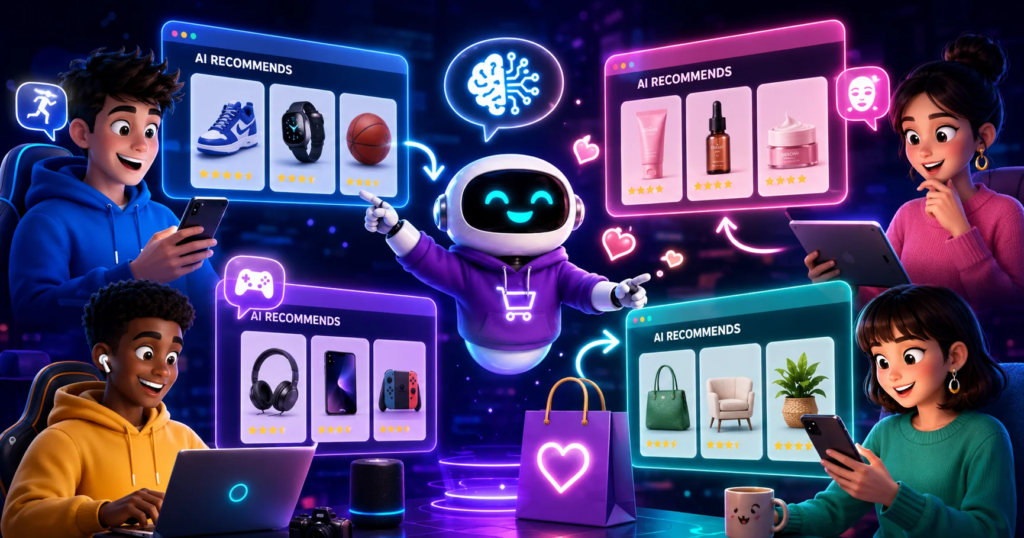
AI will make online shopping more personalized and conversational. Shoppers will be able to describe what they need in natural language, receive better recommendations, ask product questions, compare options, and get more helpful support before and after purchase.
Will AI shopping assistants become common?
Yes, AI shopping assistants are likely to become more common, especially in stores with large catalogs or products that require guidance. They can help shoppers find products, ask questions, compare options, and make buying decisions with more confidence.
How can small ecommerce stores use AI?
Small ecommerce stores can use AI for product descriptions, customer support, email automation, product recommendations, AI search, shopping assistance, and ad copy. The best approach is to start with one clear problem instead of installing too many AI tools at once.
What are the biggest risks of AI in ecommerce?
The biggest risks include wrong recommendations, inaccurate AI answers, poor product data, privacy concerns, too much automation, generic content, expensive tools with unclear ROI, and a lack of human support when customers need real help.
Can AI increase ecommerce sales?
AI can help increase ecommerce sales when it improves product discovery, answers customer questions, personalizes recommendations, reduces cart abandonment, or increases average order value. However, AI does not guarantee sales by itself. It works best when the store already has good products and real customer demand.
What AI tools should ecommerce stores use first?
The first AI tool should match the store’s biggest problem. If customers ask too many questions, start with an AI chatbot. If shoppers cannot find products, start with AI search. If product pages are weak, start with AI product description tools. If average order value is low, start with product recommendations.