

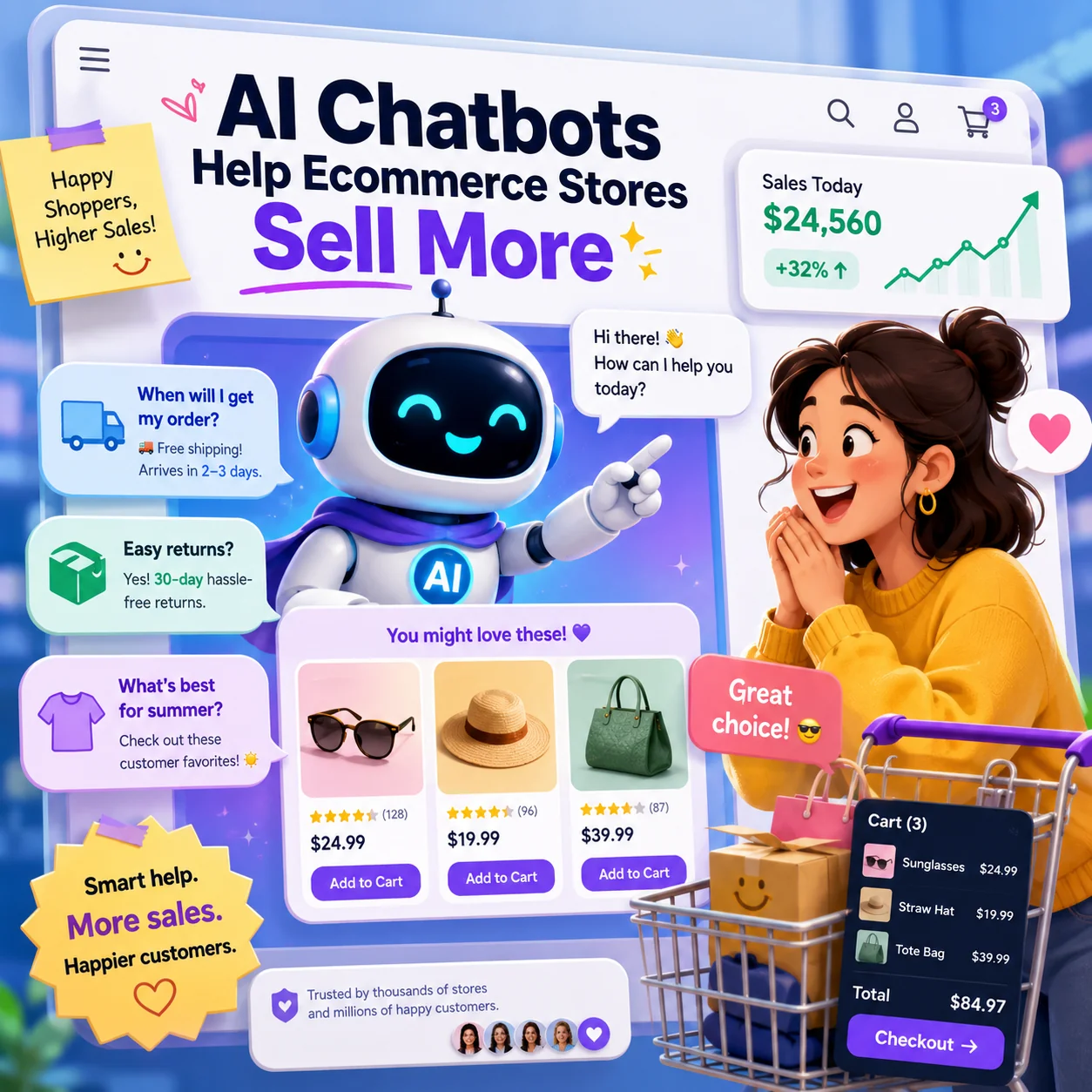
Ecommerce stores do not lose sales only because of bad products or high prices. Many sales are lost because shoppers have unanswered questions, small doubts, or moments of friction before checkout.
A customer may like a product, but still wonder if it comes in the right size, how long shipping takes, whether returns are easy, or which option is best for their needs. If they cannot find the answer quickly, they may leave the store, open another tab, compare competitors, or abandon the cart completely.
This is where AI chatbots can help.
An AI chatbot for ecommerce can answer customer questions instantly, recommend products, explain store policies, help shoppers compare options, and guide visitors toward a buying decision. Instead of waiting for an email reply or searching through FAQ pages, customers can get help while they are still interested.
That matters because timing is important in online shopping. A shopper who gets the right answer in the moment is more likely to keep browsing, add a product to the cart, or complete the purchase.
Modern AI chatbots are no longer just basic support widgets. For ecommerce stores, they can act as product guides, sales assistants, support agents, and cart recovery tools. They can help customers feel more confident before buying and help store owners reduce repetitive support work at the same time.
In this guide, we’ll look at how AI chatbots help ecommerce stores sell more, where they create the most value, what features matter, and how store owners can measure whether a chatbot is actually improving sales.
Quick Overview: How AI Chatbots Help Ecommerce Stores Sell More
AI chatbots can support different parts of the ecommerce buying journey, from answering simple questions to helping shoppers choose products and complete their orders. The table below gives a quick overview of the main ways ecommerce chatbots can help online stores increase sales.
| Chatbot Use Case | What the Chatbot Does | How It Helps Shoppers | How It Can Help Sales |
|---|---|---|---|
| Instant customer answers | Answers common questions about shipping, returns, sizing, delivery, availability, and product details. | Customers do not have to search through multiple pages or wait for support. | Reduces hesitation and keeps shoppers moving toward checkout. |
| Product recommendations | Suggests products based on the shopper’s needs, budget, preferences, or use case. | Shoppers can find relevant products faster without browsing the entire catalog. | Can increase conversions by guiding customers to products that fit their needs. |
| Product comparison | Explains the difference between similar products, models, bundles, or pricing options. | Makes it easier for customers to understand which option is best for them. | Helps reduce decision fatigue, especially in stores with large catalogs. |
| Cart abandonment support | Offers help when shoppers hesitate near the cart or checkout page. | Customers can quickly get answers about delivery, payment, returns, or discounts. | Can recover sales that might otherwise be lost before checkout. |
| Product discovery | Helps shoppers navigate categories, collections, filters, and product options through conversation. | Customers can describe what they want in plain language instead of relying only on filters. | Improves the chance that visitors find products they are ready to buy. |
| Upsells and cross-sells | Recommends accessories, bundles, refills, upgrades, or complementary products. | Shoppers discover useful add-ons they may not have found on their own. | Can increase average order value when recommendations are relevant. |
| 24/7 shopping assistance | Supports customers during nights, weekends, holidays, and busy sales periods. | Shoppers can get help when they are ready to buy, not only during business hours. | Helps stores capture sales from customers shopping outside normal support hours. |
| Customer trust | Explains store policies, product details, warranties, delivery rules, and return options. | Customers feel more informed and safer before placing an order. | Reduces uncertainty, which can help more shoppers complete their purchase. |
| Support automation | Handles repetitive questions about orders, shipping, returns, product basics, and policies. | Customers get faster answers for simple issues. | Reduces support workload and gives the team more time for higher-value conversations. |
Quick takeaway: AI chatbots help ecommerce stores sell more when they remove friction from the shopping journey. The strongest results usually come from chatbots that answer questions quickly, recommend relevant products, support shoppers before checkout, and connect to real store data.
What Is an AI Chatbot for Ecommerce?
An AI chatbot for ecommerce is an automated assistant that can talk with shoppers on an online store and help them get answers, find products, and move through the buying process.
It usually appears as a chat widget on the website, but it can also work through messaging apps, customer support platforms, or live chat systems. The main goal is simple: help shoppers faster, without forcing them to wait for a human agent every time they have a question.
An ecommerce AI chatbot can help with things like:
- answering customer support questions
- explaining shipping and return policies
- helping customers track orders
- answering product questions
- recommending products
- helping with size, fit, or compatibility
- suggesting related products
- recovering abandoned carts
- sending complex issues to a human support agent
A basic chatbot usually follows fixed scripts or predefined conversation flows. For example, it may show buttons like “Track my order,” “Return policy,” or “Contact support.” That can still be useful, but it is limited.
An AI chatbot is more flexible. It can understand natural language, which means shoppers can ask questions in a more normal, conversational way.
For example, instead of clicking through a support menu, a shopper might ask:
“Will this arrive before Friday?”
Or:
“Which of these jackets is better for cold weather?”
Or:
“I need a gift under $75 for someone who likes coffee.”
A good ecommerce AI chatbot should understand the question, connect it to the store’s product information or policies, and give a useful answer. If it is connected to the product catalog, it can also recommend real products from the store instead of giving generic advice.
This is why AI chatbots are becoming more important for online stores. They are not just tools for answering support questions anymore. When set up properly, they can help shoppers discover products, remove doubts, and feel more confident before buying.
Why Ecommerce Stores Lose Sales Before Checkout
Before looking at how AI chatbots help ecommerce stores sell more, it is important to understand why shoppers leave without buying.
Many people do not abandon an online store because they hate the product. They leave because something feels unclear, risky, or inconvenient. Sometimes the problem is small, but it is enough to stop the purchase.
A shopper may be interested in a product, but still have questions like:
- Is this the right size?
- Will it arrive on time?
- Can I return it if it does not work?
- Is this product compatible with what I already own?
- Is there a better option?
- What is the difference between these two products?
- Can I trust this store?
If those questions are not answered quickly, the customer may leave the website and look somewhere else.
This is one of the biggest problems in ecommerce. Online shoppers are impatient. They do not always want to send an email, wait for a live agent, or dig through a long FAQ page. They want answers while they are still thinking about buying.
Every unanswered question can become a lost sale.
Some of the most common reasons ecommerce stores lose sales before checkout include:
- customers cannot find the right product
- product descriptions are unclear
- shipping information is hard to find
- return policies are confusing
- customers are unsure about size, fit, or compatibility
- there is no fast way to ask a question
- the store does not build enough trust
- the shopper compares products on another website
- the customer abandons the cart after a final doubt
An AI chatbot can help reduce some of that friction.
It can answer questions instantly, guide customers toward the right product, explain policies clearly, and keep shoppers engaged while they are still on the site. This does not guarantee every visitor will buy, but it can remove small barriers that often stop people from completing a purchase.
In ecommerce, small moments matter. A quick answer about shipping, returns, sizing, or product details can be the difference between a completed order and an abandoned cart.
AI Chatbots Answer Customer Questions Instantly
One of the clearest ways AI chatbots help ecommerce stores sell more is by answering customer questions instantly.
When a shopper is close to buying, timing matters. If they have to wait hours for an email reply or leave the product page to search for information, the sale becomes weaker. The customer may get distracted, compare another store, or decide to wait until later.
An AI chatbot can respond while the shopper is still active on the website.
For example, customers may ask:
- How long does shipping take?
- Can I return this item?
- Is this product in stock?
- Does this come in my size?
- Can I exchange it if it does not fit?
- Does this product work with my device?
- What is included in the box?
- Is this product good for beginners?
These questions may seem small, but they often matter a lot to the customer. If the answer is easy to find, the shopper feels more confident. If the answer is hard to find, the shopper may leave.
A good AI chatbot can pull information from product pages, FAQ pages, shipping policies, return policies, and help center content. If it is connected properly, it can give useful answers without making the customer wait for a human support agent.
This helps sales in a few important ways.
First, it keeps the shopper on the website. Instead of opening another tab or leaving to contact support, the customer can get help directly inside the shopping experience.
Second, it reduces hesitation. Many customers do not need a long sales pitch. They just need one clear answer before they feel ready to buy.
Third, it makes the store feel more responsive. A store that answers quickly can feel more trustworthy than one where the customer has to search for basic information alone.
For ecommerce stores, instant answers are not just a support feature. They are part of the conversion process.
The faster a store can answer a buying question, the less likely the shopper is to abandon the page before checkout.
AI Chatbots Help Shoppers Choose the Right Products
AI chatbots can also help ecommerce stores sell more by guiding shoppers toward the right products.
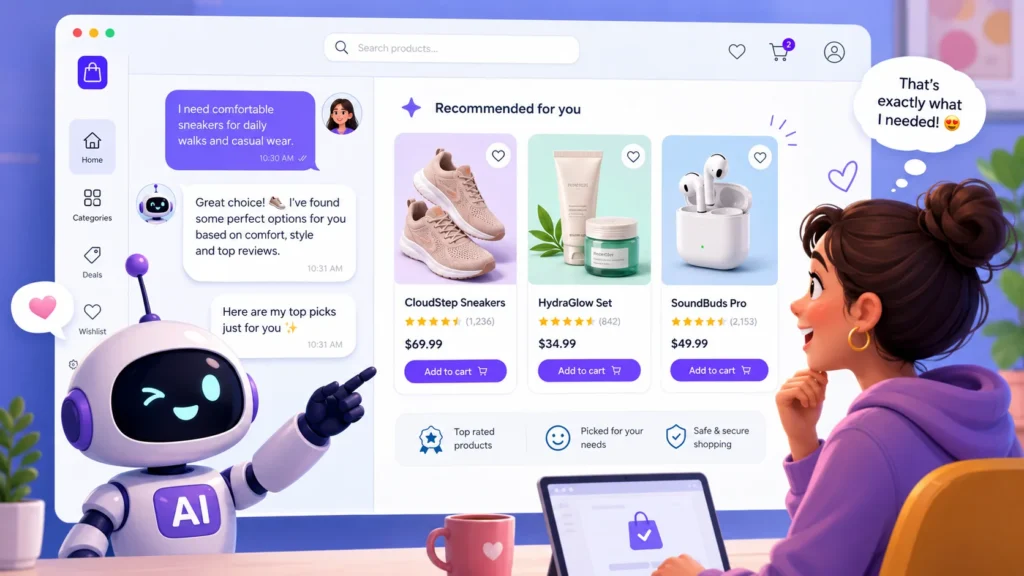
This is different from basic customer support. The chatbot is not only answering questions about shipping or returns. It is helping the customer make a better buying decision.
Many shoppers arrive at an online store with a general idea of what they want, but not a specific product in mind. They may know the problem they want to solve, the occasion they are shopping for, or the budget they want to stay within.
For example, a shopper might ask:
- What gift should I buy under $100?
- Which skincare product is best for dry skin?
- What laptop is good for college?
- What size should I choose?
- Which shoes are best for standing all day?
- What is the best option for beginners?
A traditional ecommerce experience may force the shopper to browse categories, use filters, read product pages, and compare options alone. An AI chatbot can make that process easier by asking follow-up questions and narrowing the choices.
For example, if a customer asks for a gift recommendation, the chatbot might ask who the gift is for, what the budget is, when it needs to arrive, and what the person is interested in.
If a shopper is choosing skincare, the chatbot might ask about skin type, skin concerns, routine preferences, or budget.
If a customer is buying electronics, the chatbot may help compare features, compatibility, performance, and price.
This kind of guided shopping can be very useful for stores that sell products with many options, sizes, styles, technical details, or use cases.
An AI chatbot can recommend products based on:
- budget
- use case
- style
- size
- category
- preferences
- stock availability
- product attributes
The key is that the recommendations should come from the store’s real product catalog. A useful ecommerce AI chatbot should not invent products or give generic advice that does not connect to what the store actually sells.
When the chatbot helps a shopper find the right product faster, it reduces confusion. And when customers feel less confused, they are more likely to continue toward checkout.
This is why AI chatbots are becoming closer to AI shopping assistants. They do not just respond to questions. They help customers shop with more confidence.
AI Chatbots Can Recommend Products and Increase Average Order Value
AI chatbots can also help ecommerce stores increase average order value by recommending products that make sense with what the shopper is already buying.
This is where a chatbot can become more than a support tool. It can act like a helpful sales assistant.
For example, if a customer is buying a camera, the chatbot might suggest a memory card, a tripod, a camera bag, or an extra battery. If someone is buying running shoes, it might recommend socks, insoles, or running shorts. If a shopper is buying skincare products, it might suggest a cleanser, serum, moisturizer, and sunscreen as a complete routine.
These recommendations can help the customer because they are not always sure what else they need. At the same time, they can help the store increase the value of the order.
An AI chatbot can support:
- upsells
- cross-sells
- product bundles
- accessory recommendations
- premium alternatives
- refills and repeat purchases
- complete product routines or kits
The important part is relevance.
A bad recommendation feels pushy. A good recommendation feels useful.
For example, if a customer is looking at a coffee machine, recommending a random kitchen product may feel forced. But recommending compatible filters, cleaning tablets, coffee beans, or a milk frother feels natural because those products connect to the customer’s purchase.
The same idea works in many ecommerce categories:
- Beauty: recommend a full skincare routine instead of one product.
- Fashion: recommend matching shoes, bags, or accessories.
- Electronics: recommend compatible accessories or protection plans.
- Pet products: recommend treats, toys, or supplements.
- Furniture: recommend matching tables, rugs, lamps, or decor.
When recommendations are helpful, shoppers may add more items to the cart because the extra products actually solve a need.
This is one of the main reasons ecommerce brands use AI chatbots and AI product recommendation tools together. The chatbot can understand the customer’s question, while the recommendation system can suggest relevant products from the catalog.
For store owners, the goal is not just to sell more items. The goal is to help shoppers build a better cart.
When done well, AI chatbot recommendations can improve the customer experience and increase average order value at the same time.
AI Chatbots Reduce Cart Abandonment
Cart abandonment is one of the most common problems in ecommerce. A shopper may add a product to the cart, get close to checkout, and then leave without completing the order.
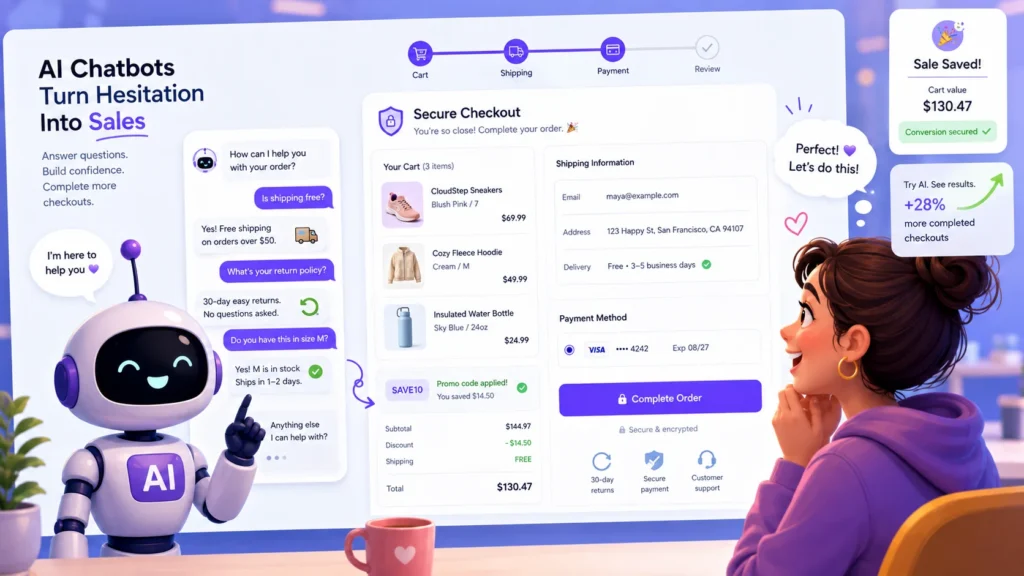
Sometimes the reason is price. Sometimes it is shipping cost. But often, the shopper simply has one final question or concern that is not answered at the right moment.
An AI chatbot can help reduce that friction by answering last-minute questions while the customer is still on the website.
For example, a shopper may ask:
- Will this arrive before Friday?
- Can I return this if it does not fit?
- Is this the right size?
- Do I need anything else with this product?
- Is there a cheaper alternative?
- Does this product come with a warranty?
- Can I exchange it later?
- Is this product safe, compatible, or beginner-friendly?
If the customer cannot find the answer quickly, they may decide to “think about it” and leave the store. In ecommerce, that often means the sale is gone.
A good AI chatbot can step in at this moment and provide a clear answer. It can explain return policies, shipping timelines, size guidance, product compatibility, or alternatives. It can also recommend a related product if the current item is not the right fit.
This is especially useful for stores that sell products where customers need extra confidence before buying, such as fashion, footwear, skincare, electronics, furniture, baby products, fitness equipment, or high-ticket items.
AI chatbots can also support cart recovery by reminding shoppers about items they left behind, answering questions about the cart, or helping them choose between products.
For example, if someone adds running shoes to the cart but hesitates, the chatbot may help answer sizing questions or suggest socks and insoles that match the product. If someone is buying a mattress, the chatbot may explain delivery, returns, warranty, and firmness options before the customer leaves.
The goal is not to pressure the shopper. The goal is to remove uncertainty.
When customers feel confident that they understand the product, shipping, returns, and next steps, they are more likely to complete the purchase.
AI chatbots will not eliminate cart abandonment completely. No tool can do that. But they can help reduce avoidable abandonment caused by unanswered questions, confusion, or hesitation before checkout.
AI Chatbots Improve Product Discovery
AI chatbots can also help ecommerce stores improve product discovery.
Product discovery is the process of helping shoppers find products they may want to buy. This sounds simple, but it can become difficult when a store has many categories, collections, filters, variants, and similar products.
A shopper may not always know the exact product name. They may only know the situation, problem, budget, or style they are looking for.
For example, a customer might ask:
- I need a birthday gift for a 12-year-old.
- Show me office chairs under $300.
- I want a black dress for a formal event.
- What skincare products should I use for dry skin?
- Find me a backpack for work that fits a laptop.
- What should I buy for a new puppy?
A traditional search bar may not always understand these requests well. It may look for exact keywords instead of understanding what the shopper actually needs.
An AI chatbot can make discovery more conversational.
Instead of forcing shoppers to search with short keywords, the chatbot can let them describe what they want in normal language. Then it can ask follow-up questions, suggest categories, recommend products, or guide the shopper toward a smaller list of options.
This is useful because many customers do not want to browse through dozens of pages. They want help narrowing the choices.
For example, if someone says they need “a gift for a coffee lover,” the chatbot may ask about budget, delivery deadline, and whether the gift should be practical, premium, or fun. Then it can recommend coffee machines, mugs, grinders, beans, accessories, or gift bundles.
This kind of experience can help shoppers discover products they may not have found on their own.
AI chatbots can also guide customers to the right collections or product pages. If a shopper asks for “comfortable shoes for work,” the chatbot can point them toward work shoes, walking shoes, insoles, or bestsellers designed for long hours of standing.
For stores with large catalogs, this can be very valuable. The more products a store has, the easier it is for customers to get lost. An AI chatbot can act as a shortcut between the customer’s need and the right product category.
Better product discovery can support sales because shoppers are more likely to buy when they find relevant products quickly.
If customers cannot find what they need, they leave. If the chatbot helps them find it faster, the store has a better chance of turning that visit into a sale.
AI Chatbots Reduce Customer Support Workload
AI chatbots can help ecommerce stores sell more, but they can also help stores operate more efficiently.
Many ecommerce support teams spend a lot of time answering the same questions again and again. These questions are important to customers, but they can take up hours of manual work every week.
Common support questions include:
- Where is my order?
- How long does shipping take?
- What is your return policy?
- Can I exchange this item?
- Does this come in another size?
- Is this product in stock?
- Do you offer free shipping?
- What payment options do you accept?
An AI chatbot can answer many of these repetitive questions automatically, especially when it is connected to the store’s FAQ page, shipping policy, return policy, product catalog, and order tracking system.
This does not mean human support becomes unnecessary.
There will always be situations where a real person should step in. For example, angry customers, refund problems, damaged orders, custom requests, billing issues, and complex product questions may still need human attention.
But AI chatbots can handle the simple questions first.
That helps the support team focus on the conversations that actually need a human response. Instead of answering the same shipping question 40 times, the team can spend more time solving difficult cases, helping high-value customers, improving product pages, and creating a better support experience.
This can help sales indirectly.
When the support team is less overwhelmed, customers can get better service. Faster answers, fewer delays, and clearer communication can make the store feel more reliable.
For small ecommerce teams, this is especially useful. A small store may not have the budget to hire support agents for every time zone or every busy season. An AI chatbot can give the store a basic support layer that works even when the team is offline.
During busy periods like Black Friday, Cyber Monday, holiday shopping, product launches, or sales campaigns, this can make a big difference.
The chatbot can handle common questions at scale, while human agents focus on the most important conversations.
In simple terms, an AI chatbot can reduce support workload while still helping customers get the answers they need. That combination can improve both operations and sales.
AI Chatbots Provide 24/7 Sales Assistance
One of the biggest advantages of AI chatbots is that they can support shoppers at any time.
Ecommerce stores are open 24/7, but most support teams are not. A customer may visit the store late at night, during the weekend, on a holiday, or from a different time zone. If they have a question and no one is available, the store may lose the sale.
An AI chatbot can help fill that gap.
It can answer common questions, recommend products, explain shipping policies, guide shoppers through product choices, and help customers feel more confident even when the human support team is offline.
This matters because online shopping does not always happen during business hours.
A shopper may browse after work. Another may shop during lunch. Someone else may visit the store at midnight after seeing an ad on social media. If they are ready to buy but need one quick answer, waiting until the next business day may be too late.
A chatbot can provide instant help in moments like:
- late-night shopping sessions
- weekend browsing
- holiday sales
- Black Friday and Cyber Monday campaigns
- product launches
- busy customer support periods
- traffic spikes from ads or influencers
For small ecommerce teams, this can be especially valuable. A store may not have enough staff to cover live chat all day, every day. An AI chatbot gives the store a basic sales and support layer that stays active even when the team is unavailable.
Of course, 24/7 chatbot support does not mean every issue should be handled by AI. Complex problems, refunds, complaints, damaged orders, and custom requests may still need a human agent.
But many pre-purchase questions are simple enough for a chatbot to answer.
If a customer asks about sizing, shipping time, return rules, product availability, or basic product details, the chatbot can often respond immediately.
This can help keep the shopper engaged and reduce the chance that they leave the store before buying.
A shopper who gets an answer now is more likely to continue than a shopper who has to wait until tomorrow.
AI Chatbots Can Personalize the Shopping Experience
AI chatbots can help ecommerce stores sell more by making the shopping experience feel more personal.
A basic website shows the same product pages, menus, and policies to every shopper. That can work, but it does not always match what each customer actually needs. One visitor may be looking for a gift. Another may be comparing technical specs. Another may need help choosing a size. Another may be returning to buy a refill.
An AI chatbot can respond differently depending on the customer’s question, behavior, cart contents, or previous interactions.
For example, a chatbot may personalize the experience based on:
- what product the shopper is viewing
- what items are in the cart
- what questions the customer asks
- past purchases, if available
- browsing behavior
- product preferences
- location or shipping destination
- previous conversations
This can make the chatbot more useful than a generic support widget.
For example, if a shopper is viewing a pair of running shoes, the chatbot can answer questions about sizing, comfort, use case, return policy, and related accessories. If someone is browsing skincare products, the chatbot can help suggest products based on skin type, routine, and concerns. If someone has a coffee machine in the cart, the chatbot can suggest compatible filters, cleaning tablets, or coffee beans.
Personalization also helps reduce irrelevant recommendations.
A shopper who wants a budget-friendly product should not be pushed only toward premium options. A customer looking for beginner-friendly gear should not receive advanced products without explanation. A shopper buying a gift should not get the same recommendations as someone shopping for themselves.
A well-trained AI chatbot can use context to make the conversation feel more relevant.
This matters because customers are more likely to buy when the store seems to understand what they need. Personalization can reduce the feeling of being lost inside a large product catalog and make the experience feel closer to talking with a helpful store associate.
However, personalization should be handled carefully.
Stores should be transparent about data usage and should avoid making customers feel uncomfortable. The goal is to be helpful, not invasive. A good AI chatbot should use available context to improve the shopping experience while still respecting customer privacy.
When used well, personalization can help customers find better products, feel more confident, and move closer to purchase.
AI Chatbots Help Build Trust Before Purchase
Trust is one of the most important parts of ecommerce.
In a physical store, customers can see the product, talk to a salesperson, ask questions, and get a better feeling for the business. Online, that trust has to be built through product pages, reviews, policies, photos, support, and the overall shopping experience.
An AI chatbot can help build trust by giving shoppers clear answers before they buy.
Many customers hesitate because they are not completely sure about something. They may wonder if the product is right for them, if the store is reliable, if the return policy is fair, or if the product will arrive on time.
An AI chatbot can help answer questions about:
- shipping times
- return policies
- exchanges
- warranty details
- product materials
- ingredients
- compatibility
- sizing
- reviews
- customer support availability
These details may not sound exciting, but they matter a lot when someone is deciding whether to buy.
For example, a customer may like a jacket but want to know whether it is waterproof. Another may want to know if a skincare product is suitable for sensitive skin. Someone buying electronics may need to know if an accessory works with their device. A parent buying baby products may want extra reassurance about safety, materials, or returns.
If the chatbot gives a helpful answer, the customer may feel more confident.
This confidence is important because shoppers often buy when they feel informed and safe. They do not always need to be pushed. Sometimes they simply need the store to remove uncertainty.
A chatbot can also make the store feel more responsive. When customers get fast answers, they may see the store as more professional and reliable.
However, accuracy matters. A chatbot should not make promises the store cannot keep. It should not guarantee delivery dates unless that information is accurate. It should not exaggerate product benefits or invent policies.
Trust grows when the chatbot is useful, honest, and clear.
That is why ecommerce stores should train the chatbot on real store information, test common answers, and make sure customers can reach a human when needed.
A good AI chatbot helps build trust by making shoppers feel supported before they make a purchase.
Best Types of Ecommerce Stores for AI Chatbots
AI chatbots can be useful for many ecommerce stores, but they are especially valuable when customers need guidance before buying.
Some products are simple. A shopper sees the product, understands it quickly, and either buys it or leaves. In that case, a chatbot may still help with support, but it may not be a major sales driver.
Other products require more thought. Customers need to compare options, understand details, choose the right size, check compatibility, or feel confident about shipping and returns. These are the situations where AI chatbots can have a bigger impact.
AI chatbots are especially useful for:
- Fashion stores: customers often need help with sizing, fit, style, colors, occasions, and outfit ideas.
- Beauty and skincare brands: shoppers may need guidance based on skin type, routine, ingredients, concerns, or product combinations.
- Electronics stores: customers often compare features, compatibility, performance, accessories, and price.
- Furniture stores: shoppers may need help with dimensions, materials, room size, color matching, delivery, and returns.
- Pet stores: customers may ask about pet size, age, breed, diet, toys, beds, supplements, or product safety.
- Supplement and wellness stores: shoppers often have questions about ingredients, use cases, routines, and product differences.
- Baby product stores: customers usually want extra reassurance about safety, materials, age range, sizing, and returns.
- Gift stores: shoppers often need help choosing products based on budget, age, interests, occasion, and delivery deadline.
- High-ticket ecommerce stores: customers usually need more confidence before buying expensive items.
- Stores with large catalogs: shoppers may need help narrowing down many options.
In all of these categories, the chatbot can help customers move from uncertainty to a clearer buying decision.
For example, a fashion shopper may ask which size to choose. A beauty customer may ask which moisturizer works best for dry skin. A furniture shopper may ask whether a sofa will fit in a small apartment. A gift shopper may ask for ideas under $50. An electronics customer may ask which product is better for beginners.
These are not just support questions. They are buying questions.
When an AI chatbot answers them well, it can help shoppers feel more confident and more ready to buy.
AI chatbots may be less important for stores with only a few simple products, very low traffic, or product pages that already answer every question clearly. In those cases, the store may get better results by improving product photos, descriptions, reviews, checkout, or traffic first.
The best fit is usually a store where customers need help choosing, comparing, or understanding products before they buy.
What Features to Look for in an Ecommerce AI Chatbot
Not every AI chatbot is a good fit for ecommerce.
Some chatbots are built mainly for general customer support. Others are designed specifically for online stores, product catalogs, order tracking, recommendations, and sales conversations. For ecommerce, the right features matter a lot.
A good AI chatbot should not just answer basic questions. It should help shoppers move through the buying journey with less friction.
Product catalog integration
One of the most important features is product catalog access.
If the chatbot is connected to the store’s product catalog, it can recommend real products, check product details, understand variants, and answer questions based on what the store actually sells.
Without catalog access, the chatbot may only give generic advice. That is not enough for ecommerce stores that want the chatbot to support sales.
FAQ and policy training
The chatbot should be trained on the store’s FAQs, shipping policies, return policies, warranty information, payment options, and support rules.
This allows it to answer common questions accurately.
For example, if a customer asks whether they can return a product after opening it, the chatbot should not guess. It should answer based on the store’s real policy.
Product recommendation ability
A strong ecommerce AI chatbot should be able to recommend products based on customer needs.
This may include:
- best products for a specific use case
- products within a budget
- similar products
- compatible accessories
- bundles
- premium alternatives
- beginner-friendly options
This is where the chatbot starts to act more like a sales assistant, not just a support tool.
Human handoff
Human handoff is essential.
AI should not be forced to answer every question. Some situations need a real person, especially refund problems, complaints, damaged orders, custom requests, billing issues, or high-value purchases.
A good chatbot should know when to transfer the conversation to a human support agent, live chat, email, or helpdesk ticket.
Order tracking support
For ecommerce stores, order tracking is one of the most common support requests.
If the chatbot can connect to order data, it may help customers check order status, shipping updates, delivery estimates, and tracking links without contacting support manually.
This can reduce repetitive tickets and improve the post-purchase experience.
Cart recovery features
Some ecommerce chatbots can help with cart recovery.
They may answer last-minute questions, remind shoppers about items in the cart, suggest alternatives, explain shipping and returns, or offer help before the customer leaves.
This can be useful when shoppers hesitate near checkout.
Custom brand voice
The chatbot should sound like it belongs to the brand.
A luxury fashion brand, a funny gift shop, a beauty brand, and an electronics store should not all sound the same. The tone should match the customer experience the store wants to create.
Good chatbot tools usually allow some level of customization for tone, style, greetings, answers, and escalation rules.
Analytics and reporting
Store owners should be able to see whether the chatbot is helping.
Useful analytics may include:
- chat engagement rate
- common customer questions
- products recommended by the chatbot
- clicks on recommended products
- add-to-cart actions after chat
- conversion rate for chatbot users
- support tickets reduced
- customer satisfaction
Without analytics, it is hard to know whether the chatbot is improving sales or just adding another widget to the site.
Easy ecommerce platform integration
The chatbot should work well with the ecommerce platform the store uses.
For many stores, that means Shopify, WooCommerce, BigCommerce, Magento, or a custom ecommerce platform.
Easy integration matters because store owners should not need a large development project just to test a chatbot. The easier it is to install, train, and measure, the easier it is to decide whether it is worth keeping.
The best ecommerce AI chatbot is not the one with the most features. It is the one that connects to the store’s real data, helps customers quickly, transfers complex issues to humans, and supports the buying journey in a measurable way.
Common Mistakes Ecommerce Stores Make With AI Chatbots
AI chatbots can help ecommerce stores sell more, but only when they are set up properly.
A poorly configured chatbot can do the opposite. It can frustrate shoppers, give weak answers, recommend the wrong products, or make the store feel less trustworthy. The goal is not just to add a chatbot because AI sounds modern. The goal is to make the shopping experience easier.
Here are some common mistakes ecommerce stores should avoid.
Installing a chatbot without a clear goal
One of the biggest mistakes is adding a chatbot without knowing what it is supposed to improve.
Before installing one, store owners should ask:
- Do we want to reduce support tickets?
- Do we want to answer product questions faster?
- Do we want to recommend products?
- Do we want to reduce cart abandonment?
- Do we want to help shoppers choose between similar products?
If there is no clear goal, it becomes hard to measure whether the chatbot is actually useful.
Not connecting the chatbot to product data
For ecommerce, product data matters a lot.
If the chatbot cannot access the product catalog, it may give generic answers instead of useful recommendations. It may not know which products are in stock, what sizes are available, what variants exist, or which accessories are compatible.
A chatbot that is not connected to real product data may sound smart, but it will not be very helpful for shoppers who are trying to buy.
Not testing the chatbot before launch
Another common mistake is launching the chatbot without testing common questions.
Store owners should test questions like:
- What is your return policy?
- How long does shipping take?
- Which size should I choose?
- Can you recommend a gift under $50?
- Is this product in stock?
- What is the difference between these two products?
If the chatbot gives vague, wrong, or confusing answers, it should be adjusted before customers rely on it.
Forgetting human handoff
AI should not handle every situation alone.
Some customers need a real person, especially when the issue involves refunds, damaged orders, complaints, billing problems, custom requests, or expensive purchases.
If a chatbot traps customers in an automated conversation with no clear way to reach a human, it can hurt trust.
A good chatbot should make escalation easy when the issue is too complex or sensitive.
Making the chatbot too aggressive
A chatbot should help shoppers, not interrupt them constantly.
Too many popups, pushy messages, or forced sales prompts can annoy customers. This is especially true on mobile, where screen space is limited.
Instead of pushing every visitor immediately, the chatbot should appear in helpful moments. For example, it can offer help when a shopper spends time on a product page, returns to the cart, or asks a question.
Using outdated store policies
Chatbots need accurate information.
If shipping rules, return policies, product details, or warranty information change, the chatbot should be updated too.
Outdated answers can create customer frustration. For example, if the chatbot promises a return window that no longer exists, the support team may have to deal with the problem later.
Ignoring site speed and mobile experience
Some chatbot widgets can affect site performance, especially if they add heavy scripts or load poorly on mobile.
Store owners should check how the chatbot affects page speed and the mobile shopping experience. A chatbot that helps support but slows down the store may still hurt conversions.
Not measuring results
A chatbot should be treated like any other ecommerce tool. It should be measured.
Store owners should look at whether the chatbot improves response time, reduces support tickets, increases product clicks, supports add-to-cart actions, or helps conversions.
If there is no measurement, it is easy to keep paying for a tool just because it feels useful.
The best AI chatbot setup is simple: define the goal, connect good data, test the answers, keep human support available, and measure the impact over time.
How to Measure Whether an AI Chatbot Helps Sales
An AI chatbot should not be kept on an ecommerce store just because it looks modern. It should help the business in a measurable way.
Some store owners install a chatbot, see that customers are using it, and assume it is working. But usage alone is not enough. A chatbot may receive many conversations and still have little impact on sales if it does not guide shoppers toward useful answers, product pages, carts, or purchases.
To know whether an AI chatbot is helping, ecommerce stores should track the right metrics.
Chat engagement rate
Chat engagement rate shows how many visitors actually interact with the chatbot.
If many shoppers open the chatbot and ask questions, that can be a good sign. It means customers need help and are willing to use the tool. If almost nobody uses it, the chatbot may be poorly placed, poorly timed, or not clearly useful.
Clicks on recommended products
If the chatbot recommends products, store owners should track whether shoppers click those recommendations.
This helps show whether the chatbot is making useful suggestions. If customers ignore every recommendation, the chatbot may be too generic or poorly connected to the product catalog.
Add-to-cart rate after chat
One of the most important metrics is whether shoppers add products to the cart after using the chatbot.
If customers ask a question, receive an answer, and then add a product to the cart, that suggests the chatbot may be reducing hesitation or helping with product discovery.
Conversion rate for chatbot users
Store owners should compare conversion rates between shoppers who use the chatbot and shoppers who do not.
If chatbot users convert at a higher rate, that may suggest the chatbot is helping. However, this should be interpreted carefully. People who use chat may already be more engaged than casual visitors.
Still, this comparison can be useful when combined with other data.
Average order value
If the chatbot recommends accessories, bundles, or complementary products, average order value is an important metric.
A chatbot that helps customers build better carts may increase the value of each order. For example, a shopper buying a coffee machine may also add filters, beans, or cleaning tablets after the chatbot suggests them.
Cart abandonment rate
If the chatbot is designed to answer checkout questions or reduce last-minute hesitation, store owners should watch cart abandonment rates.
The goal is to see whether fewer shoppers leave after adding products to the cart. This is especially useful when the chatbot helps with shipping, returns, discounts, sizing, or product compatibility.
Support tickets reduced
An AI chatbot can also save time by reducing repetitive support tickets.
Store owners should track whether the number of basic support requests goes down after the chatbot is installed. This may include questions about shipping, returns, order tracking, sizing, availability, and store policies.
Fewer repetitive tickets can reduce support workload and help the team focus on more complex customer problems.
Response time
Faster response time can improve the customer experience.
If customers previously waited hours for simple answers, and now receive instant help through the chatbot, that can make the store feel more responsive and trustworthy.
Customer satisfaction
Customer satisfaction is also important.
Some chatbot tools allow shoppers to rate the answer or conversation. Store owners should review these ratings and look for complaints, confusion, or repeated problems.
A chatbot that increases sales but frustrates customers may create long-term damage. The goal is to improve both conversion and customer experience.
Revenue influenced by chat
Some platforms can track revenue influenced by chatbot conversations.
This may include orders where the customer interacted with the chatbot before buying, clicked a recommended product, received a cart recovery message, or used the chatbot during the buying journey.
This is one of the most useful metrics, but it should not be the only one. Store owners should look at revenue together with customer satisfaction, support workload, and overall conversion quality.
The most important point is simple: do not judge an AI chatbot only by how many conversations it has. Judge it by whether it helps customers move closer to a purchase and whether it improves the store’s overall shopping experience.
Are AI Chatbots Worth It for Ecommerce Stores?
AI chatbots can be worth it for ecommerce stores, but only when they solve a real problem.
A chatbot should not be added just because AI is popular. It should help the store answer questions faster, improve product discovery, reduce cart abandonment, recommend products, or lower support workload.
For many ecommerce stores, AI chatbots are worth testing when the store has:
- regular website traffic
- repetitive customer questions
- a large product catalog
- products that need explanation
- high cart abandonment
- a small support team
- customers who need help choosing products
- opportunities for upsells, cross-sells, or bundles
For example, a fashion store may benefit from a chatbot that helps with sizing, fit, and outfit suggestions. A beauty brand may use a chatbot to recommend skincare routines. An electronics store may use one to explain product differences and compatibility. A furniture store may use a chatbot to answer questions about dimensions, delivery, materials, and returns.
In these cases, the chatbot is not just answering random questions. It is helping shoppers make better buying decisions.
AI chatbots may be less valuable for stores with very little traffic, only a few simple products, or product pages that already answer every important question clearly. If a store does not have enough visitors, the chatbot will not have many opportunities to help. If the store has weak product photos, unclear pricing, poor branding, or slow shipping, a chatbot will not fix those bigger problems by itself.
The best way to decide is to start with one clear use case.
For example:
- If support is the problem, use the chatbot to answer common questions.
- If product discovery is the problem, use the chatbot to guide shoppers to the right products.
- If cart abandonment is the problem, use the chatbot to answer last-minute checkout concerns.
- If average order value is the problem, use the chatbot to recommend bundles or complementary products.
Then measure the results.
Look at whether the chatbot reduces repetitive support tickets, increases product clicks, improves add-to-cart actions, helps recover carts, or influences revenue. If the chatbot does not improve anything important, it may not be worth the monthly cost.
For most growing ecommerce stores, AI chatbots are worth considering because they can support both sales and customer service. But the best results come when the chatbot is connected to good product data, trained on accurate store information, tested regularly, and supported by human handoff when needed.
In simple terms, an AI chatbot is worth it when it makes shopping easier for customers and helps the store operate more efficiently.
AI chatbots are also part of a larger shift in online retail. For a broader look at where this is going, read our guide on the future of AI in ecommerce.
Conclusion
AI chatbots can help ecommerce stores sell more by removing friction from the shopping experience.
Many shoppers do not leave because they are completely uninterested. They leave because they have questions, doubts, or small concerns that are not answered quickly enough. They may wonder about shipping, returns, sizing, compatibility, product differences, or whether a product is really the right choice.
An AI chatbot can help answer those questions in the moment.
When used well, an ecommerce AI chatbot can provide instant answers, guide shoppers toward the right products, recommend complementary items, reduce cart abandonment, support customers 24/7, and lower repetitive support workload.
That makes the chatbot more than a simple support widget. It can become a sales assistant, product guide, and customer experience tool.
However, AI chatbots are not magic. They need accurate product data, clear store policies, good setup, regular testing, and human support when needed. A chatbot that gives vague answers, recommends irrelevant products, or traps customers in automation can hurt trust instead of improving sales.
The best ecommerce chatbots are helpful, fast, accurate, and connected to the real shopping journey.
For store owners, the smartest approach is to start with one clear goal. Use the chatbot to answer support questions, improve product discovery, reduce cart abandonment, increase average order value, or help shoppers choose between products.
Then measure the result.
If the chatbot helps customers make better decisions and makes the store easier to shop, it can become a valuable part of the ecommerce sales process.
Next, you may want to compare the best AI chatbots for ecommerce stores and choose the one that fits your platform, product catalog, budget, and customer support needs.
Frequently Asked Questions About AI Chatbots for Ecommerce
How do AI chatbots help ecommerce stores sell more?
AI chatbots help ecommerce stores sell more by answering customer questions quickly, guiding shoppers to the right products, recommending complementary items, reducing hesitation before checkout, and offering support even when the human team is not available.
Many customers leave an online store because they are unsure about something. They may have questions about sizing, shipping, returns, compatibility, product quality, or which option is best for their needs. An AI chatbot can answer those questions in real time and help the shopper continue toward a purchase.
Can AI chatbots increase conversion rates?
Yes, AI chatbots can help increase conversion rates when they are set up properly.
A chatbot can improve conversions by removing friction from the buying journey. For example, it can answer product questions, help shoppers compare options, explain return policies, recommend the right product, and support customers near checkout.
However, a chatbot does not automatically increase conversions just because it is installed. The results depend on product data, chatbot quality, store traffic, customer intent, and how well the chatbot is connected to the shopping experience.
Do AI chatbots reduce cart abandonment?
AI chatbots can help reduce cart abandonment by answering last-minute questions before a shopper leaves the store.
Customers often abandon carts because they are unsure about shipping costs, delivery time, returns, sizing, payment options, discounts, or whether the product is the right choice. A chatbot can appear during the cart or checkout process and offer help at the exact moment when the customer may be hesitating.
This does not mean a chatbot will fix every cart abandonment problem. If shipping is too expensive, checkout is confusing, or delivery is too slow, the store still needs to solve those issues. But a chatbot can help reduce abandonment caused by unanswered questions.
Can AI chatbots recommend products?
Yes, many ecommerce AI chatbots can recommend products based on customer questions, preferences, browsing behavior, cart contents, or product catalog data.
For example, a shopper may ask for a gift under $50, a beginner-friendly camera, a moisturizer for dry skin, or a sofa for a small apartment. A good AI chatbot can use that information to suggest relevant products from the store.
Product recommendations work best when the chatbot is connected to the store’s real product catalog, inventory, collections, variants, and product descriptions.
Are AI chatbots better than live chat?
AI chatbots are not always better than live chat. They are better for some tasks, while human agents are better for others.
AI chatbots are useful for instant answers, common questions, order tracking, product guidance, and 24/7 support. Live chat is better for complex problems, complaints, refunds, damaged orders, custom requests, emotional situations, and high-value customer conversations.
The best setup for many ecommerce stores is not AI chatbot versus live chat. It is AI chatbot plus human handoff. The chatbot handles simple and repetitive questions, while human agents step in when the situation needs personal attention.
What is the best AI chatbot for ecommerce?
The best AI chatbot for ecommerce depends on the store’s platform, budget, product catalog, support needs, and sales goals.
A Shopify store may look for a chatbot that integrates easily with Shopify, understands product data, supports order tracking, recommends products, and works with the store’s helpdesk or email support system.
A larger ecommerce business may need more advanced features, such as custom workflows, CRM integration, multilingual support, analytics, and deeper personalization.
In general, the best ecommerce AI chatbot is the one that can connect to real store data, answer accurately, recommend relevant products, transfer customers to humans when needed, and show measurable results.
Do small ecommerce stores need AI chatbots?
Small ecommerce stores do not always need AI chatbots, but many can benefit from them.
A small store may benefit from an AI chatbot if it receives repeated customer questions, sells products that require explanation, has limited support staff, or gets traffic outside business hours.
However, if the store has very low traffic, only a few simple products, or unclear product pages, it may be better to improve product descriptions, images, reviews, and checkout first.
For small stores, the best approach is to start simple. Use the chatbot to answer common questions, explain policies, and help shoppers find the right products. Then measure whether it actually improves customer experience or sales.
Can AI chatbots work with Shopify?
Yes, AI chatbots can work with Shopify.
Many ecommerce chatbot tools are designed specifically for Shopify stores or offer Shopify integrations. These tools may connect with product catalogs, collections, customer data, order tracking, discounts, and support workflows.
For Shopify store owners, the most important thing is to choose a chatbot that fits the store’s real needs. Some stores may need product recommendations. Others may need customer support automation, order tracking, cart recovery, or a combination of these features.
What should an ecommerce AI chatbot be connected to?
An ecommerce AI chatbot should be connected to the data it needs to answer customers accurately.
Useful connections may include:
- product catalog
- product descriptions
- inventory data
- collections and categories
- shipping policy
- return policy
- warranty information
- order tracking system
- customer support platform
- email marketing or CRM tools
- analytics tools
The more relevant and accurate the data, the more useful the chatbot can be. A chatbot that is not connected to real store information may give generic answers that do not help shoppers make buying decisions.
How do you measure chatbot ROI?
To measure chatbot ROI, ecommerce stores should compare the cost of the chatbot with the value it creates.
Important metrics include chatbot-assisted revenue, conversion rate for chatbot users, add-to-cart actions after chat, clicks on recommended products, average order value, cart abandonment rate, support tickets reduced, response time, and customer satisfaction.
For example, if the chatbot costs $100 per month but helps generate extra sales, reduce support workload, and improve customer experience, it may be worth keeping.
The key is to measure business outcomes, not just conversation volume. A chatbot with many chats is not automatically successful. A chatbot is valuable when it helps shoppers make decisions, saves support time, and contributes to revenue in a clear way.