

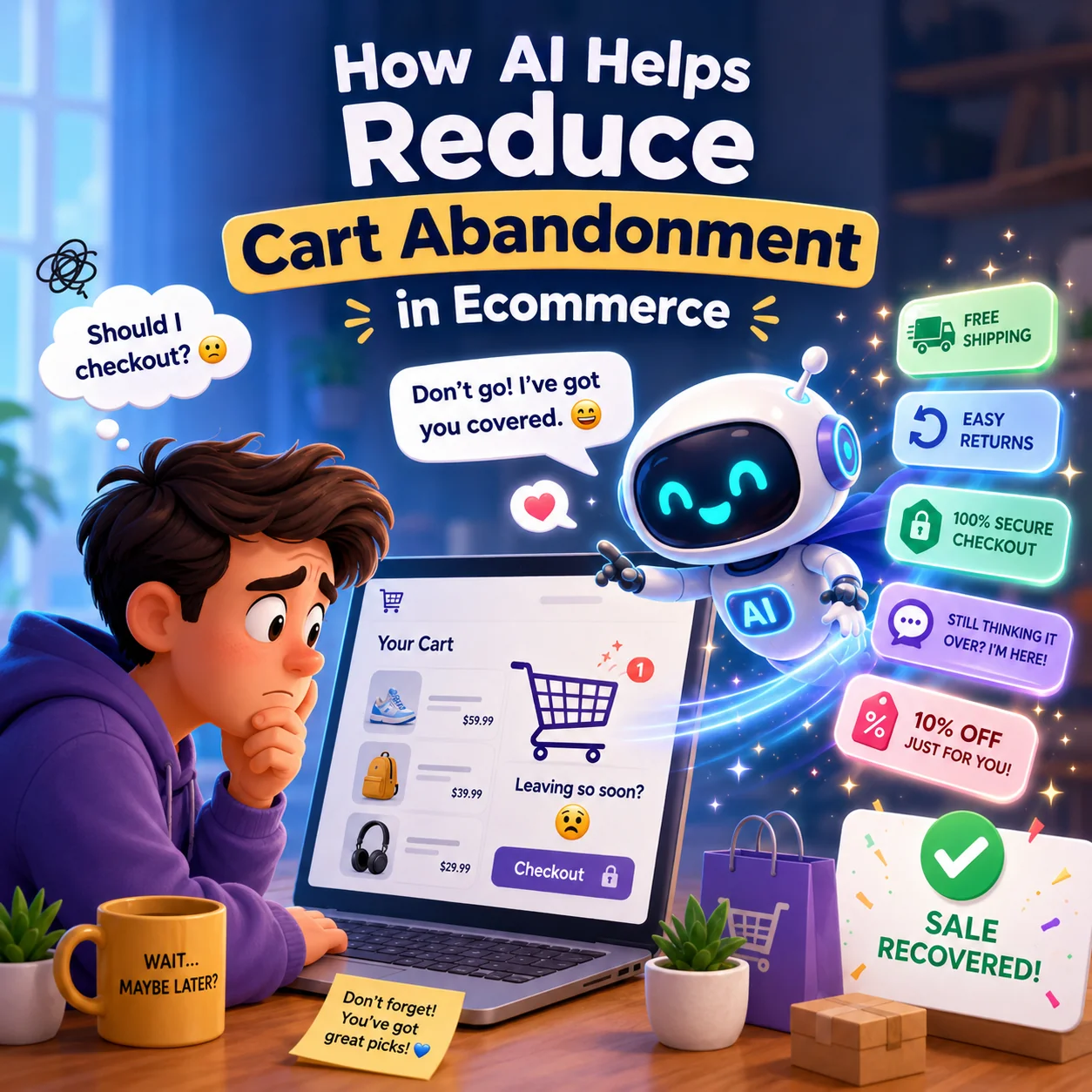
Cart abandonment is one of the most frustrating problems in ecommerce. According to the Baymard Institute, the average online shopping cart abandonment rate is about 70%, which means many shoppers add products to their cart but leave before completing the purchase.
A shopper visits your store, finds a product they like, adds it to the cart, and then leaves before completing the purchase. From the outside, it looks like the sale was almost finished. But for some reason, the customer stopped before checkout.
This does not always mean the shopper changed their mind completely.
Many abandoned carts happen because of small moments of friction. The customer may see an unexpected shipping cost. They may worry about delivery time. They may not understand the return policy. They may have a question about sizing, compatibility, payment options, or whether the product is really the right choice.
Sometimes, they simply get distracted and forget to come back.
This is where AI can help.
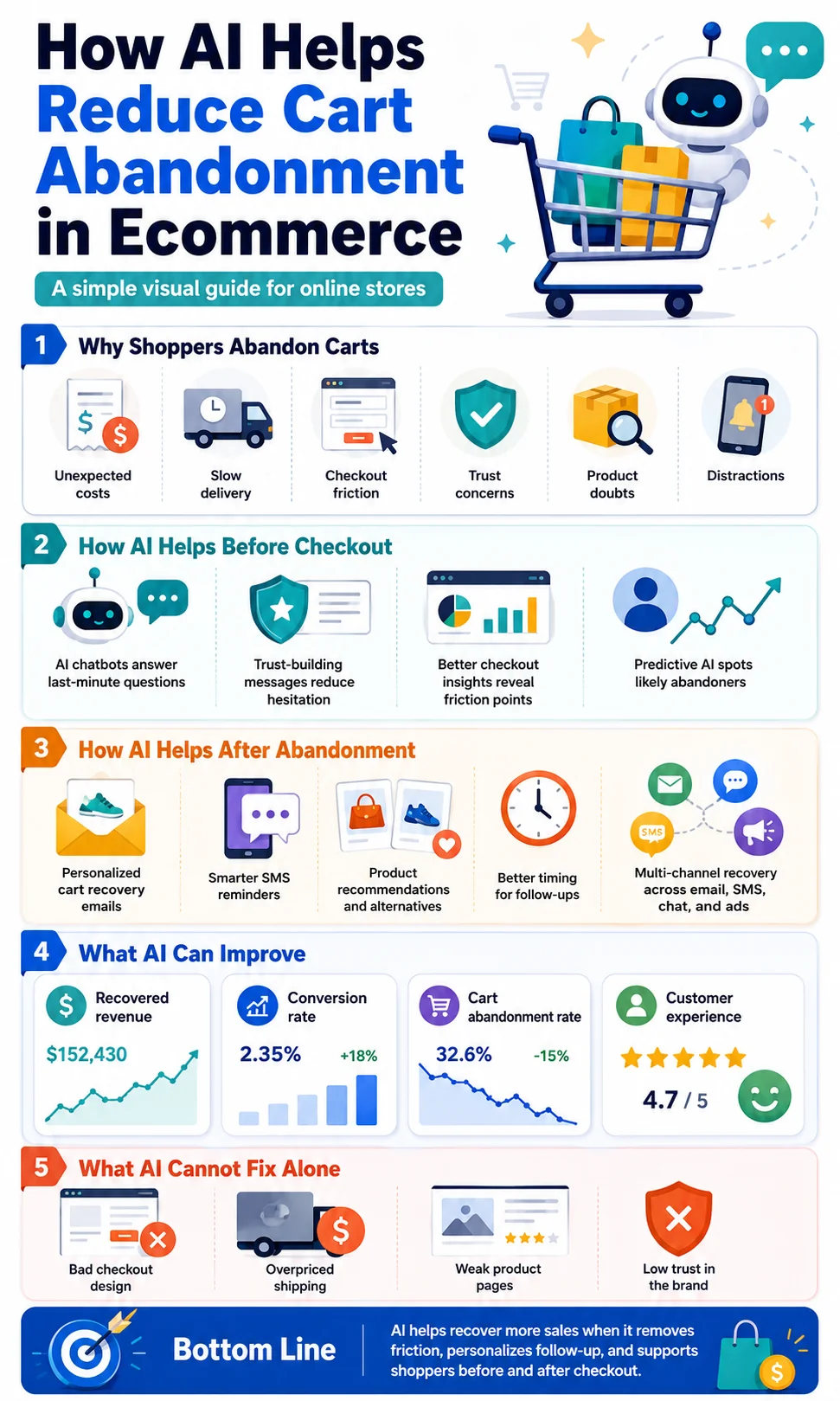
AI can reduce cart abandonment by helping ecommerce stores understand why shoppers leave, answer last-minute questions, personalize recovery messages, recommend better product options, and choose the right time to follow up. Instead of treating every abandoned cart the same way, AI can make the recovery process more relevant to each customer.
That does not mean AI is a magic fix for every checkout problem. If shipping is too expensive, the website is slow, or the checkout process is confusing, those issues still need to be fixed. But when AI is used properly, it can help remove some of the hesitation that stops shoppers from completing their orders.
In this guide, we’ll look at how AI helps reduce cart abandonment in ecommerce, what problems it can solve, what it cannot fix, and how online stores can measure whether AI cart recovery is actually working.
Quick Overview: How AI Helps Reduce Cart Abandonment
AI can help ecommerce stores reduce cart abandonment in several ways, from answering questions before checkout to personalizing recovery messages after a shopper leaves. The table below gives a quick overview of the main AI use cases and how they can help recover more sales.
| AI Use Case | What It Does | How It Reduces Cart Abandonment | Best For |
|---|---|---|---|
| AI chatbot support | Answers last-minute questions about shipping, returns, sizing, payment, delivery, and product details. | Reduces hesitation by giving shoppers quick answers before they leave the cart or checkout page. | Stores with many pre-purchase questions. |
| Personalized cart recovery | Customizes recovery emails, SMS messages, chatbot prompts, and reminders based on shopper behavior. | Makes follow-up messages feel more relevant than a generic “You left something behind” reminder. | Stores using email or SMS marketing. |
| Product recommendations | Suggests similar products, lower-priced alternatives, bundles, accessories, or better-fit options. | Helps recover sales when the original product in the cart was not quite right for the shopper. | Stores with large catalogs or many similar products. |
| Price and offer optimization | Uses discounts, free shipping reminders, price-drop alerts, bundles, and offer logic more strategically. | Helps reduce price hesitation without automatically giving every shopper the same coupon. | Stores with price-sensitive shoppers or higher cart values. |
| Checkout friction analysis | Identifies where shoppers leave during cart, shipping, payment, account creation, or checkout steps. | Shows store owners what part of checkout may need to be simplified or improved. | Stores with high checkout abandonment. |
| Predictive cart abandonment | Uses behavior signals to estimate which shoppers are most likely to leave before buying. | Allows stores to offer help, reassurance, or a relevant message before the cart is lost. | Growing stores with enough behavioral data. |
| Multi-channel recovery | Coordinates cart recovery across email, SMS, chatbots, push notifications, onsite messages, and ads. | Reaches shoppers through the channels where they are most likely to respond. | Stores with active marketing automation. |
| Trust-building messages | Highlights reviews, return policies, warranties, secure checkout, delivery details, and support options. | Reduces uncertainty for shoppers who are close to buying but still need reassurance. | New brands, high-ticket stores, and products where trust matters. |
Quick takeaway: AI helps reduce cart abandonment when it removes friction from the buying journey. The strongest results usually come from using AI to answer questions, personalize recovery messages, improve timing, recommend better products, and identify where shoppers hesitate before checkout.
What Is Cart Abandonment?
Cart abandonment happens when a shopper adds one or more products to their online shopping cart but leaves the store before completing the purchase.
In simple terms, the customer showed buying intent, but the order was never finished.
This can happen at different stages of the buying journey. Some shoppers leave right after adding a product to the cart. Others start the checkout process, enter some details, and then stop before paying. Shopify, for example, explains that an abandoned checkout happens when a customer starts checkout but leaves before completing the purchase, which is why many stores use abandoned checkout emails to bring shoppers back.
For store owners, cart abandonment is important because it shows a gap between interest and revenue. The shopper was not just browsing casually. They took an action that suggested they were considering a purchase.
That makes abandoned carts different from normal website exits.
If someone visits a product page and leaves, they may have only been researching. But if someone adds a product to the cart and then leaves, there was usually stronger intent. Something stopped them from finishing the order.
This is why cart abandonment is such a valuable signal in ecommerce. It tells the store that the customer may still be interested, but something in the process created friction.
That friction could be related to price, shipping, trust, payment options, product uncertainty, delivery time, or even a simple distraction. The job of AI is not only to send a reminder after the shopper leaves. A better use of AI is to understand what may have caused the hesitation and respond in a more useful way.
For example, a generic abandoned cart email may say, “You left something behind.” But an AI-assisted recovery system can be more specific. It may highlight free shipping, recommend a similar product, answer a common sizing question, or send the reminder at a better time based on shopper behavior.
So, cart abandonment is not just a lost sale. It is also a clue. It shows where shoppers are getting close to buying, where they are hesitating, and where the ecommerce experience may need improvement.
Why Do Shoppers Abandon Their Carts?
Shoppers abandon carts for many reasons, but most of them come down to one thing: friction.
The customer may still want the product, but something makes the purchase feel harder, riskier, more expensive, or less urgent. According to the Baymard Institute, common reasons for cart abandonment include extra costs, slow delivery, forced account creation, checkout complexity, trust concerns, and payment issues.
One of the biggest reasons is unexpected cost.
A shopper may like the product price on the product page, but then reach the cart and see shipping, taxes, fees, or other extra charges. At that moment, the order may no longer feel like a good deal. Even if the customer still likes the product, the final price can make them pause.
Delivery time is another major reason.
If the customer needs the product soon and the store does not clearly show delivery estimates, they may leave to compare other options. This is especially common for gifts, event-related purchases, fashion items, electronics, beauty products, and anything the shopper needs by a specific date.
Trust also matters a lot.
If a customer does not fully trust the store, they may hesitate before entering payment details. They may look for reviews, return information, warranty details, secure payment indicators, or signs that the business is legitimate. If those trust signals are missing or hard to find, the shopper may decide not to take the risk.
Some shoppers abandon their carts because the checkout process feels too long or annoying.
They may be asked to create an account, fill in too many fields, re-enter information, or go through too many steps. On mobile, even small checkout problems can feel bigger because typing is slower and screen space is limited.
Product uncertainty can also stop the sale.
A customer may wonder:
- Is this the right size?
- Will this fit my device?
- Can I return it if it does not work?
- Is this the best option for my needs?
- Are there better reviews for another product?
- Can I get this cheaper somewhere else?
These questions may seem small, but they can be enough to delay or kill the purchase.
There are also simpler reasons. Some people use the cart like a wishlist. Others get distracted, compare prices, wait for payday, or decide to come back later. Not every abandoned cart means the store did something wrong.
But many abandoned carts do reveal problems that can be improved.
AI can help by identifying patterns, answering questions, personalizing recovery messages, and giving store owners better insight into where shoppers hesitate. The more clearly a store understands why people abandon carts, the easier it becomes to reduce the problem.
How AI Can Identify Cart Abandonment Patterns
AI can help ecommerce stores reduce cart abandonment by finding patterns that are easy to miss manually.
A store owner may know that people are abandoning carts, but that is only the surface problem. The more useful question is: where are shoppers leaving, and what do those exits have in common?
For example, AI and analytics tools can help look at behavior such as:
- which products are added to carts but not purchased
- which checkout step loses the most shoppers
- whether customers leave after seeing shipping costs
- whether mobile users abandon more often than desktop users
- whether certain product categories have higher abandonment
- whether new customers abandon more often than returning customers
- whether shoppers leave after payment, delivery, or account creation steps
This kind of analysis matters because cart abandonment is not always caused by one single problem.
One store may lose shoppers because shipping costs appear too late. Another may lose them because the checkout form is too long. Another may have a trust issue. Another may have a mobile checkout problem. Another may have customers who are interested but waiting for a discount.
Google Analytics, for example, has a checkout journey report that helps stores see where users abandon each step of the checkout funnel. AI can build on this type of behavioral data by helping ecommerce teams spot repeated patterns, segment customers, and decide what kind of recovery message or store improvement makes the most sense.
For example, if shoppers often leave after seeing shipping costs, the store may need clearer shipping information earlier in the buying journey. If people abandon after choosing a size, the store may need a better size guide or an AI chatbot that answers fit questions. If shoppers abandon expensive products more often, the store may need stronger trust signals, financing options, reviews, or product comparison help.
AI can also help separate casual browsers from high-intent shoppers.
A person who adds one product and leaves after a few seconds may not need the same follow-up as someone who visited the product page three times, compared variants, added the item to the cart, started checkout, and then stopped at shipping.
Those two shoppers are not the same.
The second shopper is probably much closer to buying. AI can help identify that difference and trigger a more relevant response, such as a shipping clarification, a product question prompt, a personalized reminder, or a small incentive if it makes sense for the store.
This is where AI becomes more useful than a basic abandoned cart email.
Instead of treating every cart the same way, AI can help ecommerce stores understand the context behind the abandonment. That context can lead to better timing, better messaging, better product recommendations, and better checkout improvements.
In simple terms, AI helps store owners stop guessing. It gives them a clearer view of where shoppers hesitate and what can be improved before more sales are lost.
AI Chatbots Can Answer Last-Minute Questions Before Checkout
One of the most useful ways AI can reduce cart abandonment is by answering last-minute questions before the shopper leaves.
This is important because many customers do not abandon their cart because they hate the product. They abandon the cart because they are unsure about one small thing, and that small doubt is enough to stop the purchase.
At the cart or checkout stage, shoppers may ask questions like:
- How long does shipping take?
- Can I return this if it does not fit?
- Is this product available in another size or color?
- Will this work with my device?
- Do you offer free shipping?
- Can this arrive by Friday?
- Is this product safe for sensitive skin?
- What is the difference between these two options?
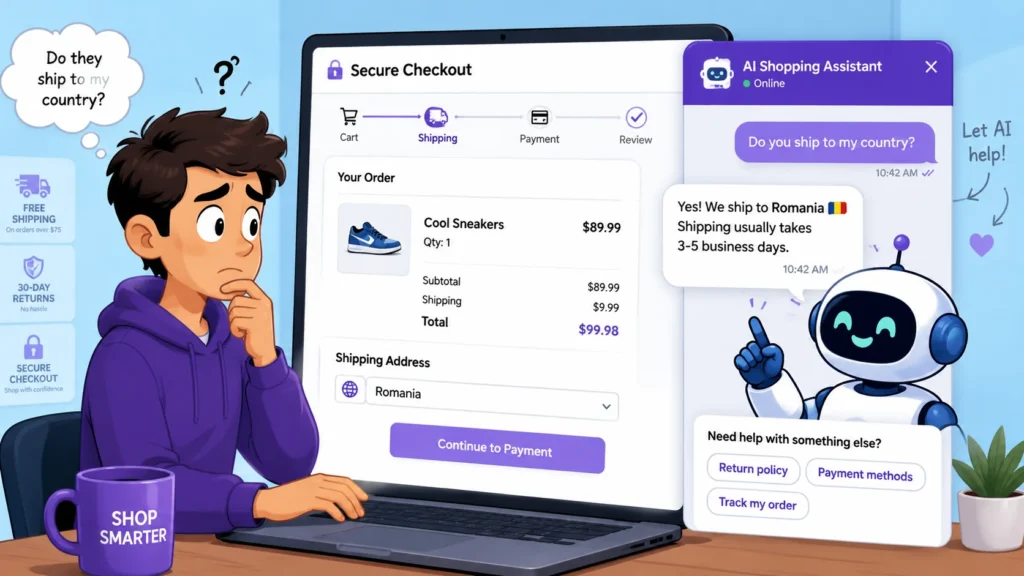
If the shopper cannot find the answer quickly, they may leave the store and look somewhere else.
An AI chatbot can help by giving fast answers inside the shopping experience. Shopify’s guide to live chat for customer service explains how real-time conversations can support shoppers during the buying process, not only after the purchase.
For ecommerce stores, this matters because timing is everything.
A question answered tomorrow may not save the sale. A question answered while the customer is still on the cart page might.
For example, if a shopper is worried about returns, the chatbot can explain the return policy. If they are unsure about sizing, it can point them to a size guide or ask a few questions. If they are checking delivery time, it can provide shipping information or help them understand available options.
This type of help can reduce hesitation.
It also makes the store feel more responsive. Even if the customer does not need a human agent, the simple fact that help is available can make the buying experience feel safer and more professional.
However, the chatbot must be accurate.
It should not guess about delivery dates, return rules, discounts, warranty details, or product compatibility. If the question is too complex or sensitive, the chatbot should offer a human handoff instead of trying to force an answer.
The best AI chatbot setup is not about replacing customer support completely. It is about answering simple but important questions at the exact moment when shoppers are deciding whether to complete the order.
When that happens, AI chatbots can turn hesitation into confidence, and confidence is often what moves a customer from cart to checkout. For a deeper look at this topic, read our guide on how AI chatbots help ecommerce stores sell more.
AI Can Personalize Cart Recovery Messages
Basic abandoned cart messages usually treat every shopper the same way.
They often say something simple like “You left something in your cart” or “Complete your order.” That can work sometimes, but it does not always match the reason the shopper left. One customer may be worried about shipping cost. Another may be comparing prices. Another may be unsure about size. Another may need more trust before entering payment details.
AI can make cart recovery messages more personal and more useful.
Instead of sending the same reminder to everyone, AI can help adjust the message based on customer behavior, cart value, product category, previous purchases, browsing history, and the stage where the shopper abandoned the purchase.
For example, an AI-assisted recovery message could focus on:
- the exact product left in the cart
- a reminder about free shipping
- a return policy reassurance
- a product review or rating
- a lower-priced alternative
- a compatible accessory
- a limited-time offer
- a delivery estimate
- a size guide or buying guide
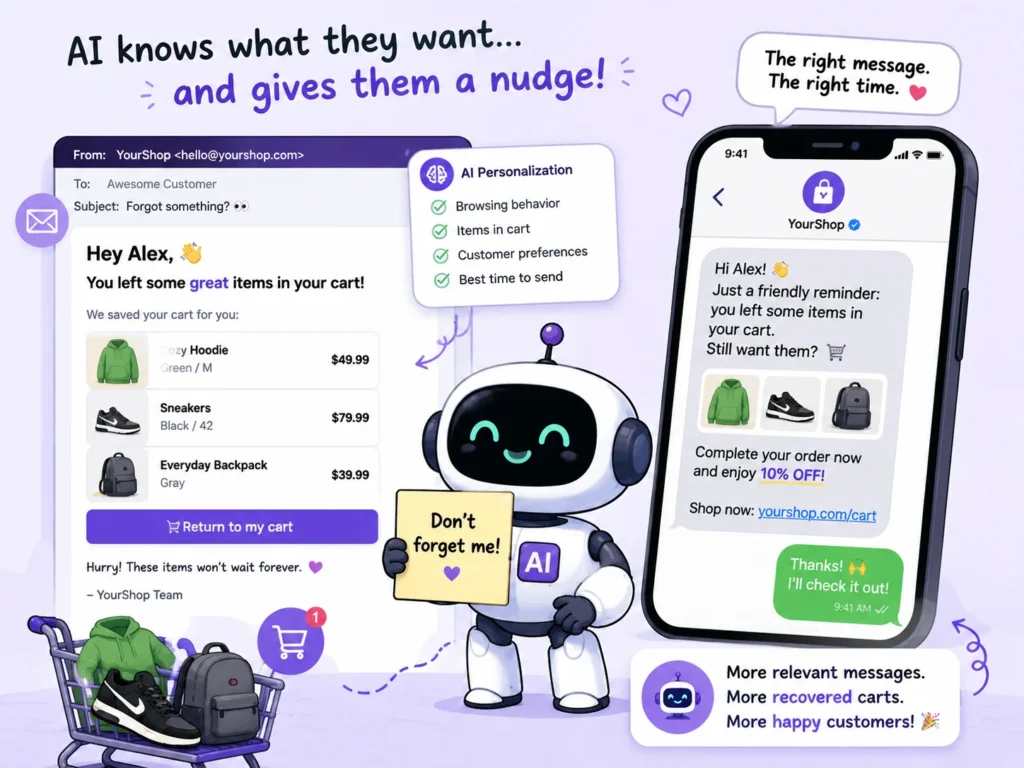
This matters because a good recovery message should not feel like a random automated reminder. It should feel like it understands what the shopper was trying to do.
Klaviyo’s guide on creating an abandoned cart flow shows how abandoned cart messages can use timing, dynamic product content, and follow-up emails to bring shoppers back after they leave.
AI can take that idea further by helping stores decide what kind of message makes the most sense for each shopper.
For example, a customer who abandoned a $35 skincare product may not need the same message as someone who abandoned a $900 espresso machine. The first shopper may respond to a simple reminder or product benefit. The second may need reviews, warranty details, financing information, shipping clarity, or a stronger trust signal.
AI can also help avoid overusing discounts.
Many stores rely too much on coupon codes for abandoned cart recovery. That can recover some orders, but it can also train customers to wait for discounts. A smarter approach is to use discounts only when needed and test other types of messages first, such as product education, social proof, shipping information, or customer support prompts.
Personalized cart recovery works best when the message matches the reason for hesitation.
If the shopper left because of uncertainty, give clarity. If they left because of price, show value or a relevant offer. If they left because the product was not quite right, recommend a better option. If they simply got distracted, a short reminder may be enough.
That is the real advantage of AI. It helps ecommerce stores move from generic reminders to smarter recovery messages that feel more relevant, more helpful, and more likely to bring the shopper back.
AI Product Recommendations Can Recover Lost Sales
Sometimes, a shopper does not abandon the cart because they no longer want to buy. They abandon it because the product in the cart is not quite right.
Maybe the price feels too high. Maybe the size is uncertain. Maybe the customer is comparing similar options. Maybe they like the idea of the product, but they are not fully convinced that this specific item is the best choice.
This is where AI product recommendations can help.
Instead of only reminding shoppers about the exact product they left behind, AI can suggest better alternatives or complementary options that match the shopper’s intent. Shopify explains that AI recommendation systems can use customer behavior, product attributes, and past interactions to suggest more relevant products to online shoppers.
For cart abandonment, this can be very useful.
For example, if a shopper abandons an expensive pair of running shoes, AI may recommend a similar pair at a lower price. If someone leaves a camera in the cart, AI may suggest a beginner-friendly alternative, a bundle with a memory card, or a model with stronger reviews. If a customer abandons a skincare product, AI may recommend a product better suited to their skin type or concern.
AI recommendations can help recover lost sales in several ways:
- suggesting lower-priced alternatives
- showing similar products with better reviews
- recommending products with faster shipping
- offering bundles that feel like better value
- showing compatible accessories
- highlighting bestsellers in the same category
- recommending products based on previous browsing behavior
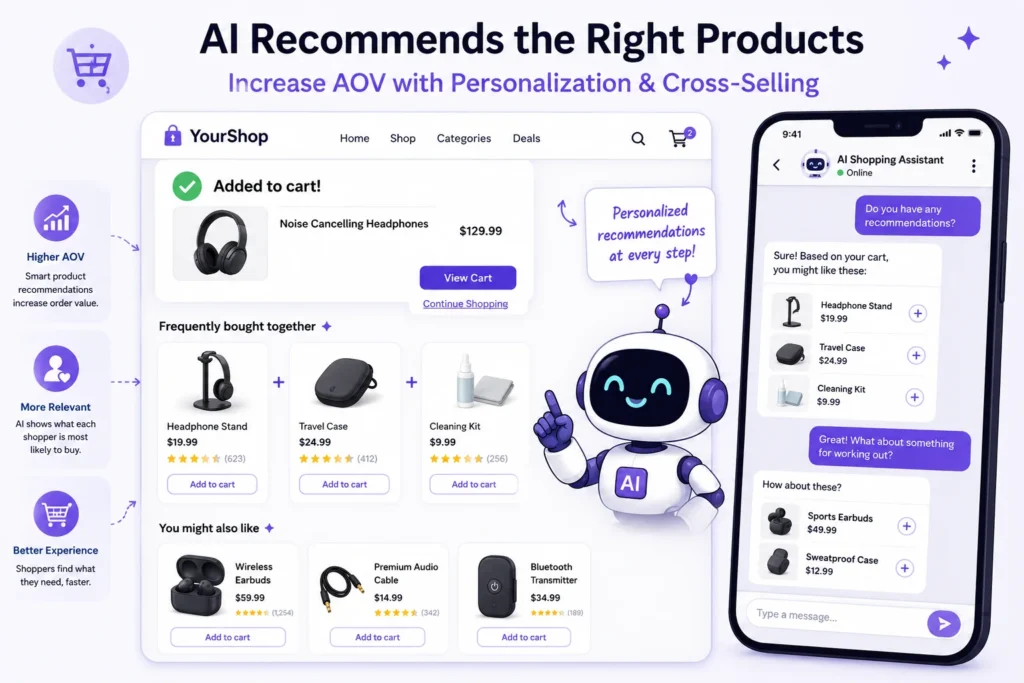
This matters because abandoned cart recovery should not always be about pushing the same product again.
If the shopper left because they had doubts about that exact item, repeating the same product may not solve the problem. A smarter approach is to help the shopper find a product that fits better.
For example, a customer shopping for a laptop may abandon a high-end model after seeing the final price. Instead of sending only a reminder, the store could recommend a slightly cheaper model with similar specs. That gives the shopper another path to purchase instead of losing the sale completely.
AI can also help increase average order value when the shopper is already close to buying.
If someone abandons a coffee machine, the recovery message could include coffee beans, filters, cleaning tablets, or a starter bundle. If someone leaves a dress in the cart, the store could recommend shoes or accessories that match. If someone leaves a baby stroller in the cart, the store could recommend a rain cover, organizer, or car seat adapter.
The key is relevance.
Bad recommendations can feel random or pushy. Good recommendations feel helpful. They show the shopper that the store understands what they are trying to buy and gives them better options instead of simply shouting, “Come back and complete your order.”
AI product recommendations can recover lost sales because they give shoppers another reason to continue. Sometimes that reason is a better product. Sometimes it is a better price. Sometimes it is a useful add-on. And sometimes it is just the confidence that they are making the right choice. Product recommendations are also part of the larger AI shopping assistant experience, which we explain in more detail in our guide on what an AI shopping assistant is and how it works.
AI Can Help Reduce Price-Related Abandonment
Price is one of the biggest reasons shoppers hesitate before checkout.
A customer may like the product, but once they see the final total, they start thinking again. The product price, shipping cost, taxes, fees, or lack of a discount can make the order feel more expensive than expected.
This does not always mean the shopper cannot afford the product. Sometimes they simply feel unsure about the value.
AI can help ecommerce stores reduce price-related abandonment by making pricing, offers, and product value feel more relevant to each shopper.
For example, AI can help with:
- personalized discount offers
- free shipping threshold reminders
- price-drop alerts
- bundle recommendations
- lower-priced product alternatives
- payment option suggestions
- value-based product comparisons
- timed recovery messages for high-intent shoppers
Shopify’s guide to discount pricing strategies explains different ways ecommerce stores can use discounts, bundles, free shipping, and promotional offers to encourage purchases without relying on random price cuts.
This is important because not every abandoned cart needs a coupon.
If a store sends a discount every time someone abandons a cart, customers may learn to wait. They add products to the cart, leave, and expect a coupon to arrive later. That can hurt profit margins and train shoppers to avoid paying full price.
AI can help stores become more selective.
For example, a first-time visitor who abandons a low-value cart may not need a discount. A returning customer with a high-value cart may be worth a stronger recovery offer. A shopper who leaves after seeing shipping costs may respond better to a free shipping reminder than a percentage discount.
AI can also help stores recommend better-value options instead of immediately reducing the price.
If someone abandons a premium product, the store can show a similar lower-priced alternative. If someone leaves because the order total feels too high, the store can recommend a bundle that creates more value. If a shopper is close to a free shipping threshold, the store can suggest a small add-on that helps them qualify.
This kind of personalization can feel more helpful than a generic coupon.
For example, instead of saying, “Here is 10% off,” the store might say, “You are $12 away from free shipping,” or “Here is a similar option with faster delivery,” or “This bundle includes the accessory most customers buy with this product.”
That gives the shopper a reason to reconsider the purchase without making the store look desperate.
Price-related abandonment is not always about making products cheaper. Often, it is about making the value clearer.
AI can help ecommerce stores understand when to offer a discount, when to highlight benefits, when to recommend alternatives, and when to focus on shipping, bundles, or payment flexibility.
Used carefully, AI can reduce price-related cart abandonment while protecting the store’s margins.
AI Can Improve the Checkout Experience
AI can also help reduce cart abandonment by showing ecommerce stores where the checkout experience creates friction.
Sometimes, the problem is not the product. It is the checkout process itself.
A shopper may be ready to buy, but then the checkout feels too long, confusing, slow, or inconvenient. They may have to create an account, enter too much information, deal with payment errors, wait for pages to load, or search for delivery details that should have been clear earlier.
Small checkout problems can turn into lost sales very quickly.
Shopify’s guide to checkout page design recommends keeping checkout simple, offering express checkout, accepting multiple payment methods, enabling guest checkout, and reassuring customers with a secure checkout experience.
AI can help stores find which of these areas may be causing problems.
For example, AI and analytics tools can detect patterns like:
- customers leaving after seeing the shipping page
- mobile users abandoning more often than desktop users
- payment failures happening with specific methods
- customers stopping when account creation is required
- high abandonment on pages with slow loading times
- users repeatedly editing shipping or billing fields
- customers leaving after discount codes fail
These patterns can help store owners understand what needs to be fixed.
If many shoppers leave after the shipping step, the store may need clearer shipping costs earlier in the journey. If mobile abandonment is high, the checkout may need better mobile optimization. If many users leave after a failed payment, the store may need more payment options or a clearer error message.
AI can also help prioritize improvements.
Instead of guessing whether to change button colors, add more trust badges, rewrite product descriptions, or simplify forms, store owners can focus on the checkout points where customers are actually dropping off.
This is important because checkout optimization should be practical, not random.
A store does not need to change everything at once. It needs to find the moments where shoppers hesitate and remove as much friction as possible.
AI can also support checkout personalization.
For example, a returning customer may see faster payment options, a shopper near a free shipping threshold may see a relevant reminder, and a customer with a high-value cart may receive extra reassurance about returns, warranty, or delivery.
The goal is not to make checkout complicated with too many messages.
The goal is to make checkout feel easier, clearer, and safer.
When AI helps a store understand checkout friction and respond at the right moment, it can reduce abandonment and help more shoppers complete the purchase they already started.
AI Can Predict Which Carts Are Most Likely to Be Abandoned
AI can help ecommerce stores move from reacting to abandoned carts to predicting which carts are most likely to be abandoned in the first place.
This is important because not every shopper behaves the same way.
Some customers add products to the cart casually, almost like they are saving items for later. Others are much closer to buying. They may view the same product several times, compare variants, read reviews, add the item to the cart, start checkout, and then hesitate at the final step.
AI can help identify those different levels of intent.
For example, AI may look at signals like:
- how many times the shopper visited the product page
- whether they compared similar products
- whether they added and removed items from the cart
- how long they stayed on the cart page
- whether they paused at the shipping or payment step
- whether they returned to the store multiple times
- whether they used a discount code field
- whether they checked delivery or return information
Google Analytics, for example, offers predictive metrics such as purchase probability, churn probability, and predicted revenue for eligible properties. Ecommerce stores can use this kind of predictive thinking to understand which shoppers are more likely to buy, which may leave, and which may need a more relevant follow-up.
For cart abandonment, this can be very useful.
A shopper who reaches checkout and stops at the shipping page may need delivery clarity. A shopper who removes an expensive product may need a cheaper alternative. A shopper who keeps returning to the same product may need reassurance, reviews, or a limited-time reminder.
AI can help trigger different responses depending on the predicted reason for hesitation.
For example, a high-intent shopper may receive a cart reminder sooner than a casual browser. A shopper with a high-value cart may receive a message that highlights warranty, customer support, or secure checkout. A shopper who seems price-sensitive may receive a bundle offer, free shipping reminder, or lower-priced product suggestion.
This does not mean stores should pressure every visitor with aggressive messages.
Prediction should be used carefully. The goal is not to annoy customers. The goal is to understand when someone may need help and provide the right kind of help at the right moment.
When used well, predictive AI can help ecommerce stores focus their recovery efforts on the carts that matter most. Instead of sending the same message to everyone, the store can respond based on customer behavior, purchase intent, and the likely reason behind the hesitation.
AI Can Help Recover Abandoned Carts Across Multiple Channels
Abandoned cart recovery is not limited to email anymore.
Email is still one of the most common recovery channels, but shoppers do not all respond the same way. Some people check email often. Others respond faster to SMS. Some may come back after seeing an onsite message, a push notification, a chatbot prompt, or a retargeting ad.
AI can help ecommerce stores recover abandoned carts across multiple channels instead of relying on one generic follow-up.
For example, cart recovery can happen through:
- email reminders
- SMS messages
- onsite chatbot messages
- push notifications
- WhatsApp messages
- Messenger conversations
- retargeting ads
- personalized website banners
Mailchimp’s guide to abandoned cart automation flows shows how ecommerce stores can use automated email or SMS workflows to bring shoppers back after they leave items in their cart.
The advantage of AI is that it can help decide which message, channel, and timing may work best for each shopper.
For example, a returning customer who usually opens emails may receive an email reminder. A mobile-first customer who opted in to SMS may receive a short text message. A shopper still browsing the site may see a chatbot prompt before leaving. A customer who looked at the same product multiple times may later see a retargeting ad with that product or a similar alternative.
This matters because abandoned cart recovery should feel helpful, not random.
If a shopper receives too many messages in too many places, the store can look pushy. But if the recovery message appears in the right channel at the right time, it can feel like a useful reminder.
AI can also help coordinate messages so the customer does not receive the same reminder again and again.
For example, if the shopper returns and completes the purchase after an email, the store should not keep sending SMS reminders or ads for the same cart. If the customer clicks a product recommendation but still does not buy, the next message can focus on reviews, delivery, or a better offer instead of repeating the same text.
Multi-channel cart recovery works best when the channels are connected.
The goal is not to chase the customer everywhere. The goal is to understand where the shopper is most likely to respond and use that channel in a respectful, relevant way.
When AI helps coordinate email, SMS, chatbots, onsite messages, and ads, abandoned cart recovery can become more intelligent. Instead of one basic reminder, the store can create a smoother recovery journey that gives the shopper more chances to come back and finish the order.
AI Can Improve Timing for Cart Recovery
Timing can make a big difference in abandoned cart recovery.
If a message arrives too late, the shopper may have already bought from another store, lost interest, or forgotten why they wanted the product in the first place. If the message arrives too quickly, it can feel pushy, especially if the customer is still browsing or simply stepped away for a moment.
AI can help ecommerce stores find better timing for cart recovery messages by looking at customer behavior, purchase intent, product type, cart value, and past response patterns.
For example, Klaviyo’s guide to creating an abandoned cart flow recommends adding a time delay before the first reminder and testing what works best for the business, because different brands and audiences may respond differently.
This is exactly where AI can be useful.
A shopper who abandons a low-cost product may respond well to a quick reminder. A shopper considering a high-ticket item may need more time, more reassurance, or a follow-up that includes reviews, warranty details, or financing information. A returning customer may need a different timing sequence than someone visiting the store for the first time.
AI can help optimize timing based on patterns such as:
- how soon customers usually return after abandoning a cart
- which time delays lead to more recovered orders
- whether email, SMS, or chatbot reminders work faster
- which product categories need longer decision time
- whether high-value carts require a different follow-up sequence
- when specific customers are most likely to open or click messages
This allows stores to avoid a one-size-fits-all recovery strategy.
Instead of sending every abandoned cart email after the same delay, AI can help adjust the follow-up based on the shopper and the situation. Some customers may need a reminder after one hour. Others may respond better after several hours. Some may need a second reminder the next day. Others may need no discount at all, just clearer shipping or return information.
Timing also matters across channels.
An email may work well after a few hours. A chatbot message may work while the shopper is still on the site. An SMS may be better for customers who opted in and usually respond quickly. Retargeting ads may work later, after the shopper continues browsing elsewhere.
AI can help coordinate these touchpoints so the store does not overwhelm the customer.
The goal is not to send more messages. The goal is to send better messages at better moments.
When cart recovery timing is smarter, the message feels less like an interruption and more like a useful reminder. That can help bring shoppers back while their interest is still fresh, without making the store feel aggressive or annoying.
AI Can Improve Timing for Cart Recovery
Timing can make a big difference in abandoned cart recovery.
If a message arrives too late, the shopper may have already bought from another store, lost interest, or forgotten why they wanted the product in the first place. If the message arrives too quickly, it can feel pushy, especially if the customer is still browsing or simply stepped away for a moment.
AI can help ecommerce stores find better timing for cart recovery messages by looking at customer behavior, purchase intent, product type, cart value, and past response patterns.
For example, Klaviyo’s guide to creating an abandoned cart flow recommends adding a time delay before the first reminder and testing what works best for the business, because different brands and audiences may respond differently.
This is exactly where AI can be useful.
A shopper who abandons a low-cost product may respond well to a quick reminder. A shopper considering a high-ticket item may need more time, more reassurance, or a follow-up that includes reviews, warranty details, or financing information. A returning customer may need a different timing sequence than someone visiting the store for the first time.
AI can help optimize timing based on patterns such as:
- how soon customers usually return after abandoning a cart
- which time delays lead to more recovered orders
- whether email, SMS, or chatbot reminders work faster
- which product categories need longer decision time
- whether high-value carts require a different follow-up sequence
- when specific customers are most likely to open or click messages
This allows stores to avoid a one-size-fits-all recovery strategy.
Instead of sending every abandoned cart email after the same delay, AI can help adjust the follow-up based on the shopper and the situation. Some customers may need a reminder after one hour. Others may respond better after several hours. Some may need a second reminder the next day. Others may need no discount at all, just clearer shipping or return information.
Timing also matters across channels.
An email may work well after a few hours. A chatbot message may work while the shopper is still on the site. An SMS may be better for customers who opted in and usually respond quickly. Retargeting ads may work later, after the shopper continues browsing elsewhere.
AI can help coordinate these touchpoints so the store does not overwhelm the customer.
The goal is not to send more messages. The goal is to send better messages at better moments.
When cart recovery timing is smarter, the message feels less like an interruption and more like a useful reminder. That can help bring shoppers back while their interest is still fresh, without making the store feel aggressive or annoying.
AI Can Build More Trust Before Purchase
Some shoppers abandon their carts because they do not fully trust the store yet.
This is especially common when someone is buying from a brand for the first time. They may like the product, but before entering payment details, they start looking for signs that the store is safe, reliable, and easy to deal with if something goes wrong.
Trust can be the difference between a completed order and an abandoned cart.
A shopper may ask themselves:
- Is this store legitimate?
- Will my order arrive on time?
- Can I return the product if it does not work?
- Are there real customer reviews?
- Is the payment process secure?
- What happens if the product arrives damaged?
- Can I contact support if I need help?
If those questions are not answered clearly, the customer may leave before buying.
AI can help reduce this kind of cart abandonment by making trust-building information easier to find at the right moment. The Baymard Institute explains that trust signals in ecommerce can influence whether users feel comfortable completing a purchase, especially when they are evaluating an unfamiliar online store.
For example, an AI chatbot can answer questions about returns, warranties, shipping times, product materials, payment security, and customer support. An AI cart recovery system can also include trust-focused information in follow-up messages, such as reviews, guarantees, delivery details, or return policy reminders.
This is useful because trust concerns often appear near the end of the buying journey.
The shopper may already want the product. They may already have it in the cart. But when it is time to pay, they hesitate. At that moment, a simple reminder about free returns, secure checkout, verified reviews, or fast support can help reduce uncertainty.
AI can also personalize trust signals based on the product or customer behavior.
For example, someone buying an expensive electronics product may care about warranty and compatibility. Someone buying skincare may care about ingredients, safety, and reviews from people with similar skin concerns. Someone buying furniture may care about delivery, damage protection, and return rules.
Instead of showing the same generic trust message to everyone, AI can help show the most relevant reassurance for that shopper.
This can include:
- highlighting customer reviews for the product in the cart
- showing return policy details before checkout
- answering warranty questions instantly
- explaining delivery timelines clearly
- reminding shoppers about secure payment options
- showing customer support availability
- recommending products with stronger ratings or better fit
Trust-building should not feel fake or forced.
The goal is not to overwhelm the shopper with badges, popups, and promises. The goal is to answer the concerns that may stop the purchase.
AI helps because it can respond to those concerns in context. If the shopper asks about returns, the answer should focus on returns. If they pause at delivery, the message should focus on shipping. If they compare expensive products, the store may need to highlight reviews, warranty, or support.
When customers feel informed and protected, they are more likely to finish the order.
That is why AI can help build trust before purchase. It gives shoppers the right reassurance at the right time, which can reduce hesitation and help more carts turn into completed sales.
What AI Cannot Fix About Cart Abandonment
AI can help reduce cart abandonment, but it cannot fix every problem by itself.
This is important to understand because some ecommerce stores expect AI to solve issues that are really caused by weak fundamentals. If the store has a slow website, confusing checkout, poor product pages, unclear policies, or expensive shipping, AI may help a little, but it will not magically remove the deeper problem.
For example, AI can remind a shopper to come back to their cart, but it cannot make a bad checkout experience feel good. Baymard’s research on checkout usability shows how many ecommerce checkout issues come from friction in the checkout flow itself, which means the store still needs to improve the user experience, not only automate follow-up messages.
AI also cannot make an overpriced product feel like a good deal if shoppers can easily find a better offer somewhere else.
It may suggest a discount, show a bundle, or highlight product benefits, but if the pricing is far away from customer expectations, the store may still lose the sale. In that case, the problem is not only cart recovery. It may be positioning, pricing, product value, or competition.
AI also cannot fully fix trust problems.
A chatbot can answer questions about returns, shipping, warranties, and payment security. A recovery email can show reviews or guarantees. But if the store looks unprofessional, has no real reviews, hides important policies, or feels risky, many shoppers will still hesitate.
The same applies to poor product presentation.
If product photos are weak, descriptions are vague, size guides are missing, or important details are hard to understand, AI may only be covering up a bigger content problem. Shoppers need enough information to feel confident before they buy.
AI cannot fully fix:
- very expensive shipping
- slow website speed
- broken checkout pages
- confusing forms
- limited payment options
- unclear return policies
- poor product photos
- weak product descriptions
- lack of customer reviews
- uncompetitive pricing
- low trust in the brand
This does not mean AI is not useful.
It means AI works best when the store already has a solid shopping experience. The better the product pages, checkout flow, shipping information, reviews, and support process are, the more effective AI cart recovery can become.
Think of AI as an optimization layer, not a replacement for the basics.
It can help identify friction, personalize messages, recommend alternatives, answer questions, and recover lost carts. But the store still needs to offer a buying experience that feels clear, trustworthy, and easy to complete.
When the fundamentals are weak, fix those first. When the fundamentals are strong, AI can help recover more sales from shoppers who were already close to buying.
Best Ecommerce Stores for Cart Abandonment AI
AI cart abandonment tools can help many ecommerce stores, but they are most useful when the store already has enough traffic and enough buying intent to make recovery worthwhile.
In other words, AI works best when people are already adding products to the cart, but something stops them before checkout.
If a store has very little traffic, the first priority may be getting more visitors. If people visit but do not add products to the cart, the bigger issue may be product pages, pricing, photos, or product-market fit. But if shoppers are adding products to the cart and leaving before payment, AI can become much more valuable.
BigCommerce’s guide to abandoned carts explains that abandoned cart recovery can include tactics like personalized follow-up emails, exit-intent popups, retargeting, and incentives. AI can make these tactics more relevant by helping stores understand customer behavior and personalize the recovery journey.
The best candidates for cart abandonment AI usually include:
- stores with steady traffic
- stores with a high cart abandonment rate
- stores with medium or high average order value
- stores with products that require explanation
- stores with large product catalogs
- stores with repeat customers
- stores that already use email or SMS marketing
- stores that receive many pre-purchase questions
- stores selling products where trust matters before checkout
Fashion stores can benefit because shoppers often hesitate over sizing, fit, colors, and returns. An AI chatbot or recovery system can answer size questions, suggest similar products, or remind shoppers about easy exchanges.
Beauty and skincare stores can also benefit because customers may need help with ingredients, skin type, routines, and product combinations. If someone abandons a moisturizer, AI may recommend a product for dry skin, sensitive skin, or anti-aging concerns based on previous behavior or questions.
Electronics stores are another strong fit.
Customers often compare specs, compatibility, warranties, and prices before buying. If a shopper abandons a laptop, camera, smart device, or accessory, AI can help by recommending alternatives, explaining product differences, or highlighting warranty and support information.
Furniture and home goods stores can also use AI cart recovery well because shoppers often need reassurance about dimensions, delivery, materials, assembly, and returns. These are not always impulse purchases. Customers may need extra confidence before completing the order.
AI cart abandonment tools are also useful for stores selling higher-ticket products.
The more expensive the product, the more hesitation a customer may feel before buying. AI can help by showing reviews, explaining payment options, highlighting guarantees, answering questions, or recommending a slightly lower-priced alternative.
That said, AI cart abandonment tools may not be the first priority for every store.
If the store has almost no traffic, a very small catalog, weak product pages, or no clear demand, AI recovery will have limited impact. There simply may not be enough abandoned carts to recover.
The best use case is a store where shoppers are already showing interest, but too many of them leave before completing the order.
For those stores, AI can help turn abandoned carts into a more useful sales opportunity. It can identify patterns, personalize messages, recommend better options, and help customers come back when they were already close to buying.
Features to Look for in an AI Cart Abandonment Tool
Not every cart abandonment tool is the same.
Some tools only send a basic abandoned cart email. Others support advanced automation, customer segmentation, SMS reminders, product recommendations, discounts, checkout analytics, and revenue attribution. For ecommerce stores that want to use AI seriously, the goal is to choose a tool that does more than send one generic reminder.
A good AI cart abandonment tool should help the store understand why shoppers leave and give the business practical ways to bring them back.
Shopify’s documentation on recovering abandoned checkouts shows the basic idea: stores can review abandoned checkouts and use recovery emails to encourage shoppers to return. AI-focused tools can build on that foundation with more personalization, smarter timing, better segmentation, and deeper reporting.
Cart behavior tracking
The tool should track what shoppers do before they abandon the cart.
This includes which products they added, where they stopped, whether they reached checkout, whether they viewed shipping information, and whether they returned later. Without behavior tracking, the store is mostly guessing.
Email and SMS recovery flows
A strong cart abandonment tool should support automated recovery flows across email and, where appropriate, SMS.
Email works well for detailed reminders, product photos, reviews, and return policy information. SMS can work well for short, urgent reminders, especially when customers have clearly opted in.
AI message personalization
Personalization is one of the biggest reasons to use AI.
The tool should help customize messages based on the product, cart value, customer behavior, previous purchases, and likely reason for abandonment. A shopper leaving a $40 beauty product should not receive the same message as someone abandoning a $1,200 furniture order.
Product recommendation engine
A useful AI cart abandonment tool should be able to recommend relevant products.
This may include similar products, lower-priced alternatives, better-rated options, complementary items, bundles, or products with faster shipping. This is helpful when the original product in the cart was not quite right for the shopper.
Discount and offer logic
The tool should allow smart discount rules.
That does not mean every abandoned cart should receive a coupon. A better setup allows the store to decide when to offer a discount, when to show free shipping, when to suggest a bundle, and when to avoid discounts completely.
Checkout analytics
Cart recovery is easier when the store knows where people leave.
The tool should show whether shoppers abandon at the cart page, shipping step, payment step, discount code field, account creation step, or another part of checkout. These details help the store fix the real problem instead of only sending reminders.
Customer segmentation
Different customers need different recovery strategies.
A good tool should let the store segment shoppers by cart value, product category, customer type, location, purchase history, traffic source, and engagement level. This makes recovery messages more relevant and less repetitive.
A/B testing
Store owners should be able to test different messages, subject lines, offers, timing, and channels.
For example, one version may highlight free shipping, while another highlights reviews. One sequence may send the first reminder after one hour, while another waits longer. Testing helps the store learn what actually works with its audience.
Ecommerce platform integration
The tool should connect easily with the platform the store already uses.
For many ecommerce businesses, that means Shopify, WooCommerce, BigCommerce, Magento, or a custom store setup. Good integration makes it easier to access product data, cart data, customer data, and order data.
Revenue attribution
Finally, the tool should show whether it is actually recovering revenue.
Useful reporting should include recovered orders, recovered revenue, message performance, click-through rate, conversion rate, revenue per recipient, and the cost of discounts used in recovery campaigns.
This matters because the goal is not just to send more messages. The goal is to recover profitable sales.
The best AI cart abandonment tool is one that combines automation with intelligence. It should help the store understand shopper behavior, personalize follow-up, recommend better products, test different strategies, and measure the results clearly. Shopify store owners can also compare broader ecommerce AI options in our guide to the best AI tools for Shopify store owners.
How to Measure Whether AI Reduces Cart Abandonment
AI cart recovery should be measured like any other ecommerce investment.
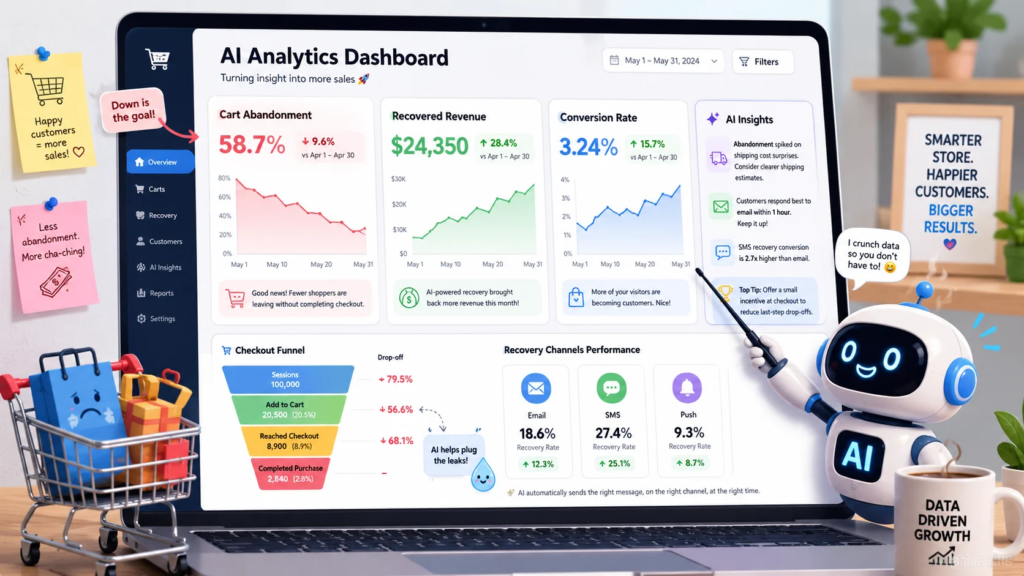
It is not enough to say, “The tool sent a lot of messages” or “Customers clicked the chatbot.” Those numbers can be useful, but they do not prove that AI is actually reducing cart abandonment or recovering profitable sales.
The real question is simple: are more shoppers completing their orders because of the AI system?
To answer that, ecommerce stores should track a few key metrics.
Cart abandonment rate
This is the main metric.
Cart abandonment rate shows how many shoppers add products to the cart but do not complete the purchase. If AI is working, the store should eventually see this number improve, especially for customer segments where AI recovery messages, chatbots, or personalized offers are being used.
Checkout abandonment rate
Checkout abandonment is slightly different from cart abandonment.
It focuses on shoppers who actually start checkout but leave before paying. Google Analytics explains that the checkout journey report can show how many users abandon each step in the checkout funnel, which helps stores understand where customers are dropping off.
This is useful because a shopper who abandons at the cart page may need a different solution than someone who abandons at the payment step.
Recovered revenue
Recovered revenue shows how much money came from abandoned cart recovery campaigns.
This may include purchases from cart recovery emails, SMS messages, chatbot prompts, push notifications, or retargeting campaigns. It is one of the most important numbers because it connects AI recovery directly to sales.
Conversion rate from recovery messages
Stores should measure how many shoppers return and buy after receiving a recovery message.
For example, if 1,000 abandoned cart emails are sent and 50 people complete a purchase, that gives the store a clearer view of whether the recovery flow is working.
Click-through rate
Click-through rate shows whether shoppers are interested enough to click back to the cart, product page, or checkout page.
A low click-through rate may mean the message is too generic, the timing is wrong, the subject line is weak, or the offer is not relevant.
Average order value
AI cart recovery should not only bring people back. It may also influence what they buy.
If AI recommends bundles, accessories, or better-fit products, the store should track whether average order value changes. A good AI recommendation system may help recover the sale and increase the order value at the same time.
Discount usage and margin impact
Recovered revenue can look good on the surface, but stores also need to watch discount usage.
If the AI system recovers carts only by offering large discounts, the store may be getting revenue but losing margin. That is why it is important to compare recovered sales with the cost of incentives, free shipping, coupons, and promotional offers.
Revenue per recipient
Revenue per recipient is useful for email and SMS recovery campaigns.
It shows how much revenue each message recipient generates on average. This can help compare different flows, timing rules, customer segments, and message types.
Customer satisfaction
Cart recovery should not annoy shoppers.
If AI messages feel too aggressive, too frequent, or too personal in a creepy way, they can damage the customer experience. Stores should review customer feedback, unsubscribe rates, spam complaints, chatbot ratings, and support replies to make sure recovery campaigns still feel helpful.
Return on investment
Finally, stores should compare the value created by AI cart recovery with the cost of the tool.
This includes software fees, SMS costs, discount costs, setup time, and ongoing management. If the system recovers enough profitable sales and reduces manual work, it may be worth keeping. If it only sends more messages without improving revenue, it may need to be adjusted or replaced.
The best way to measure AI cart abandonment performance is to look at the full picture: abandonment rate, recovered revenue, conversion rate, customer experience, and profit margin.
AI should not just make the store busier. It should help more shoppers complete their orders in a way that still makes financial sense for the business.
Is AI Worth Using for Cart Abandonment?
AI is worth using for cart abandonment when the store has a real abandonment problem and enough shopping activity to make recovery meaningful.
For example, if people are visiting the store, adding products to the cart, starting checkout, and then leaving, AI can help. It can identify patterns, answer questions, personalize follow-up messages, recommend better products, improve timing, and recover some of the sales that would otherwise be lost.
But AI is not always the first thing a store should invest in.
If the store has very little traffic, very few add-to-cart actions, poor product photos, weak product descriptions, or a checkout that is clearly broken, the first priority should be fixing the basics. AI cart recovery works best when shoppers are already showing buying intent.
In simple terms, AI is more useful when the store has carts to recover.
WooCommerce’s guide to abandoned cart emails explains how follow-up messages can bring shoppers back after they leave products behind. AI can improve this idea by making the follow-up more personalized, better timed, and more relevant to the customer’s behavior.
AI cart abandonment tools are usually worth testing if the store has:
- steady traffic
- regular abandoned carts
- a clear checkout flow
- products with enough margin to support recovery campaigns
- email or SMS subscribers
- customers who ask questions before buying
- products that require explanation or comparison
- a medium or high average order value
For stores like this, AI can become a useful sales recovery layer.
It can help recover distracted shoppers with simple reminders. It can help hesitant shoppers with product answers, reviews, return policy details, or delivery information. It can help price-sensitive shoppers with free shipping thresholds, bundles, or lower-priced alternatives.
The value depends on the quality of the setup.
A generic abandoned cart email may recover some sales. But an AI-assisted system can be more strategic. It can send different messages to different shoppers, test timing, suggest relevant products, and measure which recovery flows actually produce revenue.
That said, store owners should not judge AI only by recovered revenue.
They should also look at profit margin, discount usage, customer experience, unsubscribe rates, and whether the system is making the brand feel helpful or annoying. A cart recovery campaign that brings in sales but trains customers to wait for discounts may not be healthy long term.
AI is usually not worth it if the store is too early.
If there is almost no traffic, no email list, no product demand, or no real checkout activity, then AI cart recovery will have limited impact. In that case, the store should focus first on traffic, product pages, pricing, checkout speed, trust signals, and customer acquisition.
But for growing ecommerce stores with real cart abandonment, AI is absolutely worth testing.
The best approach is to start small. Use AI to improve one part of cart recovery first, such as abandoned cart emails, chatbot support before checkout, personalized product recommendations, or smarter follow-up timing.
Then measure the result.
If AI helps more shoppers complete their orders, reduces repeated hesitation, and recovers profitable revenue, it can become a valuable part of the ecommerce sales system.
Conclusion
AI can help reduce cart abandonment by making the ecommerce buying journey less confusing, less risky, and more personalized.
Most abandoned carts are not completely cold leads. In many cases, the shopper already showed real buying intent. They found a product, added it to the cart, and got close to checkout. Something stopped them before the final step.
That “something” could be shipping cost, delivery time, price hesitation, product uncertainty, lack of trust, checkout friction, or simply distraction.
This is where AI can make a real difference.
AI can help ecommerce stores identify abandonment patterns, answer last-minute questions, personalize recovery messages, recommend better products, improve follow-up timing, and recover shoppers across email, SMS, chatbots, onsite messages, and retargeting channels.
It can also help store owners understand where the buying journey is breaking down. If many shoppers leave at the shipping step, the store may need clearer delivery information. If customers abandon high-ticket products, they may need stronger trust signals. If shoppers leave after comparing products, they may need better recommendations or product guidance.
As Stripe explains in its guide to checkout optimization, improving checkout can involve reducing friction, offering preferred payment methods, and making the process easier for customers. AI can support that larger goal by helping stores understand behavior and respond more intelligently.
But AI should not be treated like a magic fix.
If the website is slow, shipping is too expensive, checkout is broken, product pages are weak, or customers do not trust the brand, those issues still need to be solved. AI works best when it is added on top of a solid ecommerce foundation.
The best approach is simple: start with the biggest cart abandonment problem, use AI to improve that specific area, and measure the results.
For some stores, that may mean smarter abandoned cart emails. For others, it may mean an AI chatbot at checkout, personalized product recommendations, better timing, or AI-powered customer segmentation.
When used well, AI can help turn more abandoned carts into completed orders. It gives shoppers better support at the moment they need it and gives store owners better insight into why sales are being lost. Cart recovery is only one part of the larger shift toward smarter online shopping, which we cover in our guide on the future of AI in ecommerce.
Next, ecommerce store owners may want to compare the best AI cart abandonment tools and choose one that fits their platform, budget, product catalog, and recovery strategy.
Frequently Asked Questions About Cart Abandonment AI
How does AI reduce cart abandonment?
AI reduces cart abandonment by helping ecommerce stores understand why shoppers leave before completing checkout and by responding with more relevant support.
For example, AI can identify checkout friction, answer last-minute questions, personalize abandoned cart messages, recommend better products, optimize follow-up timing, and help stores choose the best recovery channel. Instead of sending the same reminder to every shopper, AI can make the recovery process more specific to the customer’s behavior and cart contents.
Can AI recover abandoned carts?
Yes, AI can help recover abandoned carts, especially when shoppers leave because of hesitation, distraction, product uncertainty, price concerns, or unanswered questions.
AI can support recovery through email, SMS, chatbots, push notifications, onsite messages, product recommendations, and retargeting. The best results usually come when AI is connected to real cart data, product data, customer behavior, and ecommerce analytics.
What is cart abandonment in ecommerce?
Cart abandonment happens when a shopper adds products to an online shopping cart but leaves before completing the purchase.
This is different from a normal website visit because the shopper has already shown buying intent. They were interested enough to add something to the cart, but something stopped them before checkout was completed.
Why do customers abandon carts?
Customers abandon carts for many reasons, including unexpected shipping costs, slow delivery, complicated checkout, lack of trust, limited payment options, unclear return policies, product doubts, price comparison, technical issues, or simple distraction.
According to the Baymard Institute, extra costs, forced account creation, slow delivery, and checkout complexity are among the common reasons shoppers leave before buying.
Can AI chatbots reduce cart abandonment?
Yes, AI chatbots can help reduce cart abandonment by answering customer questions before the shopper leaves the store.
For example, a chatbot can answer questions about shipping, returns, sizing, product compatibility, payment options, delivery time, discounts, and warranty details. If the chatbot gives the shopper the right answer at the right moment, it can reduce hesitation and help them continue to checkout.
Can AI personalize abandoned cart emails?
Yes, AI can personalize abandoned cart emails based on the shopper’s cart, product category, behavior, purchase history, location, and likely reason for abandonment.
Instead of sending a generic “You left something in your cart” message, AI can help create emails that mention the specific product, highlight reviews, recommend alternatives, show delivery information, remind customers about free shipping, or offer a relevant incentive when appropriate.
What are the best AI tools for abandoned cart recovery?
The best AI tools for abandoned cart recovery depend on the ecommerce platform, budget, customer base, and recovery strategy.
Some stores may need email and SMS automation. Others may need AI chatbots, personalized product recommendations, predictive analytics, checkout behavior tracking, or retargeting support. Shopify stores, for example, may look for tools that integrate directly with Shopify checkout, product data, customer data, and marketing flows.
Can Shopify stores use AI for cart abandonment?
Yes, Shopify stores can use AI for cart abandonment through apps and tools that support abandoned checkout emails, SMS recovery, chatbot assistance, product recommendations, customer segmentation, and personalized marketing automation.
Shopify stores can also use AI to understand which customers are more likely to abandon carts, what products are abandoned most often, and what type of recovery message may work best for different shoppers.
How do you measure abandoned cart recovery?
Abandoned cart recovery can be measured by tracking cart abandonment rate, checkout abandonment rate, recovered revenue, recovery message conversion rate, click-through rate, average order value, revenue per recipient, discount usage, and return on investment.
The most important thing is to measure real business results, not only message volume. A cart recovery system is useful when it helps more shoppers complete their orders and does so in a profitable way.
Is AI cart recovery worth it for small ecommerce stores?
AI cart recovery can be worth it for small ecommerce stores if they already have traffic, add-to-cart activity, and repeated cart abandonment.
However, if the store has very little traffic, weak product pages, unclear pricing, poor images, or a broken checkout experience, those basics should usually be fixed first. AI works best when shoppers are already showing buying intent and the store needs help recovering some of the sales that are being lost before checkout.