
Online shopping has become easier than ever, but for many customers, it can still feel overwhelming.
A shopper may land on an e-commerce store looking for a simple product, then suddenly face hundreds of options, filters, reviews, sizes, colors, prices, and product descriptions. In theory, more choice sounds good. In reality, too much choice often creates confusion.
| Question | Quick Answer |
|---|---|
| What is an AI shopping assistant? | An AI shopping assistant is a virtual tool that helps online shoppers find, compare, and choose products using artificial intelligence. |
| Who uses AI shopping assistants? | They are commonly used by ecommerce stores, Shopify stores, DTC brands, online retailers, and businesses with large product catalogs. |
| What does an AI shopping assistant do? | It recommends products, answers product questions, compares options, provides personalized suggestions, and guides shoppers toward better buying decisions. |
| Is it the same as a chatbot? | No. A basic chatbot usually handles support questions, while an AI shopping assistant helps customers discover products and make purchase decisions. |
| Why does it matter for ecommerce? | It can improve product discovery, reduce customer hesitation, answer repetitive questions, and create a more personalized shopping experience. |
That is where an AI shopping assistant comes in.
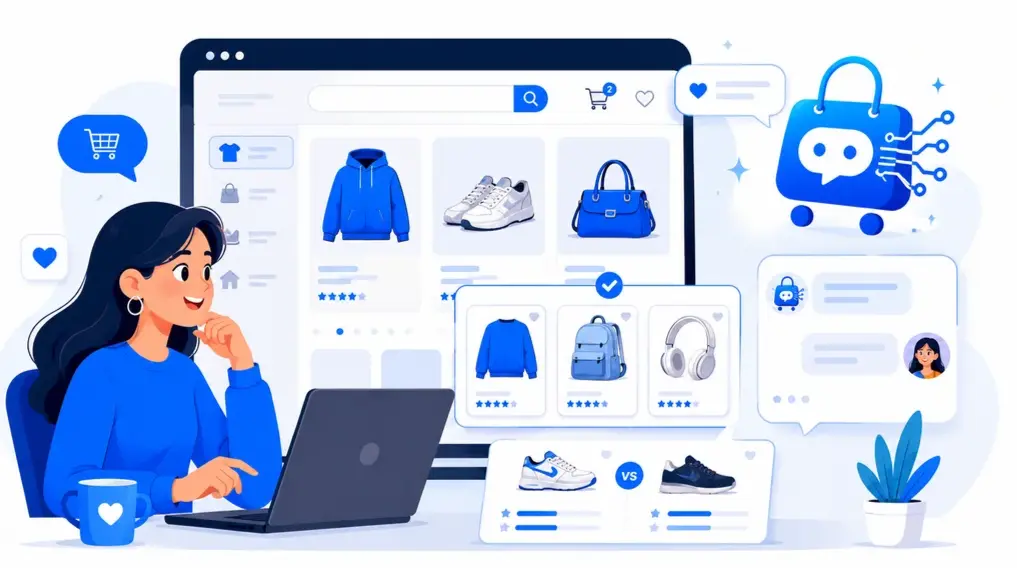
An AI shopping assistant is a virtual assistant that helps online shoppers find the right products faster. Instead of forcing customers to search through endless product pages, it can understand what they are looking for, ask helpful questions, recommend products, compare options, and guide them toward a buying decision.
Think of it as a digital version of a helpful in-store sales assistant, but available directly on an e-commerce website, often through chat, product search, or personalized recommendations.
For online stores, this technology can do more than improve customer experience. A good AI shopping assistant can help increase product discovery, reduce friction, answer common product questions, support upsells and cross-sells, and make the shopping journey feel more personal.
In this guide, we’ll explain what an AI shopping assistant is, how it works, how it differs from a regular chatbot, and why more ecommerce brands are starting to use AI to help customers shop smarter.
What Is an AI Shopping Assistant?
An AI shopping assistant is a virtual tool that helps online shoppers find, compare, and choose products using artificial intelligence.
Instead of making customers browse through dozens of product pages on their own, an AI shopping assistant can guide them through the buying process in a more natural way. A shopper can ask a question, describe what they need, share a budget, mention a preference, or compare two products, and the assistant can respond with relevant suggestions.
For example, instead of typing a basic search like:
“black running shoes”
a customer could ask:
“I need comfortable black running shoes for daily walks and light jogging, under $120.”
A traditional search tool may only match a few keywords. An AI shopping assistant tries to understand the full request: the product type, color, use case, comfort need, activity level, and budget. Then it can recommend products that better match what the shopper actually wants.
In simple terms, an AI shopping assistant works like a digital sales associate for an online store. It can help customers answer questions such as:
What product is right for me?
Which option is better for my needs?
Does this product fit my budget?
What size, model, color, or version should I choose?
Are there better alternatives?
What products go well together?
This makes the online shopping experience feel less like searching through a catalog and more like having a conversation with someone who understands the store’s products.
An AI shopping assistant can appear in different forms. Some are built into a website as a chat widget. Others work through smart product search, personalized recommendations, voice assistants, or guided shopping quizzes. In many ecommerce stores, the assistant combines several of these features into one experience.
It is also important to understand that an AI shopping assistant is not the same thing as a basic chatbot.
A simple chatbot usually follows predefined scripts. It may answer questions about shipping, returns, order tracking, or store policies. That can be useful, but it is limited.
An AI shopping assistant goes further. It is designed to understand shopping intent, recommend products, compare options, and help customers make better buying decisions.
In other words, a chatbot may help a customer get support. An AI shopping assistant helps a customer shop.
How Does an AI Shopping Assistant Work?
An AI shopping assistant works by combining product data, customer intent, and artificial intelligence to guide shoppers toward better product choices.
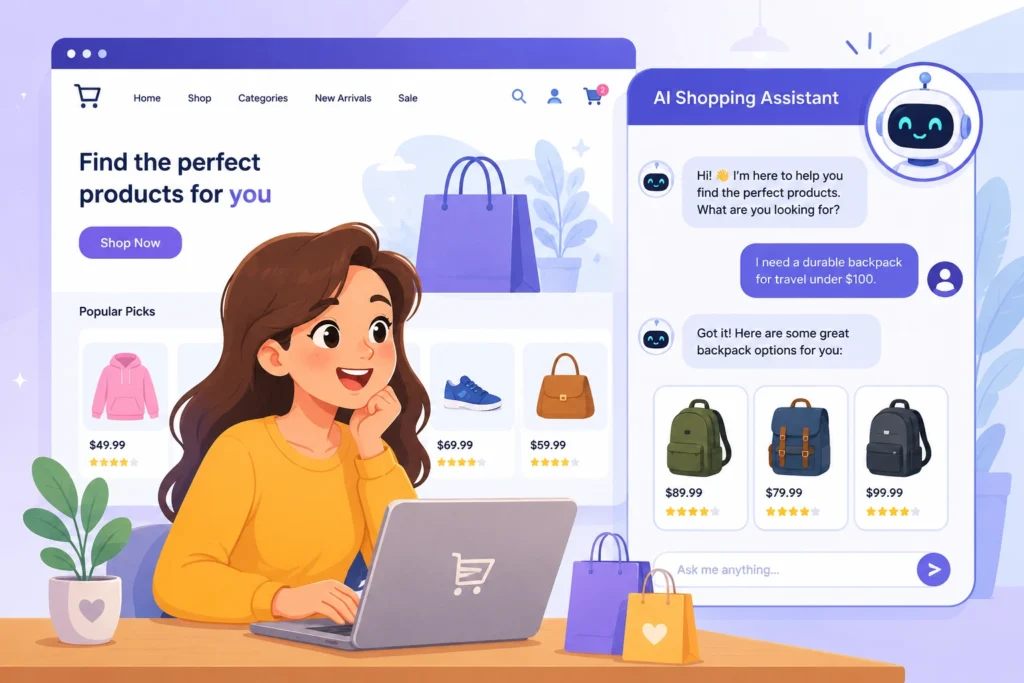
At a basic level, the assistant receives a question or request from the shopper, understands what the person is trying to buy, checks the store’s product catalog, and then suggests relevant products or answers. The experience feels simple for the customer, but behind the scenes there are several steps happening at the same time.
It understands what the shopper wants
The first job of an AI shopping assistant is to understand the shopper’s intent.
A customer does not always search in clean product keywords. They may describe a problem, a situation, a budget, or a personal preference.
For example, a shopper might ask:
“I need a gift for my dad under $75.”
“I want a dress for a beach wedding.”
“What laptop is good for college and light gaming?”
“Show me skincare products for dry skin.”
A traditional search bar may struggle with these types of requests because they are not just keywords. They include context. An AI shopping assistant tries to understand the meaning behind the request, not just the exact words.
It looks at things like product type, price range, use case, size, color, style, occasion, and customer preferences. Then it uses that information to narrow down the best options.
It connects to the store’s product catalog
An AI shopping assistant needs access to real product information. This usually includes:
product names
product descriptions
prices
categories
sizes and variants
stock availability
images
reviews
shipping details
return policies
FAQs and product specifications
This part matters a lot. A good AI shopping assistant should not invent products or make random suggestions. It should recommend items that actually exist in the store and match the customer’s needs.
For example, if a customer asks for “black winter boots under $150,” the assistant should be able to check which black boots are available, whether they are in stock, what sizes exist, and whether the price fits the customer’s budget.
The better the product data, the better the assistant becomes.
It recommends relevant products
Once the assistant understands the request and checks the product catalog, it can recommend products that match the shopper’s needs.
These recommendations may be based on:
the customer’s question
product details
previous browsing behavior
popular products
customer reviews
similar products
available inventory
price range
purchase history, if available
The goal is not just to show products. The goal is to show the right products.
For example, instead of showing every pair of running shoes in the store, the assistant may recommend three options and explain why each one fits the customer’s request.
That explanation is important. A useful AI shopping assistant does not just say, “Here are some products.” It can say something like:
“This pair is good for daily walking because it has extra cushioning. This one is better for running because it is lighter. This third option is the most budget-friendly.”
That kind of guidance makes the experience feel more helpful and less random.
It answers product questions
Many shoppers hesitate before buying because they still have questions.
They may want to know:
Is this jacket waterproof?
Does this bag fit a 15-inch laptop?
Is this product good for beginners?
What size should I choose?
Can I use this device with my phone?
Is this item better than the cheaper version?
An AI shopping assistant can answer these questions using the information available in product descriptions, reviews, FAQs, and store policies.
This is one of the biggest advantages for ecommerce stores. Instead of forcing the shopper to leave the page, search manually, or contact customer support, the assistant can answer many questions instantly.
That can reduce friction and help the customer feel more confident before buying.
It guides the shopper toward the next step
A good AI shopping assistant does not stop at answering questions. It can also guide the shopper toward the next logical step.
Depending on the store, it may suggest:
adding a product to the cart
comparing two items
choosing the right size or variant
adding a complementary product
checking a bundle
viewing reviews
moving to checkout
contacting human support if needed
For example, if someone buys a camera, the assistant might suggest a compatible memory card, tripod, or camera bag. If someone is choosing skincare products, it might recommend a complete routine instead of just one product.
This is where an AI shopping assistant becomes valuable for both the customer and the store. The customer gets useful guidance, while the store has a better chance of increasing conversion rate and average order value.
In simple terms, the assistant works like a smart layer between the shopper and the product catalog. It helps turn a vague need into a clear buying decision.
Key Features of an AI Shopping Assistant
An AI shopping assistant can include different features depending on the platform, the ecommerce store, and the type of products being sold. Some tools are simple chat-based assistants, while others combine product search, recommendations, customer support, and personalization in one system.
Here are the most important features to look for.
Conversational product search
One of the main features of an AI shopping assistant is conversational search.
Instead of typing short keywords into a search bar, shoppers can describe what they want in normal language. This makes the experience feel more natural, especially when the customer does not know the exact product name.
For example, a customer might say:
“I need a lightweight jacket for rainy weather.”
“Find me a birthday gift for a 10-year-old.”
“I want a comfortable office chair for back pain.”
The assistant can understand the request and show products that match the situation, not just the exact keywords.
This is especially useful for stores with large catalogs, where customers can easily get lost between categories, filters, and product pages.
Personalized product recommendations
A strong AI shopping assistant should be able to recommend products based on what the customer actually needs.
These recommendations can come from:
the shopper’s question
their browsing behavior
past purchases
product ratings
similar products
current inventory
budget and preferences
popular products among similar customers
The goal is to make recommendations feel useful, not random.
For example, if a shopper says they need “a simple skincare routine for dry skin,” the assistant should not just show every moisturizer in the store. It should suggest a small set of products that work together, such as a cleanser, moisturizer, and sunscreen.
That kind of recommendation feels more like expert guidance.
Product comparison
Many shoppers hesitate because they are choosing between two or three similar products.
An AI shopping assistant can help by comparing products side by side in simple language.
For example, a customer may ask:
“Which one is better for beginners?”
“Is this laptop better than the cheaper model?”
“What is the difference between these two jackets?”
The assistant can explain the differences in price, features, materials, use cases, reviews, and value.
This helps customers make decisions faster and reduces the chance that they leave the website to search for answers somewhere else.
Size, fit, and style guidance
For fashion, footwear, furniture, beauty, and similar categories, choosing the right option can be difficult.
An AI shopping assistant can help customers choose:
the right size
the right fit
the right color
the right style
the right product variant
the best option for a specific occasion
For example, in a clothing store, a shopper might ask:
“What size should I choose if I am between medium and large?”
Or:
“What should I wear to a casual outdoor wedding?”
The assistant can guide the customer based on available product information, sizing charts, reviews, and store policies.
This can be very useful for reducing hesitation before purchase and possibly lowering return rates.
Customer support answers
An AI shopping assistant can also answer common customer support questions.
These may include:
shipping times
return policies
exchange rules
payment options
warranty information
order tracking
product availability
delivery restrictions
This does not mean it should replace human support completely. But it can handle many repetitive questions instantly.
For ecommerce stores, this can reduce support workload. For shoppers, it creates a faster and smoother buying experience.
Upsell and cross-sell suggestions
A useful AI shopping assistant can also suggest related products.
If a customer is buying a camera, the assistant may recommend a memory card, tripod, camera bag, or extra battery.
If a customer is buying running shoes, it may suggest socks, insoles, or running shorts.
If a customer is buying skincare products, it may recommend a full routine instead of a single product.
This can help increase average order value, but it has to be done carefully. The recommendations should feel helpful, not pushy.
The best AI shopping assistants suggest products that genuinely make sense for the customer’s goal.
Cart abandonment assistance
Some shoppers add products to their cart but do not complete the purchase. They may still have doubts about sizing, shipping, price, return policies, or whether the product is right for them.
An AI shopping assistant can help answer last-minute questions before checkout.
For example:
“Will this arrive before Friday?”
“Can I return this if it does not fit?”
“Is there a cheaper alternative?”
“Do I need anything else with this product?”
By answering these questions quickly, the assistant may help reduce friction and keep the shopper moving toward checkout.
Integration with ecommerce platforms
A good AI shopping assistant should connect easily with the ecommerce platform the store already uses.
Common integrations may include:
Shopify
WooCommerce
BigCommerce
Magento / Adobe Commerce
custom ecommerce platforms
product feeds
CRM systems
email marketing tools
customer support platforms
The better the integration, the more useful the assistant becomes.
If the assistant can access product data, inventory, customer questions, and order information, it can give much better answers than a generic chatbot placed on top of the website.
Human handoff
Even the best AI shopping assistant will not answer everything perfectly.
Sometimes the customer needs help from a real person, especially for complex issues, expensive products, complaints, refunds, or special requests.
That is why human handoff is important.
A good assistant should know when to stop and transfer the conversation to customer support, live chat, email, or a sales representative.
This makes the experience safer and more trustworthy.
Analytics and insights
AI shopping assistants can also help store owners understand what customers are asking for.
For example, the store may discover that shoppers often ask:
whether a product is waterproof
which size to choose
what product is best for beginners
whether an item works with another product
why shipping takes longer for certain items
These insights can help improve product descriptions, FAQs, category pages, ads, and even inventory decisions.
So the assistant is not just a sales tool. It can also become a source of customer research.
AI Shopping Assistant vs Traditional Ecommerce Search
Traditional ecommerce search is useful, but it has one big limitation: the shopper usually needs to know what to type.
If a customer searches for “black sneakers,” the store can show black sneakers. If they search for “wireless headphones,” the store can show wireless headphones. That works fine when the shopper already knows the product category, the right keywords, and the exact type of item they want.
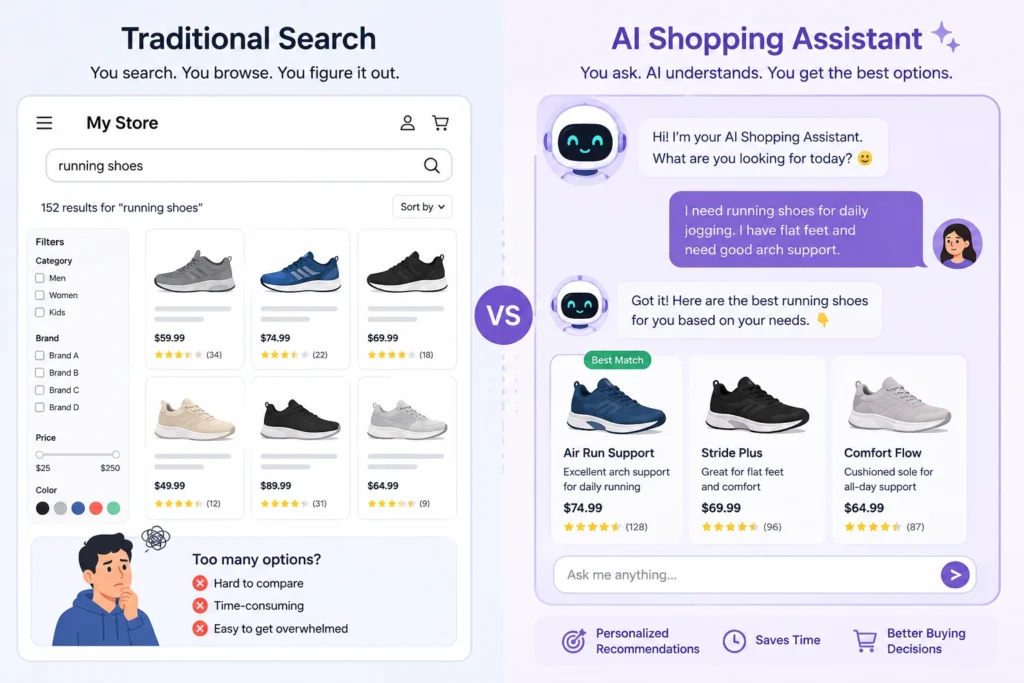
But many shoppers do not think that way.
A lot of customers arrive with a need, not a keyword.
They might say:
“I need comfortable shoes for standing all day.”
“I want a gift for someone who likes cooking.”
“I need a laptop for school, Netflix, and some light gaming.”
“I want skincare products, but I do not know where to start.”
A traditional search bar may struggle with these searches because they are more conversational. They include context, intent, budget, personal preferences, and sometimes uncertainty.
An AI shopping assistant is designed for that kind of situation.
Instead of only matching keywords, it tries to understand what the shopper actually means. It can ask follow-up questions, narrow down the options, and recommend products based on the customer’s goal.
For example, with traditional search, a shopper might type:
“black running shoes men size 10”
With an AI shopping assistant, the same shopper could say:
“I need comfortable black shoes for running and walking, around $120.”
That second request gives the assistant more useful information. It includes the use case, color, activity, comfort need, and budget. A good AI shopping assistant can use all of that context to recommend better options.
The difference is simple:
Traditional ecommerce search helps shoppers find products based on keywords.
An AI shopping assistant helps shoppers find products based on intent.
This makes the shopping experience feel more natural. Instead of forcing customers to adjust their language to match the store’s search system, the store can understand the customer’s language.
For ecommerce stores, this can be especially valuable when the product catalog is large or complex. If a store sells hundreds or thousands of products, customers may not want to click through category pages, filters, and product grids. They may prefer to ask a question and get a short list of relevant options.
Traditional search is still important. Customers should still be able to search by product name, category, brand, size, color, or SKU. But an AI shopping assistant adds another layer on top of that experience.
It helps with the moments when the customer does not know exactly what to search for.
In other words, traditional search is good when the shopper knows the product. An AI shopping assistant is more useful when the shopper knows the problem, the occasion, or the result they want.
AI Shopping Assistant vs Chatbot
An AI shopping assistant and a chatbot can look similar at first. Both may appear as a small chat window on an ecommerce website. Both can answer questions. Both can help customers during the shopping journey.
But they are not exactly the same thing.
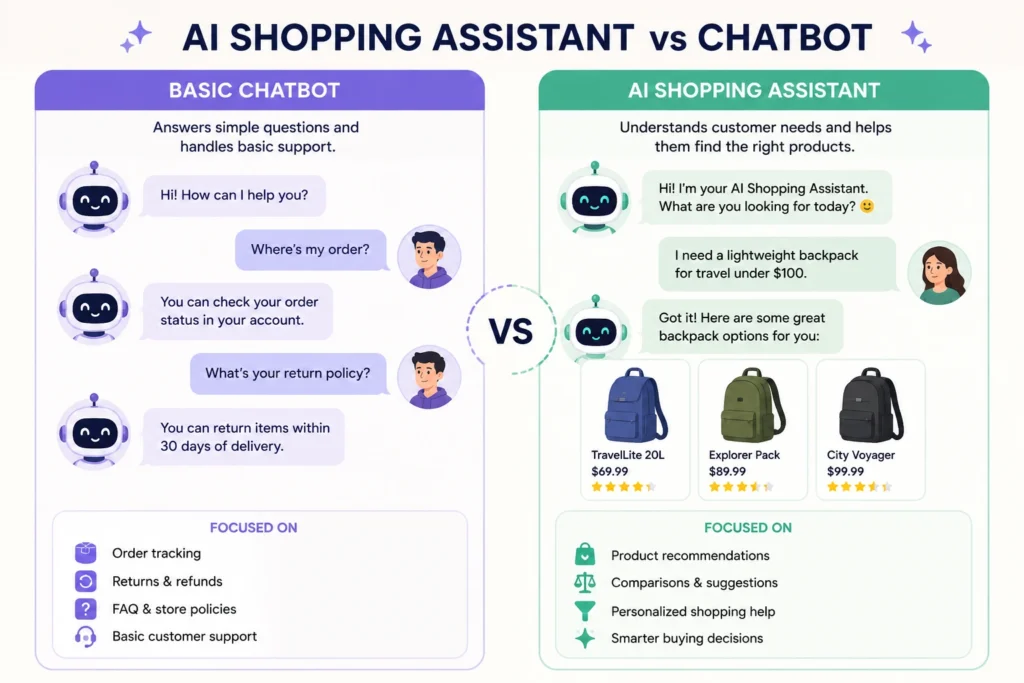
A basic chatbot is usually designed for customer support. It helps shoppers with common questions about shipping, returns, order tracking, store hours, refunds, or payment options. In many cases, it follows fixed conversation flows or pre-written answers.
For example, a basic chatbot may help with questions like:
“Where is my order?”
“What is your return policy?”
“How long does shipping take?”
“Do you ship internationally?”
That is useful, but it does not always help the customer choose the right product.
An AI shopping assistant is more focused on the buying decision. It helps shoppers discover products, understand options, compare items, and choose what fits their needs.
For example, an AI shopping assistant can handle questions like:
“I need a gift for my wife under $100.”
“What is the best laptop for a college student?”
“Which of these jackets is warmer?”
“What skincare products should I use for dry skin?”
“Can you help me find a black dress for a formal event?”
The difference is that the AI shopping assistant is not only answering support questions. It is actively helping the customer shop.
A chatbot usually reacts to a question.
An AI shopping assistant guides the shopper toward a better product choice.
This distinction matters for ecommerce stores. If a store only needs to answer repetitive support questions, a chatbot may be enough. But if the store wants to improve product discovery, increase conversions, recommend products, and create a more personalized experience, an AI shopping assistant is usually a better fit.
A simple way to think about it is this:
A chatbot helps customers get information.
An AI shopping assistant helps customers make decisions.
Of course, the two can overlap. Many modern AI shopping assistants also include chatbot features. They can answer support questions, explain return policies, and provide shipping information. But their main value comes from understanding shopping intent and connecting that intent to the right products.
In other words, all AI shopping assistants can act like chatbots, but not every chatbot is a true AI shopping assistant.
Benefits of AI Shopping Assistants for Ecommerce Stores
For ecommerce stores, an AI shopping assistant is not just a nice feature to add to the website. When it is implemented well, it can support sales, improve the customer experience, and reduce some of the pressure on support teams.
The main value comes from helping shoppers make decisions faster.
Many online stores already get traffic. The problem is that a lot of visitors do not buy. They browse, compare, hesitate, open multiple tabs, and sometimes leave without adding anything to the cart. An AI shopping assistant can reduce that friction by giving customers clearer guidance while they are still on the website.
Better product discovery
Product discovery is one of the biggest challenges in ecommerce.
A store may have great products, but if customers cannot find the right ones, those products do not sell. Filters and categories help, but they are not always enough, especially when the catalog is large.
An AI shopping assistant can make product discovery easier by turning a vague request into a useful recommendation.
For example, instead of forcing a shopper to browse through every backpack in a store, the assistant can respond to a request like:
“I need a backpack for work that fits a laptop and looks professional.”
From there, it can suggest a few relevant options instead of showing the entire category.
This helps customers move from confusion to decision faster.
Higher conversion rates
When shoppers get helpful answers at the right moment, they are more likely to buy.
A customer may be interested in a product but still unsure about the size, material, compatibility, shipping time, or whether the product is right for their specific need. If they cannot find the answer quickly, they may leave the site.
An AI shopping assistant can answer those questions instantly and keep the customer engaged.
This can be especially useful for products that require explanation, such as electronics, skincare, supplements, furniture, software, fitness equipment, or higher-priced items.
The more confident a shopper feels, the easier it becomes for them to complete the purchase.
Lower customer support workload
Many ecommerce support teams answer the same questions every day.
Questions like:
“Where is my order?”
“What is your return policy?”
“Does this come in another size?”
“How long does shipping take?”
“Is this product compatible with this model?”
An AI shopping assistant can handle many of these repetitive questions automatically, especially when it is connected to product information, FAQ pages, shipping policies, and order data.
This does not mean human support becomes unnecessary. There will always be situations where a real person is needed. But the assistant can reduce the number of simple, repetitive tickets and allow the support team to focus on more complex issues.
More personalized shopping experiences
Personalization is one of the biggest reasons ecommerce brands are interested in AI.
A regular product page shows the same information to everyone. An AI shopping assistant can adapt the experience based on what the shopper says they need.
For example, two customers may look at the same running shoes, but their needs may be different.
One wants shoes for daily walking.
Another wants shoes for long-distance running.
Another needs extra support because they have flat feet.
A useful AI shopping assistant can guide each person differently. That makes the experience feel more relevant and less generic.
Higher average order value
AI shopping assistants can also help ecommerce stores increase average order value by suggesting products that naturally go together.
This can include:
complementary products
accessories
bundles
premium alternatives
replacement items
refills
complete routines or kits
For example, if someone is buying a coffee machine, the assistant might suggest filters, cleaning tablets, coffee beans, or a milk frother.
If someone is buying skincare, it might suggest a full routine instead of one product.
The key is that these suggestions should feel useful. A good assistant does not just push more products. It explains why a related product makes sense.
Fewer abandoned carts
Cart abandonment often happens because the customer still has doubts.
They may wonder if the item will arrive on time, whether they can return it, whether they picked the right size, or whether there is a better option.
An AI shopping assistant can answer those last-minute questions before the customer leaves.
For example:
“Yes, this item is eligible for returns within 30 days.”
“This product usually ships within two business days.”
“If you are between sizes, the reviews suggest sizing up.”
That kind of answer can remove hesitation and help the shopper continue toward checkout.
Better customer insights
An AI shopping assistant can also reveal what customers really care about.
Store owners can learn what shoppers are asking before they buy, what objections come up often, what products are confusing, and what information is missing from product pages.
For example, if many customers ask whether a jacket is waterproof, the store may need to make that detail clearer on the product page.
If shoppers keep asking for “gifts under $50,” the store may create a dedicated gift guide.
If people ask the same sizing question over and over, the sizing chart may need improvement.
In this way, the assistant can become more than a sales tool. It can also help improve the entire ecommerce experience.
Benefits of AI Shopping Assistants for Shoppers
AI shopping assistants are not only useful for ecommerce stores. They can also make online shopping easier, faster, and less stressful for customers.
A lot of people enjoy shopping online, but the experience is not always simple. There are too many products, too many reviews, too many filters, and sometimes too little useful guidance. The customer has to do most of the work alone.
An AI shopping assistant changes that by giving shoppers a more guided experience.
Less time spent searching
One of the biggest benefits is speed.
Instead of clicking through pages of products, a shopper can simply describe what they need.
For example:
“I need a carry-on suitcase for a 5-day trip.”
“I want a gift for a new mom.”
“Help me find a comfortable office chair under $300.”
The assistant can narrow the options and show a shorter, more relevant list of products.
This is useful because most customers do not want to compare 80 products. They want a few good options that actually match their needs.
More relevant recommendations
Traditional ecommerce recommendations can feel random. Sometimes they are based only on what is popular, what other people bought, or what the store wants to promote.
An AI shopping assistant can make recommendations feel more personal.
If the shopper shares a budget, style preference, size, use case, or problem, the assistant can use that context to suggest better products.
For example, instead of recommending the best-selling backpack, it can recommend a backpack that fits a laptop, works for daily commuting, and stays under the customer’s budget.
That kind of recommendation feels more useful because it is connected to the shopper’s actual situation.
Easier product comparison
Many shoppers get stuck when they have to choose between similar products.
They may look at two jackets, two laptops, two skincare products, or two coffee machines and not understand the real difference.
An AI shopping assistant can explain the comparison in plain language.
For example:
“This model is better if you want longer battery life. The cheaper model is still good for basic use, but it has less storage and a slower processor.”
That kind of explanation helps shoppers make decisions with more confidence.
Better answers before buying
Customers often have small questions before they buy. These questions may not be big enough to contact support, but they can still stop the purchase.
For example:
“Will this fit in a small apartment?”
“Is this good for beginners?”
“Can I return it if it does not fit?”
“Does this come with everything I need?”
“Is this compatible with my phone?”
If the answer is hard to find, the customer may leave. An AI shopping assistant can answer many of these questions directly on the website, while the shopper is still interested.
This makes the buying process feel smoother.
More confidence in the final decision
A good shopping assistant does not just push a product. It explains why a product may be a good fit.
That explanation matters.
When shoppers understand why a product matches their needs, they feel more confident. They are not just guessing based on photos, reviews, or price. They are making a more informed decision.
This is especially important for products that are expensive, technical, personal, or hard to choose.
Examples include:
laptops
fitness equipment
skincare products
furniture
baby products
fashion and footwear
home appliances
software subscriptions
In these categories, customers often need guidance before they feel ready to buy.
A more human shopping experience
Online stores can sometimes feel cold and impersonal. The shopper is alone with product grids, filters, and descriptions.
An AI shopping assistant can make the experience feel more like talking to someone helpful.
It can ask questions, clarify needs, explain options, and guide the customer step by step.
Of course, it is not a real human sales associate. But when it works well, it gives shoppers something many ecommerce websites lack: direction.
For the customer, that can make online shopping feel less confusing and more comfortable.