

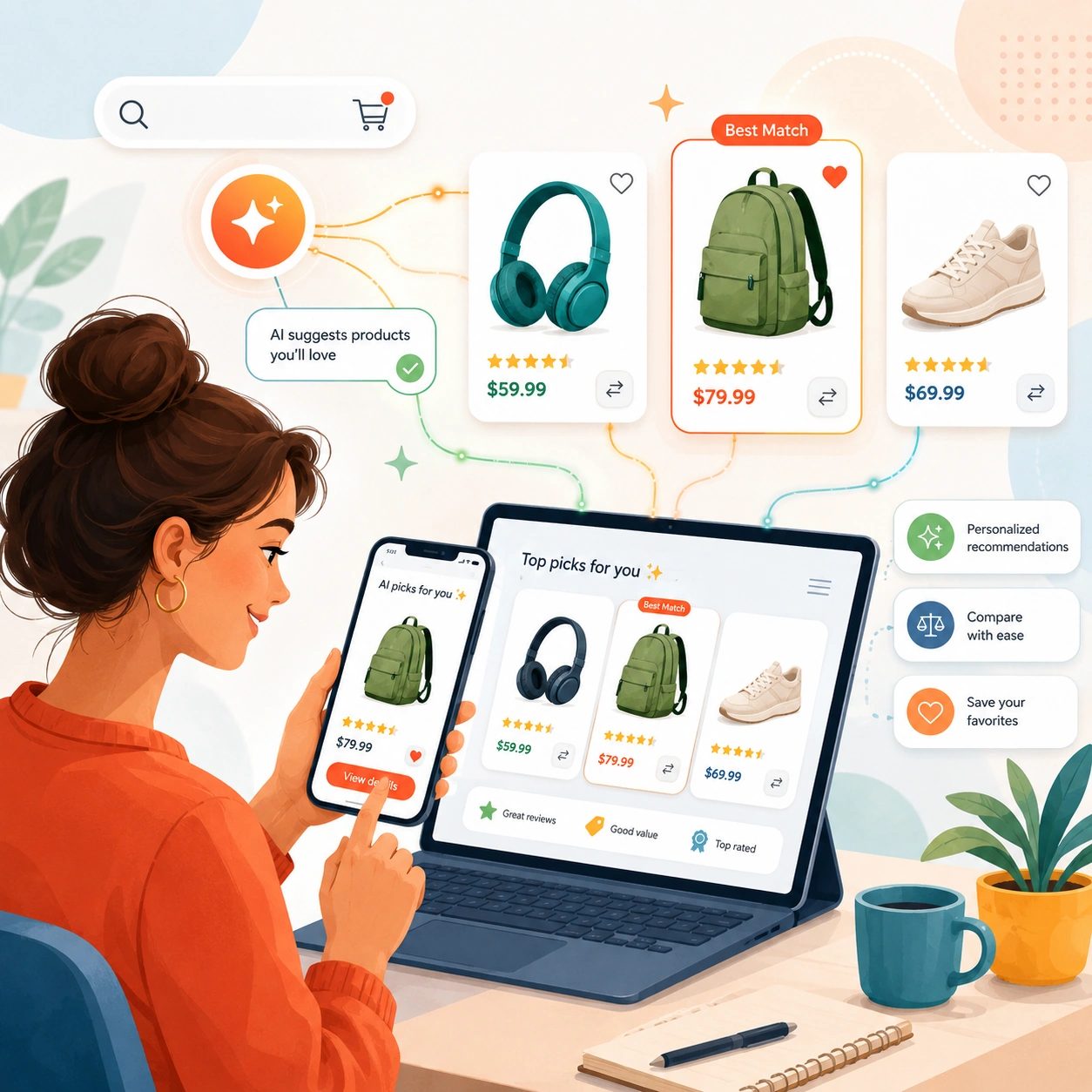
Online shopping gives people more choice than ever, but more choice does not always make buying easier. Someone looking for a laptop, running shoes, skincare, or a gift may have to compare dozens of similar products, interpret conflicting reviews, check prices across several stores, and decide which specifications actually matter.
An AI shopping assistant is designed to reduce that friction. Instead of relying only on keywords, category menus, and product grids, shoppers can describe what they need in ordinary language, ask follow-up questions, compare relevant options, and narrow the results without restarting the search every time a preference changes.
For example, rather than searching separately for “laptop,” “lightweight,” “good battery,” and “under $1,000,” a shopper could ask:
“Find a lightweight laptop under $1,000 for remote work, video calls, and frequent travel.”
A useful assistant should recognize that the request is not only about price. It may involve battery life, portability, webcam quality, reliability, screen size, and the difference between a work device and a gaming laptop. The goal is not to make the final decision for the shopper. It is to reduce the number of irrelevant options and make the trade-offs easier to understand.
Amazon’s Alexa for Shopping shows how this experience is developing. Amazon says shoppers can use it to compare products side by side, evaluate prices and reviews, ask product questions, find alternatives, and make more informed purchase decisions.
AI shopping assistants can appear in many forms: a retailer search bar, a chatbot, a mobile app, a browser-based shopping tool, a voice assistant, or a visual-search feature that helps someone find products from a photo. Some focus mainly on product discovery, while others can also compare products, track prices, answer delivery questions, suggest alternatives, or help create a shopping list.
To understand the core concept in more detail, see our guide to what an AI shopping assistant is and how it works.
However, AI does not automatically make shopping decisions more reliable. An assistant can only be as useful as the information it receives. Incomplete specifications, outdated inventory, weak review data, or inaccurate generated answers can still lead shoppers toward the wrong choice.
In this guide, we explain how AI shopping assistants help people find better products, the main types available today, how they differ from traditional search and product recommendations, where they can still fail, and how they may change online shopping as product discovery becomes more conversational and personalized.
Quick Overview: What an AI Shopping Assistant Can Do
An AI shopping assistant can support several parts of the buying journey. Some assistants focus mainly on search and product discovery, while others also help compare options, answer questions, track prices, or guide shoppers through follow-up decisions.
Google Cloud describes conversational commerce search as a guided product-discovery experience that can understand natural-language requests, support follow-up questions, and help shoppers narrow broad searches through conversation. This is one reason AI assistants are becoming more useful when a catalog contains too many similar options. Google Cloud’s conversational product filtering documentation explains how AI can prompt shoppers with useful follow-up questions after a broad search.
| Capability | What It Helps With | Example Shopper Request |
|---|---|---|
| Natural-language product search | Finds products based on a complete need, not just a short keyword. | “Find a quiet blender under $150 for a small apartment.” |
| Product comparison | Explains meaningful differences between shortlisted products. | “Compare these laptops by battery life, weight, and warranty.” |
| Personalized recommendations | Adjusts suggestions using stated preferences or permitted shopper behavior. | “Show wide-fit running shoes from brands I have bought before.” |
| Follow-up refinement | Lets shoppers change one condition without restarting the search. | “Only show options available in black and under $100.” |
| Alternative suggestions | Offers similar products when the original item is unavailable or too expensive. | “Show comparable options that can arrive by Friday.” |
| Visual shopping | Finds similar products from an uploaded image or screenshot. | “Find a chair like this in dark green.” |
| Price and stock support | Helps shoppers monitor price changes, availability, or restocks. | “Tell me when this drops below $80.” |
| Shopping support | Answers practical questions about fit, compatibility, delivery, or returns. | “Will this case fit my 14-inch laptop?” |
The strongest assistants do not try to replace ordinary product pages, filters, or customer judgment. They help shoppers reach a smaller, more relevant set of options before those traditional ecommerce tools take over. This is closely connected to the product-discovery principles covered in our guide to AI search for ecommerce.
What Is an AI Shopping Assistant?
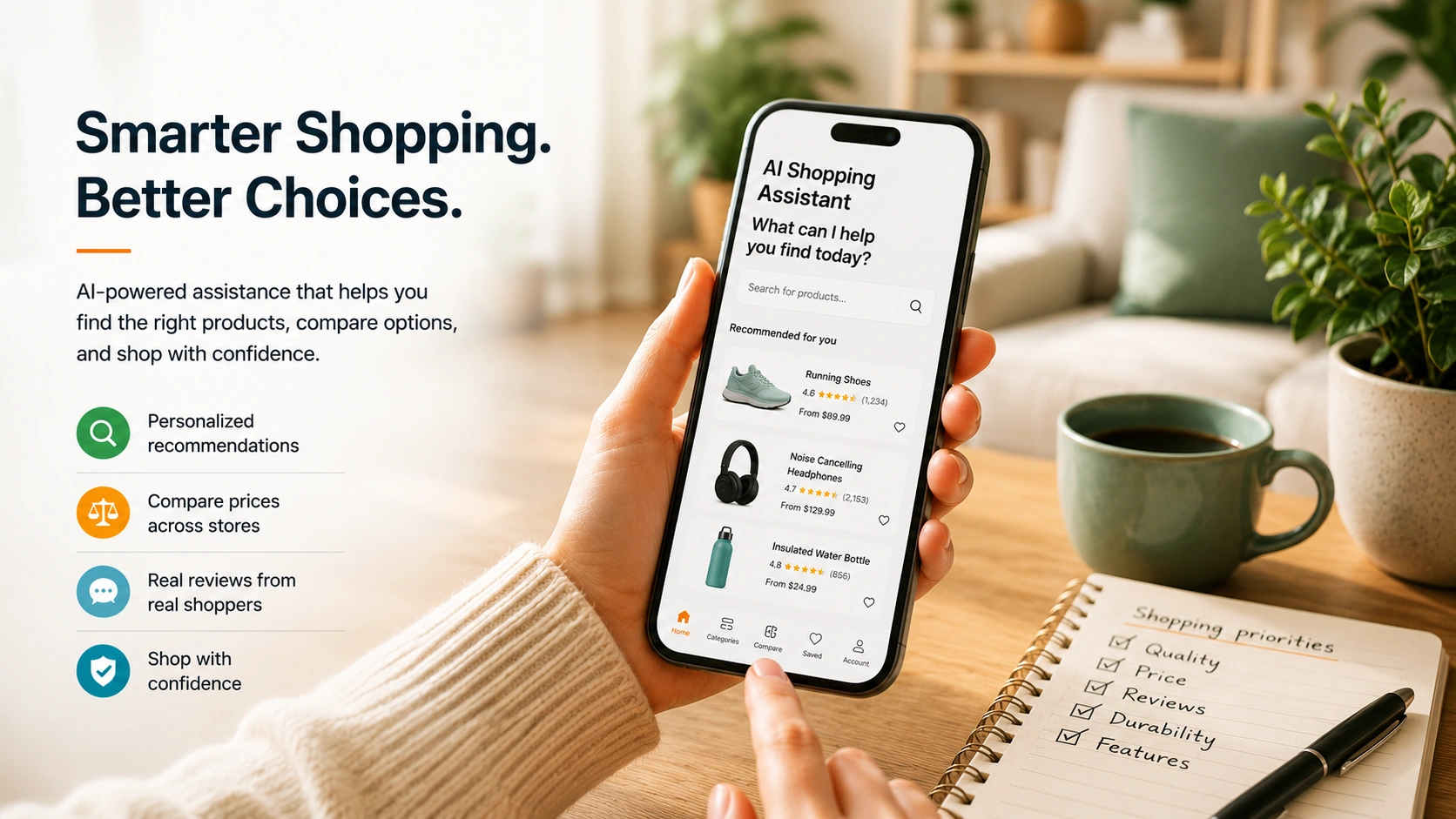
An AI shopping assistant is a software system that helps people discover, compare, and evaluate products using natural-language conversation, product data, search signals, and sometimes personal preferences.
It is more than a basic website chatbot. A useful shopping assistant can understand what a customer is trying to accomplish, identify relevant product attributes, narrow a large catalog, explain trade-offs, and guide the shopper toward a smaller set of realistic options.
For example, a shopper may ask:
“I need noise-canceling headphones for long flights, but I do not want to spend more than $250.”
The assistant should recognize several conditions at once:
- Product category: noise-canceling headphones
- Main use case: long flights
- Important feature: strong noise cancellation
- Budget limit: $250
- Likely secondary factors: comfort, battery life, portability, and microphone quality
Instead of showing every headphone under $250, it can narrow the results to models that better fit travel use, then explain why they are relevant.
It Combines Search, Recommendations, and Guidance
Traditional ecommerce search mainly helps shoppers find products. Recommendation engines suggest related items or alternatives. An AI shopping assistant can combine both functions with conversation and decision support.
That means it may help someone:
- Describe a need in everyday language
- Find products that match several requirements
- Compare shortlisted options
- Ask follow-up questions
- Find lower-cost or faster-delivery alternatives
- Understand compatibility, sizing, reviews, or return conditions
Google Cloud describes conversational commerce as an AI-guided shopping experience that understands intent and preferences, supports natural conversation, and helps shoppers move from product discovery toward purchase decisions. Google Cloud’s AI Commerce Search platform positions this type of assistant as a way to provide personalized guidance throughout the shopping journey.
It Can Appear in Different Places
An AI shopping assistant does not need to look like one specific interface. It may appear as:
- A conversational search bar on an ecommerce website
- A chat assistant on a product or category page
- A mobile shopping app feature
- A visual-search tool that accepts a photo or screenshot
- A voice-based shopping assistant
- A browser extension that compares products across stores
The best interface depends on the shopping task. Someone buying a replacement charger may prefer direct search and filters. Someone choosing a mattress, camera, skincare routine, or home-office setup may benefit from a more detailed conversation.
It Depends on Reliable Product Information
An assistant can only make useful recommendations when it has accurate information about products. It needs dependable data on price, availability, dimensions, compatibility, delivery, materials, reviews, and return conditions.
If the underlying catalog is incomplete or outdated, the assistant may recommend unavailable products, misunderstand features, or make claims that are not supported by verified product information.
That is why an AI shopping assistant should be treated as a guided decision tool, not as an unquestionable authority. It can reduce research time and surface better options, but shoppers should still be able to inspect product pages, verify important details, and make the final choice themselves.
For a deeper look at the technology that powers this experience, read our guide to AI search for ecommerce.
How AI Shopping Assistants Work
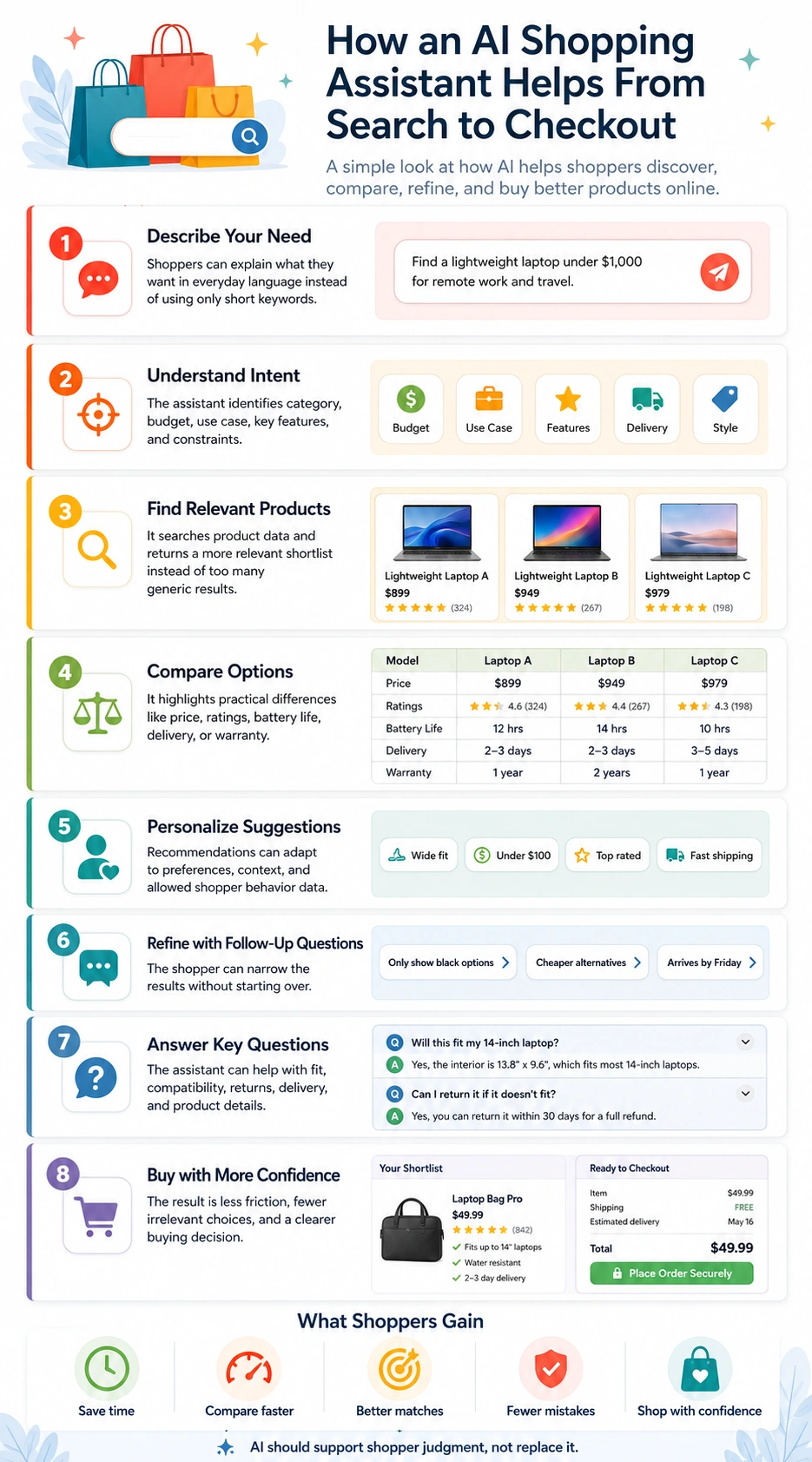
An AI shopping assistant turns a broad shopping request into a more focused product decision. The interface may look like a chat, a search bar, or a product-comparison tool, but the underlying process usually follows a similar pattern: understand the request, retrieve relevant products, rank the options, and help the shopper refine the result.
Google Cloud describes conversational commerce systems as tools that can switch between traditional product search and natural conversation depending on what the shopper needs. That allows a customer to begin with a broad question, then narrow the results through follow-up instructions instead of restarting the search. Google Cloud’s Vertex AI Search for commerce explains that this type of system can use shopper intent, product catalog data, and behavioral signals to guide product discovery.
1. The Shopper Describes a Need
The process starts when someone enters a request. That request may be short and specific, such as “USB-C charger for MacBook Air,” or more open-ended:
“I need a durable backpack for a three-day city trip that fits under an airplane seat.”
The second request contains several conditions at once:
- Product category: backpack
- Use case: three-day city travel
- Priority: durability
- Travel requirement: personal-item size for air travel
- Likely secondary needs: capacity, organization, weight, and comfort
A standard product search may match words. An AI shopping assistant tries to interpret the whole situation.
2. It Identifies Intent and Constraints
The assistant then separates the request into useful signals. These may include the product type, budget, size, style, intended use, delivery deadline, brand preference, compatibility requirement, or features the shopper wants to avoid.
For example, a request for “a quiet fan for sleeping in a small bedroom” may imply:
- Low operating noise
- Compact dimensions
- Sleep mode or timer
- A display that can be dimmed
- A reasonable price for home use
The assistant should not treat every implied detail as a strict rule. It may ask a short clarifying question when the answer would materially improve the results.
3. It Searches the Product Catalog
Once the request is understood, the assistant searches available product data. This can include titles, descriptions, structured attributes, prices, stock status, sizes, materials, compatibility details, delivery information, and customer-review signals.
A strong system combines exact matching with semantic understanding. Exact matching matters for model numbers, part codes, and compatibility. Semantic search matters when a shopper describes a problem instead of naming a product precisely.
For example, “something that keeps lunch cold all day” may retrieve insulated lunch bags, cooler totes, and thermal containers even if the shopper never uses those exact category names.
4. It Ranks the Most Relevant Options
The assistant then ranks potential matches. The order may depend on how closely products fit the request, whether they are in stock, price, delivery timing, compatibility, ratings, and retailer-defined rules.
When personalization is enabled, the assistant may also use session context or previous preferences. A shopper who repeatedly selects wide-fit shoes may see more wide-fit options higher in the results, provided that does not conflict with the current request.
The current query should remain the strongest signal. If a shopper asks for a premium leather briefcase, the assistant should not prioritize inexpensive fabric bags simply because that person has bought lower-cost products before.
5. It Explains and Refines the Results
After showing a shortlist, the assistant can support follow-up questions such as:
- “Show me cheaper options.”
- “Which one has the best warranty?”
- “Only show products that arrive before Friday.”
- “Compare the top three by weight and battery life.”
- “Remove anything that requires a subscription.”
The advantage is continuity. The shopper does not need to repeat every earlier requirement. The assistant can keep the context while applying the new condition.
This type of refinement is closely related to the product-search workflow explained in our guide to AI search for ecommerce.
6. It Should Ground Answers in Verified Data
One of the most important limits is accuracy. An assistant should base product comparisons and explanations on verified catalog data, not invent missing specifications or make unsupported claims.
For example, it should not claim that a laptop has a 12-hour battery life, that a jacket is waterproof, or that a product fits a specific device unless that information exists in a reliable source.
A well-designed assistant helps shoppers understand the available evidence. It should not pretend to know more than the product data supports.
Main Types of AI Shopping Assistants
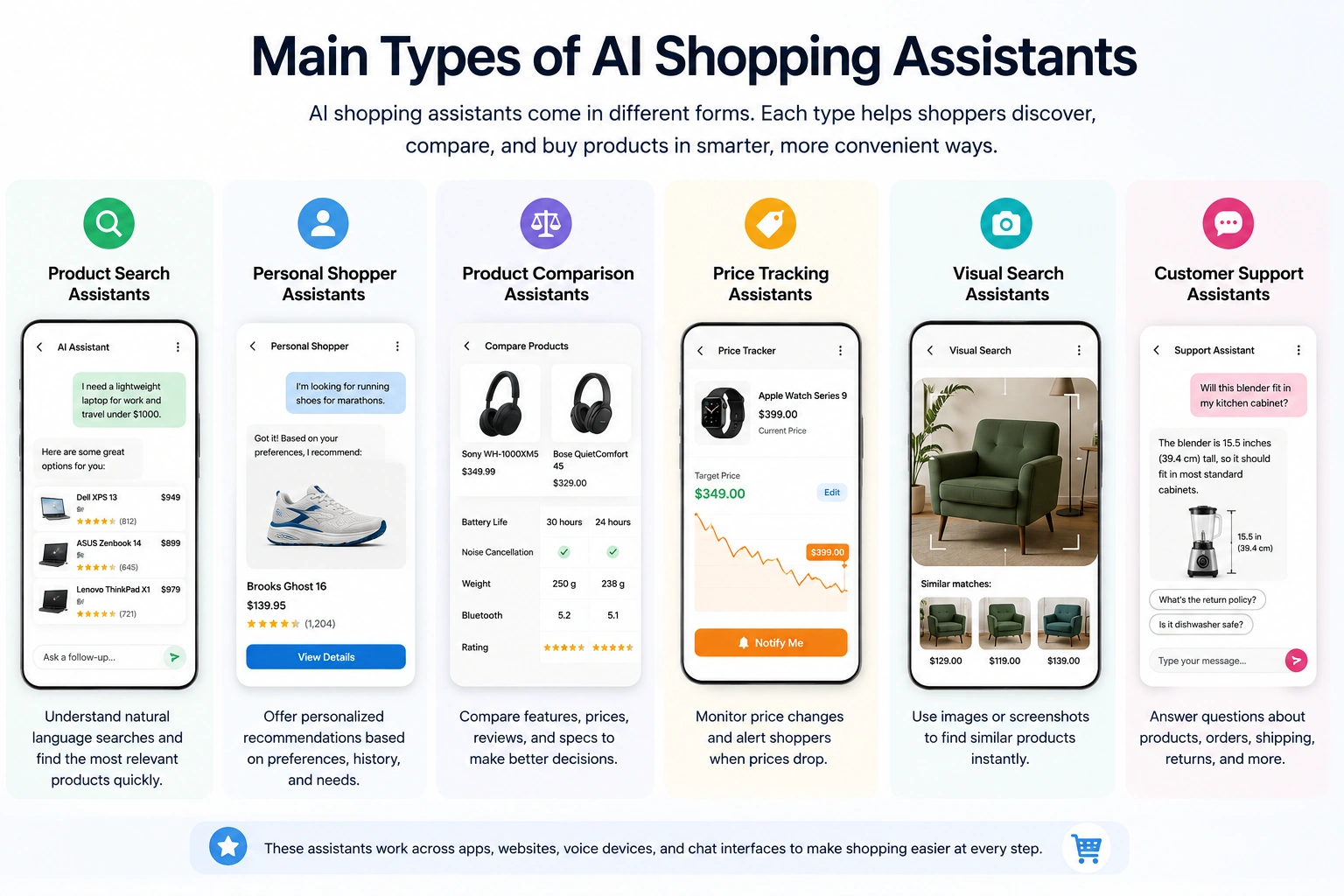
AI shopping assistants can solve different parts of the buying journey. Some are designed to help shoppers find products faster, while others focus on comparison, price tracking, visual discovery, or customer-support questions.
The most useful type depends on the purchase. A shopper buying an exact replacement charger may only need fast search and compatibility checks. Someone choosing a camera, mattress, skincare routine, or home-office setup may benefit from a more conversational assistant that can explain trade-offs and narrow a large set of options.
AI Product Search Assistants
These assistants help shoppers find products through natural-language requests instead of relying only on short keywords and filters.
For example:
“Find a compact desk under $300 that can fit two monitors.”
The assistant can interpret the category, budget, size limitation, and functional requirement before ranking matching products. This type of assistant is especially useful for large catalogs where ordinary keyword search creates too many irrelevant results.
Google Cloud describes AI Commerce Search as a product-discovery system that can support text and image-based guided search, personalized results, and conversational refinement for broad or complex requests.
AI Personal Shoppers
An AI personal shopper goes beyond retrieval. It can ask follow-up questions, understand preferences, create a shortlist, and explain why one product may suit the shopper better than another.
For example, instead of simply returning skincare products, it may ask about skin type, sensitivity, ingredients to avoid, budget, and desired routine length before suggesting suitable options.
This style is more valuable when the shopper is uncertain, the product category is complex, or there are several trade-offs to consider. Our guide to AI personal shoppers explains how this type of assistant combines product discovery with more personalized decision support.
AI Product Comparison Assistants
Comparison assistants help shoppers evaluate a small group of options using the criteria that matter most.
Someone could ask:
“Compare these three laptops by battery life, weight, warranty, and total cost.”
A useful comparison assistant should summarize verified differences rather than repeat long specification lists. It should also make trade-offs clear, such as one laptop being lighter but offering fewer ports, or another costing more but including a longer warranty.
AI Deal and Price-Tracking Assistants
These assistants focus on timing and value. They can help shoppers monitor price changes, set alerts, identify comparable lower-cost products, or decide whether a current price is unusually high.
Amazon’s Alexa for Shopping includes functions such as price-history checks, deal discovery, price tracking, and actions that can notify shoppers when an item reaches a chosen price threshold. This kind of feature is useful when someone knows what they want but does not need to buy immediately.
Visual Shopping Assistants
Visual assistants help shoppers search using an image instead of a detailed written description. A person can upload a photo or screenshot and ask for something visually similar, then add requirements such as a lower price, a specific color, or faster delivery.
This can be especially useful for:
- Fashion and accessories
- Furniture and home decor
- Jewelry
- Art and design-led products
- Products where style is difficult to describe with keywords
Visual similarity should still be combined with verified product details such as dimensions, materials, availability, and price. A chair that looks similar in a photo may have very different measurements or build quality.
AI Customer-Support Shopping Assistants
Some assistants are designed to answer practical questions that often prevent shoppers from buying. These may include questions about sizing, delivery, returns, stock, compatibility, setup, or warranty coverage.
For example:
- “Will this case fit a 14-inch laptop?”
- “Can this arrive before Friday?”
- “Which size should I choose based on this chart?”
- “Does this work with an iPhone 16?”
These assistants work best when they can retrieve answers from verified store policies and product attributes rather than generating vague or unsupported replies.
The Best Experience Often Combines Several Types
In practice, a single shopping journey may use several assistant capabilities. A shopper might begin with natural-language search, ask for a comparison, request a cheaper alternative, check delivery timing, and then set a price alert.
The most useful AI shopping assistant is not necessarily the one that talks the most. It is the one that gives the shopper accurate, relevant help at the moment they need it and makes the path from question to product choice easier.
How AI Shopping Assistants Help Shoppers Find Better Products
The main value of an AI shopping assistant is not that it shows more products. It helps shoppers spend less time sorting through irrelevant options and more time evaluating products that fit their actual needs.
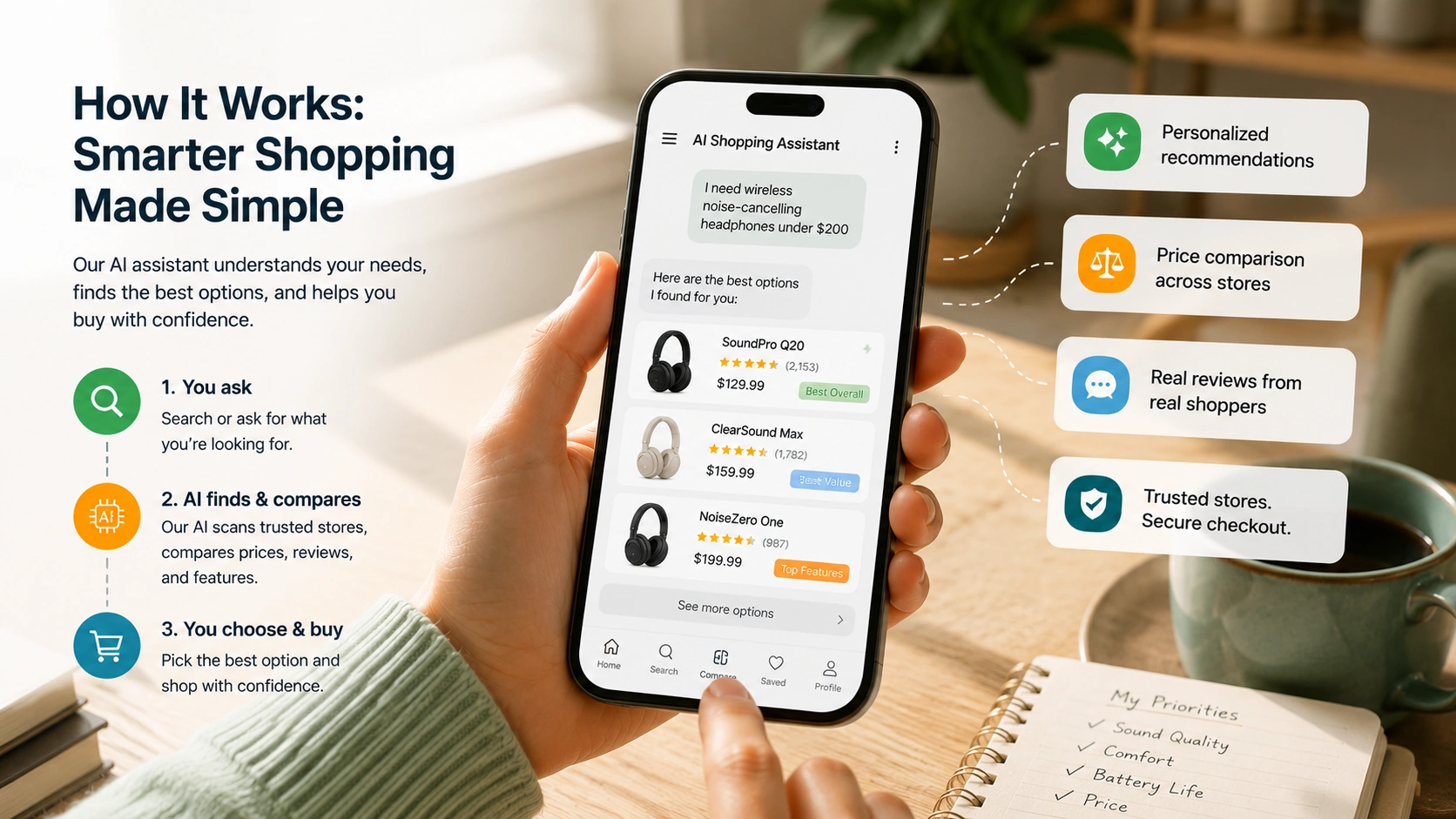
That matters most when the purchase involves several trade-offs. A shopper may know the budget but not the correct product category, understand the problem but not the technical specifications, or have too many similar options to compare confidently.
They Let Shoppers Search in Everyday Language
Many people do not search using the exact language found in a retailer’s catalog. They describe a situation, problem, or outcome instead.
For example:
“I need a carry-on suitcase that is lightweight, durable, and easy to roll through airports.”
An AI shopping assistant can connect that request with product attributes such as cabin-size dimensions, low weight, wheel quality, hard-shell or soft-shell construction, handle design, and warranty coverage.
This can be much easier than asking the shopper to understand every category filter before they have even seen the available options.
They Reduce Information Overload
Product pages can contain dozens of specifications, reviews, ratings, images, bundles, and variations. An assistant can help summarize the details that matter for the current decision.
For example, instead of forcing someone to compare ten laptop pages manually, it can highlight practical differences:
- Which model is lighter for travel
- Which option has the best battery life
- Which product offers more storage
- Which one includes a longer warranty
- Which choice fits the shopper’s budget most closely
Amazon describes its Alexa for Shopping experience as supporting product comparison, price-history checks, product alternatives, and shopping guidance. These are useful examples of how AI can turn a large group of listings into a more manageable decision. Amazon’s overview of Alexa for Shopping shows how the assistant can help shoppers compare similar products and evaluate options before buying.
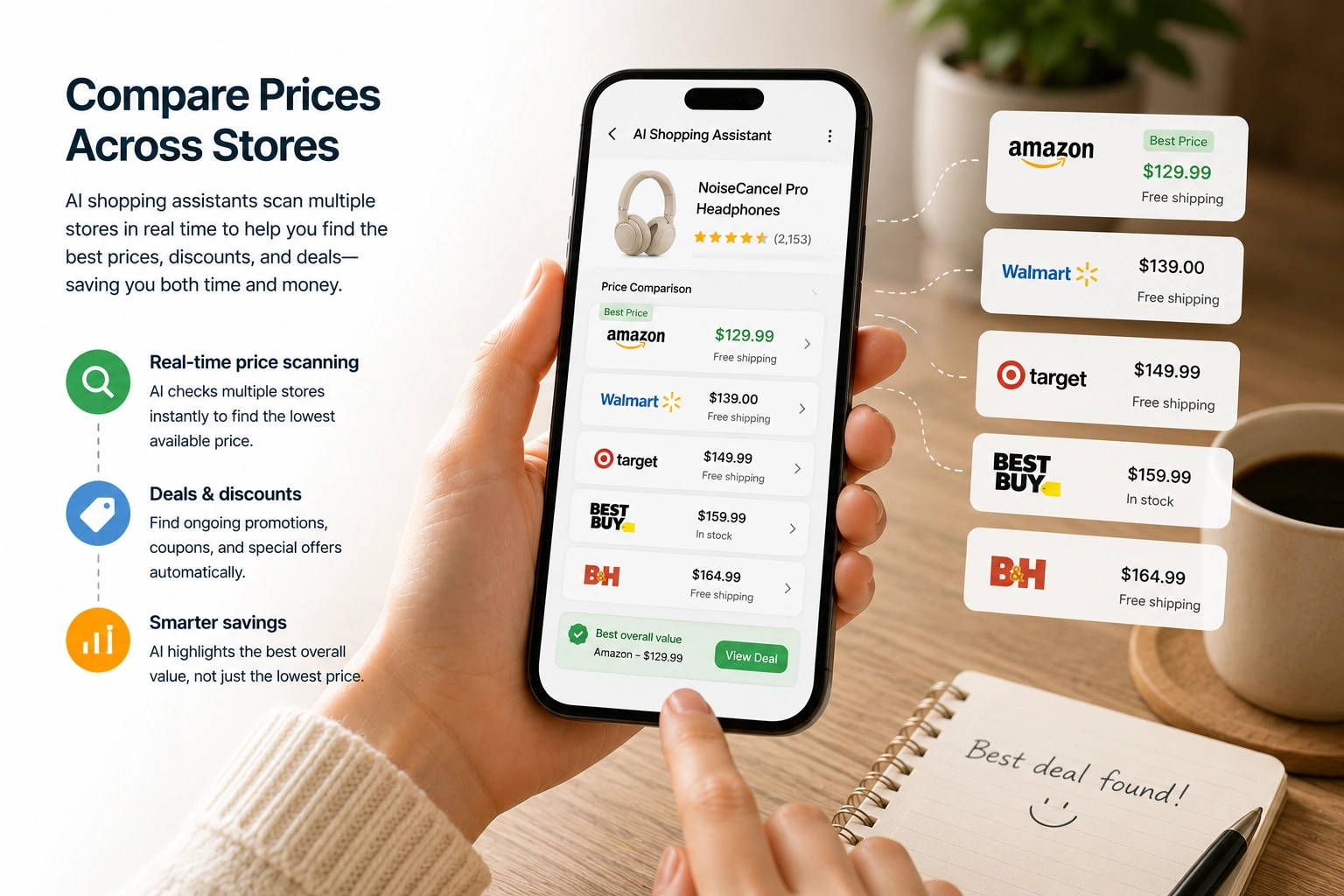
They Help Shoppers Understand Trade-Offs
There is rarely one universally “best” product. A better assistant should make trade-offs clear instead of pretending that one option is perfect for everyone.
For example, while comparing two vacuum cleaners, it may explain:
- One option has stronger suction but weighs more.
- Another costs less but has a shorter battery life.
- A third includes more attachments but has a smaller dust bin.
This helps shoppers choose based on priorities rather than on whichever listing has the most attractive marketing language.
They Make Follow-Up Questions Easier
Shopping needs often change during research. A shopper may start with one request and then realize that delivery time, color, compatibility, or price matters more than expected.
An AI assistant can preserve the earlier context while handling requests such as:
- “Only show options available in black.”
- “Which one can arrive before Friday?”
- “Show me something cheaper with similar features.”
- “Remove anything that requires assembly.”
- “Which option is best for a beginner?”
That continuity reduces the need to restart the search, rebuild filters, and repeat the same requirements multiple times.
They Can Suggest Useful Alternatives
When a preferred product is out of stock, outside the budget, or unavailable for fast delivery, an assistant can suggest alternatives that solve the same underlying problem.
A useful alternative should not simply be a random product from the same category. It should preserve the shopper’s most important requirements.
For example, someone looking for a waterproof hiking jacket under $150 may be offered a similar jacket in another color, a previous-season model, or a slightly lighter option with a different insulation level. The shopper can then see exactly what changes with each alternative.
They Can Help With Product Questions Before Checkout
Many abandoned shopping sessions happen because a shopper has one unanswered question: Will it fit? Is it compatible? Can it arrive on time? Is the return policy reasonable?
An AI assistant can help answer questions such as:
- “Will this keyboard work with an iPad?”
- “Does this luggage fit most airline carry-on limits?”
- “Which size should I choose based on this chart?”
- “Can I return this if it does not fit?”
The answers must come from verified product data and store policies. When this information is incomplete, the assistant should be transparent rather than guess.
They Can Make Complex Purchases Less Intimidating
AI shopping assistants can be particularly helpful in categories where shoppers may not know the technical language, such as electronics, home improvement, skincare, fitness equipment, pet products, or furniture.
A first-time buyer does not always know which specifications matter. The assistant can translate a practical need into useful criteria and help the shopper evaluate options with more confidence.
This is also why AI assistants can work well alongside AI product recommendations. Recommendations can surface relevant products, while the assistant helps explain which one may best fit the shopper’s stated needs.
They Should Support, Not Replace, Shopper Judgment
The best AI shopping assistant does not pressure people to buy quickly or hide the limitations of a product. It should help shoppers understand the available choices, verify important details, and make a more informed decision.
For high-cost, safety-related, or compatibility-sensitive purchases, shoppers should still review the official specifications, product policies, and independent information before completing the order.
How AI Shopping Assistants Help Ecommerce Stores
AI shopping assistants can help ecommerce stores improve product discovery, answer common pre-purchase questions, and reduce friction between the first search and the final checkout. Their value is not simply that they can chat with visitors. The useful part is connecting the conversation to accurate product, inventory, policy, and delivery data.
For a retailer, the assistant can become an additional product-discovery layer between a shopper’s question and the catalog. Instead of forcing visitors to work through several category pages and filters, it can help them reach a relevant shortlist faster.
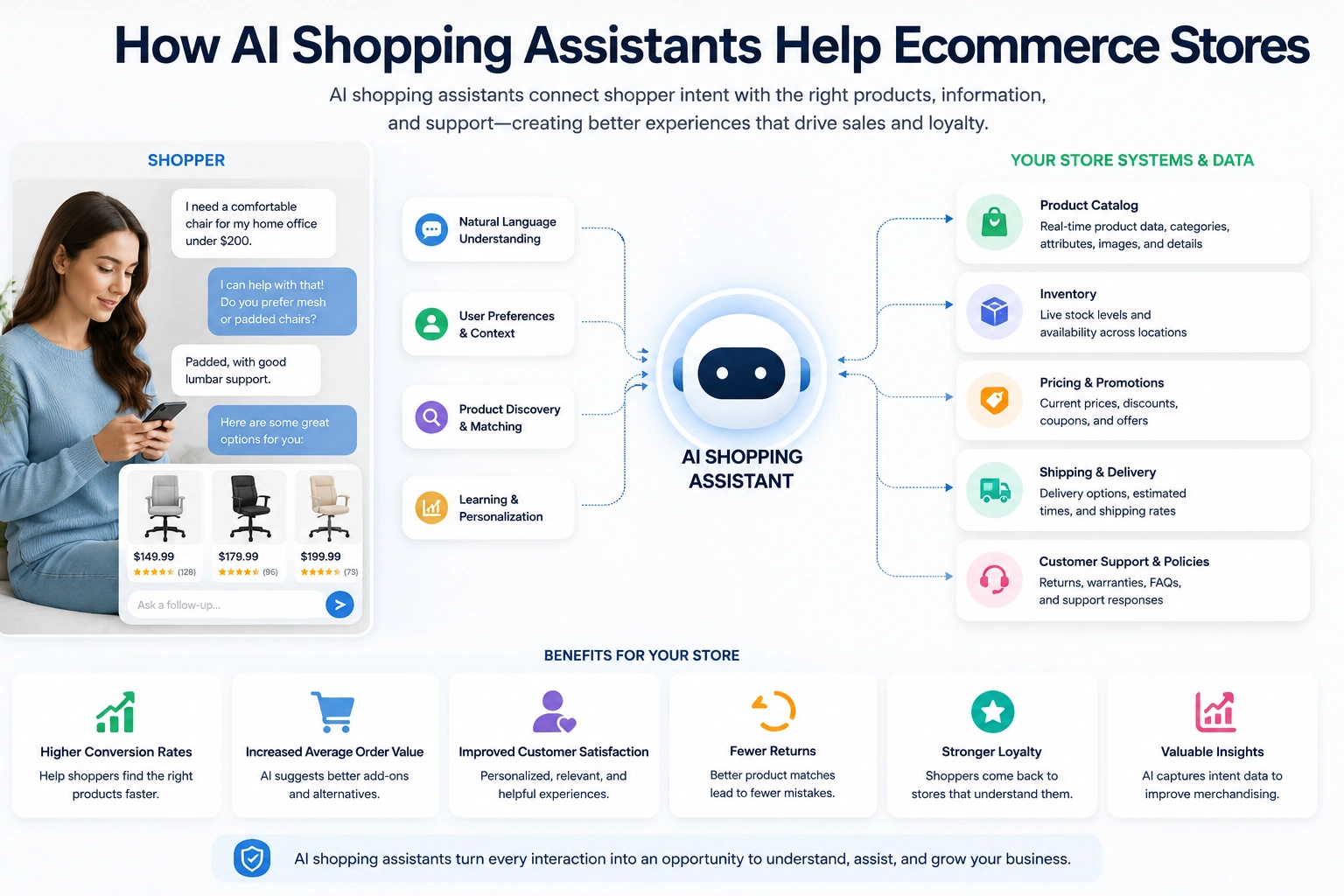
They Can Improve Product Discovery
Large stores often have hundreds or thousands of products with similar titles, overlapping features, and inconsistent customer search terms. An AI shopping assistant can translate a broad need into useful product attributes and guide the shopper toward the right area of the catalog.
For example, a customer may ask:
“I need a compact sofa for a small apartment that is comfortable enough for everyday use.”
The assistant can help identify relevant considerations such as width, depth, seating capacity, fabric durability, delivery options, and budget. This can make the catalog easier to explore without removing traditional filters or category navigation.
Google Cloud’s Vertex AI Search for commerce describes conversational commerce as a way to combine natural-language product discovery with personalized guidance, helping retailers move shoppers from an initial request toward a more relevant set of products.
They Can Answer Questions That Block Purchases
Many shoppers do not leave because they dislike the product. They leave because one practical question remains unanswered.
An assistant can help address questions such as:
- “Will this fit my device?”
- “Which size should I order?”
- “Can this arrive before Friday?”
- “What is the difference between these two versions?”
- “Is this item returnable?”
- “Does this include the accessory I need?”
These answers need to be grounded in verified store information. If the product data or policy is unclear, the assistant should say so and direct the shopper to the relevant product page or human-support channel.
They Can Make Recommendations More Relevant
Product recommendations are most useful when they reflect the shopper’s current goal. An AI assistant can use the active conversation to recommend alternatives, compatible accessories, bundles, or lower-cost options without treating every shopper in the same way.
For example, a shopper looking for a beginner camera may need a simple model, a compatible memory card, and an easy-to-carry bag. Someone else searching for a professional camera may care more about sensor size, lens compatibility, and video performance.
The assistant can help distinguish between these needs before recommendations are shown. This creates a more useful journey than displaying the same “popular products” panel to every visitor.
They Can Reduce Search Friction Before Checkout
Search friction often appears long before a shopper abandons a cart. It can happen when visitors cannot find the right product, do not understand a specification, cannot compare options, or discover too late that an item is unavailable.
By helping users refine searches, surface relevant alternatives, and answer product questions early, an AI assistant can remove some of the uncertainty that contributes to abandoned sessions. This is closely connected to the issues covered in our guide to how AI helps reduce cart abandonment in ecommerce.
They Can Reveal What Shoppers Actually Want
Assistant conversations can give retailers useful signals about customer demand. Repeated questions may reveal missing catalog attributes, unclear product descriptions, unavailable sizes, weak filters, or products that shoppers expect the store to carry.
For instance, if visitors repeatedly ask for “non-toxic cookware for small kitchens,” the retailer may learn that product titles, filters, or category pages do not make those requirements easy to find.
This information can help improve:
- Product titles and descriptions
- Filters and category structure
- Inventory planning
- Bundling opportunities
- Frequently asked questions
- Customer-support documentation
They Should Work With Human Support, Not Replace It Entirely
AI assistants are well suited to routine product-discovery and support questions. They are less reliable when the issue involves a complex return, account security, a damaged order, a high-value purchase, or an exception to store policy.
A strong ecommerce setup gives shoppers a clear way to reach a human when the assistant cannot verify an answer or when the situation requires judgment. The goal is not to automate every conversation. It is to help people solve simple questions quickly while ensuring difficult cases receive proper support.
Good Data Determines Whether the Assistant Is Useful
An AI shopping assistant cannot compensate for inaccurate product information. Stores need clean titles, structured attributes, current inventory, reliable prices, clear shipping rules, and verified compatibility details.
When those foundations are in place, the assistant can improve how shoppers interact with the catalog. When they are not, it can create more confusion by recommending unavailable items or giving answers that the store cannot support.
AI Shopping Assistant vs. Traditional Search vs. Product Recommendations
Traditional ecommerce search, product recommendations, and AI shopping assistants can all help people discover products. However, they solve different parts of the buying journey.
Traditional search is best when a shopper knows exactly what they want. Product recommendations are useful for surfacing related or potentially interesting items. An AI shopping assistant is designed to combine search, recommendations, comparison, and follow-up guidance around the shopper’s specific goal.
| Feature | Traditional Search | Product Recommendations | AI Shopping Assistant |
|---|---|---|---|
| Starting point | A keyword, product name, or SKU | Browsing behavior, previous activity, or current page | A question, need, goal, or product request |
| Understands natural language | Usually limited | Not usually required | Yes, often designed for full sentences and follow-up questions |
| Finds exact products | Strong for model names, brands, and product codes | Less focused on exact requests | Can combine exact search with broader intent understanding |
| Suggests alternatives | Sometimes limited | Yes | Yes, with explanations based on the shopper’s needs |
| Compares products | Usually requires manual comparison | Rarely provides detailed comparison | Can summarize relevant trade-offs and differences |
| Supports follow-up questions | No | No | Yes |
| Uses shopper context | Usually limited to the active query | Often uses browsing or purchase behavior | Can use the active conversation, stated preferences, and permitted behavior data |
| Best for | Fast, exact product lookup | Discovery of related, complementary, or similar products | Complex decisions, comparisons, and guided product discovery |
Traditional Search Is Best for Exact Requests
Traditional search remains important when the shopper knows the exact product, brand, model number, or compatibility code they need.
For example, someone searching for:
“Canon LP-E17 battery”
usually wants precise matching, not a broad conversation about camera accessories. Exact search, structured filters, and compatibility data are still essential for this type of purchase.
Product Recommendations Help Shoppers Discover More
Recommendation systems are usually proactive. They may suggest products that are frequently bought together, similar to a product already viewed, popular within a category, or relevant to a shopper’s previous activity.
For example, after a shopper opens a laptop product page, a recommendation engine may suggest a sleeve, wireless mouse, docking station, or similar laptop model. It does not necessarily need the shopper to ask a question first.
Google’s AI Commerce Search recommendations documentation explains that recommendation systems can use product data and recorded user events to return personalized product suggestions for a shopper and their current activity.
An AI Shopping Assistant Adds Guidance
An AI shopping assistant can use both search and recommendation capabilities, but it adds a conversational layer.
For example, a shopper may start with:
“I need a beginner camera for travel under $700.”
Then continue with:
- “Which one is easiest to use?”
- “Show me lighter options.”
- “What lens would I need for city photography?”
- “Which option has the best return policy?”
The assistant can preserve the context and guide the shopper through the decision instead of treating every question as unrelated.
The Best Ecommerce Experience Uses All Three
Retailers do not need to choose only one approach. The strongest shopping experiences often combine exact search for known products, recommendations for discovery, and an AI assistant for customers who need additional guidance.
This is also why an AI assistant should not be treated as a replacement for a well-designed ecommerce site. Product pages, filters, specifications, reviews, and clear return information still matter. The assistant simply helps shoppers use those resources more effectively.
For a closer look at the support side of this experience, see our guide to how AI chatbots help ecommerce stores sell more.
What AI Shopping Assistants Still Get Wrong
AI shopping assistants can make product discovery easier, but they are not automatically accurate, neutral, or complete. Their recommendations depend on the quality of the product catalog, the reliability of pricing and inventory data, the ranking rules used by the retailer, and the limits of the AI model itself.
A helpful assistant should make shopping simpler without creating false confidence. When the information is incomplete or uncertain, it should explain that clearly instead of presenting a guess as a fact.
They Can Misunderstand Ambiguous Requests
Shopping requests are often open to interpretation. A customer searching for “comfortable work shoes” may mean office shoes, safety footwear, nursing shoes, or footwear for standing all day.
If the answer would change the product results significantly, the assistant should ask a short follow-up question instead of making an assumption.
“Will you mainly wear them in an office, a hospital, or an industrial workplace?”
A good assistant knows when more context is needed. A poor one returns a confident but irrelevant product list.
They Can Give Incorrect Product Information
Generative AI can produce convincing explanations even when a product detail is missing, outdated, or unclear. This creates a risk of incorrect claims about compatibility, dimensions, materials, delivery dates, warranties, return conditions, or performance.
For example, an assistant should not claim that a jacket is waterproof, that a charger works with a specific device, or that an item will arrive before Friday unless that information comes from verified product and delivery data.
The NIST Generative AI Profile identifies confabulation, harmful bias, privacy, and information-integrity issues as risks that organizations need to manage when deploying generative AI systems.
They May Recommend Products That Are No Longer Available
A recommendation is only useful when the product can actually be purchased. If inventory, price, delivery estimates, or product variants are not updated in real time, the assistant may suggest items that are out of stock, discontinued, unavailable in the shopper’s location, or no longer within the stated budget.
This is particularly frustrating when the shopper has already spent time comparing options. Retailers need reliable connections between the assistant, catalog, inventory system, and delivery data.
They Can Over-Personalize Results
Personalization can make shopping faster, but it can also narrow the options too aggressively. Someone who usually buys lower-cost products may occasionally want a premium item. A customer who purchased one brand in the past may still want to compare competitors.
The shopper’s current request should be more important than assumptions based on previous behavior. People should also be able to turn personalization off or adjust the preferences used by the assistant.
They Can Favor Popular or Sponsored Products
Assistants may rank products using click activity, sales history, retailer rules, or paid placements. This can make popular products more visible, even when a newer or less promoted product is a better match.
Sponsored recommendations should be clearly labeled. Commercial priorities should not override the shopper’s stated budget, compatibility needs, or required features.
The U.S. Federal Trade Commission has examined how retailers and pricing providers use consumer data for targeted and individualized pricing, showing why transparency matters when personal data influences shopping experiences. The FTC’s surveillance-pricing study highlights the range of data that can be used in these systems.
They Can Create Privacy Concerns
An AI shopping assistant may use search history, clicks, previous purchases, location, device information, cart activity, or stated preferences to personalize results. That information can be useful, but shoppers should understand what is collected and how it affects recommendations.
Retailers should clearly explain:
- Which data is used for personalization
- Whether conversations are stored
- How long information is retained
- Whether data is shared with third parties
- How shoppers can limit or disable personalization
They Cannot Replace Product Pages or Independent Judgment
AI can summarize options, but it cannot replace the official product page, return policy, warranty terms, or independent research for an important purchase.
For high-cost, technical, safety-related, or compatibility-sensitive products, shoppers should still verify the details that matter most before buying. An assistant can reduce research time, but it should not become the only source of truth.
This is also important for ecommerce stores using conversational tools. As explained in our guide to how AI chatbots help ecommerce stores sell more, the most useful AI support depends on accurate store data, clear escalation paths, and realistic limits on what automation can answer.
The Best Assistants Show Their Limits
A trustworthy AI shopping assistant should be willing to say:
- “I could not verify that compatibility detail.”
- “This product is currently out of stock.”
- “These results are sponsored.”
- “You may want to confirm this directly with the retailer.”
That kind of transparency may feel less impressive than an instant answer, but it creates a better shopping experience over time. The goal is not to sound certain. The goal is to help shoppers make decisions using reliable information.
The Future of AI Shopping Assistants
AI shopping assistants are moving beyond simple product chatbots. The next generation is likely to combine conversational search, visual discovery, price tracking, personalized guidance, and more automated actions across the shopping journey.
The direction is clear: shoppers will increasingly be able to describe a goal, compare options, refine the results, track prices, and sometimes delegate routine tasks to an assistant instead of managing every step manually.
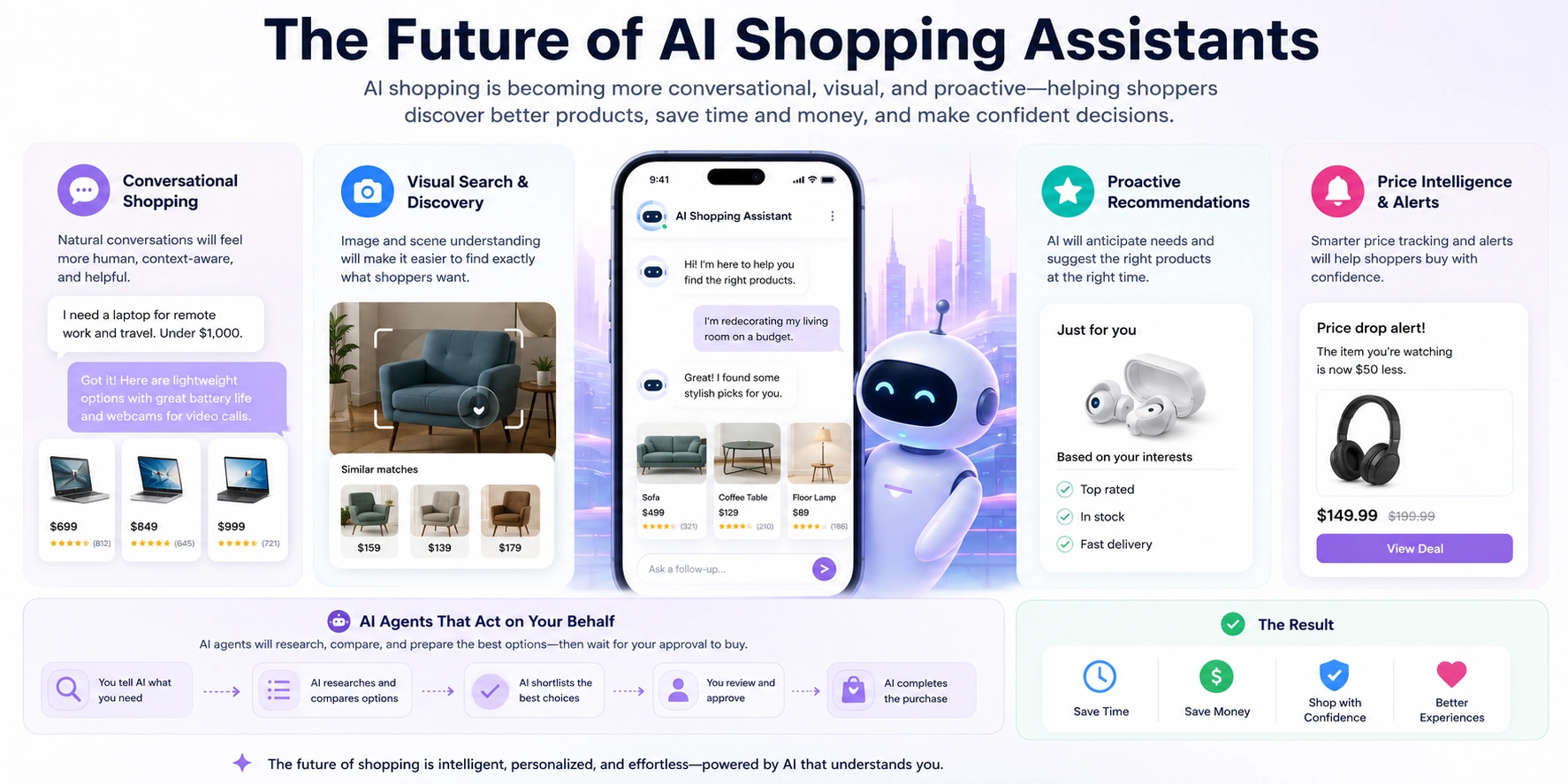
Shopping Will Become More Conversational
Traditional product search often begins with a short phrase such as “wireless headphones” or “coffee machine.” Future shopping assistants will be better at handling complete goals and follow-up requests.
A shopper may begin with:
“I need a home office setup for a small apartment under $1,500.”
Then continue with:
- “I already have a laptop, so only include the desk, chair, monitor, and lighting.”
- “Make the desk suitable for two monitors.”
- “Show options that can arrive this week.”
- “Which chair is best for working eight hours a day?”
The assistant will be expected to preserve the context, understand the trade-offs, and keep narrowing the options without forcing the shopper to restart from the beginning.
Visual and Multimodal Shopping Will Grow
Shoppers increasingly want to search using more than text. They may upload a photo, use voice, share a screenshot, or combine an image with a written request.
For example, someone could upload a photo of a living room and ask:
“Find a similar coffee table in a darker wood finish under $400.”
This is especially useful in fashion, furniture, home decor, accessories, and beauty, where appearance may be easier to communicate visually than through product filters.
Amazon already supports image-based shopping questions through Alexa for Shopping, including requests to find products with a similar style or solve a problem shown in a photo. Amazon’s overview of Alexa for Shopping also describes image uploads, personalized product guidance, price history, and conversational shopping actions.
Assistants Will Become More Proactive
Most shopping assistants currently respond after a shopper asks a question. Future systems are likely to take a more proactive role when users explicitly allow it.
They may help with:
- Price-drop alerts
- Restock notifications
- Replacement-product reminders
- Recurring household purchases
- Gift suggestions based on saved preferences
- Better alternatives when a preferred item becomes unavailable
Amazon has already introduced features that allow shoppers to set a target price, receive alerts, and in some cases authorize automatic purchases when products reach that price. This shows how assistants may gradually move from product research toward limited, user-approved actions.
AI Agents May Handle More of the Research Process
Another major change is the rise of agentic shopping systems. These are assistants designed to complete more than one isolated task. They may compare options across stores, monitor availability, evaluate delivery conditions, and prepare a purchase for approval.
Google announced an open standard for agentic commerce in January 2026, designed to help retailers connect with AI agents throughout the shopping journey. The initiative reflects a future in which product information, prices, inventory, and checkout systems may need to work not only for human shoppers but also for AI agents acting on their behalf.
For retailers, this makes structured product data even more important. An assistant cannot compare products accurately when details about price, variants, compatibility, delivery, or returns are incomplete.
Shopping Assistants Will Need More Transparency
As assistants become more capable, shoppers will need clear answers to basic questions:
- Why was this product recommended?
- Is this result sponsored?
- Which information came from the retailer and which came from outside sources?
- Is the price current?
- What personal data influenced the ranking?
- Can I turn off personalization or automated actions?
The future of AI shopping should not mean less control for the shopper. The best assistants will make recommendations easier to understand and easier to challenge.
Retailers Will Need Better Product Data
Future assistants will depend on reliable product information more than polished marketing language. Retailers will need accurate specifications, real-time inventory, clear variant data, verified compatibility information, delivery estimates, return policies, and structured product attributes.
This is one reason ecommerce AI is becoming a broader operational issue, not just a customer-service feature. The assistant may be the visible interface, but the quality of its advice depends on the systems behind it.
For a wider view of these changes, see our guide to the future of AI in ecommerce.
The Likely Outcome
AI shopping assistants are unlikely to replace ordinary product pages, filters, reviews, and human judgment. Instead, they will make those tools easier to use by helping shoppers get to the right products faster and understand the choices in front of them.
The most useful future assistants will not be the ones that make the most decisions. They will be the ones that reduce unnecessary research, provide trustworthy information, explain trade-offs clearly, and leave the final purchase decision with the customer.
Conclusion
An AI shopping assistant can make online shopping easier when it helps people move from a vague need to a smaller, more relevant set of products. It can understand natural-language requests, compare options, explain trade-offs, surface alternatives, answer product questions, and help shoppers refine their choices without restarting the search every time.
The real benefit is not simply faster shopping. It is better decision support. A useful assistant helps a shopper understand why a product may fit their budget, use case, preferences, delivery deadline, or compatibility requirements.
However, AI shopping assistants are only as reliable as the information behind them. Accurate product data, current inventory, clear pricing, verified specifications, transparent sponsored placements, and honest limits are essential. Shoppers should still check product pages and key policies before buying expensive, technical, or compatibility-sensitive products.
For ecommerce stores, the opportunity is to make product discovery less frustrating and customer support more useful. For shoppers, the opportunity is to spend less time opening dozens of tabs and more time evaluating the options that genuinely fit.
Google’s recent commerce updates show that shopping is becoming more conversational, visual, and agent-assisted, with AI increasingly supporting discovery, comparison, and purchase decisions across the customer journey. Google’s latest shopping AI update outlines how these experiences are evolving for both shoppers and retailers.
The best AI shopping assistants will not be the ones that make every decision automatically. They will be the ones that provide useful context, explain trade-offs clearly, respect the shopper’s preferences, and leave the final choice in human hands.
Explore more guides on AI Shopping Assistant to learn how AI is changing ecommerce search, product recommendations, shopping chatbots, personal shoppers, and online buying decisions.
Frequently Asked Questions
What is an AI shopping assistant?
An AI shopping assistant is a tool that helps people discover, compare, and evaluate products through natural-language questions, product data, search signals, and sometimes personal preferences. It may appear as a chat assistant, conversational search bar, mobile feature, voice assistant, or visual-search tool.
How is an AI shopping assistant different from a normal chatbot?
A normal chatbot may answer support questions or direct visitors to help pages. An AI shopping assistant is more focused on product discovery and purchase decisions. It can help shoppers describe what they need, narrow product options, compare alternatives, explain trade-offs, and answer relevant questions about compatibility, delivery, returns, or stock.
Are AI shopping assistants accurate?
They can be useful, but they are not always accurate. Their answers depend on the quality of the retailer’s product catalog, inventory data, prices, specifications, policies, and delivery information. Important details such as compatibility, warranty terms, materials, sizing, and return conditions should still be verified on the official product page before purchase.
Can an AI shopping assistant find cheaper alternatives?
Yes. A well-designed assistant can suggest lower-cost alternatives that preserve the shopper’s most important requirements. For example, it may show a similar product in another color, a previous model, a different brand, or an option with fewer premium features but a lower price.
Can AI shopping assistants compare products?
Yes. They can compare shortlisted products using criteria that matter to the shopper, such as price, weight, battery life, sizing, warranty coverage, delivery time, compatibility, reviews, or included accessories.
The best comparisons explain trade-offs instead of declaring one product universally better. For example, one product may be cheaper, another may have stronger performance, and a third may have a better warranty.
Do AI shopping assistants use personal data?
Some do. Depending on the retailer and the shopper’s settings, an assistant may use current-session activity, previous purchases, browsing history, saved preferences, location, cart activity, or device information to personalize results.
Retailers should clearly explain what data is collected, how it influences recommendations, whether conversations are stored, and how shoppers can limit or disable personalization. The Federal Trade Commission’s guidance on online tracking explains how websites and apps may collect and use consumer information for personalized experiences.
Can an AI shopping assistant make purchases automatically?
Some systems can assist with price alerts, restock notifications, recurring purchases, or user-approved checkout actions. However, shoppers should remain in control of spending limits, selected products, delivery details, and payment authorization.
Will AI shopping assistants replace normal ecommerce search?
No. Traditional search and filters remain important, especially when shoppers know the exact product, model number, brand, or compatibility code they need. AI shopping assistants work best as an additional layer that helps people who have broader questions, complex requirements, or too many similar products to compare.
Can AI shopping assistants replace human customer support?
They can handle many routine questions, but they should not replace human support entirely. Complex returns, damaged orders, account-security issues, high-value purchases, policy exceptions, and unclear product data often require a person who can investigate and make a judgment call.
What should ecommerce stores do before adding an AI shopping assistant?
Stores should first improve the data behind their catalog. That includes accurate titles, structured attributes, current inventory, reliable pricing, clear variant information, shipping rules, return policies, compatibility details, and product specifications.
AI works best when the information it can retrieve is current, complete, and verified. Without that foundation, an assistant may create more confusion instead of helping shoppers make better decisions.