

Online shopping gives consumers access to more products than ever, but having more choices does not always make it easier to decide what to buy. A search for a laptop, mattress, skincare product, or birthday gift can produce hundreds of similar-looking results. Shoppers must then compare prices, specifications, customer reviews, delivery terms, and return policies, often across several websites.
Traditional filters can narrow the selection, but they still require shoppers to understand which product features matter. Research from the Baymard Institute shows that effective product filtering helps users reduce catalogs containing thousands of products to a much smaller group that reflects their individual needs. The problem is that many shoppers do not know which filters to select or how technical specifications relate to the way they plan to use a product.
This is where an AI personal shopper can help. Instead of requiring users to search with exact keywords and manually compare every option, an AI personal shopper allows them to describe what they need in everyday language. A shopper might ask for “a lightweight laptop under $1,000 with strong battery life for remote work” or “a birthday gift under $75 for a child who enjoys science.” The system can interpret the request, identify the most important requirements, search available product information, and recommend relevant options.
AI personal shoppers can take several forms, including conversational chatbots, retailer tools, mobile apps, browser extensions, voice assistants, and visual search platforms. Some operate inside a single online store, while others help users research products from multiple retailers. More advanced tools can compare specifications, summarize reviews, suggest alternatives, explain trade-offs, and refine their recommendations through follow-up questions.
The technology builds on capabilities such as natural language processing, product search, recommendation systems, and machine learning. Natural language processing allows software to interpret written or spoken requests, while recommendation technology helps rank products according to factors such as relevance, preferences, budget, and shopping behavior. Together, these systems can turn a broad shopping question into a more focused decision.
However, an AI personal shopper is not automatically neutral or accurate. Its recommendations may depend on the product data it can access, the retailers included in its search, how recently prices were updated, and whether sponsored products or affiliate relationships influence the results. Shoppers still need to verify important details before completing a purchase.
In this guide from AI Shopping Assistant, we will explain what an AI personal shopper is, how it works, what it can realistically do, and how it differs from traditional product search and broader AI shopping assistants. We will also examine its benefits, limitations, privacy concerns, and the role this technology may play in the future of online shopping.
Quick Overview: How AI Personal Shoppers Work
An AI personal shopper helps users move from a broad shopping need to a smaller, more relevant selection of products. The table below summarizes the main capabilities, how they work, and the value they can provide.
| Capability | What It Does | Example | Main Benefit |
|---|---|---|---|
| Natural-language shopping | Understands shopping requests written in everyday language. | “Find a lightweight laptop under $1,000 for remote work.” | Removes the need to know exact product names or technical terms. |
| Product discovery | Searches available product data and creates a relevant shortlist. | Finding running shoes for wide feet and long-distance road running. | Reduces the time spent browsing unsuitable products. |
| Personalized recommendations | Uses the shopper’s budget, preferences, intended use, and previous choices. | Recommending a compact desk for a small apartment and two monitors. | Produces suggestions that better match the individual shopper. |
| Product comparison | Compares relevant specifications, prices, warranties, reviews, and trade-offs. | Comparing three smartphones by camera quality, battery life, and software support. | Makes complex differences easier to understand. |
| Review summarization | Identifies repeated strengths and complaints across customer reviews. | Noticing that buyers praise comfort but frequently report inconsistent sizing. | Saves shoppers from reading hundreds of individual reviews. |
| Budget matching | Filters options by price and may consider long-term ownership costs. | Comparing printers by purchase price, cartridge cost, and maintenance. | Helps shoppers identify value rather than simply choosing the cheapest item. |
| Alternative suggestions | Recommends substitutes when the preferred product is unavailable or unsuitable. | Finding a less expensive camera with similar travel-friendly features. | Prevents the shopping process from ending when the first choice does not work. |
| Compatible bundles | Suggests accessories or products designed to work together. | Pairing a laptop with a compatible dock, monitor, mouse, and sleeve. | Reduces compatibility mistakes and forgotten accessories. |
| Conversational refinement | Allows the shopper to adjust requirements through follow-up questions. | “Keep the same features, but show only products available this week.” | Lets shoppers refine the search without starting over. |
| Price and availability support | May compare sellers, track price changes, or check whether products are in stock. | Receiving an alert when a television drops below a selected price. | Can help shoppers choose a better time or place to buy. |
Not every AI personal shopper includes all of these capabilities. Some work only inside one retailer’s catalog, while others can compare several stores, analyze reviews, track prices, or assist throughout the wider shopping journey.
What Is an AI Personal Shopper?
An AI personal shopper is a digital tool that uses artificial intelligence to help a person discover, compare, and choose products. Instead of presenting a long list of search results, it tries to understand what the shopper actually needs and then recommends a smaller group of relevant options.
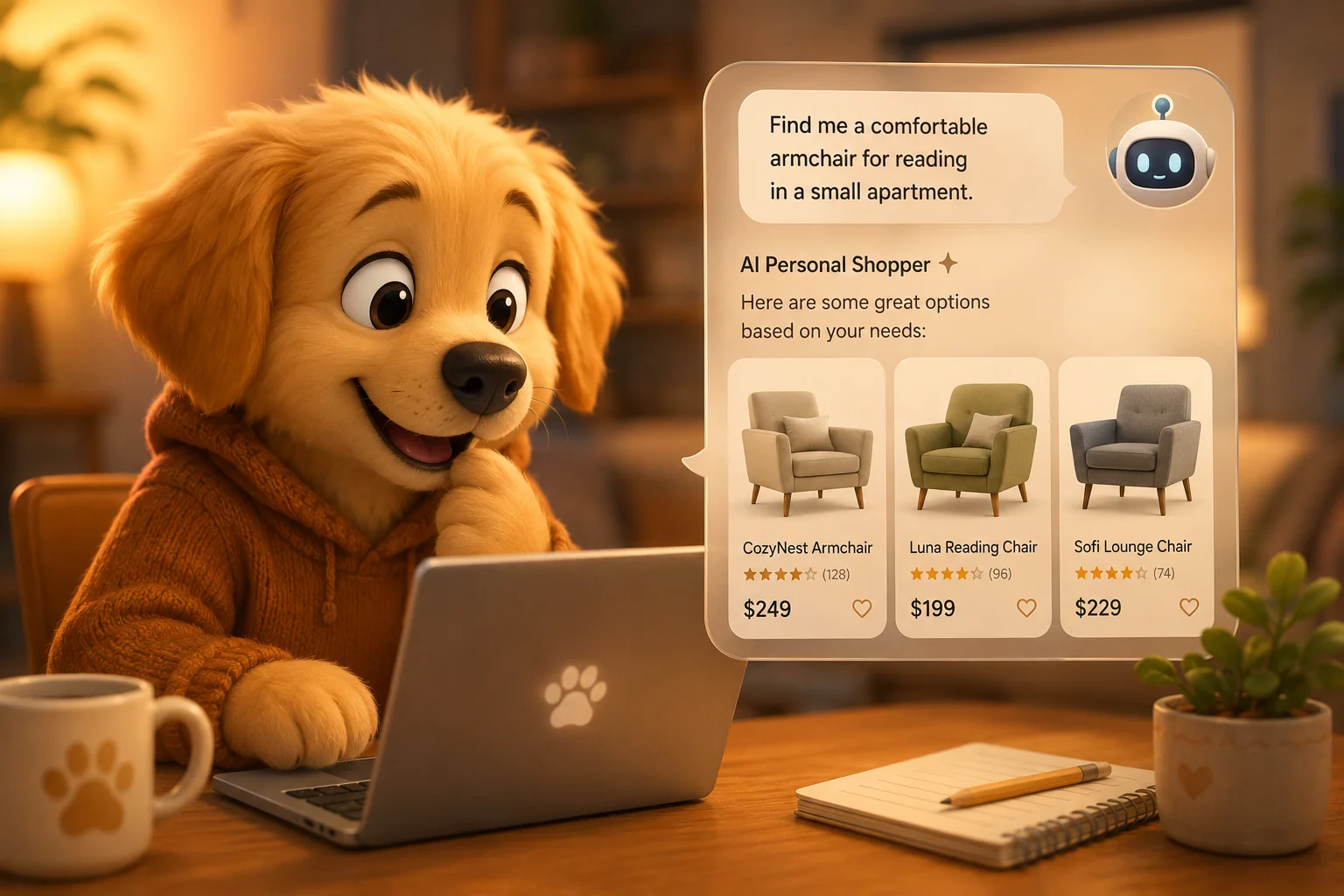
The shopper can describe the purchase in ordinary language, without knowing the exact product name or technical specifications. For example:
“I need a lightweight laptop under $1,000 with good battery life for remote work and occasional travel.”
The AI can turn that request into practical criteria such as price, weight, battery performance, portability, memory, and suitability for common work tasks. It can then use those criteria to filter and rank available products.
This ability depends partly on natural language processing, a branch of artificial intelligence that enables computers to interpret and work with human language. Instead of matching only isolated keywords, the system attempts to understand the meaning and intent behind the request.
An AI personal shopper may appear as:
- A conversational chatbot on an ecommerce website
- A shopping feature inside a retailer’s mobile app
- A standalone product research platform
- A browser extension
- A voice-based assistant
- A visual search tool that accepts photographs or screenshots
Some tools search products from only one retailer. Others may compare products across several stores, marketplaces, or product databases. The range of available recommendations depends on which catalogs and data sources the platform can access.
An AI personal shopper may also consider information such as:
- The shopper’s maximum budget
- Preferred brands, colors, sizes, or materials
- The intended use of the product
- Required and optional features
- Previous purchases or browsing behavior
- Delivery requirements
- Customer ratings and review patterns
- Compatibility with products the shopper already owns
The goal is not simply to recommend the most popular or expensive item. A useful AI personal shopper should identify products that fit the shopper’s specific situation and explain why each option may be suitable.
A Simple AI Personal Shopper Example
Imagine that someone wants to buy running shoes but does not know which model to choose. The shopper could ask:
“Find running shoes under $150 for wide feet, long-distance road running, and strong cushioning.”
A traditional product search may treat terms such as “running shoes,” “wide,” and “under $150” as separate keywords or filters. An AI personal shopper can interpret the request as a complete set of needs and prioritize:
- A wider fit
- Cushioning suitable for longer distances
- Durability for road surfaces
- A price below the stated limit
It may then recommend several products and explain the differences between them. One model may provide the strongest cushioning, another may be lighter, and another may offer better value.
The shopper can continue the conversation by asking:
- “Which option is best for beginners?”
- “Show me only shoes available in black.”
- “Which model has the best return policy?”
- “Find a cheaper alternative with similar cushioning.”
This conversational guidance is what separates an AI personal shopper from a basic search bar. It can maintain context, respond to follow-up questions, and help the shopper refine the decision without starting over.
AI Personal Shopper vs. a General AI Shopping Assistant
The terms are often used interchangeably, but an AI personal shopper usually focuses specifically on product selection and personalized recommendations.
A broader AI shopping assistant may also help with store navigation, checkout questions, shipping information, order tracking, returns, and customer support.
In practice, many ecommerce platforms combine both roles. The same assistant may help a customer choose a product, check whether it is in stock, explain delivery options, and later provide an order update.
How Does an AI Personal Shopper Work?
An AI personal shopper usually combines several technologies rather than relying on a single model. It may use natural language processing to understand the request, product search to identify relevant items, recommendation systems to rank the options, and generative AI to explain the results in conversational language.
The exact process varies by platform, but most AI personal shoppers follow five main steps.
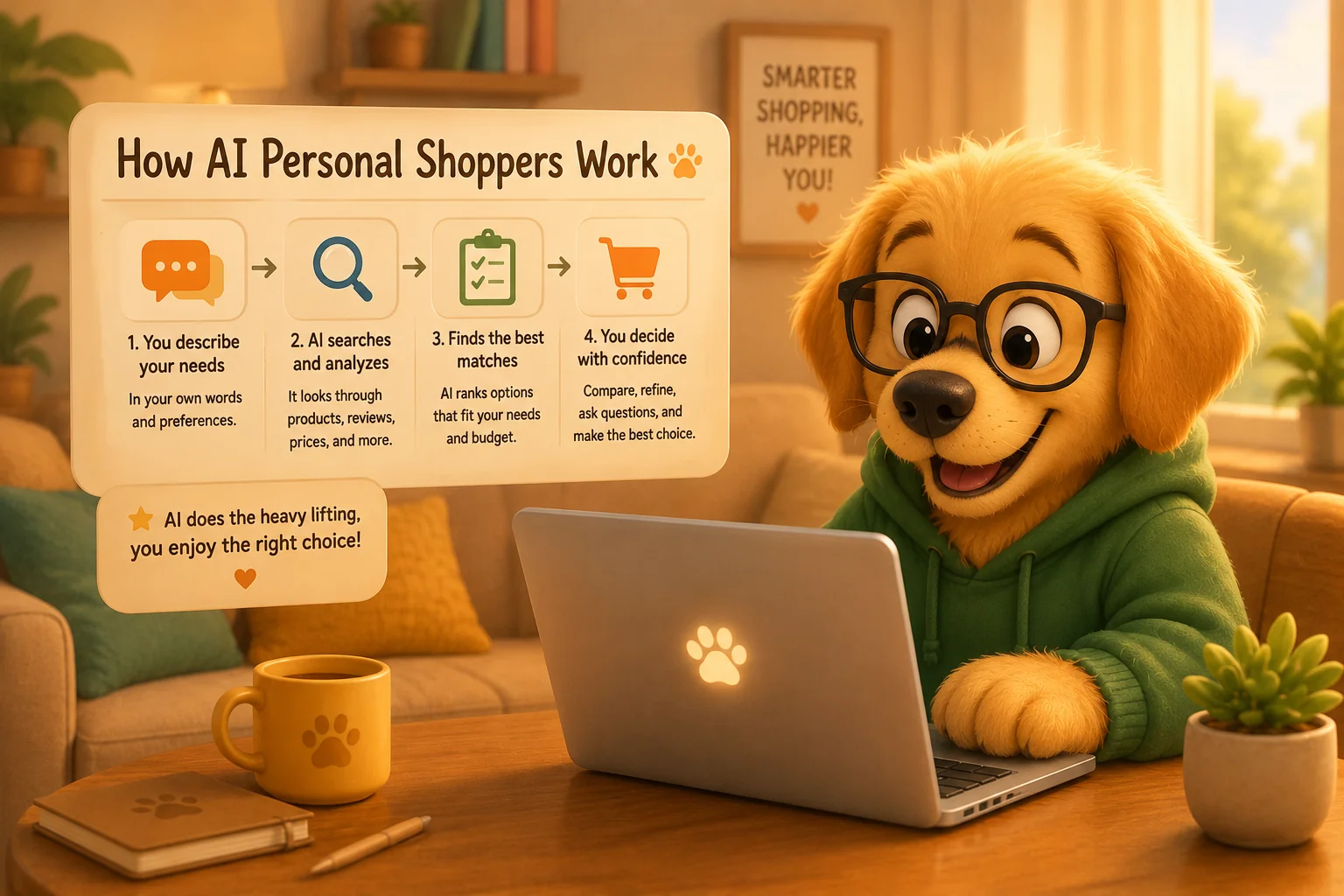
1. The Shopper Describes What They Need
The process begins with a request. The shopper may type a message, speak to a voice assistant, answer guided questions, select preferences, or upload an image.
A useful request might include:
- The type of product
- The intended use
- The maximum budget
- Required features
- Preferred size, color, style, or brand
- Features or brands to avoid
- Delivery requirements
For example:
“Find a compact air purifier under $250 for a bedroom, with quiet operation and low replacement-filter costs.”
The shopper does not need to know every technical specification. The AI can interpret the practical need and translate it into product criteria.
2. The AI Identifies Intent and Constraints
The system analyzes the request to separate essential requirements from preferences.
In the air purifier example, the AI may identify:
- A maximum price of $250
- A size suitable for a bedroom
- Low noise during nighttime use
- Reasonable long-term filter costs
It may also detect missing information and ask a follow-up question, such as the size of the room or whether the shopper is concerned about allergies, pet hair, smoke, or odors.
This clarification step matters because the phrase “best air purifier” does not have one universal answer. The strongest choice depends on the shopper’s room, budget, priorities, and intended use.
3. The System Searches Product Data
After interpreting the request, the AI searches the product information available to the platform.
This may include:
- Product titles and descriptions
- Technical specifications
- Current prices
- Available colors and sizes
- Inventory status
- Shipping information
- Warranty and return terms
- Customer ratings and reviews
- Compatibility information
A retailer-based assistant may search only that store’s catalog. A broader shopping tool may compare several retailers or marketplaces.
The recommendation is only as reliable as the underlying data. If the catalog contains outdated prices, incomplete specifications, or incorrect stock information, the AI may return recommendations that appear relevant but cannot be trusted without verification.
4. The AI Generates, Scores, and Ranks Product Candidates
Most recommendation systems do not evaluate every product in the same way. They first create a smaller group of possible matches, then score and rank those products according to relevance.
Google’s overview of recommendation-system architecture describes a common process involving candidate generation, scoring, and re-ranking. Candidate generation reduces a large catalog to a smaller group, scoring estimates how relevant each item may be, and re-ranking can account for additional considerations such as diversity, freshness, or business constraints.
For an AI personal shopper, ranking factors may include:
- How closely the product matches the request
- Price and value
- Availability
- Customer review patterns
- Compatibility
- Previous shopper preferences
- Delivery speed
- Long-term ownership costs
This ranking stage is closely related to the technology discussed in our guide to how AI product recommendations increase ecommerce sales. The difference is that an AI personal shopper usually adds a conversational layer and builds the recommendation around a specific request from the user.
5. The AI Explains the Recommendations
A useful AI personal shopper should not simply display three products and label one as “best.” It should explain why each option was selected and what trade-offs the shopper should understand.
For example:
“This model is the best fit for quiet bedroom use because it has a low sleep-mode noise level and lower annual filter costs. The main disadvantage is that it covers a smaller room than the second option.”
A strong explanation may include:
- Why the product matches the request
- The main advantages
- The most important limitation
- Who the product is best suited for
- How it compares with the alternatives
- Which details still need to be verified
6. The Shopper Refines the Results
The shopper can then change the request without starting over.
Useful follow-up questions might include:
- “Show me a cheaper option.”
- “Which one has the lowest long-term maintenance cost?”
- “Only include products available this week.”
- “Compare the top two in a table.”
- “Which option is easiest to use?”
- “What is the biggest disadvantage of each product?”
The AI uses the new information to adjust the ranking and remove options that no longer match the shopper’s priorities.
7. Some Systems Learn From Shopper Behavior
Certain AI personal shoppers can also improve recommendations using previous interactions, such as:
- Products viewed
- Items saved
- Purchases completed
- Recommendations rejected
- Preferred brands
- Typical spending range
Google Cloud’s retail recommendation documentation explains that personalized recommendations can be generated using product catalogs, user events, and the shopper’s current activity. This means the system can combine historical behavior with what the customer is doing during the current session. :contentReference[oaicite:0]{index=0}
This can make future suggestions more relevant, but it also introduces privacy concerns. Shoppers should be able to understand what information is being collected, how long it is retained, and whether it is used only for recommendations or also for advertising.
What Can an AI Personal Shopper Actually Do?
An AI personal shopper can support several parts of the buying decision, but its capabilities vary from one platform to another. A retailer-based assistant may search only one store’s catalog, while a broader tool may compare products from multiple sources.
The most useful systems do more than display personalized product recommendations. They help shoppers turn an unclear need into specific criteria, understand the differences between products, and narrow the options through follow-up questions.
Discover Products Through Natural-Language Requests
A shopper does not always know the exact product name or technical terminology required for an effective search. An AI personal shopper allows the user to describe the desired outcome instead.
For example:
“I need a compact desk for a small apartment, with enough space for two monitors and a budget of $300.”
The assistant can identify the important constraints, including dimensions, monitor capacity, storage needs, and price. It can then search for products that satisfy the complete request rather than matching only the phrase “compact desk.”
This is particularly useful in categories such as electronics, furniture, fitness equipment, beauty, and home appliances, where shoppers may understand the problem they want to solve but not the specifications they should search for.
Ask Follow-Up Questions
When the original request is too broad, an AI personal shopper can ask questions before recommending products.
Someone searching for a new television may be asked:
- How large is the room?
- What is the maximum budget?
- Will the television be used for gaming?
- Is the room usually bright or dark?
- Which streaming services or devices will be connected?
These questions prevent the assistant from treating “the best television” as if it had one answer for every shopper. They also make the recommendation process more similar to a conversation with a knowledgeable sales associate.
Compare Products and Explain Trade-Offs
An AI personal shopper can compare products using the factors that matter most to the individual user. Instead of repeating every specification, it can focus on the differences that may affect the final decision.
For example, when comparing three laptops, the assistant may explain that:
- One model offers the best performance but has shorter battery life.
- Another is lighter and easier to carry but has a smaller display.
- The third provides the best value but uses less premium materials.
This is more useful than declaring one product the universal winner. Most purchases involve trade-offs, and the right choice depends on how the product will be used.
A shopper can also request a more focused comparison:
“Compare these models only by battery life, weight, warranty, and total price.”
Summarize Product Reviews
Popular products may have hundreds or thousands of customer reviews. An AI personal shopper can analyze those reviews and identify repeated themes, helping the user understand common strengths and complaints without reading every comment.
A review summary might explain that:
- Customers frequently praise the product’s comfort.
- Many buyers report that the sizing runs small.
- Battery life is strong during normal use but weaker during gaming.
- The product is easy to assemble, although the instructions are unclear.
Review summaries should still be treated cautiously. Fake reviews, incentivized feedback, product revisions, and small sample sizes can affect the conclusions. A trustworthy assistant should distinguish between a repeated pattern and an isolated complaint.
Suggest Alternatives
If the preferred product is too expensive, unavailable, poorly reviewed, or incompatible with the shopper’s needs, the assistant can look for alternatives.
These may include:
- A cheaper product with similar essential features
- A premium upgrade with meaningful improvements
- A comparable option from another brand
- An older model that provides better value
- A substitute available for faster delivery
The alternative should solve the same problem, not merely belong to the same product category. If a shopper needs a lightweight camera for travel, recommending a larger professional camera simply because it has better specifications may ignore the most important requirement.
Recommend Compatible Products and Bundles
An AI personal shopper can help build a complete purchase by recommending accessories or products that work together.
Examples include:
- A camera with a compatible memory card, battery, bag, and tripod
- A laptop with a docking station, monitor, mouse, and protective sleeve
- A skincare routine with products intended to be used together
- A camping setup with a tent, sleeping bags, mats, and lighting
Compatibility is more important than popularity. The assistant should verify that an accessory works with the selected product rather than recommending it only because other customers frequently purchase the two items together.
Help Shoppers Stay Within Budget
A good AI personal shopper can treat the budget as more than a basic maximum-price filter. It can compare the total cost of ownership and identify products that provide better long-term value.
This may include:
- The initial purchase price
- Shipping costs
- Required accessories
- Subscriptions
- Replacement parts or consumables
- Maintenance expenses
For example, a low-cost printer may require expensive ink cartridges, while a more expensive model could cost less over several years. The cheapest item is not always the most economical choice.
Support Visual Shopping
Some AI shopping tools allow shoppers to upload a photograph or screenshot and search for visually similar products. This can be useful when the shopper likes the appearance of an item but does not know how to describe it.
A user might upload a photograph of a chair and ask:
“Find something with a similar design, but in dark green and under $500.”
Visual shopping is particularly useful for clothing, furniture, home decor, accessories, and beauty products. However, visual similarity does not guarantee the same dimensions, materials, quality, or functionality, so those details still need to be checked.
Track Prices and Product Availability
Depending on the platform, an AI personal shopper may monitor prices, identify discounts, notify the user when an item returns to stock, or compare offers from different sellers.
Amazon describes its Rufus conversational shopping assistant as a tool that can answer product questions, compare options, and help customers make more informed purchasing decisions within Amazon’s store.
Price and inventory information can change quickly. Before purchasing, shoppers should verify the final price, seller, delivery date, return terms, and whether additional fees are included.
Provide Assistance Throughout the Shopping Journey
Some systems continue helping after the initial recommendation. They may answer questions about delivery, returns, checkout, stock, or product compatibility.
This is where an AI personal shopper begins to overlap with the broader role of ecommerce chatbots. Our guide to how AI chatbots help ecommerce stores sell more explains how conversational tools can support product discovery while also answering customer questions throughout the buying journey.
The most effective AI personal shoppers reduce effort without removing the shopper’s control. They provide a short list of relevant options, explain why those products were selected, and allow the user to change the criteria before making a final decision.
AI Personal Shopper vs. Traditional Product Search
Traditional product search and AI personal shopping both help users find products, but they approach the task differently. A standard ecommerce search engine generally depends on keywords, categories, filters, and sorting controls. An AI personal shopper attempts to understand the shopper’s wider goal and guide the decision through conversation.
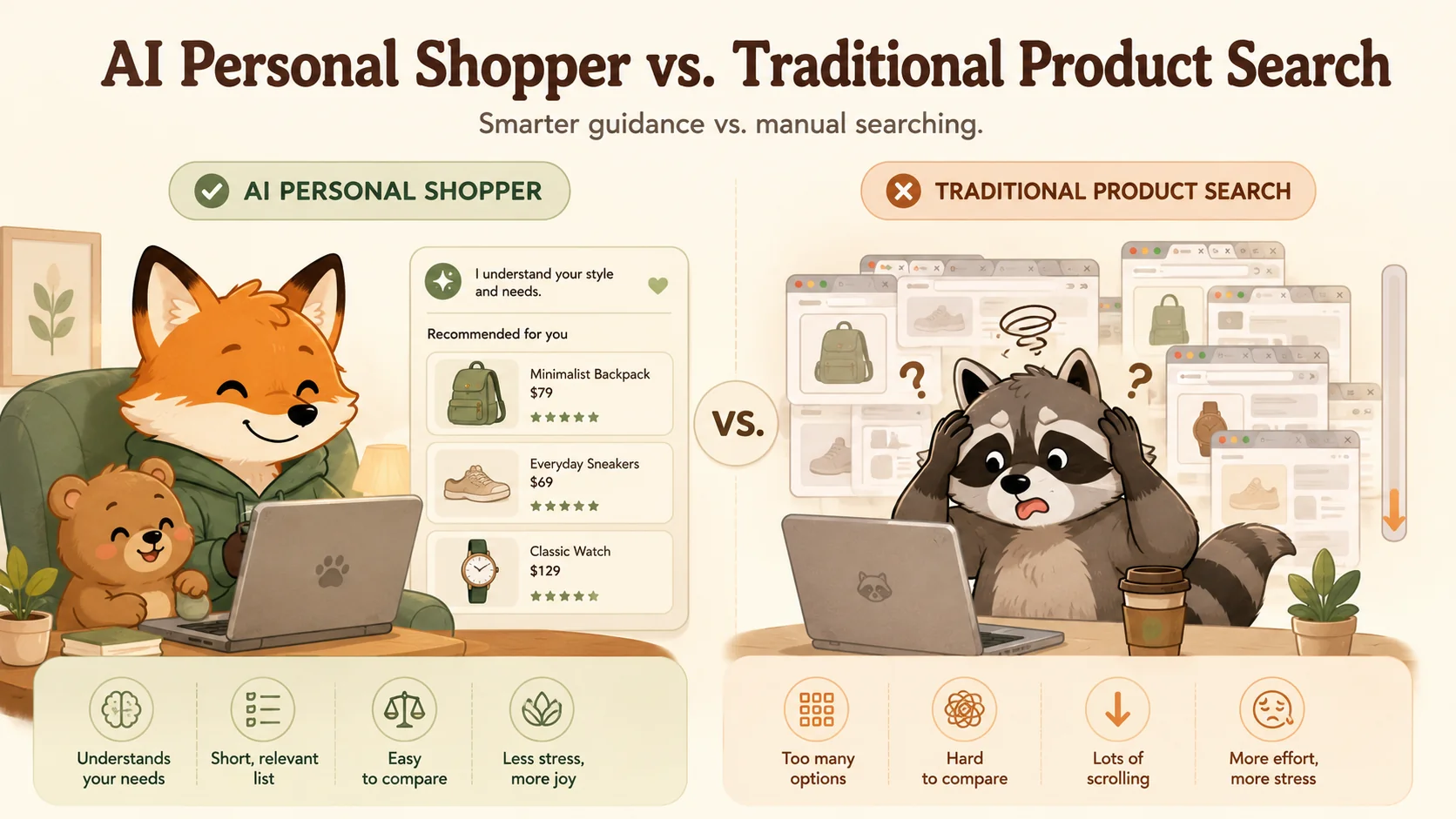
The difference becomes clearer when the shopper does not know the exact product name or specifications they need.
For example, a traditional search may begin with:
“Office chair.”
The retailer may return hundreds of chairs and ask the shopper to filter by price, material, color, brand, rating, and other attributes.
An AI personal shopper can begin with a more complete request:
“I need a comfortable office chair under $400 for working eight hours a day in a small home office.”
The AI can interpret requirements that were not expressed as standard product filters, including long-session comfort, ergonomic support, compact dimensions, and budget.
| Traditional Product Search | AI Personal Shopper |
|---|---|
| Primarily matches keywords and selected filters | Attempts to understand the shopper’s intent and complete request |
| Often returns a long list of products | Tries to create a smaller, more relevant shortlist |
| Requires shoppers to understand which filters matter | Can translate practical needs into product requirements |
| Usually treats each search as a separate action | Can retain context across follow-up questions |
| Leaves most comparisons to the shopper | Can compare products and explain important trade-offs |
| Results may be generic | Recommendations may reflect personal preferences and intended use |
| Provides limited explanation for the ranking | Can explain why each product was recommended |
Traditional Search Works Best With Exact Queries
Traditional search is efficient when the shopper already knows what they want. Someone searching for an exact model number, replacement part, book title, or product name may not need a conversation with an AI assistant.
For example, a shopper looking for a specific printer cartridge can enter the cartridge number, compare a few sellers, and complete the purchase quickly. Adding several AI-generated questions may make this simple task slower rather than easier.
Traditional search may be the better option when:
- The shopper knows the exact product or model
- The product has few meaningful variations
- The user wants to browse without personalization
- The shopper prefers to control every filter manually
- The goal is simply to compare prices for the same item
AI Personal Shoppers Are Better at Open-Ended Requests
An AI personal shopper becomes more useful when the shopper has a goal but does not yet know which product will solve it.
Consider this request:
“I need a backpack for a two-week trip through Europe.”
The shopper has not mentioned dimensions, airline limits, comfort, security, materials, or capacity. A conventional search may return a general list of travel backpacks. An AI personal shopper can ask questions and identify practical considerations such as:
- Carry-on size restrictions
- Expected trip length
- Preferred capacity
- Comfort during long walks
- Weather resistance
- Laptop storage
- Security features
- Maximum budget
This intent-based approach can turn a vague request into a more useful product search.
AI Search Supports Follow-Up Questions
One of the biggest differences is the ability to continue the same search through conversation.
After receiving an initial set of products, the shopper might say:
- “Show me something smaller.”
- “Keep the same features but lower the budget to $150.”
- “Which option has the best warranty?”
- “Remove products that require a subscription.”
- “Compare only the top two.”
The AI can apply the new instruction while retaining the earlier requirements. With traditional search, the shopper may need to change filters, open new tabs, or begin the search again.
Google explains that its AI Mode in Search supports follow-up questions and can divide complex requests into related subtopics before searching for relevant information. This type of conversational search reflects the broader direction of AI-assisted product discovery.
AI Can Explain Why a Product Fits
A traditional search results page generally shows product titles, prices, ratings, and short descriptions. The shopper must decide why one product may be better than another.
An AI personal shopper can provide a recommendation with context:
“This backpack is the strongest option for airline travel because it meets common carry-on dimensions, weighs less than the alternatives, and has a separate laptop compartment. The main disadvantage is its limited external storage.”
The explanation should include both benefits and compromises. A product is rarely best in every category, and a trustworthy assistant should not hide meaningful disadvantages.
AI Personal Shopping Can Be More Personalized
Traditional search results may be influenced by the search terms, product popularity, retailer priorities, and advertising. An AI personal shopper may also consider information about the individual user.
This could include:
- Preferred brands
- Typical budget
- Previous purchases
- Saved products
- Preferred sizes or colors
- Products previously rejected
Personalization can make recommendations more relevant, but it may also narrow product discovery or create privacy concerns. Shoppers should be able to change, remove, or disable stored preferences.
AI Personal Shoppers Do Not Automatically Produce Better Results
A conversational interface can feel more intelligent than a search bar, but the quality of the results still depends on the underlying product data and ranking system.
An AI personal shopper may perform poorly when:
- Product specifications are incomplete
- Prices or stock information are outdated
- The system searches only a limited group of retailers
- The shopper’s request is misunderstood
- Sponsored products influence the recommendations
- The AI presents uncertain information too confidently
Traditional filters may sometimes be more transparent because shoppers can see exactly which criteria they selected. AI recommendations can be harder to evaluate when the ranking process is not explained.
The Best Shopping Experience May Combine Both
AI personal shoppers do not need to replace traditional ecommerce search. The strongest shopping experience may combine conversational guidance with familiar product lists, filters, comparison tables, and sorting tools.
A shopper could begin with a natural-language request, receive a relevant shortlist, and then use standard filters to adjust the price, brand, size, or delivery date. This gives the user AI assistance without removing direct control over the results.
Traditional search remains useful for exact and simple purchases. AI personal shopping provides the greatest value when the request is complex, the shopper is uncertain, or the products require careful comparison.
AI Personal Shopper vs. AI Shopping Assistant
The terms AI personal shopper and AI shopping assistant are often used as if they mean the same thing. They overlap, but the difference is mainly one of scope.
An AI personal shopper focuses primarily on helping an individual choose the right product. It tries to understand the shopper’s preferences, intended use, budget, priorities, and constraints before recommending suitable options.
An AI shopping assistant may perform that same role while also supporting other parts of the customer journey, including store navigation, checkout, shipping questions, returns, and order tracking.
| AI Personal Shopper | AI Shopping Assistant |
|---|---|
| Focuses mainly on product discovery and selection | May support the entire shopping journey |
| Builds recommendations around individual needs | May answer both personalized and general store questions |
| Compares products and explains trade-offs | May also help with checkout, delivery, returns, and order status |
| Usually provides the most value before the purchase | Can assist before, during, and after the purchase |
| Acts like a digital product adviser | Acts more like a combination of product adviser and customer service agent |
The Main Difference Is the Task Being Solved
An AI personal shopper is most useful when the customer needs help answering questions such as:
- Which laptop is best for my budget?
- Which running shoes fit my training needs?
- What gift should I buy for this person?
- Which product offers the best value?
- What is a suitable alternative to this item?
An AI shopping assistant may answer those questions while also handling requests such as:
- Is this product currently in stock?
- Can it be delivered before Friday?
- What is the return policy?
- Where is my order?
- How can I change my delivery address?
Google Cloud describes its Conversational Commerce agent as a guided shopping capability that can provide personalized assistance throughout the shopping journey. This reflects how modern ecommerce systems are beginning to combine product discovery with broader customer support rather than treating them as completely separate functions.
Personal Shoppers Focus More Heavily on Individual Preferences
A true AI personal shopper should build its recommendations around the shopper’s situation instead of showing the same products to every visitor.
It may consider:
- Maximum budget
- Preferred brands
- Previous purchases
- Sizes, colors, or materials
- Products already owned
- Features the shopper wants to avoid
- The way the product will be used
For example, two people may both search for a travel laptop. One may prioritize battery life and low weight, while the other needs a larger display and stronger performance. A personal shopper should recognize that the same product may not be suitable for both users.
This kind of personalization is closely related to the recommendation technology used across ecommerce, but the personal shopper adds direct conversation and user-specific reasoning to the process.
Shopping Assistants Often Connect to More Store Systems
To support customers throughout the buying journey, a broader AI shopping assistant may need access to systems beyond the product catalog.
These may include:
- Inventory data
- Customer accounts
- Order management systems
- Shipping and tracking information
- Return and refund tools
- Store policies
- Checkout and payment support
This allows the assistant to continue helping after the product has been selected.
For example, a conversation may begin with:
“Help me choose a compact coffee machine under $300.”
After the shopper selects a model, the conversation may continue with:
“Can it arrive by Thursday, and can I return it if it does not fit on my counter?”
The first question belongs mainly to personal shopping. The second requires access to delivery and return information. To the customer, however, both requests are part of one continuous shopping experience.
Many Tools Now Combine Both Roles
In practice, the distinction between the two categories is becoming less clear. Retailers increasingly want one conversational system that can recommend products, answer questions, reduce uncertainty, and support the customer after checkout.
IBM notes that virtual shopping assistants can guide shoppers through ecommerce experiences, provide product suggestions, and help move customers through the sales journey. The broader use of AI across customer experience can also include service and support after the purchase.
This combined approach can be more convenient because customers do not need to switch between a recommendation tool, a customer service chatbot, and an order-tracking page.
Our guide to how AI chatbots help ecommerce stores sell more examines this wider role in more detail, including product guidance, customer questions, and support throughout the buying process.
Which Term Should Shoppers Use?
For most consumers, the terminology matters less than the assistant’s actual capabilities.
A shopper who needs help choosing a product should look for features such as:
- Natural-language product search
- Follow-up questions
- Transparent recommendations
- Product comparison
- Review summaries
- Price and availability information
A shopper who also needs help after choosing a product should look for broader capabilities such as:
- Inventory confirmation
- Shipping information
- Checkout assistance
- Order tracking
- Returns and refunds
- Access to human support
An AI personal shopper is therefore best understood as the product-selection part of a wider AI shopping assistant. Some tools provide only that focused service, while others combine it with customer support across the entire ecommerce journey.
Benefits of Using an AI Personal Shopper
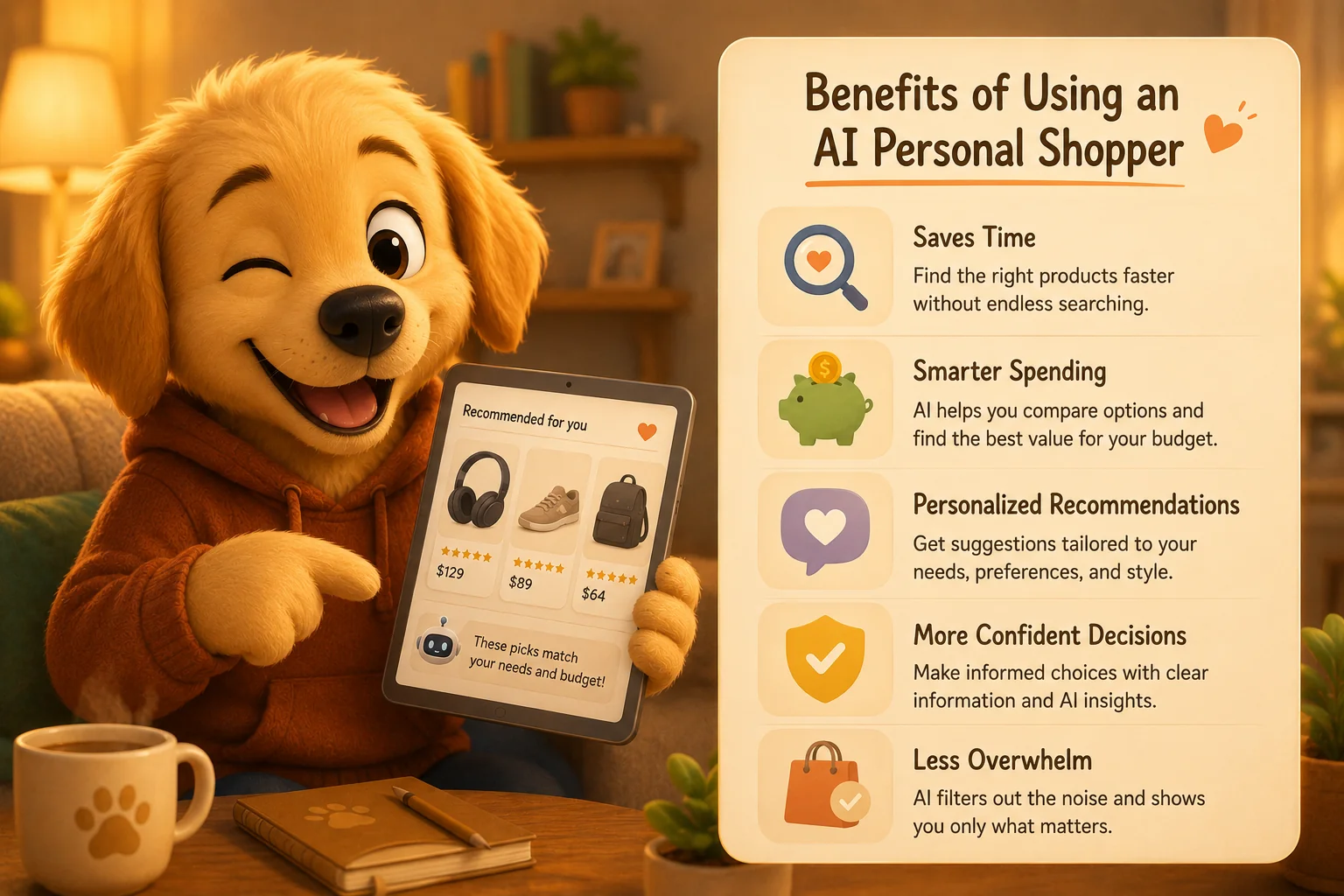
The main advantage of an AI personal shopper is not that it gives shoppers access to more products. Most ecommerce websites already offer more options than a person can realistically compare. Its value comes from reducing the effort required to identify which products deserve attention.
When the system understands the shopper’s priorities and has access to reliable product data, it can make research, comparison, and decision-making more manageable.
It Reduces the Time Spent Researching Products
A complex purchase may require shoppers to visit several websites, open multiple product pages, compare specifications, read reviews, and check prices before making a decision.
An AI personal shopper can bring the most relevant information together and organize it around the user’s request. Instead of researching twenty products independently, the shopper may receive a shortlist of three or four options with the important differences already explained.
For example, someone buying a laptop may ask the assistant to compare:
- Performance for the intended tasks
- Battery life
- Weight and portability
- Display quality
- Warranty coverage
- Total price
The shopper should still verify the final specifications, but the assistant can reduce the repetitive work required to reach a useful shortlist.
It Can Reduce Choice Overload
Large product selections can become difficult to evaluate, particularly when many options appear similar. Research into choice overload and consumer decision-making shows that the effects of having many options depend on factors such as the complexity of the decision, the shopper’s preferences, and how the choices are presented.
An AI personal shopper can make a large catalog easier to navigate by presenting a small number of products for clearly defined reasons.
Instead of displaying fifty similar products, it may identify:
- The best overall match
- The strongest budget option
- The best premium alternative
- The option with the fastest delivery
This does not remove choice. It organizes the choice around the shopper’s priorities.
It Helps Shoppers Understand Complex Products
Technical specifications are not always meaningful to people who do not regularly buy products from a particular category.
A shopper may see terms such as processor generation, refresh rate, air-delivery rate, foam density, or sensor size without knowing how those specifications affect real-world use.
An AI personal shopper can translate those details into practical language. For example, rather than simply listing a monitor’s refresh rate, it can explain whether that feature matters for office work, gaming, video editing, or general browsing.
The assistant can also distinguish between:
- Essential features
- Useful upgrades
- Features that matter only for specialized users
- Specifications that may not justify a higher price
This is especially useful for electronics, appliances, cameras, fitness equipment, tools, and other products where marketing language can make simple decisions appear more complicated.
It Can Produce More Relevant Recommendations
Traditional product filters usually treat each preference separately. A shopper may select a price range, brand, color, and rating, but the search engine may still struggle to understand the complete situation.
An AI personal shopper can combine several needs into one request.
For example:
“Find a lightweight stroller for city use that folds easily, fits in a small car, and costs less than $400.”
The recommendation should consider all of those requirements together. A stroller that is inexpensive but difficult to fold would not be a strong match, even if it satisfies the budget.
This contextual approach can be more useful than recommendations based only on popularity or products that other customers frequently purchased.
It Makes Product Comparisons Easier to Understand
Product pages do not always present information consistently. One retailer may emphasize technical specifications, while another focuses on promotional benefits or customer reviews.
An AI personal shopper can place the most important differences into a consistent format and tailor the comparison to the user.
For example, the same three smartphones could be compared differently depending on the shopper:
- A photographer may care most about camera performance and storage.
- A traveler may prioritize battery life, durability, and connectivity.
- A budget-conscious shopper may focus on price and software support.
The assistant can also explain the main compromise associated with each option instead of presenting one product as perfect.
It Can Help Shoppers Control Their Budget
An AI personal shopper can use price as part of the complete recommendation rather than as a simple filter.
It may help the user understand:
- Which product offers the strongest value within the budget
- Whether a premium upgrade provides a meaningful benefit
- Which cheaper alternative preserves the essential features
- Whether accessories or subscriptions increase the final cost
- How maintenance and replacement costs affect long-term value
For example, the cheapest printer may require costly cartridges, while a more expensive model may have lower operating costs. The best budget decision may therefore depend on how often the product will be used.
It Can Increase Confidence Before Purchase
Shoppers often hesitate because they are uncertain about compatibility, sizing, product quality, or whether another option would be better.
An AI personal shopper can reduce some of this uncertainty by explaining:
- Why a product matches the request
- Which requirements it does not fully satisfy
- What customers commonly praise or criticize
- Which accessories may be required
- What information should be checked before purchase
A recommendation becomes more trustworthy when it includes limitations. If the assistant mentions only advantages, shoppers may have difficulty distinguishing useful guidance from a sales message.
It Allows the Shopper to Refine the Decision
Shopping requirements often change during the research process. A user may discover that a feature matters more than expected or decide that the original budget was unrealistic.
With a conversational assistant, the shopper can revise the request without starting again:
“Keep the same requirements, but increase the budget to $800 and prioritize battery life.”
The AI can preserve the existing context while updating the recommendations. This makes the search process more flexible than repeatedly adjusting filters or opening new product pages.
It Can Make Shopping More Accessible
Conversational search may also help users who find complex ecommerce interfaces difficult to navigate.
Depending on the platform, shoppers may be able to:
- Use ordinary language instead of technical filters
- Speak a request instead of typing it
- Ask for simpler explanations
- Upload an image instead of describing a visual style
- Receive step-by-step guidance
AI does not replace the need for accessible website design, but it can provide another way to interact with a store and its product catalog.
The Benefits Depend on the Quality of the Assistant
These advantages are not automatic. An AI personal shopper can only be useful when it has accurate product information, understands the request, explains its reasoning, and clearly identifies uncertainty.
A confident recommendation based on incomplete data may be less useful than a transparent traditional search. Shoppers should therefore use AI to narrow and understand their options, while continuing to verify the final price, specifications, compatibility, seller, and return terms before buying.
How AI Personal Shoppers Help Ecommerce Stores
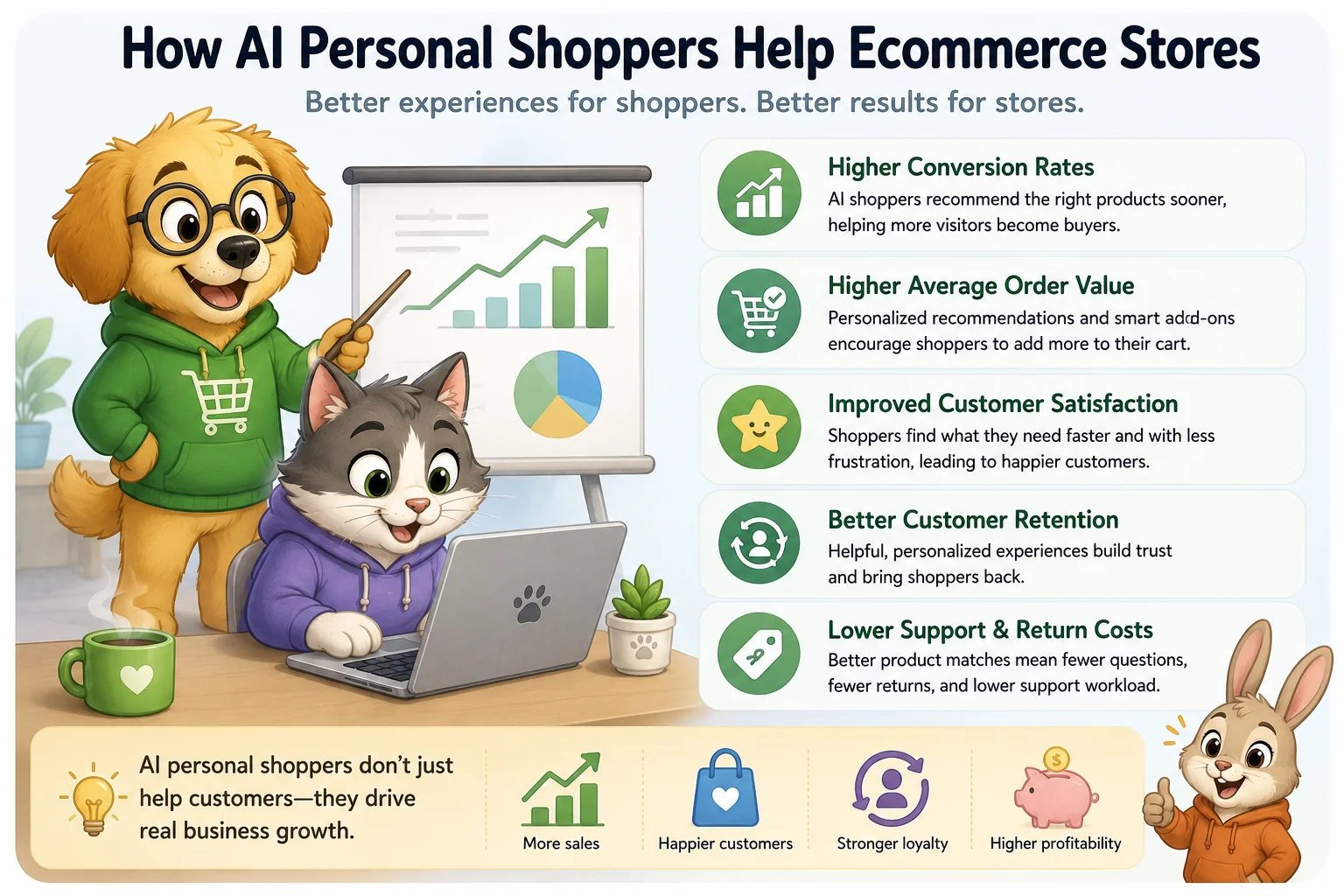
AI personal shoppers are designed to make shopping easier for customers, but they can also create measurable benefits for ecommerce businesses. When shoppers receive more relevant guidance, they may find suitable products faster, explore more of the catalog, and feel more confident about completing a purchase.
These results are not guaranteed simply because a store adds an AI chatbot. The assistant must be connected to accurate product data, understand the customer’s request, and provide recommendations that are genuinely useful rather than overly promotional.
They Can Improve Product Discovery
Many ecommerce stores carry products that shoppers never discover. Traditional search results tend to favor popular items, exact keyword matches, and products with strong sales histories. Relevant niche products may remain hidden deeper in the catalog.
An AI personal shopper can connect customers with products that better match their individual needs, even when those products are not bestsellers.
For example, a shopper looking for a compact desk may not search for the technical category or exact dimensions used in the store’s catalog. The assistant can interpret a request such as:
“I need a desk for a small apartment that can support two monitors and costs less than $300.”
It can then identify suitable products based on dimensions, weight capacity, price, and intended use.
This can help retailers:
- Expose more of their product catalog
- Match niche products with relevant shoppers
- Reduce dependence on bestseller lists
- Improve discovery for products with unfamiliar names or technical descriptions
They Can Increase Conversion Rates
A shopper may be interested in buying but still leave because the available choices are confusing or the differences between products are unclear.
An AI personal shopper can reduce this uncertainty by narrowing the options, answering product questions, and explaining why a particular item may be suitable.
For instance, someone buying a home security camera may be uncertain about storage, weather resistance, night vision, subscriptions, and smart-home compatibility. A conversational assistant can ask about these requirements and recommend a smaller group of relevant products.
The goal is not to pressure the customer into buying. It is to remove the information gaps that prevent an interested shopper from making a decision.
They Can Increase Average Order Value
AI personal shoppers can recommend accessories, bundles, replacements, and upgrades that improve the original purchase.
Useful examples include:
- A camera with a compatible memory card and spare battery
- A laptop with a docking station and protective sleeve
- A coffee machine with the correct filters or cleaning products
- A skincare product with complementary items for a simple routine
These suggestions can increase average order value, but only when they are relevant. Recommending unrelated or unnecessary products can make the assistant feel like an aggressive sales tool.
Our guide to how AI product recommendations increase ecommerce sales explains in more detail how relevance, cross-selling, and product placement can influence conversions and order value.
They Can Reduce Cart Abandonment
Some shoppers reach the cart but leave because important questions remain unanswered. They may be unsure about compatibility, sizing, delivery, return terms, or the total cost.
An AI personal shopper can address these concerns before the customer exits.
For example, the assistant may confirm:
- Whether an accessory is compatible with the selected product
- Whether the correct size is available
- When the order is expected to arrive
- Whether the product can be returned
- Whether additional components are required
Baymard Institute’s ongoing cart abandonment research identifies issues such as high extra costs, slow delivery, and unclear purchase conditions among the reasons users abandon checkout. An AI assistant cannot fix poor policies or an expensive checkout, but it can make key information easier to find before the customer leaves.
We examine this wider use case in our article about how AI helps reduce cart abandonment in ecommerce.
They Can Improve Customer Engagement
A conversational experience can encourage shoppers to explore products more actively than a static search page.
Instead of scrolling through categories, the customer can explain what they want, answer follow-up questions, and request alternatives.
This interaction may lead to:
- More products viewed
- More comparisons completed
- More items saved
- Longer sessions
- More return visits
However, the assistant should remain optional. Some shoppers know exactly what they want and prefer to use ordinary search and filters without interruptions.
They Can Reveal What Customers Actually Want
Traditional analytics show which products customers viewed or purchased, but conversational requests can reveal the reasons behind those actions.
A shopper may explain that they need:
- A compact product for a small apartment
- A beginner-friendly option
- A product without a subscription
- An alternative compatible with an older device
- A gift within a strict budget
When analyzed responsibly, these requests can help retailers identify recurring customer needs and gaps in the catalog.
This information may improve:
- Product descriptions
- Category organization
- Buying guides
- Merchandising
- Inventory planning
- Frequently asked questions
Stores should still be transparent about how conversations and personal preferences are collected, stored, and used.
They Can Support Customer Service Teams
During promotions, holidays, and product launches, customer service teams may receive many repetitive pre-purchase questions.
An AI personal shopper can handle common requests such as:
- Which product is suitable for a particular use?
- What is the difference between two models?
- Which accessories are compatible?
- Which product can arrive before a deadline?
- What size should the shopper select?
This can allow human employees to focus on unusual, sensitive, or complex situations.
The assistant should also recognize when it lacks reliable information and transfer the conversation to a human instead of inventing an answer.
They Can Support More Relevant Personalization
AI personal shoppers can use the customer’s current request and, when permitted, previous preferences to provide a more personalized experience.
McKinsey has reported that consumers increasingly expect personalized interactions and may become frustrated when those expectations are not met. However, effective personalization requires more than displaying a customer’s name or repeating previous purchases. It must help solve the current shopping problem. :contentReference[oaicite:0]{index=0}
A returning customer may receive recommendations that reflect:
- Preferred brands
- Typical spending range
- Previous purchases
- Sizes or compatibility requirements
- Features repeatedly selected or rejected
This can make future shopping faster, but customers should be able to review, change, or delete stored preferences.
They May Help Reduce Avoidable Returns
Returns often happen because the product does not fit, work with another device, match the available space, or perform as expected.
An AI personal shopper may reduce some avoidable returns by clarifying:
- Dimensions
- Compatibility
- Size and fit
- Materials
- Included accessories
- Product limitations
For example, the assistant may warn that a monitor requires a port the shopper’s laptop does not have, or that a furniture item may be too large for the available space.
AI cannot eliminate returns, and it cannot physically evaluate comfort, texture, or quality. However, clearer information can reduce purchases based on misunderstandings.
The Technology Does Not Fix a Weak Ecommerce Experience
An AI personal shopper cannot compensate for inaccurate product descriptions, hidden fees, poor shipping options, confusing returns, or unreliable customer service.
If the underlying ecommerce experience is weak, adding an AI interface may simply make those problems more visible.
Retailers should therefore treat AI personal shopping as part of a broader customer experience strategy. The assistant works best when it is supported by:
- Accurate product data
- Transparent prices
- Reliable inventory information
- Clear delivery expectations
- Simple return policies
- Access to human support
The business benefit comes from helping customers make better decisions, not from adding AI simply because the technology is popular.
Limitations, Bias, and Privacy Concerns
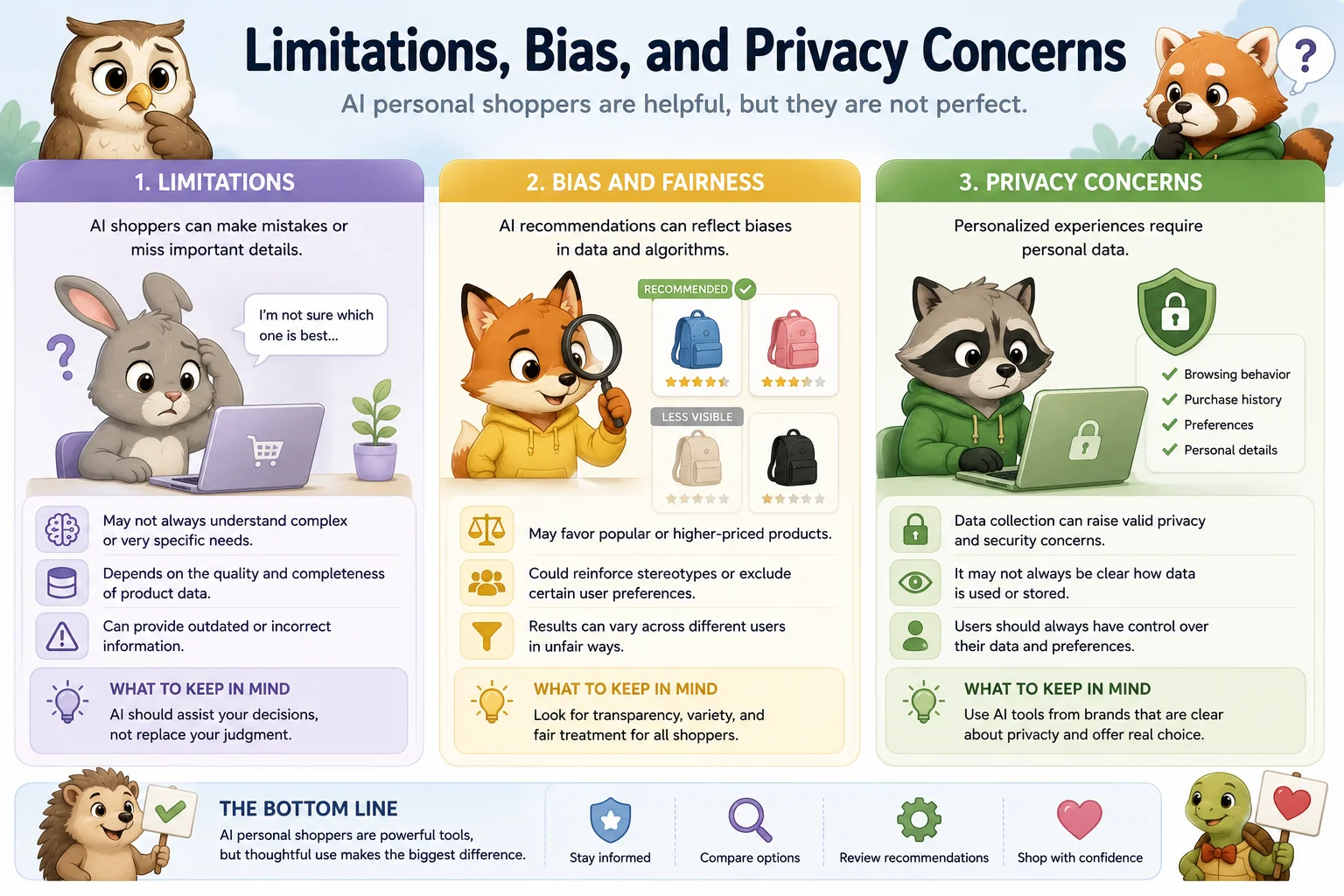
AI personal shoppers can reduce research time and make product comparisons easier, but they should not be treated as completely neutral or infallible advisers. Their recommendations depend on the data they can access, the ranking rules used by the platform, and the commercial relationships behind the service.
A polished conversational answer may sound authoritative even when the information is incomplete or uncertain. Shoppers should therefore use AI recommendations as decision support, not as a replacement for verification and personal judgment.
Recommendations Are Only as Good as the Product Data
An AI personal shopper cannot reliably recommend a product when the underlying catalog contains missing, outdated, or inaccurate information.
Common data problems include:
- Old prices
- Incorrect stock status
- Missing dimensions
- Incomplete compatibility details
- Outdated model specifications
- Unclear warranty terms
- Missing shipping or subscription costs
For example, the assistant may recommend a product because it appears to fit the shopper’s budget, but the actual cost may be higher after shipping, required accessories, memberships, or recurring fees are added.
The shopper should always verify the final price, seller, specifications, delivery date, and return terms on the retailer’s product page.
The AI May Misunderstand the Request
Natural-language shopping is convenient, but a request can still be vague or open to several interpretations.
Consider the prompt:
“Find a good camera for travel.”
The shopper has not explained whether they prioritize low weight, professional image quality, video performance, weather resistance, interchangeable lenses, or price.
A responsible assistant should ask clarifying questions instead of silently making assumptions. It should also explain when several requirements conflict.
For example, the lightest, cheapest, most durable, and highest-performing product may not be the same item. The AI should show the trade-offs rather than pretending that one option satisfies every priority perfectly.
Recommendations May Be Commercially Biased
An AI personal shopper may search only one retailer, a limited group of commercial partners, or products that provide reliable data feeds. It may also earn money from affiliate commissions, sponsored placements, or retailer agreements.
This creates several possible sources of bias:
- Sponsored products may receive additional visibility.
- Higher-commission products may be favored.
- Smaller retailers may be excluded.
- Products with incomplete data may never appear.
- The assistant may prioritize the retailer’s inventory goals.
The Federal Trade Commission states that endorsements must be honest and not misleading, and that material connections between a promoter and a seller should be disclosed clearly. The same principle matters when an AI shopping tool recommends products from companies that pay commissions or sponsor placements.
Shoppers should be able to understand:
- Whether the recommendation is sponsored
- Whether the platform earns a commission
- Which retailers were searched
- Whether paid products receive preferential placement
- How the final ranking was determined
For more detail, the FTC’s Endorsement Guides explain why commercial relationships should be disclosed when they could affect how consumers evaluate a recommendation.
AI Can Present Incorrect Information Confidently
One of the most serious risks is that an AI assistant may generate an answer that sounds clear and convincing even when part of it is wrong.
It may incorrectly claim that:
- An accessory is compatible
- A feature is included
- A warranty covers a particular problem
- A product meets a safety standard
- A price is the lowest available
- A product is suitable for a particular user
This risk becomes more important for expensive, safety-sensitive, or technically complex purchases.
Shoppers should independently verify:
- Compatibility
- Electrical or safety requirements
- Medical or health-related claims
- Warranty and return terms
- Subscription commitments
- Current prices and inventory
A trustworthy assistant should clearly identify uncertainty instead of presenting every conclusion as verified fact.
Review Summaries Can Hide Important Context
AI-generated summaries can save time, but they may also oversimplify customer feedback.
The original reviews may include:
- Fake or incentivized reviews
- Comments about an older version of the product
- Complaints about the seller rather than the item
- Conflicting experiences
- Very small sample sizes
- Unusual customer expectations
An assistant might report that customers praise a product’s durability without explaining that the conclusion is based on a small number of reviews or that recent buyers report different problems.
Shoppers should look at review volume, recency, repeated complaint patterns, and whether the feedback relates to the exact product version being considered.
Personalization Requires Personal Data
To provide increasingly relevant recommendations, an AI personal shopper may collect information about the user’s behavior and preferences.
This data may include:
- Search history
- Products viewed
- Purchases
- Saved items
- Preferred brands
- Typical spending range
- Sizes and style preferences
- Location
- Uploaded images
- Voice recordings or conversation history
This information can improve product relevance, but it may also be used for advertising, profiling, or sharing with business partners.
The FTC advises consumers to review privacy settings, cookie choices, and personalized advertising controls because websites and apps may collect information through browsing activity and tracking technologies. Its guide to how websites and apps collect and use personal information provides practical steps for limiting tracking and personalized advertising.
Privacy, Bias, and Transparency Are Connected
Privacy is not the only concern. A system that uses incomplete or unrepresentative customer data may also produce biased recommendations.
The NIST AI Risk Management Framework identifies transparency, accountability, privacy, fairness, reliability, and the management of harmful bias as important characteristics of trustworthy AI systems.
Applied to AI personal shopping, this means retailers should be able to explain:
- What data influences recommendations
- How shopper profiles are created
- Whether users can correct inaccurate preferences
- How commercial priorities affect rankings
- How the system is tested for inaccurate or unfair outcomes
For example, a personalization system should not assume that a shopper’s past purchases permanently define their future preferences. Users should be able to reset, edit, or disable personalization.
Too Much Personalization Can Limit Discovery
Personalization may repeatedly show shoppers products similar to those they have already viewed or purchased. Over time, this can create a narrow recommendation loop.
A customer who previously purchased inexpensive products may continue receiving only low-cost options, even when they are now interested in a premium upgrade. Someone who usually selects neutral colors may rarely see brighter styles.
A balanced AI personal shopper should:
- Use past preferences without treating them as permanent rules
- Allow shoppers to explore outside their usual profile
- Include some diverse alternatives
- Explain when past behavior influenced a recommendation
- Let users turn personalization off
AI Cannot Physically Test the Product
An AI personal shopper generally works with product descriptions, specifications, images, and reviews. It does not personally test comfort, fit, durability, texture, noise, smell, or long-term reliability.
This limitation matters for products such as:
- Clothing and footwear
- Mattresses and office chairs
- Cosmetics and fragrances
- Furniture
- Sports equipment
- Professional tools
The assistant can organize reported experiences, but it cannot guarantee that a product will feel comfortable or perform well for every individual.
The Shopper Still Needs to Make the Final Decision
The best use of an AI personal shopper is to reduce a large market to a manageable shortlist, explain meaningful differences, and highlight details that require verification.
It should not replace:
- Reading the final product page
- Checking the seller and return policy
- Confirming compatibility
- Reviewing important safety information
- Seeking professional advice when necessary
AI personal shoppers are most useful when they make the decision process clearer. They become less trustworthy when they hide uncertainty, commercial influence, or the limits of the available data.
How to Use an AI Personal Shopper Safely and Effectively
An AI personal shopper can save time and make complex purchases easier to understand, but the quality of the result depends partly on how the shopper uses it. A vague request may produce generic suggestions, while a clear prompt can help the system identify products that better match the buyer’s real needs.
The strongest approach is to use AI for research, comparison, and clarification while keeping control of the final decision.
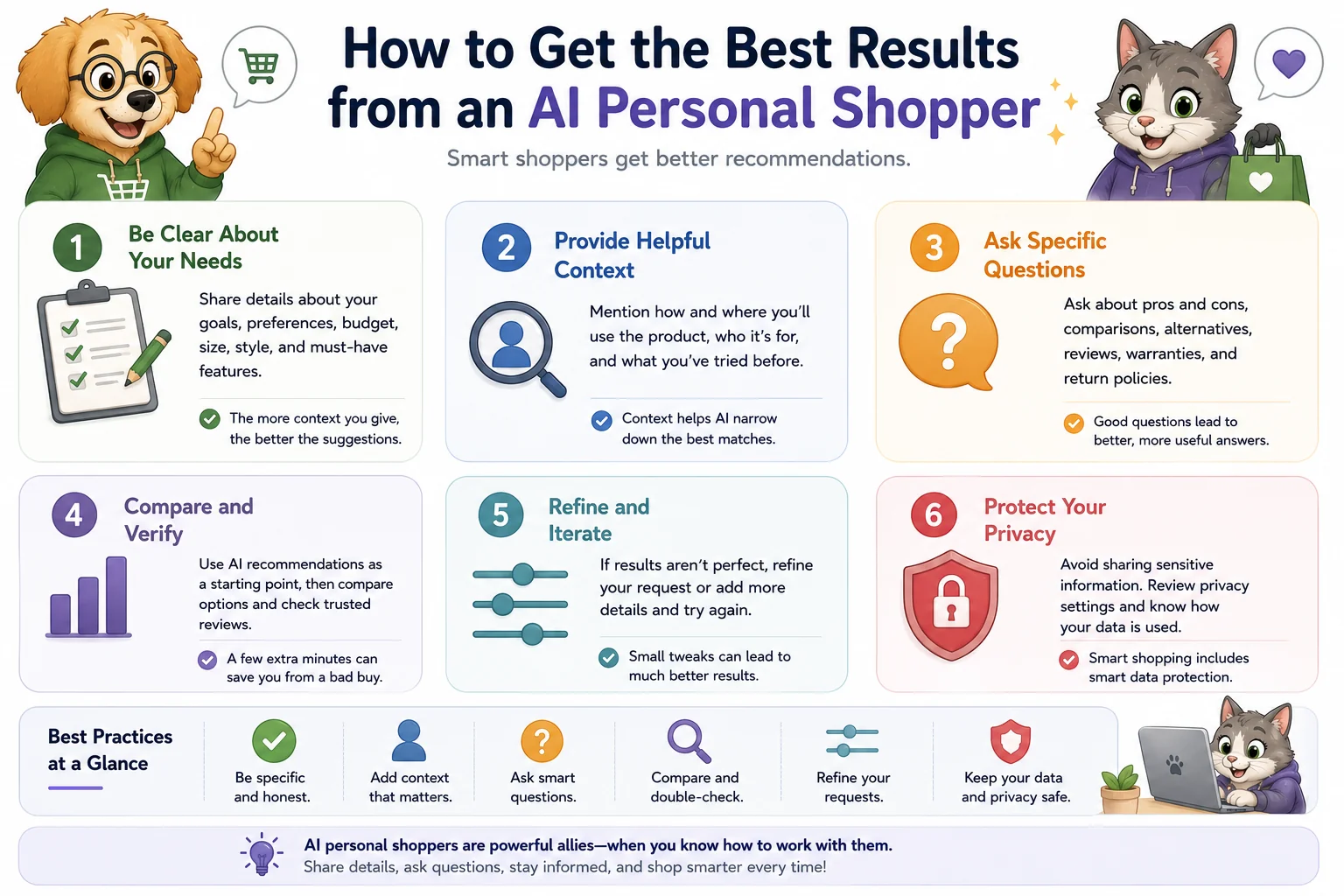
Describe the Real Shopping Need
Instead of entering only a product category, explain what the product will be used for and which constraints matter most.
A weak request might be:
“Find me a laptop.”
A stronger request would be:
“Find a lightweight laptop under $1,000 for remote work, video calls, spreadsheets, and frequent travel. I need at least 16 GB of RAM and strong battery life.”
Useful information may include:
- Maximum budget
- Intended use
- Required features
- Preferred size, color, or style
- Brands to include or avoid
- Delivery deadline
- Products or accessories already owned
The shopper does not need to know every technical term. Describing the practical situation is often enough for the assistant to identify the relevant specifications.
Separate Essential Requirements From Preferences
Not every requirement has the same importance. Shoppers should tell the AI which conditions are mandatory and which are flexible.
For example:
“My maximum budget is $500, and the product must fit in a 30-inch-wide space. Color is flexible, but I would prefer black.”
This helps the assistant avoid recommending a visually appealing product that fails an essential size or budget requirement.
A useful request may distinguish between:
- Must-have features
- Preferred features
- Deal breakers
- Areas where compromise is acceptable
Ask the Assistant to Explain Its Reasoning
Do not accept a recommendation simply because the assistant labels it “best.” Ask why the product was selected and how it matches the request.
Useful questions include:
- Why is this product a good match?
- Which of my requirements does it not fully satisfy?
- What is the main disadvantage?
- Who is this product best suited for?
- Why is it ranked above the alternatives?
A transparent explanation makes it easier to identify whether the recommendation is based on the shopper’s priorities or on generic popularity.
Request More Than One Option
One recommendation can hide important trade-offs. Ask the AI to provide several clearly differentiated choices.
For example:
- Best overall option
- Best budget option
- Best premium option
- Best option for durability
- Best option for fast delivery
This gives the shopper alternatives and reduces the risk of treating one product as the only reasonable choice.
Ask for a Focused Comparison
Long specification lists can create more confusion. Tell the assistant which factors should be included in the comparison.
For example:
“Compare the top three options by final price, battery life, weight, warranty, and return policy.”
The comparison should focus on the criteria that affect the shopper’s decision rather than repeating every feature listed by the manufacturer.
Check Whether Recommendations Are Sponsored
Shoppers should ask whether the assistant earns commissions, includes sponsored products, or searches only selected retailers.
Useful questions include:
- Are any of these results sponsored?
- Do you earn a commission if I purchase?
- Which retailers were included in the search?
- Are there relevant stores or brands you cannot access?
A commercial relationship does not automatically make a recommendation unreliable, but it should be disclosed clearly enough for the shopper to evaluate possible bias.
Verify the Product on the Retailer’s Website
Before purchasing, open the original product page and confirm the details that matter most.
Check:
- The exact model or version
- Current price
- Seller identity and reputation
- Stock status
- Product dimensions
- Compatibility
- Shipping costs and delivery date
- Warranty coverage
- Return and refund conditions
The Federal Trade Commission’s online shopping guidance recommends checking refund policies before buying, including return deadlines, shipping costs, and possible restocking fees.
Calculate the Total Cost
The price shown in a recommendation may not represent the full cost of ownership.
Depending on the product, the shopper may also need to consider:
- Delivery charges
- Taxes
- Required accessories
- Installation
- Subscriptions
- Replacement filters or cartridges
- Maintenance
- Extended warranties
Ask the assistant to estimate the first-year or long-term cost when recurring expenses are important.
Verify Compatibility Independently
Compatibility errors can make an otherwise good recommendation unusable.
Before buying electronics, replacement parts, automotive accessories, smart-home products, or technical equipment, verify model numbers and manufacturer requirements.
For example, confirm:
- Ports and connectors
- Operating-system support
- Voltage and plug requirements
- Vehicle make, model, and year
- Product dimensions
- Mounting requirements
- Required subscriptions or hubs
For expensive or safety-sensitive products, check the manufacturer’s documentation rather than relying only on an AI-generated summary.
Be Careful With Health and Safety Recommendations
AI personal shoppers may recommend skincare products, supplements, baby products, fitness equipment, or other items connected to health and safety. These suggestions require additional caution.
Shoppers should not treat an AI shopping recommendation as professional medical, veterinary, engineering, or safety advice.
Verify important claims with:
- A qualified professional
- The product manufacturer
- Official safety documentation
- Relevant regulatory guidance
Limit the Personal Information You Share
Shoppers may need to provide preferences, sizes, budgets, or product requirements, but they should avoid sharing unnecessary sensitive information.
Before using a highly personalized assistant, review:
- Whether conversations are saved
- How uploaded images are used
- Whether shopping history is linked to an account
- Whether data is shared with advertisers or partners
- How stored preferences can be deleted
Provide enough information to improve the recommendation, but not more than the shopping task requires.
Use Follow-Up Questions to Challenge the Recommendation
A shopper can test the quality of a recommendation by asking the assistant to look for weaknesses and alternatives.
Useful prompts include:
- What information could make this recommendation incorrect?
- What details have not been verified?
- What is the best argument against buying this product?
- Is there a cheaper product with the same essential features?
- Which option has the simplest return process?
This can reveal uncertainty that may not appear in the initial response.
Keep Records of Important Purchase Information
For expensive purchases, save the product page, receipt, order confirmation, warranty terms, and any written communication with the seller.
If the product was purchased through a marketplace, confirm which company is responsible for shipping, customer service, returns, and refunds. The FTC’s guidance for buying from an online marketplace recommends reviewing the seller’s terms, shipping fees, and return policies before completing the transaction.
Use AI to Narrow the Decision, Not Surrender It
The most effective role for an AI personal shopper is to organize information, identify suitable options, and explain the differences between them.
The shopper should still decide:
- Which trade-offs are acceptable
- Whether the seller is trustworthy
- Whether the final price is reasonable
- Whether the return policy provides enough protection
- Whether the product genuinely fits the intended use
AI can make a difficult shopping decision easier, but the final responsibility remains with the buyer.
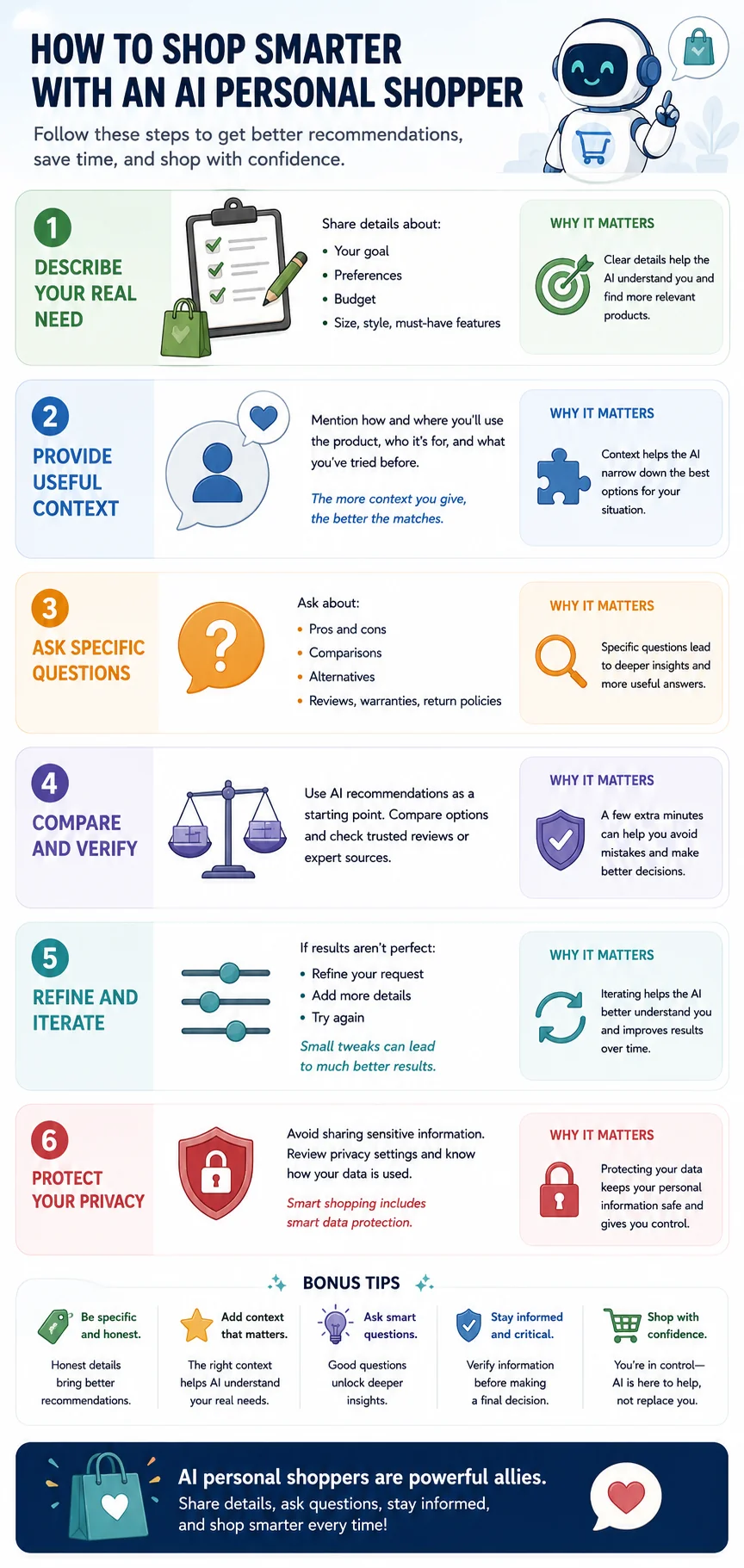
The Future of AI Personal Shopping
AI personal shopping is moving beyond simple product recommendations. The next generation of tools is likely to play a more active role in product research, comparison, cart creation, price monitoring, and checkout.
The direction is already visible across major ecommerce and AI platforms. Shopping assistants are becoming more conversational, more visual, and more capable of completing tasks on the shopper’s behalf. However, greater automation will also make transparency, data accuracy, and user control more important.
Shopping Will Become More Conversational
Traditional ecommerce requires shoppers to move between search bars, product categories, filters, comparison pages, and customer support tools. AI personal shoppers can bring more of these actions into a single conversation.
A shopper may begin with a broad request:
“I need a quiet vacuum cleaner for a small apartment with hardwood floors and a dog.”
The assistant could then ask about budget, storage space, preferred vacuum type, and whether the shopper wants a cordless model. After creating a shortlist, the user could continue with questions such as:
- “Which option is easiest to maintain?”
- “Which one has the lowest long-term cost?”
- “Remove models that require proprietary bags.”
- “Add the best option to my cart.”
This approach could gradually replace some traditional browsing sessions, particularly when the shopper has a complex need but does not know the exact product to search for.
AI Will Handle More of the Product Research
Current shopping tools can already search for products, compare specifications, and create personalized buying guides. Future systems may perform more detailed research across product pages, professional reviews, retailer policies, customer feedback, and manufacturer documentation.
OpenAI’s shopping research feature is designed to help users explore and compare products through personalized buying guides. This reflects a wider shift from AI that merely answers a shopping question to AI that performs a structured research process for the shopper.
A more advanced personal shopper could:
- Search several retailers
- Compare current prices and delivery dates
- Verify important specifications
- Summarize repeated review patterns
- Identify meaningful differences between product versions
- Present a shortlist based on the shopper’s priorities
The challenge will be ensuring that the research is based on current and reliable information rather than incomplete product feeds or outdated pages.
Visual Shopping Will Become More Important
Text is not always the easiest way to describe a product. Shoppers may know what they want visually but lack the vocabulary to explain the style, material, pattern, or design.
Future AI personal shoppers will increasingly combine text with images, screenshots, live camera input, and possibly video.
A shopper could point a phone camera at a chair, lamp, jacket, or appliance and ask:
“Find something similar, but smaller, less expensive, and available in dark blue.”
Amazon’s Lens Live combines visual product recognition with its AI shopping assistant, allowing users to identify products through the camera and ask questions while browsing.
Visual search can make product discovery easier, but the assistant must still verify dimensions, compatibility, materials, and other practical details that cannot be determined from appearance alone.
AI Personal Shoppers Will Become More Proactive
Most shopping assistants currently wait for the shopper to ask a question. Future systems may act more proactively when the user gives permission.
They could:
- Notify shoppers when a tracked product drops below a chosen price
- Identify a better deal from another retailer
- Warn that a product is likely to sell out
- Suggest replacement products when a frequently purchased item is running low
- Recommend accessories for a recent purchase
- Remind users about return deadlines or expiring warranties
Amazon has expanded its shopping assistant capabilities to include price tracking, deal discovery, cart actions, and automatic purchasing at a price selected by the shopper. These features show how AI personal shoppers may move from providing information to performing controlled shopping tasks.
AI Agents May Complete Purchases
The biggest change may come from agentic commerce, where AI systems can take actions instead of only making recommendations.
With clear user approval, an AI shopping agent could:
- Search for products
- Compare retailers
- Apply the shopper’s requirements
- Add products to a cart
- Apply eligible discounts
- Select a delivery option
- Complete checkout
OpenAI has introduced an Agentic Commerce Protocol intended to support shopping transactions involving consumers, AI agents, and businesses. Shopify is also developing agentic storefront capabilities that allow products to be discovered and purchased through AI channels.
This does not mean shoppers will hand over unlimited control. Useful systems will need clear spending limits, retailer restrictions, approval steps, and an easy way to cancel or correct an action.
Shopping May Move Outside Traditional Ecommerce Websites
In the past, most online purchases began on a retailer’s website, marketplace, or search engine. AI shopping could change where product discovery begins.
Consumers may increasingly discover and compare products inside:
- General AI assistants
- Search engine AI experiences
- Messaging platforms
- Voice assistants
- Social platforms
- Connected devices
Shopify’s agentic storefront tools are designed to help merchants make products available through AI channels such as ChatGPT, Google AI experiences, and Microsoft Copilot. This could make the product catalog accessible even when the shopper never begins the journey on the retailer’s own website.
For ecommerce businesses, this will make structured and accurate product data increasingly important. An AI assistant cannot recommend a product correctly when prices, availability, variants, dimensions, and policies are missing or difficult to interpret.
Personalization May Extend Across Multiple Purchases
Future AI personal shoppers may remember long-term preferences rather than treating every purchase as an isolated request.
With the shopper’s permission, an assistant could remember:
- Clothing and footwear sizes
- Preferred brands and materials
- Typical spending ranges
- Devices and products already owned
- Household needs
- Previous returns or rejected recommendations
- Preferences related to delivery and sustainability
This could reduce the need to repeat the same information during every search. For example, the assistant might already know which laptop the shopper owns when recommending a compatible monitor, charger, or docking station.
Long-term personalization also increases privacy risks. Shoppers should be able to review, correct, export, or delete stored preferences. The assistant should not assume that past behavior permanently defines what the user wants.
Retailers Will Need to Make Their Product Data AI-Ready
As AI becomes a more important discovery channel, retailers will need product information that machines can understand accurately.
This includes:
- Clear product titles
- Complete specifications
- Accurate prices and availability
- Structured information about sizes and variants
- Compatibility details
- Shipping and return policies
- High-quality images
- Consistent product identifiers
Poor product data may cause an AI personal shopper to ignore an otherwise suitable item or recommend it for the wrong use. Product-feed quality, therefore, may become as important for AI discovery as traditional search optimization has been for search engines.
Human Assistance Will Still Matter
AI personal shoppers may handle more routine research and comparison, but human expertise will remain valuable for purchases involving taste, emotion, safety, or specialized professional knowledge.
Human assistance may still be preferred for:
- Luxury fashion and styling
- Interior design
- Professional equipment
- Health-related products
- Complex technical systems
- High-cost or highly personal purchases
A likely model is a hybrid experience. AI can collect requirements, research options, and prepare a shortlist, while a human specialist provides deeper judgment or confirms the final recommendation.
Trust Will Become a Competitive Advantage
As AI assistants become more capable of influencing and completing purchases, shoppers will need to know whose interests the system represents.
The most trustworthy AI personal shoppers will clearly disclose:
- Which retailers and products were searched
- Whether recommendations are sponsored
- Whether the platform earns a commission
- What personal data influenced the result
- Which information has not been verified
- When the shopper must approve an action
The future of AI personal shopping will not be determined only by which assistant provides the fastest answer. It will also depend on which systems provide accurate information, meaningful control, and transparent recommendations.
Our guide to the future of AI in ecommerce explores how these technologies may affect product discovery, customer service, personalization, and online retail more broadly.
Are AI Personal Shoppers Worth Using?
AI personal shoppers can be useful when the buying decision is complex, the product catalog is large, or the shopper does not know which specifications matter. They are particularly valuable for purchases involving several preferences at the same time, such as budget, size, compatibility, performance, delivery speed, and long-term cost.
They are less necessary when the shopper already knows the exact product, model number, or replacement part required. In those cases, a traditional search bar and price comparison may be faster.
AI Personal Shoppers Are Most Useful for Complex Purchases
An AI personal shopper can provide real value when the user needs help understanding the market rather than simply locating a known item.
Good use cases include:
- Comparing laptops, smartphones, cameras, or appliances
- Finding compatible accessories
- Choosing furniture for a particular space
- Building a complete product bundle
- Finding a gift for a specific person and budget
- Understanding the trade-offs between several products
- Identifying alternatives when the preferred item is unavailable
In these situations, the assistant can reduce the amount of research required and help the shopper identify questions they may not have considered.
They Are Less Valuable for Simple or Exact Searches
Not every shopping task needs artificial intelligence.
A traditional search may be more efficient when the shopper:
- Knows the exact product name or model
- Needs a specific replacement part
- Wants to compare the same item across retailers
- Prefers to browse without personalization
- Needs a product with only one or two simple requirements
For example, someone searching for a particular ink cartridge or charging cable may not benefit from a long conversational process. The best shopping tool depends on the task.
The Value Depends on Recommendation Quality
An AI personal shopper is worth using only when it provides reliable and transparent guidance.
A useful system should:
- Understand the shopper’s request accurately
- Use current product information
- Explain why products were recommended
- Show important disadvantages and trade-offs
- Disclose sponsored or affiliate relationships
- Allow the shopper to refine or reject recommendations
- Identify information that still needs verification
A system that provides confident answers based on incomplete data may create more confusion than a normal search engine.
They Should Support Decisions, Not Replace Them
The most practical way to use an AI personal shopper is as a research and decision-support tool.
It can help the shopper:
- Create a shortlist
- Understand technical differences
- Compare prices and features
- Identify potential problems
- Ask better follow-up questions
The shopper should still verify the final product page, seller, price, compatibility, delivery information, warranty, and return policy before completing the purchase.
Used this way, an AI personal shopper can make online shopping more efficient without removing the buyer’s control.
Conclusion
An AI personal shopper is a digital tool that uses artificial intelligence to help people discover, compare, and choose products. It can interpret natural-language requests, search product data, rank suitable options, explain trade-offs, and respond to follow-up questions.
Its main advantage is not access to more products. Online shoppers already have more options than they can realistically evaluate. The real benefit is reducing a large and confusing market to a smaller group of products that match the shopper’s budget, preferences, and intended use.
AI personal shoppers can also help ecommerce stores improve product discovery, increase conversions, recommend relevant accessories, answer pre-purchase questions, and create a more personalized shopping experience.
However, the technology has important limitations. Recommendations may be influenced by incomplete data, commercial partnerships, outdated prices, limited retailer coverage, or incorrect assumptions about the shopper. Personalization may also require the collection of browsing history, purchase data, preferences, and other personal information.
The best AI personal shoppers will not simply push products. They will explain why a recommendation was made, show meaningful alternatives, disclose commercial relationships, identify uncertainty, and give shoppers control over the final decision.
As ecommerce becomes more conversational, visual, and automated, AI personal shoppers are likely to become a more common part of online product discovery. Their success will depend not only on how advanced the technology becomes, but also on whether shoppers can trust the information, understand how recommendations are generated, and remain in control of what they buy.
Frequently Asked Questions
What is an AI personal shopper?
An AI personal shopper is a digital tool that uses artificial intelligence to help users find, compare, and choose products. It can interpret natural-language requests, recommend relevant options, explain differences, and answer follow-up questions.
How does an AI personal shopper work?
An AI personal shopper analyzes the shopper’s request, identifies preferences and restrictions, searches available product data, ranks suitable options, and explains why certain products may be a good match. Some systems also learn from previous shopping behavior.
Is an AI personal shopper the same as an AI shopping assistant?
The terms overlap, but an AI personal shopper usually focuses on product discovery and selection. An AI shopping assistant may also help with checkout, delivery, returns, order tracking, and customer support.
Can an AI personal shopper compare prices?
Some AI personal shoppers can compare prices across several retailers, while others search only one store. The shopper should verify whether the tool has broad market coverage and whether the displayed prices are current.
Can an AI personal shopper summarize product reviews?
Yes. Some tools can identify repeated themes in customer reviews and summarize common advantages and complaints. These summaries should still be checked because the original reviews may contain fake feedback, outdated information, or conflicting experiences.
Can AI help me choose the right product?
AI can help create a shortlist, explain specifications, compare alternatives, and identify trade-offs. It cannot guarantee that a product will be perfect, so important information should still be verified before purchasing.
Are AI personal shoppers free?
Some are available free through retailers, search engines, marketplaces, or general AI platforms. Others may require a subscription or be included as part of a paid shopping service.
Can AI personal shoppers be trusted?
They can be useful, but they should not be treated as completely neutral or infallible. Shoppers should check whether recommendations are sponsored, whether the platform earns commissions, which retailers were searched, and which information has been independently verified.
Do AI personal shoppers use personal data?
Some systems use browsing history, purchases, saved products, preferences, location, or conversation history to personalize recommendations. Users should review the platform’s privacy settings and data policies before sharing unnecessary personal information.
Can an AI personal shopper find products from multiple stores?
Some tools compare products across several retailers, while others work only within one store or marketplace. The platform should clearly explain which sources and retailers are included.
Can an AI personal shopper complete a purchase?
Some newer AI shopping systems can add products to a cart, track prices, apply selected preferences, or assist with checkout. The shopper should retain approval over the final product, price, seller, delivery method, and payment.
Will AI personal shoppers replace traditional product search?
They are unlikely to replace traditional search completely. Exact searches, product codes, filters, and comparison pages remain useful. The strongest shopping experience will probably combine conversational AI with familiar search and browsing tools.