

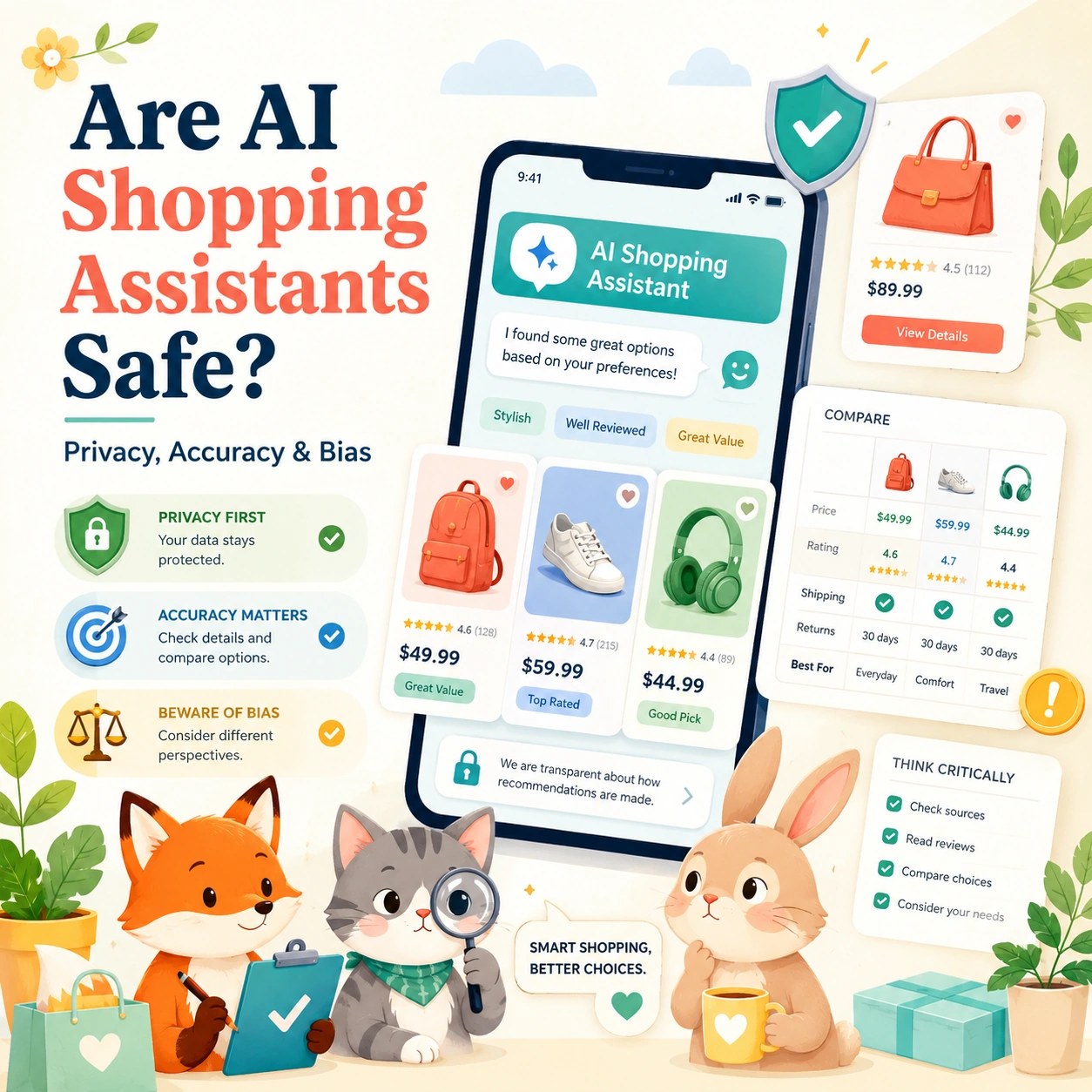
AI shopping assistants promise a simpler way to buy online. Instead of opening dozens of tabs, comparing nearly identical listings, decoding technical specifications, and wondering whether a deal is actually good, shoppers can ask a question in everyday language and receive a more focused set of options.
That convenience comes with an important question: are AI shopping assistants safe to use?
The honest answer is that they can be useful and reasonably safe when they are built around reliable product data, clear privacy practices, transparent recommendations, and meaningful human control. But they are not automatically trustworthy simply because they sound helpful. An assistant may misunderstand what a shopper wants, use incomplete pricing or stock information, over-personalize results, repeat biased patterns in its data, or present an uncertain answer with more confidence than it deserves.
For example, imagine asking an AI shopping assistant to find a laptop for remote work under $1,000. The assistant may narrow the search quickly, compare battery life and weight, point out alternatives, and explain which models appear to fit the request. That is genuinely useful. But the experience becomes less helpful if it recommends an out-of-stock model, misses an important compatibility detail, favors a sponsored product without making that clear, or bases its answer on outdated specifications.
Privacy is another part of the decision. Depending on the tool, retailer, and settings, an AI shopping assistant may use information such as current searches, clicked products, cart activity, previous purchases, approximate location, device data, or saved preferences to personalize recommendations. That does not automatically mean something improper is happening. Personalization can make a shopping experience more relevant. Still, shoppers should understand what information is being used, whether conversations are stored, how long data is retained, and whether it affects the products or prices they see.
Accuracy matters just as much. AI systems can produce answers that sound clear and convincing even when the underlying information is incomplete, outdated, or unavailable. The NIST Generative AI Profile identifies risks including confabulation, privacy concerns, and harmful bias, which is why AI-generated shopping guidance should be grounded in verified product, inventory, delivery, and policy data rather than assumptions.
This does not mean shoppers need to avoid AI tools altogether. It means they should use them as decision-support tools, not as the final authority on an important purchase. A good assistant can help someone move from a vague need to a practical shortlist. It can surface useful questions, explain trade-offs, find alternatives, and reduce research time. The final check, especially for expensive, technical, safety-related, or compatibility-sensitive products, should still happen on the official product page and the retailer’s policy pages.
To understand the basic role these tools play before looking at their risks, see our guide to what an AI shopping assistant is and how it works.
In this guide, we examine what data AI shopping assistants may collect, how personalization can influence recommendations, where accuracy problems and bias can appear, why sponsored placements need clear labeling, and what shoppers and ecommerce stores can do to make AI-assisted shopping more transparent and trustworthy.
Quick Overview: Are AI Shopping Assistants Safe?
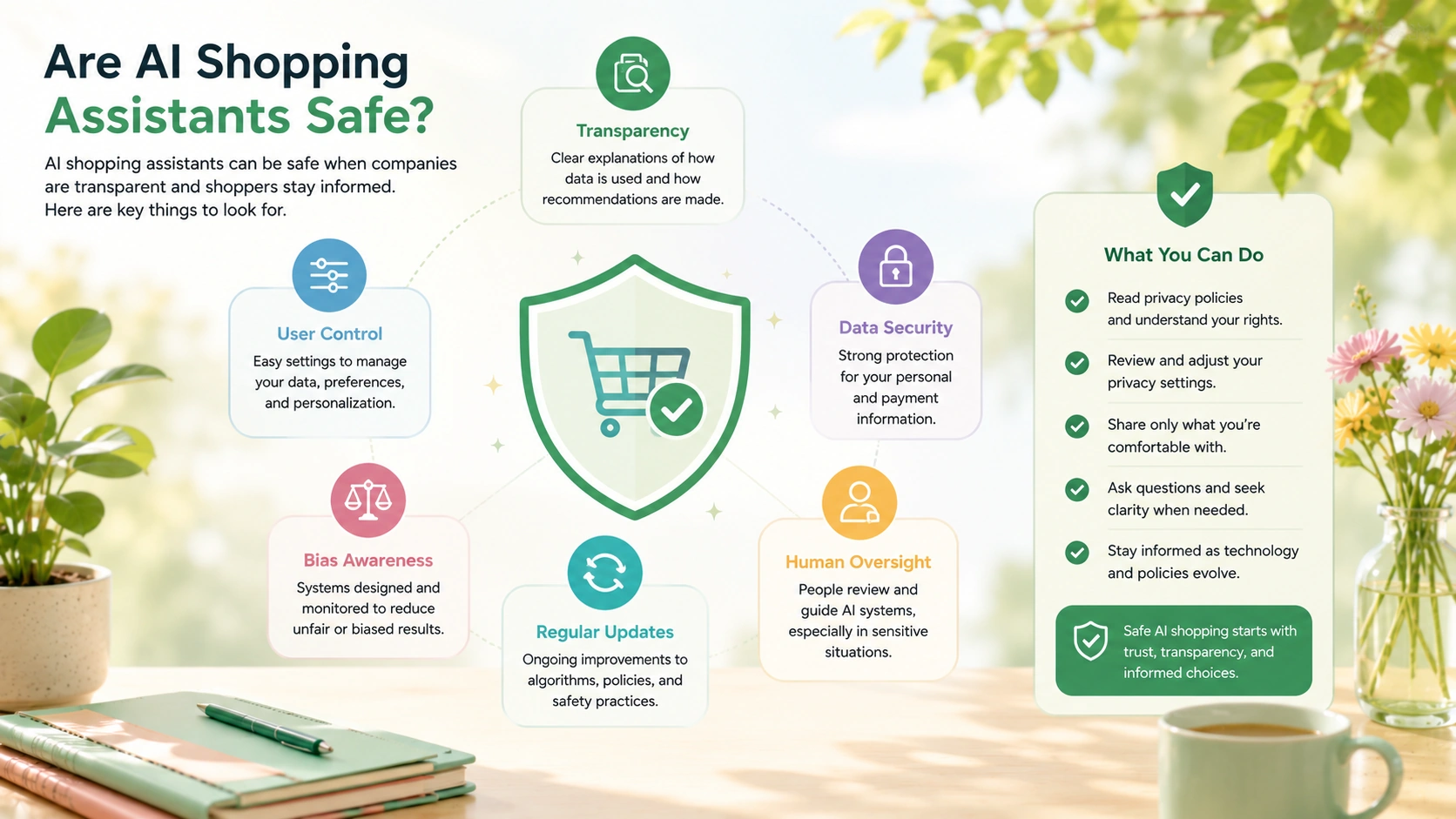
AI shopping assistants can be safe and useful, but only when shoppers understand what the tool is doing, what information it uses, and where its answers may be limited. They can save time by narrowing a large catalog, comparing options, explaining product differences, and suggesting alternatives. At the same time, they can create problems when they rely on weak data, collect more personal information than expected, hide sponsored placements, or present uncertain answers as facts.
The safest way to use an AI shopping assistant is to treat it as a research tool, not as the final authority on an important purchase. It can help create a shortlist and identify useful questions, but the shopper should still verify critical details such as price, stock status, compatibility, delivery dates, return conditions, warranty coverage, and product specifications on the retailer’s official pages.
Privacy is part of that decision. Depending on the retailer, app, browser tool, and user settings, an assistant may use current searches, clicked products, cart activity, saved preferences, past purchases, approximate location, or device information to personalize results. The Federal Trade Commission explains how websites and apps can collect online activity through technologies such as cookies, pixels, and device fingerprinting. Personalization can be helpful, but shoppers should be able to understand and control how their information influences recommendations.
| Area | Potential Risk | What a Trustworthy Assistant Should Do | What Shoppers Should Check |
|---|---|---|---|
| Privacy | The tool may use browsing activity, searches, purchase history, location signals, or device data without the shopper fully understanding it. | Explain what data is collected, why it is used, how long it is retained, and how personalization can be limited or turned off. | Review privacy settings, avoid sharing unnecessary personal details, and check whether conversations are stored. |
| Product accuracy | The assistant may provide outdated prices, incorrect stock information, unsupported compatibility claims, or inaccurate specifications. | Ground answers in current product, inventory, delivery, and policy data. It should clearly say when a detail cannot be verified. | Confirm important specifications, delivery estimates, warranties, sizing, and compatibility on the official product page. |
| Personalization | Previous clicks or purchases may narrow the results too aggressively and hide products that better fit the current request. | Keep the shopper’s current request as the strongest signal and allow preferences to be edited or disabled. | Try a broader search, compare several brands, and do not assume the first recommendation is the best available option. |
| Bias and ranking | Popular, high-margin, or sponsored products may appear more often than products that best match the shopper’s needs. | Label paid placements clearly and explain why products are being recommended. | Look for sponsorship disclosures, compare alternatives, and ask the assistant to explain why a product was selected. |
| Security and checkout | A shopper may be pushed toward sharing payment details, account information, or personal data through an untrusted tool. | Use secure authentication, protect account data, and keep payment actions under the shopper’s control. | Use established retailers and trusted apps, avoid entering payment details into unknown chat tools, and enable account security features. |
The practical question is not whether every AI shopping assistant is completely safe or completely unsafe. The better question is whether a specific tool is transparent, accurate, privacy-conscious, and easy to challenge when something looks wrong.
A trustworthy assistant should make the buying process easier without pressuring the shopper, hiding commercial incentives, or pretending to know details that it cannot verify. When it does that, it can be a useful layer of support. When it does not, it can make a purchase decision look simpler than it really is.
What Data Can AI Shopping Assistants Collect?
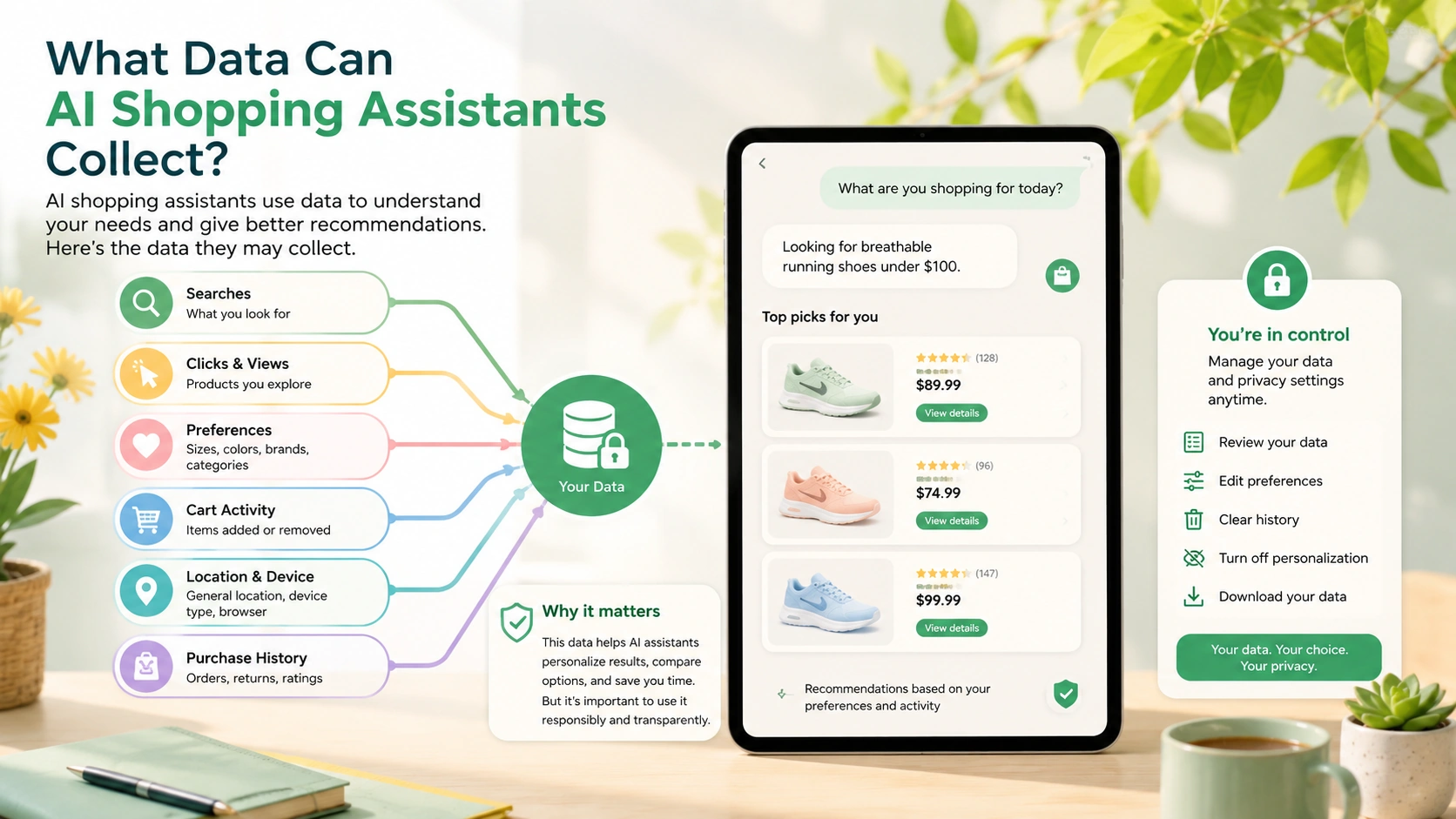
AI shopping assistants can only personalize results when they have some information to work with. That information may come directly from the shopper, from activity on the retailer’s website or app, from the product catalog, or from technical signals connected to the device and session.
Not every assistant collects the same data. A simple product-search tool may only process the words typed into a search bar and the products a shopper clicks. A more advanced assistant may also use saved preferences, previous purchases, cart activity, location signals, or conversation history to make recommendations more relevant.
The important distinction is between data that helps the assistant answer the current question and data that is stored, combined, shared, or used later for personalization, advertising, pricing, or analytics. Shoppers should be able to understand that difference before they decide how much information to share.
Information Shoppers Provide Directly
The most obvious information is what a shopper enters into the assistant. This may include a product request, budget, preferred brand, color, size, delivery deadline, or intended use.
For example, someone might write:
“Find a carry-on suitcase under $250 that is lightweight, durable, and suitable for frequent international travel.”
That request gives the assistant several useful signals: product category, budget, weight preference, durability requirement, and travel use case. This type of data is usually necessary for a relevant answer because the assistant cannot meaningfully narrow products without understanding what the shopper wants.
However, conversations can also reveal more personal details than people realize. A shopper may mention a medical condition while searching for shoes, a child’s age while buying toys, a home address while asking about delivery, or financial limits while looking for a payment plan. Those details may be useful in context, but they should not be shared casually with an unfamiliar shopping tool.
Searches, Clicks, and Browsing Activity
Many shopping systems can use activity signals such as the products a person searches for, opens, saves, compares, adds to a cart, removes from a cart, or purchases. These signals can help an assistant understand what the shopper appears to care about.
For example, a person who repeatedly views wide-fit running shoes, filters for neutral colors, and compares options under $150 may receive recommendations that reflect those choices. That can make the search experience faster. It can also create a narrower product view if the system relies too heavily on past behavior and does not give enough weight to the current request.
The Federal Trade Commission explains how websites and apps can collect information through online tracking technologies, including activity that helps companies remember preferences, personalize content, measure performance, or target advertising. A shopping assistant may use some of the same signals, depending on how the retailer or tool is designed.
Purchase History and Saved Preferences
Some assistants can use previous purchases, saved items, product ratings, wish lists, favorite brands, size preferences, or loyalty-account information. This can be helpful when the data reflects a stable preference.
For example, if a shopper has repeatedly bought fragrance-free skincare products, the assistant may reasonably prioritize fragrance-free options when that person asks for a new moisturizer. Likewise, a shopper who has saved a preferred clothing size may benefit from seeing products that are more likely to fit.
Still, past behavior should not become a permanent profile that controls every future result. Someone who usually buys lower-cost products may occasionally want a premium option. A person who bought one brand in the past may now want to compare competitors. A trustworthy assistant should allow shoppers to adjust preferences, start a fresh search, or turn personalization off when they want broader results.
Location, Device, and Technical Information
Depending on the service, an AI shopping assistant may also receive technical information such as browser type, device type, operating system, IP-based approximate location, language settings, or time zone. Retailers may use these signals to show local currency, estimate delivery dates, display available inventory, prevent fraud, or adapt the interface for a phone versus a desktop computer.
This information can improve a shopping experience in practical ways. Someone in Texas may need different stock availability or delivery estimates than someone in New York. A shopper using a mobile device may need a simpler comparison layout than someone researching products from a laptop.
But location and device data can also contribute to profiling when combined with browsing behavior, purchases, and advertising identifiers. That is why privacy policies should explain not only what data is collected, but also whether it is linked to an account, shared with third parties, or used to influence recommendations and marketing.
Cart Activity, Delivery Details, and Transaction Data
When an assistant is connected to a retailer account, it may have access to cart contents, delivery preferences, order history, returns, payment status, or loyalty-program activity. These details can make support more useful.
For example, an assistant may be able to answer questions such as:
- “Can this item arrive before Friday?”
- “Is this compatible with the product I bought last month?”
- “Can I return the size I ordered?”
- “Show accessories that work with my existing camera.”
That can be convenient, but it also means the assistant may be connected to more sensitive information than a basic search bar. Shoppers should be especially cautious with tools that ask for account logins, payment details, full addresses, or access to third-party retail accounts.
Inferences the Assistant Makes About the Shopper
Some of the most important information is not directly entered by the shopper at all. AI systems can make inferences from behavior. A tool may infer that someone is price-sensitive, prefers premium products, is shopping for a gift, is likely to need fast delivery, or is interested in a particular style.
These inferences are not always correct. Someone may be researching a gift for another person, comparing options for work, or checking a product only once out of curiosity. An assistant that treats every click as a permanent preference can make recommendations feel repetitive, inaccurate, or overly narrow.
That is why shoppers should have a way to correct the system. Useful controls include clearing conversation history, removing saved preferences, disabling personalization, choosing a “show more options” setting, or asking the assistant why a product was recommended.
What Shoppers Should Avoid Sharing
Most product searches do not require highly sensitive information. A shopper can usually ask for a product recommendation without sharing a Social Security number, bank-account information, full payment-card details, account passwords, government identification, medical records, or deeply personal family information.
Be especially careful when an unfamiliar AI shopping tool asks for information that does not appear necessary for the task. A tool helping someone compare coffee machines does not need a bank password. A chatbot helping with shoe sizing does not need a full home address before the shopper has decided to buy.
The goal is not to avoid every personalized feature. It is to share only what is relevant, use established retailers and trusted tools, and understand what happens to the information after the conversation ends.
In the next section, we look at how this data can influence recommendations, including when personalization is helpful and when it starts to limit the shopper’s choices too much.
How Personalization Can Affect Recommendations
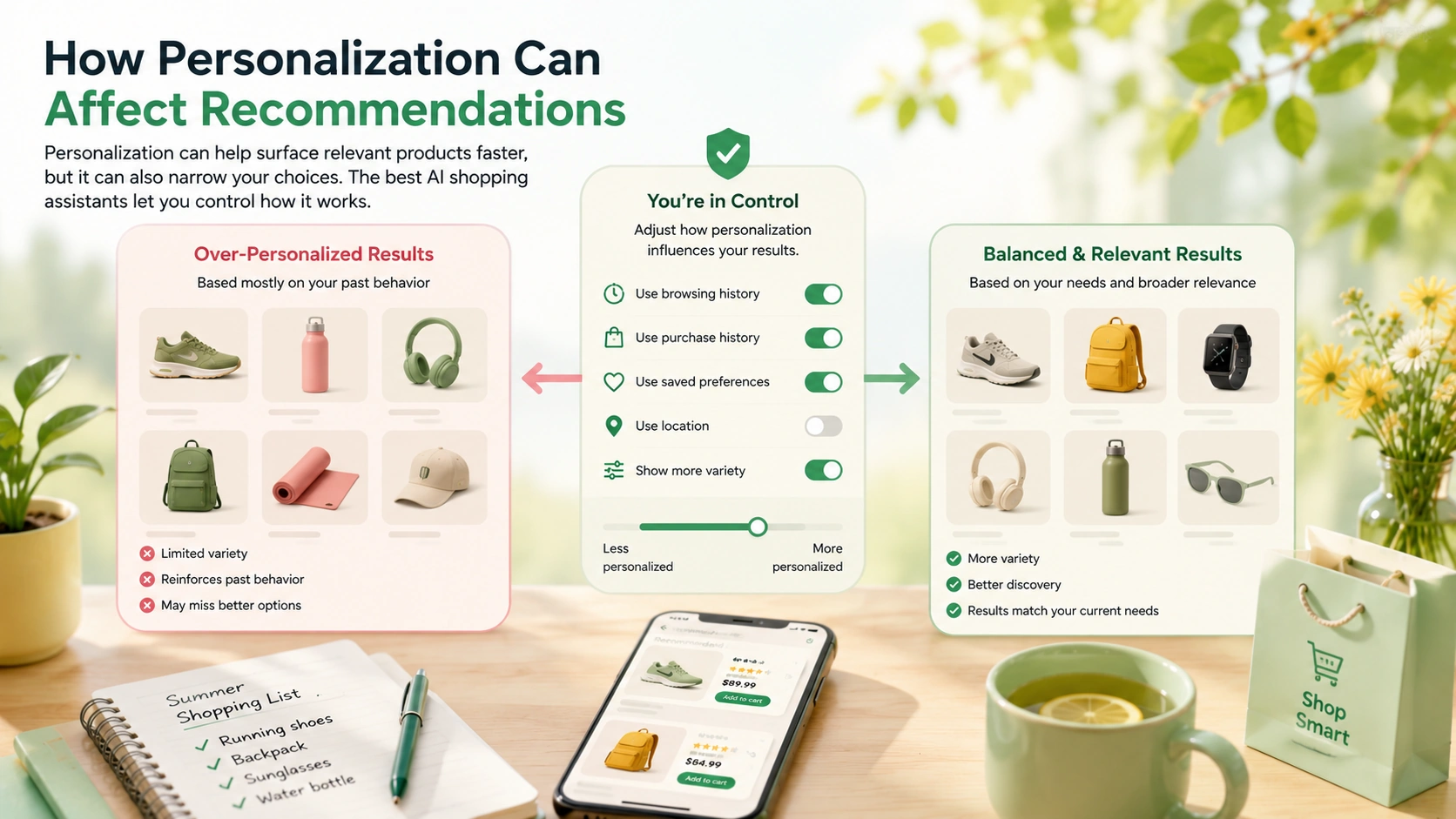
Personalization can make an AI shopping assistant more useful. When a tool remembers a shopper’s preferred size, budget range, favorite brands, delivery expectations, or product categories, it can reduce repetitive searching and surface options that are more likely to be relevant.
For example, someone who usually buys fragrance-free skincare products may appreciate an assistant that automatically prioritizes fragrance-free options. A shopper who regularly looks for wide-fit running shoes may save time when those products appear earlier in the results. Used carefully, personalization can make an overwhelming catalog feel more manageable.
But personalization can also create a narrower shopping experience. A system that relies too heavily on previous clicks, past purchases, or inferred preferences may keep showing the same types of products, brands, price ranges, or styles even when the shopper’s current needs have changed.
Personalization Can Be Helpful When It Reflects a Real Preference
The strongest use of personalization is based on information that is clearly relevant to the current shopping task. This may include a saved clothing size, a stated dietary preference, a preferred color, a known compatibility requirement, or a budget that the shopper has chosen.
For example, if someone has saved that they need a 14-inch laptop sleeve, it makes sense for an assistant to avoid showing sleeves designed for smaller or larger devices. If a shopper says they are looking for pet food without chicken, the assistant should keep that requirement active during the conversation unless the shopper changes it.
Good personalization should feel like useful memory, not invisible pressure. The shopper should be able to see why a recommendation appears and change the preference if it is no longer relevant.
Past Behavior Should Not Override the Current Request
A person’s shopping history does not always reflect what they need today. Someone who usually buys budget-friendly products may occasionally be shopping for a premium gift. A shopper who has bought one brand many times may now want to compare alternatives. Someone researching baby products may be buying for a relative, not for themselves.
That is why the current request should remain the strongest signal. If a shopper asks for a premium leather briefcase, an AI assistant should not automatically prioritize inexpensive fabric bags simply because the person previously bought lower-cost accessories.
A better assistant can use prior preferences as a helpful starting point while still giving the shopper room to explore. It may say:
“Based on your past searches, I included several lower-cost options. Would you also like to see premium alternatives?”
That approach makes the system more transparent and prevents personal history from becoming a hidden rule that limits the results.
Recommendations Can Become Too Narrow
Over-personalization happens when an assistant repeatedly reinforces the same pattern instead of showing a balanced range of options. A shopper may keep seeing products from one brand, one price range, or one style because the system assumes that previous behavior predicts every future decision.
This can be frustrating in categories where comparison matters. Someone buying a mattress, camera, laptop, stroller, appliance, or skincare product may need to see several realistic options before deciding. A narrow recommendation list can make it look as though only a few products exist, even when the retailer has many more relevant choices.
Shoppers can reduce this problem by using more specific follow-up requests, such as:
- “Show me options from other brands.”
- “Include premium and budget choices.”
- “Do not use my past purchase history for this search.”
- “Show the best matches, not only popular products.”
- “Why are these products ranked first?”
These questions encourage the assistant to explain its logic instead of simply repeating a personalized shortlist.
Personalization Can Influence More Than Product Suggestions
Personalization does not always affect only the products shown. Depending on the retailer or platform, it may also influence promotions, discounts, search ranking, ad targeting, delivery offers, or the order in which products appear.
The Federal Trade Commission’s surveillance-pricing study describes how some companies may use consumer data and behavior signals, including browsing activity, location, shopping history, and cart behavior, to tailor prices, promotions, or product visibility. That does not mean every retailer or AI shopping assistant uses these practices. It does mean shoppers should not assume that every result list, discount, or recommendation is fully neutral.
A trustworthy AI shopping assistant should clearly separate ordinary recommendations from sponsored placements, personalized offers, and paid promotions. If a product appears because it is sponsored, that should be easy to understand. If a discount is personalized, the shopper should not have to guess whether another person might see a different price.
Transparency Makes Personalization More Useful
Personalization is not automatically harmful. In many cases, it saves time and helps shoppers avoid irrelevant results. The problem begins when the system uses hidden assumptions, gives no explanation, or makes it difficult for people to control what influences the recommendations.
Helpful transparency can include simple explanations such as:
- “Recommended because you selected lightweight options.”
- “Shown first because it matches your budget and delivery deadline.”
- “Sponsored result.”
- “Based on your saved size preference.”
- “This option is lower priced than similar products you viewed.”
These small details help shoppers understand whether a recommendation is based on their request, previous behavior, retailer priorities, or paid placement.
How Shoppers Can Keep More Control
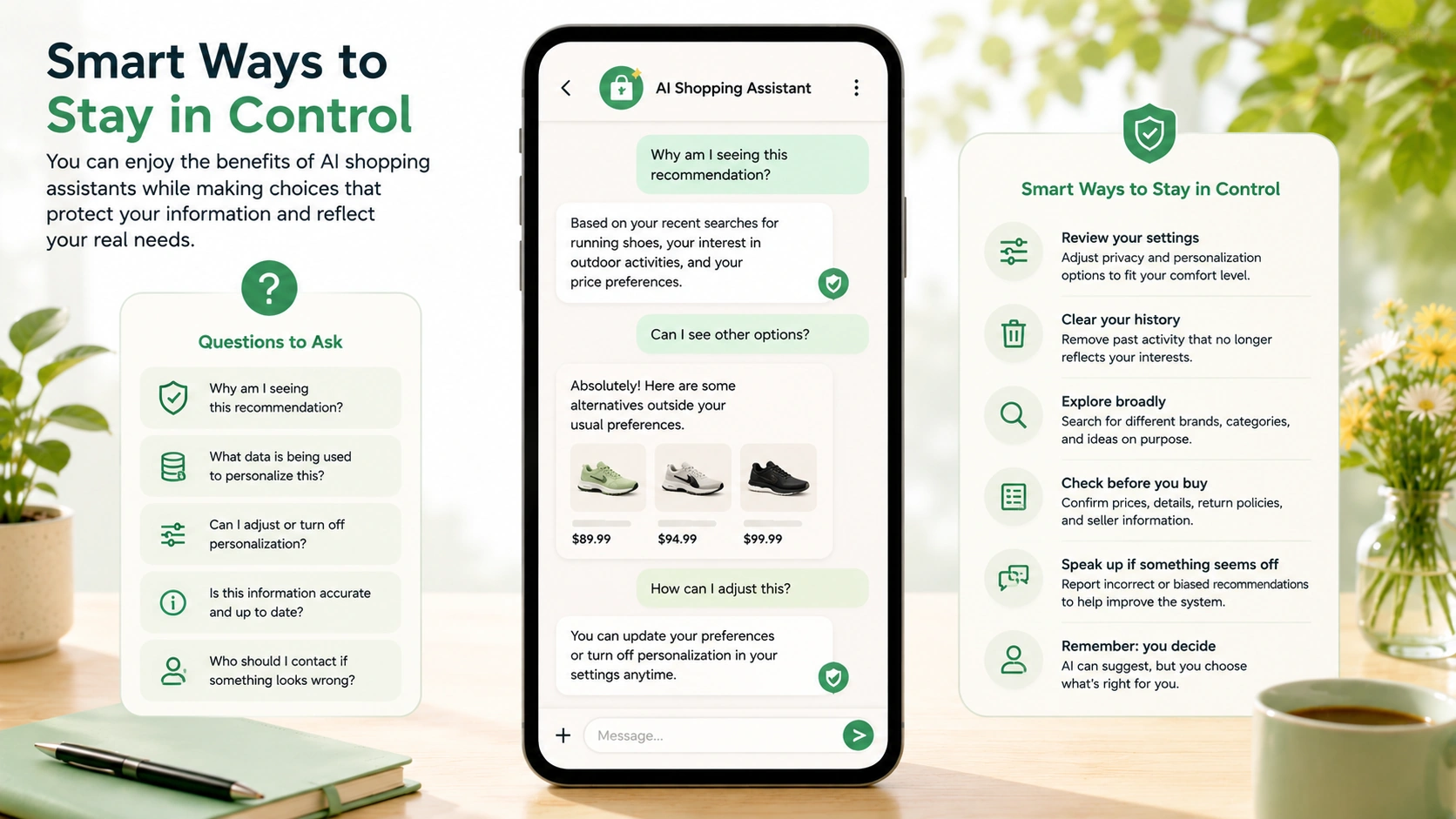
Shoppers do not need to avoid personalization completely. They simply need practical controls over how it is used. Before relying on a recommendation, it is worth checking whether the tool allows someone to clear search history, remove saved preferences, turn off personalized results, or start a fresh search session.
It can also help to compare recommendations with a standard search or a competing retailer. When the same products appear across several sources, that may increase confidence that the results are genuinely relevant. When one assistant repeatedly pushes the same brand or price range without a clear explanation, it may be worth broadening the search.
For a broader explanation of how AI systems use recommendations in ecommerce, see our guide to how AI product recommendations increase ecommerce sales.
The goal of personalization should be to make shopping easier, not to quietly narrow a person’s choices. A useful AI shopping assistant should adapt to the shopper’s needs while still giving them enough visibility, context, and control to make an independent decision.
Accuracy Risks: Wrong Prices, Stock, Compatibility, and Product Claims
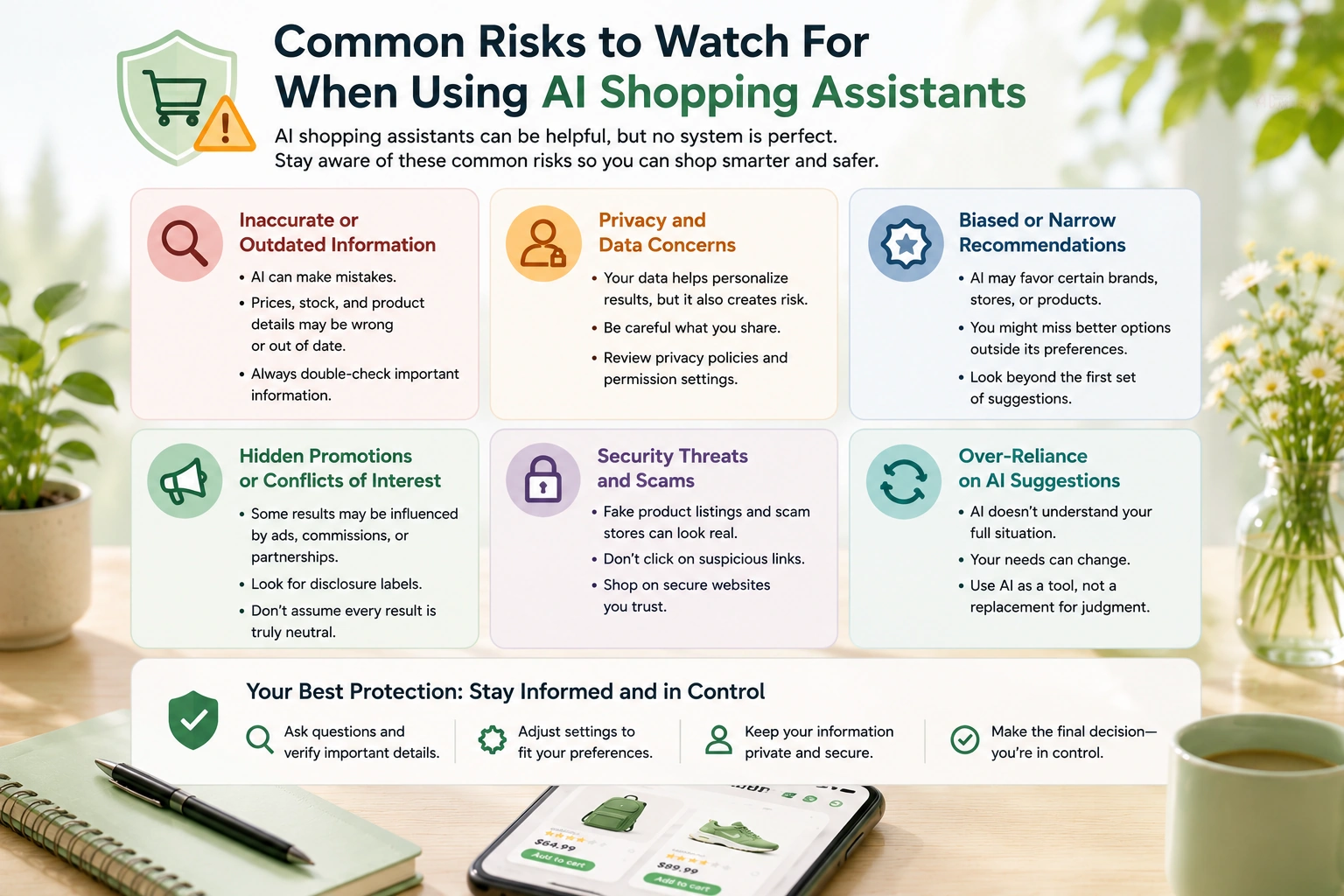
An AI shopping assistant can make a product search feel faster and more organized, but speed does not guarantee accuracy. The assistant may sound confident even when the information behind its answer is incomplete, outdated, inconsistent, or unavailable.
This is one of the most important risks for shoppers to understand. A recommendation can look useful because it includes product names, prices, ratings, comparisons, and clear explanations. But if the tool is not connected to current catalog, inventory, shipping, and policy data, it may still point someone toward the wrong product or give them a false sense of certainty.
The safest approach is to use AI-generated shopping guidance as a starting point for research. It can help identify relevant products, explain basic differences, and create a shortlist. Before buying, shoppers should still verify the details that could affect the final decision.
AI Can Sound Certain Even When the Data Is Incomplete
Generative AI is designed to produce a useful answer, even when it does not have every detail needed to answer perfectly. That can create a problem in shopping, where a missing fact may matter a lot.
For example, an assistant might say that a laptop is suitable for video editing, that a charger works with a certain device, or that a jacket is waterproof. Those statements may sound reasonable, but they should only be trusted when they are supported by verified product specifications.
A good assistant should be able to say:
- “I could not verify that compatibility detail.”
- “The product page does not confirm whether this accessory is included.”
- “Please check the official sizing chart before ordering.”
- “This delivery estimate may change depending on your location.”
That kind of answer may feel less impressive than a confident recommendation, but it is more useful in the long run. A trustworthy shopping assistant should show its limits instead of filling gaps with assumptions.
Prices Can Change Faster Than AI Recommendations
Online prices are not always stable. A product may be discounted for a few hours, sold by multiple sellers at different prices, included in a limited-time promotion, or shown with a price that changes depending on color, size, bundle, location, membership status, or shipping method.
An AI shopping assistant may identify a lower price based on information that was correct earlier in the day but is no longer current when the shopper opens the product page. This is especially common during major sales events, holiday shopping periods, flash promotions, and marketplace listings where several sellers compete for the same product.
For that reason, shoppers should always open the retailer’s official listing before assuming that a quoted price is still available. It is also worth checking:
- Whether the price applies to the exact size, color, or variation selected
- Whether shipping costs are included
- Whether a membership is required for the advertised price
- Whether the product is sold directly by the retailer or by a third-party seller
- Whether a coupon, subscription, bundle, or payment condition affects the final price
An assistant can help compare offers, but the final checkout page remains the most reliable place to confirm what the shopper will actually pay.
Stock and Availability Information Can Be Wrong
A product recommendation is not very useful when the item is already out of stock, unavailable in the shopper’s location, or no longer available in the selected variation. Inventory can change quickly, especially for popular electronics, limited-edition products, seasonal items, clothing sizes, and marketplace listings.
An assistant may recommend a product because it was available when the data was last updated. By the time the shopper clicks through, the preferred size, color, seller, or delivery option may no longer be available.
Availability becomes even more important when someone has a deadline. A shopper buying a birthday gift, travel item, replacement appliance part, or work-related accessory may care more about delivery timing than the product itself.
Before relying on an AI-generated recommendation, check:
- Whether the exact version is in stock
- Whether it can ship to the shopper’s address
- Whether the stated delivery date still applies
- Whether the item is backordered or sold through a third-party seller
- Whether a substitute product is genuinely comparable
In the United States, sellers that advertise a shipping timeframe are expected to have a reasonable basis for that claim. The FTC’s Mail, Internet, or Telephone Order Merchandise Rule guidance explains that sellers need a reasonable basis for stated shipping promises. That does not guarantee that every AI estimate will be correct, but it reinforces why delivery claims should be connected to current retailer data.
Compatibility Errors Can Lead to Expensive Mistakes
Compatibility is one of the areas where shoppers should be especially careful. A product may appear similar to another product but still fail to work with a specific phone, laptop, gaming console, vehicle, appliance, camera, tool, or home system.
For example, an AI shopping assistant may recommend:
- A laptop charger with the wrong wattage or connector
- A phone case designed for a similar but different model
- A camera lens that does not fit the shopper’s mount system
- A replacement filter that does not match a specific appliance version
- A smart-home accessory that requires a platform the shopper does not use
The assistant may understand the general product category but miss an important technical detail. A charger may be “compatible” in a broad sense but charge slowly. A case may fit a device model but block a feature. A cable may physically connect but not support the required data speed or power delivery.
For compatibility-sensitive purchases, shoppers should confirm the official model number, dimensions, connector type, voltage, platform requirements, and supported devices directly on the manufacturer’s or retailer’s product page.
Sizing and Fit Recommendations Can Also Be Unreliable
AI shopping assistants can help someone compare sizes, summarize customer feedback, or explain what a brand’s size chart says. But fit is personal, and sizing data is not always consistent across brands.
A shopper may receive a recommendation based on height, weight, previous purchases, or general customer-review patterns. That can be useful, but it is not the same as trying the item on or checking measurements carefully.
For clothing, shoes, furniture, luggage, helmets, ergonomic chairs, and other fit-sensitive products, shoppers should still check:
- The official size chart
- Measurements instead of only size labels
- Return conditions for opened or tried-on products
- Customer reviews that mention fit, width, comfort, or sizing differences
- Whether the item is final sale
An assistant can make the comparison easier, but it cannot fully predict how a shoe, chair, backpack, jacket, or mattress will feel in real life.
Product Claims Need Evidence, Not Just Persuasive Language
Some product claims matter more than others. A mistake about a decorative lamp may be inconvenient. A mistake about a child car seat, health-related product, protective equipment, power tool, electrical accessory, or allergy-sensitive skincare item can be much more serious.
AI shopping assistants should not repeat claims about safety, health, performance, durability, waterproofing, battery life, energy use, or product compatibility unless those claims are supported by reliable product information.
For example, shoppers should be cautious when an assistant makes statements such as:
- “This air purifier removes all allergens.”
- “This supplement will improve sleep.”
- “This helmet offers the highest level of protection.”
- “This charger is safe for every device.”
- “This skincare product is suitable for all sensitive skin.”
Those claims may require context, testing, certifications, limitations, or individual considerations that a short AI answer does not explain. The assistant should link shoppers back to verified specifications, safety instructions, certifications, and official product documentation when the purchase involves meaningful risk.
Reviews Can Be Helpful, but They Are Not Always Complete
AI shopping assistants may summarize customer reviews to identify common strengths and complaints. This can save time, especially when a product has hundreds or thousands of reviews.
However, review summaries can also miss important context. A product may have a high average rating because it is popular, inexpensive, or easy to use, while still having recurring complaints that matter to a specific shopper. A laptop may receive strong ratings overall but have poor battery life. A chair may be praised for appearance but criticized by taller users. A skincare product may have positive reviews from people with very different skin needs.
When using AI-generated review summaries, it helps to inspect the actual reviews that relate to the shopper’s priorities. Search for terms such as “battery,” “wide fit,” “durability,” “noise,” “small apartment,” “delivery,” “compatibility,” or “return.” This gives a more realistic view than relying only on a summary score.
How Shoppers Can Verify an AI Recommendation
Before buying, especially when the purchase is expensive, technical, safety-related, or difficult to return, shoppers should take a few extra minutes to verify the recommendation.
- Open the official product page and confirm the specifications
- Check the current price, stock status, seller, and delivery date
- Confirm compatibility using model numbers and manufacturer guidance
- Read the warranty and return policy
- Review recent customer feedback, not only the overall rating
- Compare at least two or three realistic alternatives
- Ask the assistant to explain why it recommended the product
The goal is not to turn every purchase into a long research project. It is to use AI to reduce unnecessary work while keeping enough human judgment in the process to catch mistakes before checkout.
In the next section, we look at another important issue: whether AI shopping assistants can be biased in the products they recommend, rank, or make more visible to shoppers.
Can AI Shopping Assistants Be Biased?
AI shopping assistants are not automatically neutral. Every recommendation system has to decide which products appear first, which details matter most, which alternatives are shown, and how much weight to give to price, popularity, delivery speed, ratings, retailer preferences, and a shopper’s past behavior.
That does not mean every recommendation is unfair or harmful. A system may rank a product first because it is in stock, fits the shopper’s stated budget, has better delivery options, or matches several requested features. The problem begins when the ranking logic is unclear, based on weak assumptions, or repeatedly pushes products that do not genuinely fit the shopper’s needs.
In shopping, bias can appear in several ways. It may come from incomplete product data, popularity-based ranking, personalization rules, customer-review patterns, retailer priorities, or hidden commercial incentives. The result can be a recommendation list that looks helpful but gives some products far more visibility than others for reasons the shopper cannot see.
Bias Is Not Always Intentional
Bias does not always mean that a company deliberately tries to mislead shoppers. It can develop from the data used to train or improve a system, the way product information is organized, the ranking rules chosen by a retailer, or the assumptions built into the assistant’s design.
For example, an assistant may learn that shoppers often click the most reviewed products first. Over time, it may keep ranking already popular products above newer or less visible alternatives, even when those alternatives are a better fit for a specific request.
The National Institute of Standards and Technology explains that AI systems can perpetuate or amplify harmful bias when bias becomes embedded in the data, design choices, or wider systems connected to them. In ecommerce, that can affect which products are surfaced, which options are treated as “best,” and which shopper needs are understood well.
Incomplete Product Data Can Create Unfair Results
An AI shopping assistant is only as good as the product information it can access. If one brand has detailed titles, accurate specifications, strong images, complete sizing data, and well-structured attributes, its products may be easier for the system to understand and recommend.
Another brand may sell a genuinely strong product but have incomplete descriptions, unclear compatibility information, missing dimensions, weak category labels, or inconsistent product variations. In that case, the assistant may rank it lower simply because the system has less usable information about it.
This can make a recommendation list look more objective than it really is. The assistant may not be choosing the “best” product in the market. It may be choosing the product that is easiest for the system to interpret.
Popularity Can Crowd Out Better Matches
Popular products often generate more clicks, reviews, sales, and engagement signals. Those signals can be useful because they may indicate that many shoppers have had a positive experience. But popularity is not the same as suitability.
A highly reviewed product may still be the wrong choice for a particular shopper. A popular laptop may be too heavy for frequent travel. A bestselling chair may not fit a tall person. A widely purchased skincare product may contain ingredients that a shopper wants to avoid.
If an assistant prioritizes popularity too strongly, it can create a feedback loop. Products already receiving attention continue to be recommended, receive more clicks, gain more reviews, and become even more visible. Smaller brands, newer products, and niche options may receive less exposure even when they match the shopper’s request more closely.
Personalization Can Reinforce Assumptions
Personalization can also create biased recommendations when the system makes assumptions based on past behavior. Someone who previously bought lower-cost products may keep seeing budget options, even when they are now shopping for a premium item. A shopper who clicked one brand several months ago may continue to receive that brand’s products first, even if they now want alternatives.
This is especially important when someone is shopping for another person. A parent researching a gift, a manager buying equipment for a team, or someone helping a family member may receive recommendations based on their own past activity instead of the current need.
A better AI shopping assistant should treat previous behavior as a secondary signal, not as a permanent rule. The current request, stated budget, required features, delivery deadline, and product use case should matter more than assumptions drawn from old clicks or purchases.
Product Categories Can Carry Hidden Assumptions
Some shopping categories contain language and attributes that are not equally useful for every customer. Clothing, beauty, home products, fitness equipment, baby products, and furniture often rely on broad labels such as “standard fit,” “professional,” “premium,” “family-friendly,” or “best for everyday use.”
Those labels can hide important differences. “Standard fit” may not work for every body type. “Sensitive skin” may not mean the same thing for every shopper. “Small apartment” may mean very different space limits depending on where someone lives. An assistant that repeats vague labels without asking useful follow-up questions can produce recommendations that feel generic or poorly matched.
Good systems should ask for clarification when the answer would materially change the results. For example:
“Do you need a narrow, standard, or wide fit?”
“What are the maximum dimensions that will fit in your space?”
“Are there any ingredients, materials, or features you want to avoid?”
That approach is more useful than assuming that one generic category label works for everyone.
Review Summaries Can Repeat Existing Biases
AI shopping assistants may summarize customer reviews to identify recurring strengths and complaints. This can save time, but reviews are not always a perfect source of truth. They may reflect the experiences of the most vocal customers, a narrow group of buyers, or people who use the product in very different ways than the current shopper.
For example, a chair may receive positive reviews because it looks stylish and is easy to assemble, while taller users repeatedly mention poor support. A suitcase may be highly rated by occasional travelers but perform poorly for people who fly every week. A skincare product may receive strong reviews overall while still causing problems for people with specific sensitivities.
A useful assistant should not rely only on an average rating or a broad review summary. It should help shoppers find feedback related to the criteria that matter most to them, such as durability, wide fit, noise level, skin sensitivity, battery life, delivery experience, or long-term use.
Ranking Rules Can Reflect Retailer Priorities
AI shopping assistants may be designed to optimize for several business goals at once. These can include conversion rate, inventory movement, shipping efficiency, average order value, customer retention, margin, or promotion performance.
Those goals are not automatically wrong. A retailer may reasonably want to recommend products that are available, deliver quickly, or work well with related items in the cart. But shopper needs should not disappear behind business priorities.
If a customer asks for the best value under a fixed budget, the assistant should not quietly prioritize a more expensive product simply because it creates a larger sale. If a shopper asks for a compatible replacement part, the assistant should not recommend a less suitable alternative because it is overstocked.
What Fairer Recommendations Look Like
A more trustworthy AI shopping assistant does not need to promise perfect neutrality. It should give shoppers enough context to understand why products are shown and enough control to challenge the ranking.
Helpful explanations can include:
- “Recommended because it matches your budget, size, and delivery deadline.”
- “Shown first because it has the strongest match for your requested features.”
- “This option is popular, but another product may offer better battery life.”
- “This recommendation is based partly on your saved size preference.”
- “These results include products from multiple brands and price ranges.”
That kind of transparency helps shoppers decide whether the recommendation is actually useful or simply convenient for the retailer.
How Shoppers Can Spot Possible Bias
Most shoppers will not be able to inspect an AI system’s ranking model. They can still watch for practical warning signs.
- The assistant repeatedly recommends the same brand without explaining why.
- Results stay in one narrow price range even after the shopper asks for broader options.
- Popular products appear first even when they do not match the stated requirements.
- Product explanations are vague and do not mention the shopper’s actual needs.
- The assistant cannot explain why a product was recommended.
- Alternatives from other brands or lower-priced options are difficult to find.
When that happens, shoppers can ask direct questions such as:
- “Why did you rank this product first?”
- “Show comparable options from other brands.”
- “Include lower-priced and premium alternatives.”
- “Do not use my purchase history for this search.”
- “Show products based only on the requirements I entered today.”
AI shopping assistants can make product discovery faster, but shoppers should still expect clear reasoning, relevant alternatives, and meaningful control over the recommendations they receive. In the next section, we look at a related issue: sponsored recommendations and why clear disclosure matters when commercial incentives affect what an assistant shows.
Sponsored Recommendations and Transparency
Not every product shown by an AI shopping assistant is necessarily there because it is the best match for the shopper. Some results may appear because they are popular, in stock, available for fast delivery, sold directly by the retailer, part of a promotion, or connected to a paid advertising arrangement.
That does not automatically make the recommendation dishonest. Retailers have practical reasons to prioritize products that can ship quickly, are available in the right size or color, or work well with related items in a shopper’s cart. The problem begins when commercial incentives are hidden behind language that makes a recommendation sound fully objective.
When an assistant says, “This is the best option for you,” shoppers should be able to understand what that means. Is the product ranked first because it matches the requested budget and features? Is it popular with similar shoppers? Is it sponsored? Is it the retailer’s own brand? Is the recommendation influenced by inventory levels or profit margins?
Clear answers to those questions make AI shopping more trustworthy. Hidden incentives make it harder for shoppers to judge whether a recommendation is genuinely useful or mainly beneficial to the seller.
What Is a Sponsored Recommendation?
A sponsored recommendation is a product placement influenced by payment or another commercial agreement. In a traditional ecommerce search page, this may appear as a sponsored listing near the top of the results. In an AI shopping assistant, it could appear inside a conversational answer, comparison table, product shortlist, deal suggestion, or follow-up recommendation.
For example, a shopper may ask:
“What is the best wireless keyboard under $100 for remote work?”
An assistant may return three products and describe one as the top recommendation. That result could be based entirely on product fit, price, reviews, and availability. But it could also be influenced by a paid placement, a retailer partnership, a promotion campaign, or a preference for products with higher margins.
That distinction matters because shoppers may give more weight to an AI-generated answer than to an ordinary ad. A conversational recommendation can feel personal, researched, and objective, especially when it is written in a confident tone and explains product features in detail.
The Federal Trade Commission’s guidance on native advertising explains that advertising should not mislead people about its commercial nature and that disclosures, when needed to prevent deception, should be clear and prominent. The same principle is highly relevant when AI assistants blend product recommendations with conversational shopping guidance.
Why AI Recommendations Can Feel More Trustworthy Than Ads
Traditional advertising is usually easier to recognize. A banner ad, paid placement, or sponsored search result often looks separate from the rest of a webpage. An AI assistant is different because it may present information in a more natural, helpful format.
It may say things such as:
- “This is the best-value option for your budget.”
- “I recommend this model because it has stronger reviews.”
- “This product is a better fit for your needs.”
- “Here are the top three choices for frequent travel.”
Those statements can be useful when they are based on verified product data and transparent ranking criteria. But they can also make a sponsored product feel more neutral than it actually is.
A shopper may not realize that a recommendation was affected by advertising spend, retailer-owned inventory, supplier agreements, or a campaign designed to move a specific product line. This is why disclosure needs to be visible where the recommendation appears, not hidden in a long terms-of-service page or buried behind a small icon.
Sponsored Does Not Always Mean Bad
A sponsored result is not automatically a poor product. A brand may pay for visibility while still offering a product that genuinely fits the shopper’s request. The issue is not whether paid placements should exist. The issue is whether shoppers can tell the difference between a sponsored result and an organically ranked recommendation.
For example, a retailer may show a sponsored suitcase that matches a shopper’s budget, size requirement, and delivery deadline. That may still be a reasonable option. But the shopper should know that the product received paid visibility so they can decide how much weight to give the recommendation.
Transparency allows people to make an informed choice. Someone may decide that the sponsored product is still the best fit. Another shopper may prefer to compare it with non-sponsored alternatives before buying. Both choices are reasonable when the commercial relationship is clear.
Retailer-Owned Brands and Inventory Priorities
Sponsored listings are only one type of commercial influence. AI shopping assistants may also prioritize a retailer’s own brands, products held in a specific warehouse, items with higher inventory levels, or products that create better margins for the store.
Again, these priorities are not always unreasonable. A retailer may want to recommend products that are available immediately, less likely to be cancelled, easier to return, or more reliable to ship. Those factors can improve the customer experience.
However, a shopper asking for the best option should not receive a narrow list that quietly excludes better alternatives simply because they are less profitable or belong to another brand.
A more transparent assistant could explain:
- “This item is recommended because it is in stock and can arrive tomorrow.”
- “This product is part of a current promotion.”
- “This is a retailer-owned brand.”
- “This result is sponsored.”
- “Here are similar alternatives from other brands.”
That gives the shopper useful context without forcing them to guess why one product appears first.
How Sponsored Results Should Be Labeled
A clear disclosure should be easy to notice, easy to understand, and placed close to the recommendation it relates to. Labels such as “Sponsored,” “Paid placement,” “Advertisement,” or “Promoted product” are generally clearer than vague phrases that shoppers may overlook.
Less useful disclosures include wording that is confusing, overly technical, hidden behind a tooltip, placed far away from the recommendation, or written in a color that blends into the page.
For AI shopping assistants, a simple label could appear directly beside the product name or at the beginning of the recommendation:
“Sponsored recommendation: This option matches your budget and delivery preference, but it is a paid placement.”
That is much more useful than presenting the product as an ordinary top recommendation and revealing the commercial relationship only after the shopper clicks several times.
Shoppers Should Be Able to Ask Why a Product Was Recommended
One of the advantages of AI shopping assistants is that shoppers can ask follow-up questions. That should include questions about ranking and commercial influence.
Useful questions include:
- “Why is this product ranked first?”
- “Is this recommendation sponsored?”
- “Show me similar products that are not sponsored.”
- “Are these results based on my past purchases?”
- “Show options from several brands.”
- “Which product is the best match based only on price, features, and reviews?”
- “Are any of these products from the retailer’s own brand?”
A trustworthy assistant should be able to answer those questions clearly. It does not need to reveal every technical detail of its ranking system, but it should explain the main reasons a product was shown and disclose whether paid placement affected the result.
Watch for Language That Sounds More Certain Than the Evidence
Shoppers should be cautious when an AI assistant uses absolute language without explaining the criteria behind it. Phrases such as “the best product,” “the perfect choice,” “the number one option,” or “the smartest deal” can sound persuasive, but they are often too broad to be meaningful.
A better recommendation uses specific reasoning. Instead of saying:
“This is the best laptop for you.”
It could say:
“This laptop is a strong match because it stays within your $1,000 budget, weighs less than three pounds, has a 14-inch screen, and is currently available for delivery this week. A cheaper alternative has less storage, while a higher-priced option offers a better webcam.”
That explanation gives the shopper something they can evaluate. It shows the trade-offs, reveals the criteria used, and leaves room for the shopper to disagree.
How Shoppers Can Compare Results More Fairly
When using an AI shopping assistant, it helps to avoid treating the first recommendation as the final answer. A quick comparison can reveal whether the assistant is showing a balanced range of products or repeatedly pushing the same brand, seller, or price point.
Before buying, shoppers can ask the assistant to provide:
- One lower-priced option
- One premium alternative
- One option from a different brand
- One non-sponsored product, where available
- A comparison based on the specific features that matter most
This approach is especially useful for expensive purchases such as laptops, mattresses, cameras, appliances, furniture, travel gear, or fitness equipment. The goal is not to create unnecessary doubt. It is to make sure the shopper sees realistic alternatives before committing to a product.
What Trustworthy AI Shopping Assistants Should Do
A trustworthy assistant should make commercial influences visible without making the shopping experience confusing. It should separate paid placement from ordinary ranking, explain the main reason a product appears, and give shoppers practical ways to broaden or refine the results.
Strong practices include:
- Clearly labeling sponsored products and paid placements
- Explaining why a product was recommended
- Providing alternatives across brands and price ranges
- Keeping the shopper’s current request more important than sales priorities
- Making it easy to identify retailer-owned brands
- Allowing shoppers to request non-sponsored or less-personalized results
- Avoiding claims that make a recommendation sound more objective than it is
AI shopping assistants can become a useful source of product guidance, but only when convenience does not come at the cost of clarity. The shopper should always know when a recommendation is based on product fit, when it is influenced by personalization, and when commercial incentives may have played a role.
In the next section, we look at practical ways shoppers can use AI shopping assistants more safely, protect their privacy, verify important details, and keep control over the final buying decision.
How to Use an AI Shopping Assistant More Safely
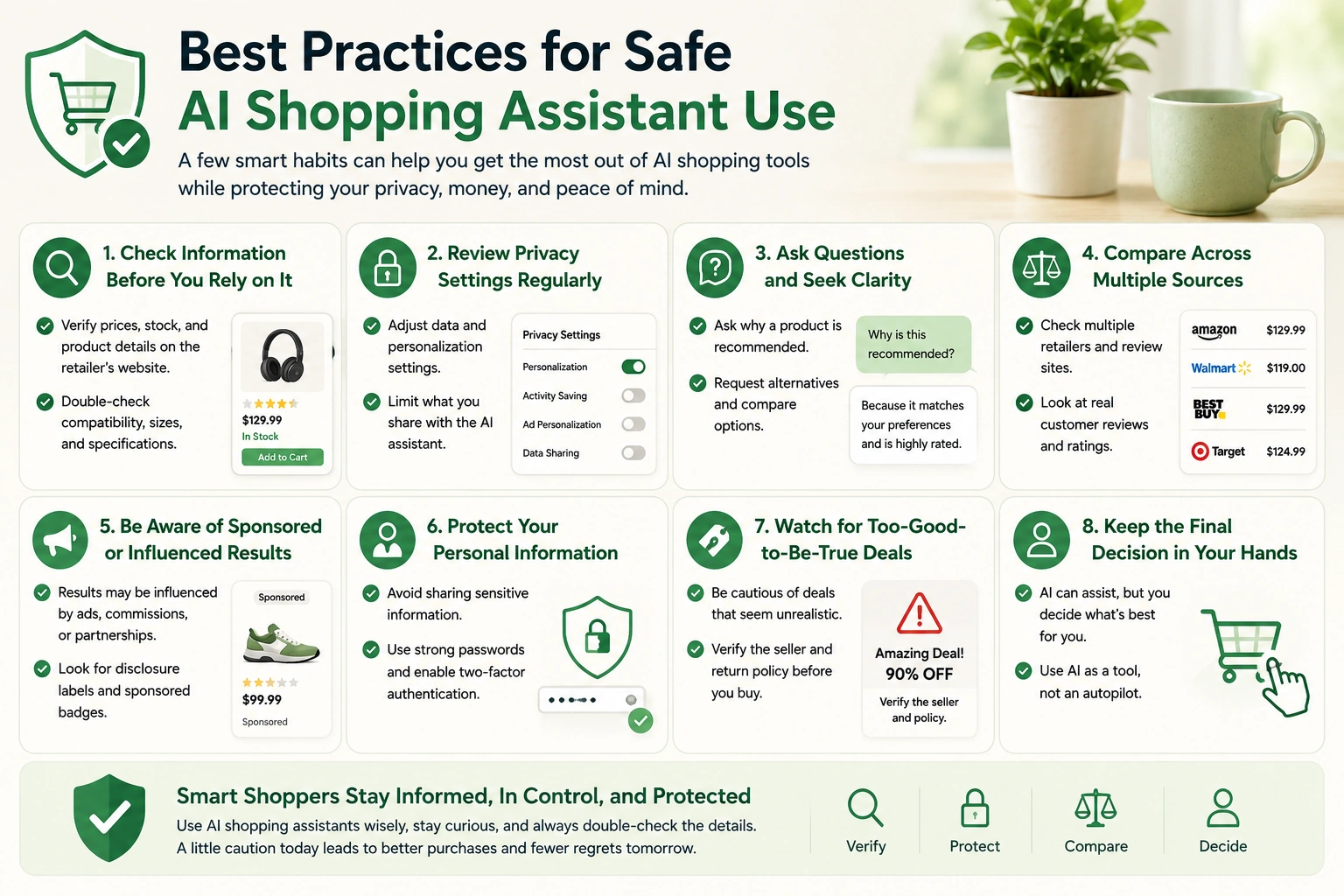
AI shopping assistants can save time, reduce research, and make complicated product decisions easier. The safest way to use them is to treat them as a helpful research layer, not as the final authority on a purchase.
A useful assistant can help you create a shortlist, compare features, find alternatives, understand technical language, and identify questions worth asking before checkout. But it should not replace the product page, return policy, manufacturer documentation, or your own judgment.
The goal is not to avoid AI shopping tools completely. It is to use them in a way that gives you the convenience of AI without giving up privacy, accuracy, or control over the final decision.
Use Established Retailers and Trusted Shopping Tools
Start with tools operated by retailers, marketplaces, browser extensions, or shopping platforms you already recognize and trust. A legitimate shopping assistant should make it clear who operates it, what website or app it belongs to, and how it handles account and payment information.
Be more cautious with unfamiliar AI chat tools that ask you to connect retail accounts, upload personal documents, enter payment details, or share information that is not necessary for a product search.
For example, a tool helping you compare laptops may reasonably ask about your budget, preferred screen size, software needs, and travel habits. It should not need your bank password, Social Security number, full payment-card details, or private account credentials.
Share Only the Information Needed for the Search
Most product searches do not require deeply personal information. You can usually get useful recommendations by sharing practical details such as budget, size, preferred style, product use case, compatibility needs, or delivery deadline.
For example, this is enough information for a useful request:
“Find a lightweight carry-on suitcase under $250 that is durable enough for frequent travel and can arrive before next Friday.”
There is no need to add unnecessary personal details about your finances, health, household situation, private travel plans, or family members unless that information is genuinely essential for the product decision.
Before using a new tool, consider whether the information you are about to enter would still feel reasonable if it were stored in a shopping account, used to personalize future recommendations, or reviewed by customer-support staff.
Ask the Assistant Why It Recommended a Product
One of the advantages of an AI shopping assistant is that you can challenge its recommendations instead of simply accepting the first result.
Useful questions include:
- “Why did you recommend this product first?”
- “Which requirements from my request does it match?”
- “Show me a cheaper option with similar features.”
- “Show alternatives from other brands.”
- “Is this result sponsored?”
- “What are the main trade-offs compared with the next option?”
- “Can you confirm whether this is compatible with my exact model?”
A trustworthy assistant should explain its reasoning in practical terms. It should mention factors such as price, availability, delivery timing, compatibility, ratings, size, features, or your stated preferences. If it cannot explain why a product appears first, treat the recommendation as a starting point rather than a conclusion.
Verify Important Details on the Official Product Page
Always open the actual product listing before buying. This matters most when the purchase is expensive, technical, safety-related, difficult to return, or dependent on compatibility.
Check the details that could change your decision:
- The current price and any shipping costs
- The exact size, color, version, or product variation
- Stock availability and estimated delivery date
- Compatibility with your device, vehicle, appliance, or existing equipment
- Warranty coverage and return conditions
- Included accessories, subscriptions, or additional requirements
- Recent customer reviews related to your specific use case
An assistant may summarize these details correctly, but the official product page is where you can confirm what the retailer is actually offering at the time you buy.
Compare More Than One Option
The first recommendation may be useful, but it is rarely the only realistic choice. Asking for two or three alternatives can help you spot differences in price, warranty, delivery speed, product quality, included accessories, or return terms.
For higher-cost purchases, ask the assistant to compare options using the criteria that matter most to you. Instead of asking for “the best laptop,” try something more specific:
“Compare these three laptops by weight, battery life, webcam quality, warranty, and total price. I travel often and use video calls every day.”
That forces the assistant to show trade-offs rather than relying on vague claims about one product being universally better.
Watch for Sponsored Results and Sales Pressure
Be careful when an assistant repeatedly pushes one brand, one seller, or one price range without clearly explaining why. A product may be a strong match, but it may also be sponsored, promoted, retailer-owned, or prioritized because it is overstocked.
Look for labels such as “Sponsored,” “Promoted,” “Paid placement,” or “Advertisement.” If the assistant does not disclose whether a product is sponsored, ask directly.
You can also request a more balanced comparison:
- “Show one lower-priced option, one mid-range option, and one premium option.”
- “Include products from at least three brands.”
- “Show non-sponsored alternatives.”
- “Rank these only by my requested features and budget.”
Clear alternatives make it easier to see whether the first recommendation is genuinely the best fit or simply the most visible product.
Use Strong Account Security
If you use an AI shopping assistant through a retailer account, protect that account as you would any other service that contains order history, saved addresses, payment methods, and personal information.
Use a strong, unique password and turn on two-factor authentication when it is available. The Federal Trade Commission recommends two-factor authentication as an important additional layer of protection for online accounts.
Also avoid using public or shared devices for purchases unless you sign out completely afterward. Be especially cautious about saving payment details on devices that other people can access.
Keep the Final Checkout Under Your Control
Some shopping tools can help with recurring purchases, price alerts, saved lists, or automated buying actions. These features can be useful, but they should never remove your ability to review the final product, price, seller, payment method, and delivery address.
Before approving a purchase, confirm:
- The exact item and variation
- The final total, including taxes and delivery costs
- The seller or marketplace merchant
- The expected delivery date
- The return and refund policy
- Whether the purchase includes a subscription or recurring charge
Automation is most useful when it reduces repetitive work, not when it makes a purchase happen without meaningful review.
Keep Records of Important Purchases
Save confirmation emails, receipts, delivery estimates, product screenshots, warranty details, and any important conversations with the seller. This can make it easier to resolve a problem if the item arrives late, is different from the listing, does not work as expected, or cannot be returned.
The FTC advises online shoppers to compare sellers and products, review return and refund policies, and keep records of purchases so they can hold sellers to their promises. FTC online-shopping guidance provides additional practical steps for safer purchases.
Know When AI Should Not Be Your Only Source
AI shopping assistants are most helpful for ordinary research, product discovery, comparisons, and routine buying decisions. They should not be the only source of advice for purchases involving health, safety, legal requirements, major financial commitments, complex compatibility, or products that could create serious consequences if chosen incorrectly.
For example, be more careful when buying safety equipment, medical-related products, child products, electrical accessories, vehicle parts, home-improvement equipment, high-value electronics, or expensive travel services. In these situations, use AI to identify questions and options, then verify the answer through official documentation, qualified professionals, or trusted independent sources.
A safer AI shopping habit is simple: use the assistant to reduce unnecessary research, ask it to explain its recommendations, compare realistic alternatives, verify critical details before checkout, and keep the final decision in your own hands.
What Ecommerce Stores Should Do to Protect Shoppers
AI shopping assistants can only become trustworthy when ecommerce stores treat them as more than a chat feature. The assistant may be the part shoppers see, but the quality of its answers depends on the systems behind it: product data, inventory updates, pricing rules, delivery information, privacy controls, security practices, and the people responsible for fixing problems when something goes wrong.
A store does not need to make its AI assistant perfect before launching it. But it should make sure the assistant is transparent about what it knows, careful about what it does not know, and connected to reliable information before it is allowed to influence purchase decisions.
The NIST Generative AI Risk Management Profile is designed to help organizations identify and manage risks connected to generative-AI systems. For ecommerce stores, that means thinking about privacy, inaccurate outputs, security, bias, transparency, and human oversight before the assistant becomes part of the buying journey.
Start With Accurate Product and Inventory Data
An AI shopping assistant cannot give reliable advice when the store’s product data is incomplete, inconsistent, or outdated. Before adding conversational search or product recommendations, retailers should make sure the catalog contains clear and structured information.
That includes:
- Accurate product titles and descriptions
- Current prices and promotional conditions
- Real-time or frequently updated stock status
- Clear product variations, such as size, color, bundle, and model
- Dimensions, materials, technical specifications, and compatibility information
- Delivery estimates and shipping restrictions
- Warranty, return, and refund conditions
- Verified information about included accessories or required subscriptions
If a product is out of stock, the assistant should not recommend it as available. If compatibility is unclear, the assistant should not make a confident claim. If a product page does not confirm whether an accessory is included, the assistant should say that it cannot verify the detail instead of guessing.
Use AI to Retrieve Verified Information, Not Invent Answers
A shopping assistant should be grounded in reliable store data whenever it answers questions about products, prices, delivery, returns, compatibility, or availability. It should retrieve relevant information from the catalog, policy pages, inventory systems, and order data instead of relying only on a general AI model.
For example, if a shopper asks:
“Will this charger work with my 2025 MacBook Air?”
the assistant should check the model-specific compatibility information, connector type, wattage, and manufacturer guidance. It should not simply produce an answer because the products appear broadly related.
When the information is missing or uncertain, a trustworthy response may be:
“I could not verify compatibility with that exact model. Please check the manufacturer’s compatibility list or contact support before ordering.”
This may sound less polished than a fast answer, but it protects both the shopper and the store from a recommendation that could lead to returns, complaints, or loss of trust.
Collect Only the Data the Assistant Actually Needs
Stores should avoid treating every conversation as an opportunity to collect as much customer data as possible. A shopping assistant may need a budget, product preference, delivery location, size, or compatibility requirement to provide useful recommendations. It does not need unnecessary personal information to answer a routine product question.
The FTC’s Protecting Personal Information: A Guide for Business recommends that businesses know what information they hold, keep only what they need, protect the information they retain, dispose of information they no longer need, and prepare for security incidents.
For an ecommerce assistant, this practical approach means:
- Limiting access to customer data based on the assistant’s real purpose
- Separating product-search conversations from sensitive account information where possible
- Giving shoppers clear choices about personalized recommendations
- Explaining whether conversation history is stored
- Providing a simple way to delete, reset, or limit saved preferences
- Avoiding the use of sensitive information when it is not needed for the shopping task
Be Clear About Personalization
Personalization can improve shopping when it helps a customer find relevant products faster. A saved shoe width, preferred clothing size, fragrance preference, or previous purchase can be useful when it genuinely applies to the current request.
But stores should not let hidden personalization quietly control every result. Shoppers should be able to understand when recommendations are influenced by browsing behavior, previous purchases, loyalty-account data, cart activity, or saved preferences.
A simple explanation can make a major difference:
- “Recommended because you previously selected wide-fit shoes.”
- “Shown first because it matches your saved delivery preference.”
- “Personalized using your previous purchases.”
- “Showing broader results because personalization is turned off.”
Stores should also give shoppers a practical way to start fresh. A person buying a gift, researching for work, or shopping for someone else should not be trapped in recommendations based on their own past behavior.
Label Sponsored Products and Commercial Priorities Clearly
AI recommendations should not make paid placements look like neutral advice. If a product is sponsored, promoted, retailer-owned, prioritized because of a campaign, or surfaced partly because of inventory goals, shoppers should be able to see that context.
Clear labels such as Sponsored, Promoted, Paid placement, or Retailer-owned brand are more useful than vague disclosures hidden in small print or separate help pages.
Stores should also avoid presenting products with absolute language unless they can explain the reason behind the recommendation. Instead of saying:
“This is the best option for you.”
the assistant should explain the decision in a way the shopper can evaluate:
“This product is a strong match because it fits your budget, is available in your requested size, and can arrive before Friday. A lower-priced alternative has fewer included accessories, while another option has a longer warranty.”
That gives customers context without pretending that one product is objectively perfect for everyone.
Test the Assistant With Real Customer Questions
Before launching an AI shopping assistant, stores should test it using the types of questions customers actually ask. This includes vague requests, technical questions, unusual product combinations, unclear wording, delivery deadlines, compatibility concerns, return-policy questions, and requests involving unavailable products.
Useful test cases include:
- “Find a gift for someone who likes cooking, but I do not know what they already own.”
- “Will this replacement filter fit the model I bought two years ago?”
- “Show me a cheaper option that arrives before Friday.”
- “Which size should I order if I am between two sizes?”
- “Can I return this product if it does not fit?”
- “Show products that do not require a subscription.”
- “Is this product currently in stock in my selected color?”
Testing should not focus only on whether the assistant can produce fluent answers. It should focus on whether those answers are accurate, understandable, properly sourced, and safe to act on.
Provide a Clear Path to Human Support
Not every shopping problem should be handled by AI. A customer may need help with a damaged order, account access, payment issue, delivery dispute, complex return, missing item, high-value purchase, or product question that cannot be confirmed through the catalog.
In those cases, the assistant should not keep repeating generic answers or pretend it can solve the issue. It should offer a clear next step, such as a support chat, phone number, email form, order-support page, or escalation to a trained member of the team.
This is especially important for stores using conversational tools to improve sales. A good AI assistant can reduce routine questions and help customers find products, while human support handles situations that require judgment, empathy, or access to information the system cannot verify. This is closely connected to the approach explained in our guide to how AI chatbots help ecommerce stores sell more.
Monitor Errors and Fix Them Quickly
An AI shopping assistant should not be treated as a one-time launch project. Product catalogs change, prices move, policies are updated, inventory shifts, and customer questions reveal problems that were not obvious during testing.
Stores should regularly review issues such as:
- Incorrect prices or delivery estimates
- Out-of-stock recommendations
- Compatibility errors
- Confusing return-policy answers
- Repeated recommendations that ignore the shopper’s request
- Unclear sponsored-product disclosures
- Customer complaints about privacy or personalization
- Questions the assistant cannot answer accurately
These patterns can reveal weaknesses in product information, store policies, filtering, inventory connections, or the assistant’s underlying instructions. Fixing them improves the experience for future shoppers and helps the store avoid repeating the same mistake at scale.
Make Privacy Controls Easy to Find and Use
Privacy controls should not be hidden behind complicated settings or legal language. Shoppers should be able to understand whether their conversations are saved, whether recommendations are personalized, what data is used, and how to change those settings.
Helpful controls can include:
- Turning personalized recommendations on or off
- Clearing conversation history
- Removing saved product preferences
- Starting a non-personalized search session
- Viewing the main reasons behind a recommendation
- Requesting that certain data not be used for future recommendations
Stores do not need to make privacy settings complicated to be transparent. Clear explanations and practical choices are often more valuable than long policy documents that most shoppers will never read.
Build for Trust, Not Just Conversion
An AI shopping assistant can increase conversion in the short term by making recommendations feel fast, confident, and persuasive. But a store that pushes inaccurate products, hides sponsorships, overuses personal data, or makes returns harder will lose trust over time.
The stronger long-term approach is to build an assistant that helps shoppers make better decisions, even when that means recommending a lower-priced option, admitting uncertainty, showing alternatives from other brands, or sending the customer to human support.
Trust grows when shoppers feel that the assistant is helping them understand the choices in front of them, not simply steering them toward the fastest possible checkout.
The Future of Trustworthy AI Shopping
AI shopping assistants will likely become more capable over time. They will be better at handling follow-up questions, comparing products across categories, understanding images, tracking prices, checking availability, and helping shoppers complete routine tasks.
That progress can make online shopping more convenient, but convenience alone will not determine whether shoppers trust these tools. The future of AI shopping will depend on whether assistants become more accurate, more transparent, easier to control, and more honest about the limits of their recommendations.
A useful AI shopping assistant should not simply become more persuasive. It should become better at helping people understand why a product was recommended, what information supports the answer, what trade-offs exist, and what still needs to be verified before purchase.
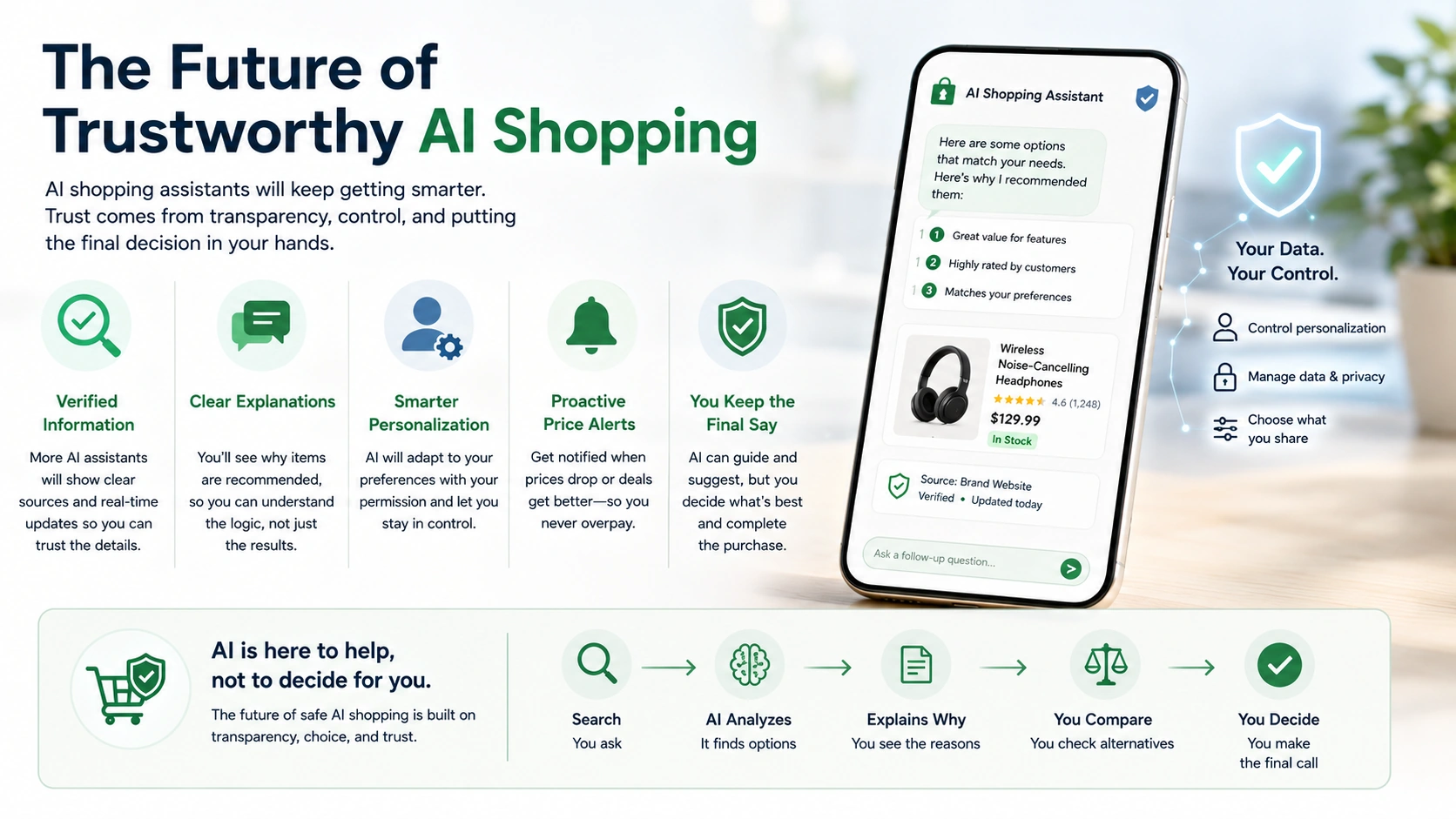
Recommendations Should Become Easier to Explain
Today, many shopping recommendations appear as a ranked list with limited explanation. A shopper may see one product first without knowing whether it was selected because of price, popularity, delivery speed, reviews, personalization, sponsorship, inventory availability, or retailer preference.
Future AI shopping assistants should make those reasons clearer. Instead of only showing a product, the assistant could explain:
- “Recommended because it matches your budget, requested size, and delivery deadline.”
- “This option costs less but has a shorter warranty.”
- “This product has stronger customer ratings for durability, but it is heavier.”
- “This result is sponsored.”
- “This recommendation uses your saved preference for wide-fit shoes.”
These explanations do not need to be technical or overwhelming. They simply need to give shoppers enough context to decide whether the recommendation actually fits their needs.
A trustworthy assistant should also be able to explain uncertainty. If it cannot verify compatibility, delivery timing, stock availability, or a product claim, it should say so clearly instead of producing a confident answer that may be wrong.
Shoppers Will Expect More Control Over Personalization
Personalization can make shopping easier, especially when someone has stable preferences such as a shoe size, dietary requirement, preferred color, delivery location, or device ecosystem. But future systems should give shoppers more control over when and how that information is used.
For example, a shopper may want different modes for different situations:
- Personalized mode: Uses saved preferences and previous shopping activity.
- Fresh search mode: Ignores purchase history and focuses only on the current request.
- Gift-shopping mode: Avoids using the shopper’s own preferences when buying for someone else.
- Privacy-first mode: Limits stored conversation history and personalized recommendations.
- Comparison mode: Shows a broader range of brands, prices, and product types.
These controls could make recommendations more useful because they give the shopper a way to correct assumptions before they shape the entire result list.
The future of AI shopping should not mean that a retailer knows more about a customer while the customer understands less about the retailer. Better systems will make personalization visible, optional, and easier to adjust.
AI Agents May Handle More Research, but Shoppers Should Keep Approval Rights
AI shopping tools may gradually move beyond answering questions and begin handling more of the research process. An assistant could monitor a price, compare alternatives when a preferred item is unavailable, check whether a product is compatible with an existing purchase, or prepare a cart for the shopper to review.
For example, a shopper might tell an assistant:
“Track this laptop until it drops below $900. If it goes out of stock, show me alternatives with similar battery life, weight, and warranty coverage.”
That can save time. But more automated shopping should not mean less customer control. The shopper should still approve the final product, price, seller, delivery address, payment method, and any recurring charge before an order is placed.
Automation is most helpful when it handles repetitive work. It becomes risky when it makes purchases based on assumptions the shopper has not reviewed.
Reliable Product Data Will Matter More Than Better Marketing Language
As AI shopping assistants become more common, retailers will need better product data. A polished product description is not enough when an assistant must compare models, verify compatibility, estimate delivery, explain returns, and recommend alternatives.
Stores will need accurate and structured information about:
- Product specifications and dimensions
- Materials and ingredients
- Compatibility requirements
- Available variations and bundles
- Current pricing and promotions
- Inventory and delivery estimates
- Warranty coverage and return conditions
- Included accessories and subscription requirements
The assistant can only be as useful as the information behind it. If the catalog is incomplete, the assistant may recommend the wrong variation, suggest an unavailable product, misunderstand an important feature, or create a comparison that looks useful but misses the details that matter most.
This is why AI shopping is not only a chatbot issue. It is also a product-data, operations, privacy, and customer-support issue. Our guide to the future of AI in ecommerce explores how these systems are likely to change product discovery and retailer operations more broadly.
Trust Will Depend on Independent Verification
Future assistants should not ask shoppers to blindly trust them. Instead, they should make verification easier.
A stronger shopping assistant could show:
- The official product source used for a claim
- The date and time a price or stock detail was last checked
- The retailer policy used to answer a return or delivery question
- The exact product attributes used in a comparison
- Whether review insights come from verified buyers
- Whether a result is sponsored or influenced by a promotion
This would help shoppers distinguish between verified product information, AI-generated summaries, customer opinions, and paid placements. The goal is not to overwhelm people with technical details. It is to give them a clear path to check the facts when a purchase matters.
More Transparent Systems Could Reduce Hidden Bias
AI shopping assistants will never be completely free from trade-offs. A system still has to decide how to balance price, quality, delivery speed, ratings, sustainability claims, popularity, personal preferences, and retailer priorities.
But future systems can become fairer by making those trade-offs more visible. A shopper should be able to ask for lower-priced alternatives, different brands, non-sponsored results, broader options, or products that prioritize one feature over another.
For example, instead of simply showing a “top pick,” an assistant could offer:
- Best value: Balances price, features, and warranty.
- Lowest cost: Prioritizes the lowest current price.
- Best for durability: Prioritizes materials, warranty, and long-term reviews.
- Fastest delivery: Prioritizes in-stock items with the earliest arrival date.
- Broad comparison: Includes multiple brands and price ranges.
This approach is more honest than pretending there is one universal “best” product for every shopper.
Privacy Expectations Will Continue to Grow
As shopping assistants use more conversation history, purchase data, product interactions, and device signals, shoppers will expect clearer privacy choices. People will want to know what is stored, how long it is retained, whether conversations are used to train systems, and whether personal data influences product rankings or offers.
Retailers that make these choices easy to understand may build stronger long-term trust than those that rely on hidden tracking or overly complex privacy settings.
A practical privacy-first shopping experience could include simple choices such as:
- “Do not save this conversation.”
- “Use my preferences only for this session.”
- “Turn off personalized recommendations.”
- “Show why this product was recommended.”
- “Delete my saved shopping preferences.”
These controls would not stop AI shopping from being useful. They would make it more respectful of the person using it.
Human Judgment Will Remain Essential
Even the most advanced AI shopping assistant will not fully replace product pages, customer reviews, warranty terms, return policies, professional advice, or human judgment.
For ordinary purchases, an assistant may save time and help narrow the options quickly. For expensive, technical, safety-related, health-related, or compatibility-sensitive purchases, shoppers will still need to verify important details through official documentation, qualified professionals, or trusted independent sources.
The strongest future AI shopping assistants will not be the ones that make the most decisions automatically. They will be the ones that reduce unnecessary research, explain trade-offs clearly, show where the information came from, protect customer privacy, and leave the final purchase decision in human hands.
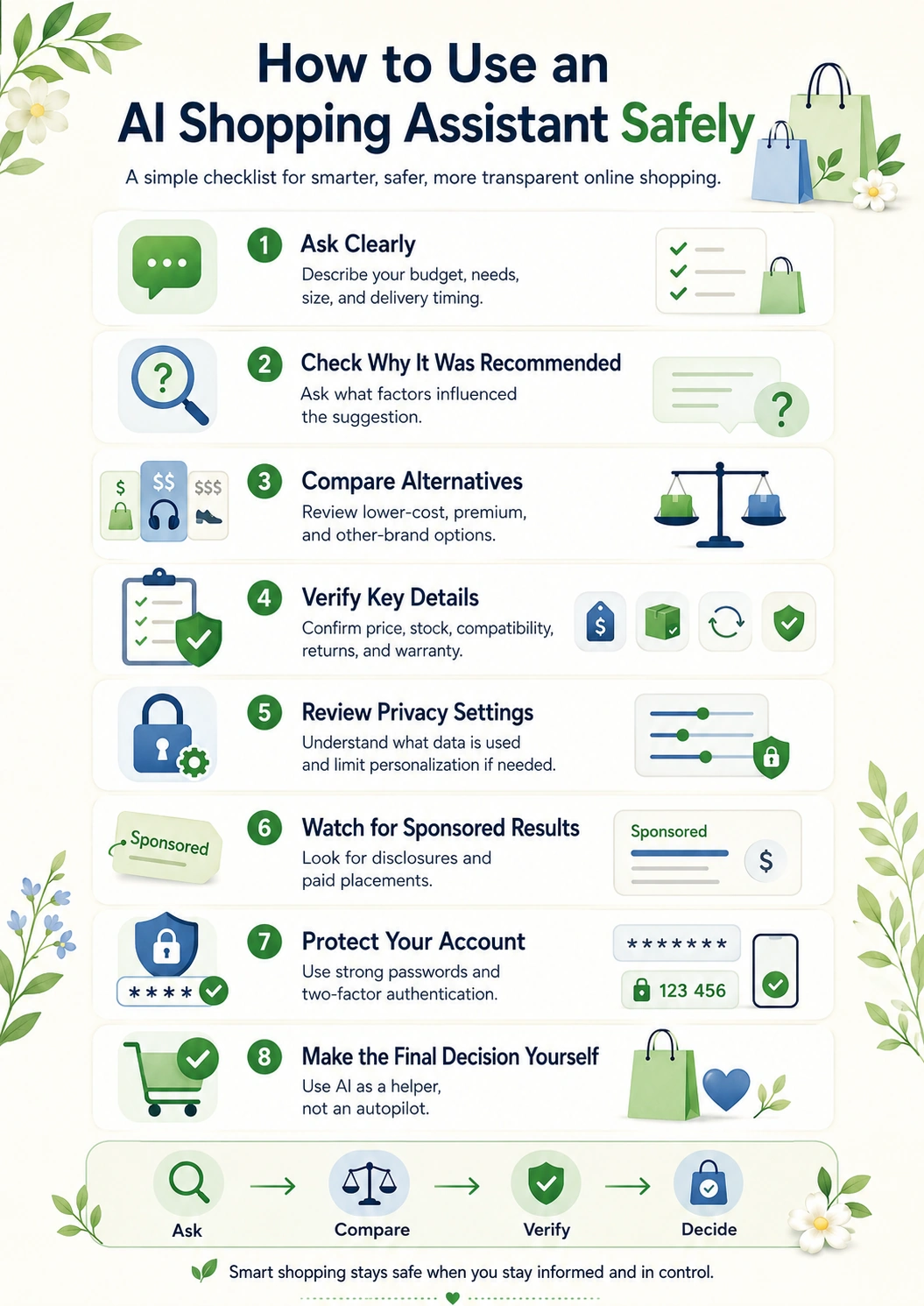
Conclusion
AI shopping assistants can make online buying easier when they help people move from a vague need to a smaller, more relevant group of products. They can save time, explain product differences, compare options, surface alternatives, and make it easier to ask follow-up questions without restarting the search from scratch.
But convenience should not be confused with certainty. An assistant may misunderstand a request, rely on outdated prices or stock information, make an incorrect compatibility claim, repeat biased patterns from its data, or recommend a sponsored product without making the commercial relationship clear.
The safest approach is to use AI shopping assistants as research and decision-support tools, not as the final authority on an important purchase. Let the assistant help you build a shortlist, compare realistic options, and identify the questions that matter. Then verify critical details on the official product page before you buy.
That means checking the final price, seller, delivery date, product variation, compatibility requirements, warranty terms, return policy, and any subscription or recurring-charge conditions. For high-cost, technical, safety-related, health-related, or compatibility-sensitive products, this extra step can prevent an expensive mistake.
Trustworthy AI shopping tools should also make their limits clear. They should explain why a product was recommended, label sponsored results, protect personal data, allow shoppers to control personalization, and admit when a detail cannot be verified. The strongest systems will not simply try to persuade people to buy faster. They will help people understand the trade-offs behind a decision.
For ecommerce stores, the opportunity is significant, but so is the responsibility. Better product data, transparent ranking, accurate inventory connections, privacy controls, clear disclosures, and easy access to human support are what turn an AI shopping assistant from a flashy feature into something shoppers can actually trust.
AI shopping is likely to become more conversational, personalized, and automated over the next few years. The best version of that future will keep the shopper in control: informed about how recommendations work, able to question the results, and free to make the final decision themselves.
Explore more practical guides on AI Shopping Assistant to learn how AI is changing product search, online recommendations, ecommerce support, and smarter buying decisions.
Frequently Asked Questions
Are AI shopping assistants safe to use?
AI shopping assistants can be safe and useful when they are connected to reliable product data, use clear privacy practices, label sponsored recommendations, and let shoppers verify important details before checkout.
However, they are not automatically accurate. An assistant may misunderstand a request, use outdated price or stock information, make an unsupported compatibility claim, or recommend products based partly on hidden personalization or commercial priorities.
Do AI shopping assistants collect personal data?
Some do. Depending on the retailer, app, browser extension, and user settings, an AI shopping assistant may use search queries, clicked products, cart activity, purchase history, saved preferences, approximate location, device information, or conversation history.
Shoppers should review privacy settings and avoid sharing information that is not needed for the product search, such as passwords, bank details, Social Security numbers, or highly personal information.
Can AI shopping assistants see my purchase history?
They may be able to see purchase history when they are connected to a retailer account, loyalty program, or shopping platform where that information is available. This can help with recommendations, repeat purchases, compatible accessories, sizing, or delivery support.
A trustworthy tool should make it clear whether purchase history is used and should provide options to limit or disable personalization.
Can AI shopping assistants give wrong answers?
Yes. AI assistants can provide incorrect answers about prices, product features, delivery estimates, availability, return policies, sizing, compatibility, or warranties when the underlying information is incomplete, outdated, or unclear.
Before buying, check the official product page and confirm the details that could affect your decision, especially for expensive, technical, safety-related, or compatibility-sensitive purchases.
Can an AI shopping assistant recommend sponsored products?
Yes. Some AI shopping tools may include sponsored listings, promoted products, retailer-owned brands, or products influenced by commercial agreements. A sponsored product is not necessarily a bad option, but the commercial relationship should be clearly disclosed.
Look for labels such as Sponsored, Promoted, Paid placement, or Advertisement. You can also ask the assistant whether a recommendation is sponsored and request non-sponsored alternatives where available.
How can I tell why an AI shopping assistant recommended a product?
Ask directly. Useful questions include:
- “Why did you recommend this product first?”
- “Which parts of my request does it match?”
- “Is this result sponsored?”
- “Show me lower-priced alternatives.”
- “Show options from different brands.”
- “What are the trade-offs compared with the next option?”
A useful assistant should explain whether the recommendation is based on price, features, availability, delivery timing, ratings, saved preferences, or a paid placement.
Can personalization make AI shopping recommendations worse?
It can. Personalization is helpful when it reflects a real and current preference, such as a saved shoe size, dietary requirement, or preferred product category. But it can become unhelpful when it relies too heavily on past behavior and keeps showing the same brands, price ranges, or styles.
For example, someone who usually buys budget products may still want a premium item for a special purchase. The current request should matter more than old browsing or purchase history.
Should I trust AI-generated product review summaries?
Review summaries can save time, but they should not replace reading relevant customer feedback. A product may have a high overall rating while still receiving repeated complaints about the issue that matters most to you, such as durability, noise, fit, battery life, delivery, or compatibility.
Use the assistant to identify common themes, then read recent reviews that mention your specific priorities before you buy.
What should I verify before buying a product recommended by AI?
Before checkout, verify the current price, seller, exact product variation, stock availability, estimated delivery date, compatibility requirements, return policy, warranty coverage, included accessories, and any subscriptions or recurring charges.
This extra check is especially important for electronics, vehicle parts, appliances, safety equipment, high-value purchases, and products that are difficult to return.
Can AI shopping assistants make purchases automatically?
Some tools can support price alerts, saved lists, recurring orders, or user-approved automatic purchases. These features can be convenient, but shoppers should retain control over the final item, total cost, seller, payment method, delivery address, and timing of the purchase.
Automation should reduce repetitive work, not remove the shopper’s ability to review an important order before it is placed.
What makes an AI shopping assistant trustworthy?
A trustworthy assistant uses verified product data, clearly explains why products are recommended, labels sponsored placements, protects personal information, allows shoppers to control personalization, and admits when a detail cannot be confirmed.
The goal should be to help people make better decisions, not simply to push them toward the fastest possible checkout.