

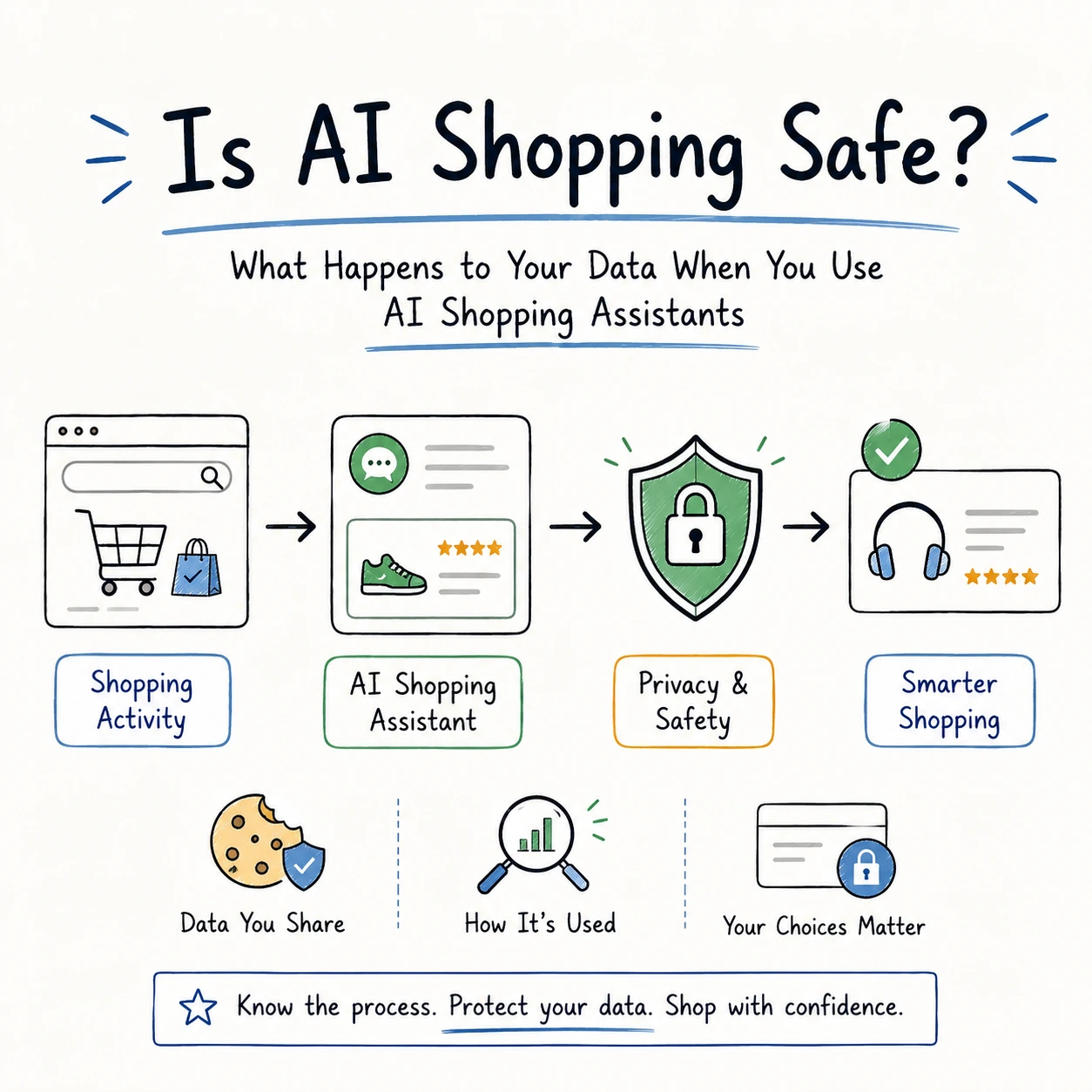
AI shopping assistants are becoming a normal part of how people discover and buy products online. From product recommendations to smart search and personalized offers, these tools are changing the way ecommerce works.
But as their use grows, so does a simple question many users have: what actually happens to my data when I use an AI shopping assistant?
| Question | Short Answer |
|---|---|
| Is AI shopping safe? | Yes, when used on trusted platforms that follow privacy regulations like GDPR and use encryption. |
| What data do AI shopping assistants collect? | Mainly behavioral data such as clicks, browsing activity, cart actions, and purchase history. |
| Does AI store my personal data? | Most systems store anonymized or aggregated data, not sensitive personal details like passwords or payment info. |
| Can AI shopping assistants track me? | Yes, but usually through cookies and behavioral signals used for personalization, not direct identity tracking. |
| How can I stay safe? | Avoid sharing sensitive data, use trusted platforms, and manage privacy or cookie settings. |
Most people don’t think about it while shopping, but every click, search, and product interaction can be used to improve recommendations and personalize the experience. This creates a balance between convenience and privacy that is not always clearly understood.
In reality, AI shopping systems are built on data. They rely on user behavior to suggest better products, optimize search results, and even recover abandoned carts. However, this does not automatically mean your personal information is exposed or misused.
In this article, we’ll explain in simple terms how AI shopping assistants use your data, what information is collected, how it is processed, and whether these systems are actually safe to use in everyday ecommerce.
What Is an AI Shopping Assistant
An AI shopping assistant is a system that helps users find, compare, and choose products online using artificial intelligence. Instead of manually browsing hundreds of products, users can rely on AI to get personalized recommendations based on their behavior and preferences.
These systems are used across modern ecommerce platforms to improve search results, suggest relevant products, and make the shopping experience faster and more intuitive.
For example, when you search for a product, an AI shopping assistant can analyze your past interactions, similar user behavior, and product data to show items that are more likely to match your needs.
In many cases, AI shopping assistants are also connected to recommendation engines and personalization systems, which help increase conversion rates and improve overall user experience.
To better understand how these systems work in ecommerce, you can also explore our guide on AI search for ecommerce, which explains how AI improves product discovery and search accuracy.
What Data Do AI Shopping Assistants Collect
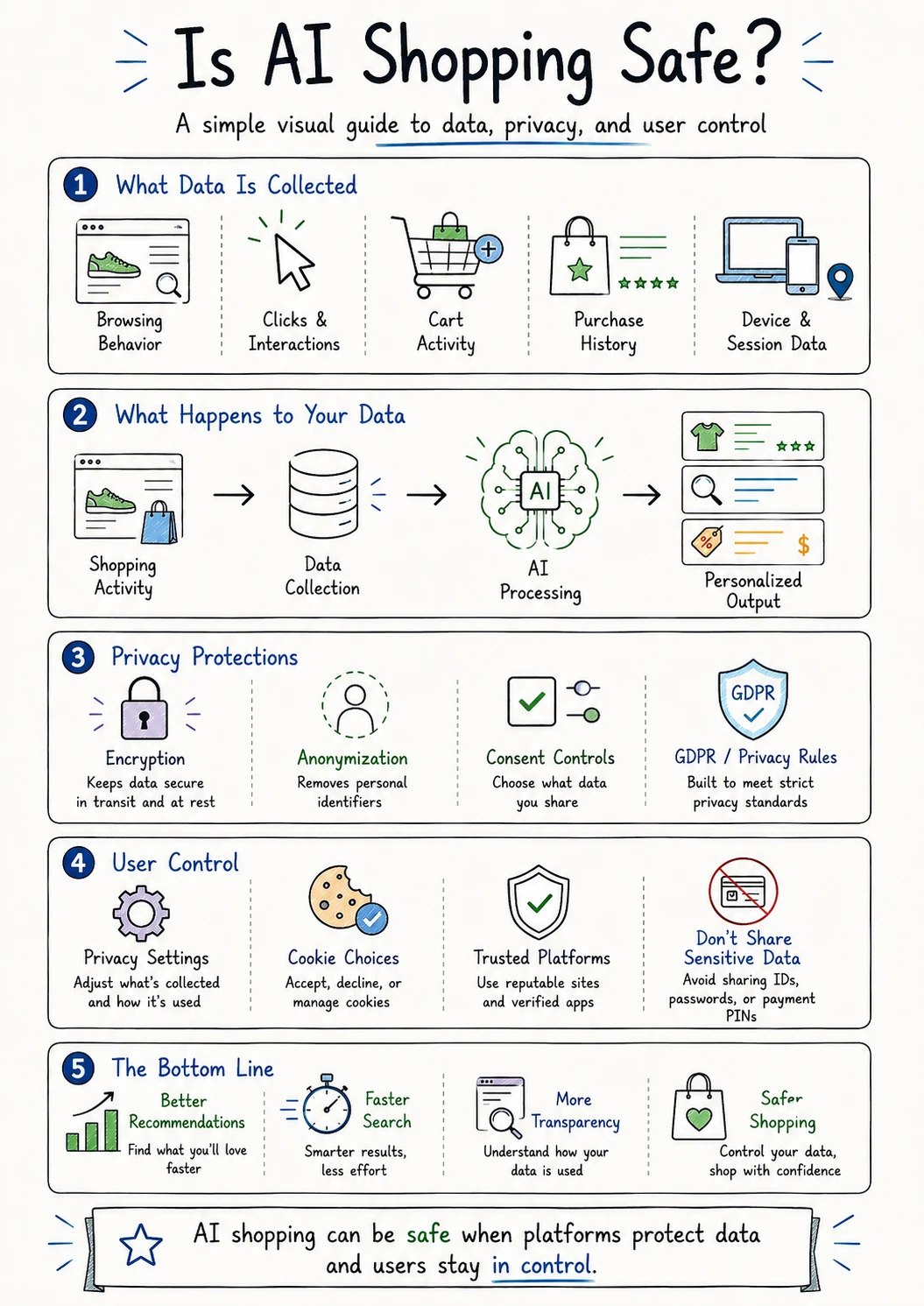
AI shopping assistants rely on data to function properly. Without data, they would not be able to personalize recommendations, improve search results, or optimize the shopping experience.
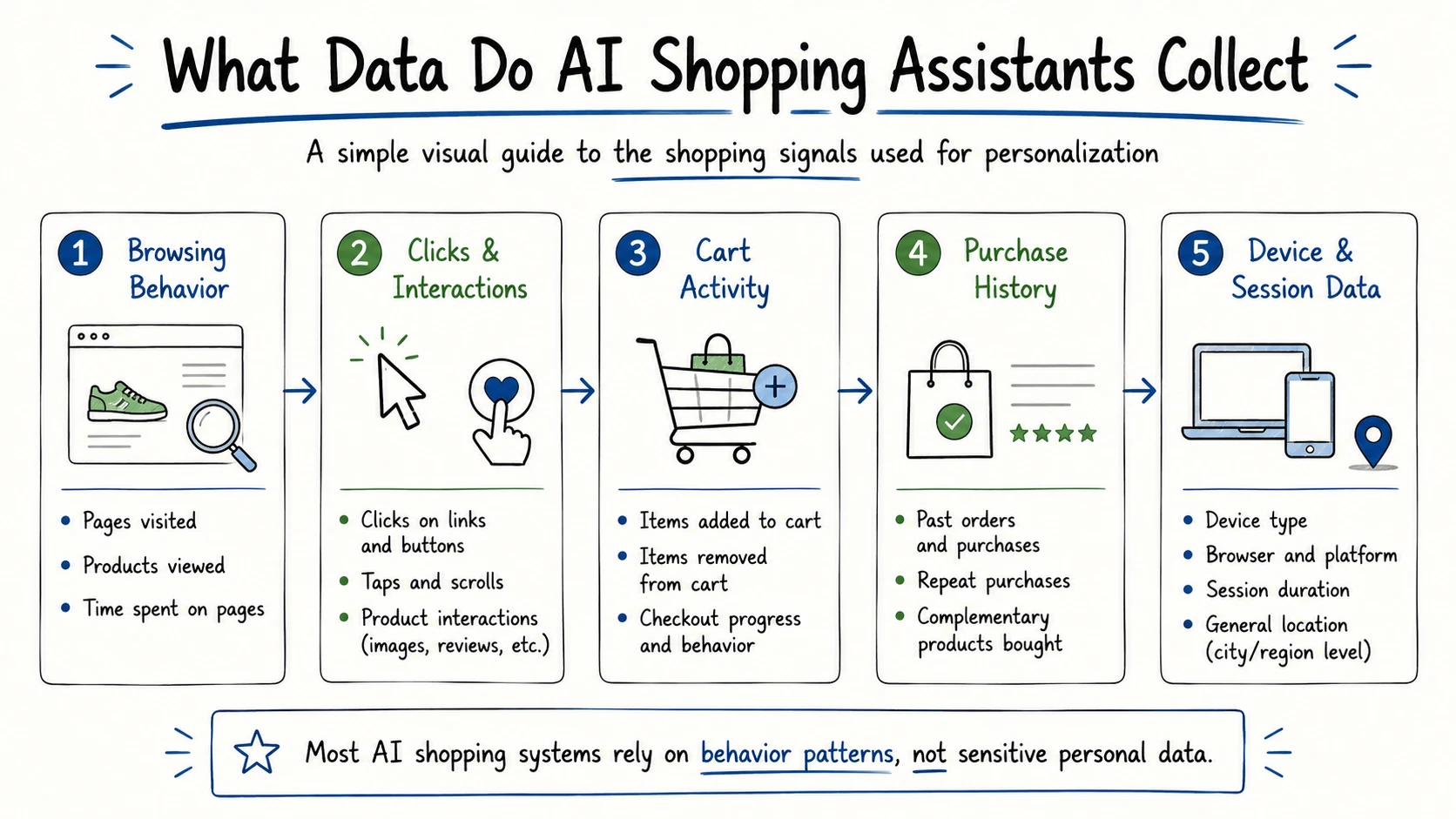
Most of the data collected is behavioral, meaning it comes from how users interact with a website rather than from personal identity details.
1. Browsing behavior
This includes pages visited, products viewed, and time spent on specific items. It helps AI understand user interests.
2. Clicks and interactions
Every click, scroll, and interaction helps the system learn what users find relevant or engaging.
3. Cart activity
AI systems track products added to the cart, removed items, and checkout behavior to improve conversion predictions.
4. Purchase history
Past purchases help AI recommend similar or complementary products in the future.
5. Device and session data
This includes general technical information such as device type, browser, and session duration, which helps improve system performance and fraud prevention.
Most of this data is anonymized or aggregated, meaning it is used for patterns and predictions rather than directly identifying individual users.
What Happens to Your Data
When you use an AI shopping assistant, your data does not simply stay stored in one place. Instead, it goes through a processing system designed to turn user behavior into useful predictions and recommendations.
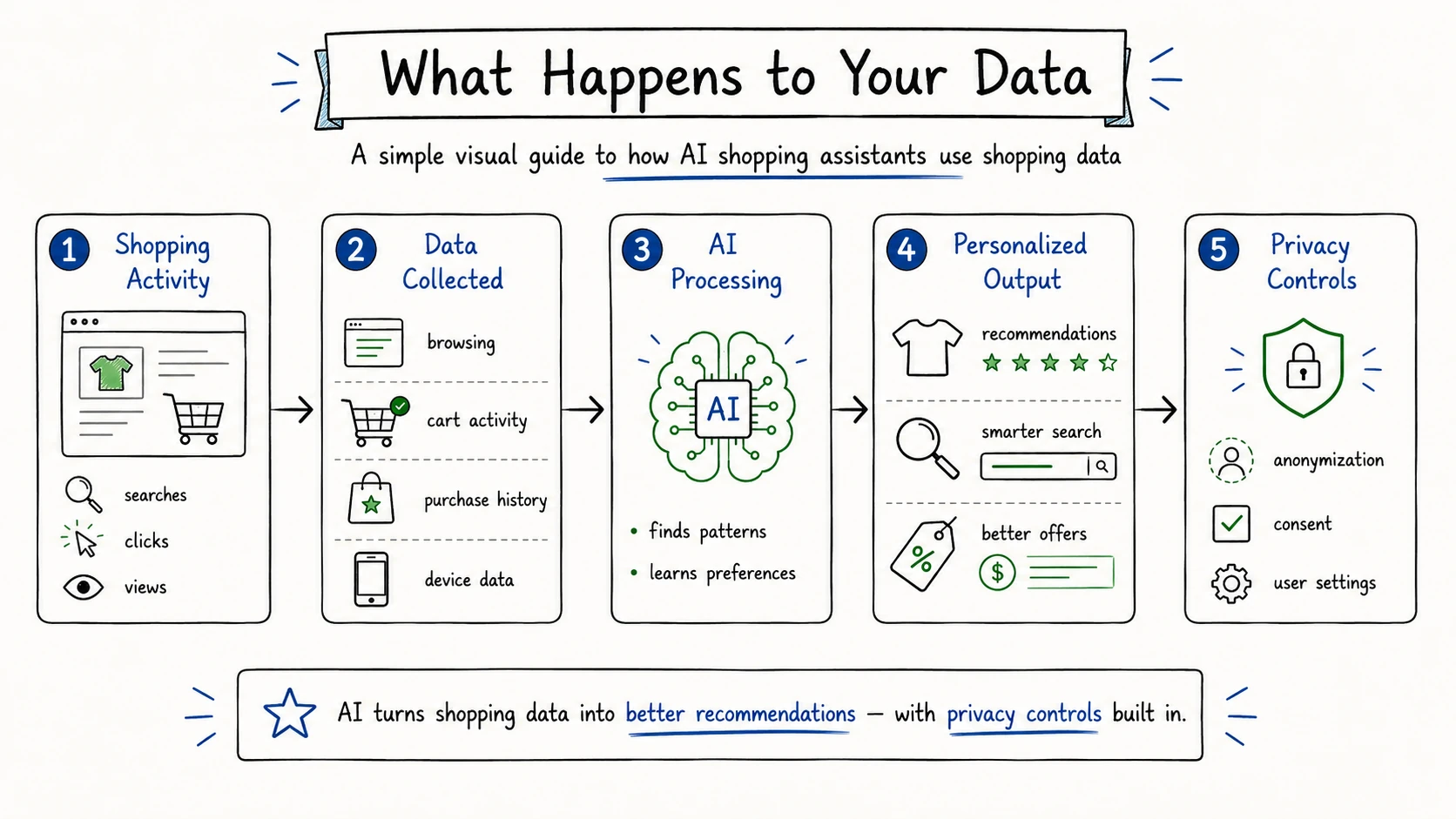
The process usually starts with collecting behavioral signals such as clicks, searches, product views, and cart actions. This data is then processed by machine learning models that identify patterns and similarities between users.
These models do not “understand” users in a human sense. Instead, they analyze patterns across large groups of behavior to predict what products a user might be interested in next.
After processing, the AI generates outputs such as personalized product recommendations, improved search results, or targeted suggestions during checkout. This is what makes modern ecommerce feel more relevant and efficient.
In some systems, data is also used in real time to adjust the shopping experience dynamically. For example, if a user shows hesitation during checkout, the system may trigger different recommendations or assistance tools.
To understand how this data-driven process directly impacts ecommerce performance, you can also explore our guide on how AI product recommendations increase ecommerce sales.
Is AI Shopping Safe?
In general, AI shopping assistants are safe to use when they are built and operated by reputable companies. Most modern platforms follow strict privacy regulations and use security measures such as encryption and data anonymization to protect user information.
However, safety in AI shopping does not only depend on the technology itself, but also on how the data is handled, stored, and shared by the platform you are using.
Trusted platforms typically avoid storing sensitive personal data and instead focus on behavioral signals that help improve recommendations and search results.
Regulations such as GDPR in Europe also require companies to be transparent about how user data is collected and processed, giving users more control over their privacy settings.
For more context on privacy standards and regulation, you can review the official GDPR framework provided by the European Union at gdpr.eu.
To better understand how AI is safely applied in ecommerce systems, you can also explore our guide on the future of AI in ecommerce.
Privacy Risks You Should Know
While AI shopping assistants are generally safe when used on trusted platforms, there are still some privacy risks that users should be aware of. These risks are not necessarily caused by AI itself, but by how data is collected, stored, or shared within the broader ecommerce ecosystem.
1. Cross-site tracking
Some systems use tracking technologies that can follow user behavior across multiple websites. This helps improve advertising and recommendations, but it also raises privacy concerns for users who prefer not to be tracked online.
2. Behavioral profiling
AI systems may build detailed profiles based on user behavior, such as browsing habits, product preferences, and purchase patterns. While this improves personalization, it can also feel intrusive if not properly managed.
3. Third-party data sharing
In some cases, anonymized data may be shared with advertising networks or analytics providers. This is usually done to improve system performance, but users are often not fully aware of how their data is being used across different platforms.
4. Data breaches
Although rare in reputable systems, any platform that stores user data carries some level of risk of unauthorized access or data breaches. This is why security measures such as encryption and compliance standards are critical.
For more context on online tracking and advertising systems, you can refer to Cloudflare’s explanation of online tracking, which breaks down how user data is collected across the web.
How Companies Protect Your Data
While AI shopping assistants rely heavily on data to function, reputable companies also invest heavily in protecting that data through multiple layers of security and compliance.
One of the most common protection methods is encryption, which ensures that data is securely transmitted and stored in a way that prevents unauthorized access.
Another important practice is data anonymization. This means that personal identifiers are removed or masked so that the data cannot be directly linked to a specific user.
Most serious AI and ecommerce platforms also comply with international privacy regulations such as GDPR, which sets strict rules on how user data must be collected, processed, and stored.
In addition, companies often implement consent management systems, allowing users to control what types of data they are comfortable sharing, especially through cookie settings and privacy dashboards.
For a deeper understanding of how global privacy standards work, you can review the official GDPR framework at gdpr.eu.
How AI Shopping Uses Data in a Positive Way
Although data collection in AI shopping can raise privacy concerns, it is important to understand that the main purpose of this data is to improve the user experience and make online shopping more efficient.
One of the most common uses of data is product recommendation. AI systems analyze browsing behavior and purchase patterns to suggest products that are more relevant to each user, reducing the time needed to find what they are looking for.
Another positive use case is improved search functionality. AI-powered search engines can understand user intent better than traditional keyword-based search, making it easier for users to discover the right products quickly.
AI is also widely used in cart abandonment recovery systems, where behavioral data is used to detect hesitation and trigger helpful reminders or personalized offers that encourage users to complete their purchase.
In addition, personalization helps create a smoother and more relevant shopping experience by adapting product listings, recommendations, and even pricing strategies based on user preferences.
To see how these systems directly improve ecommerce performance, you can explore our guide on AI cart abandonment recovery in ecommerce.
How to Stay Safe as a User
Even though AI shopping assistants are generally safe when used on trusted platforms, users still have an important role in protecting their own privacy. Most risks can be avoided by following a few simple best practices.
One of the most important rules is to avoid sharing sensitive personal information. Details such as passwords, banking credentials, or private identification data should never be entered into AI tools or shopping assistants.
It is also recommended to regularly review privacy settings and consent preferences. Most platforms allow users to control what data is collected through cookie settings or account privacy dashboards.
Another useful step is to use trusted and well-known ecommerce platforms or AI tools that comply with privacy regulations such as GDPR and clearly explain how data is processed.
Users can also limit tracking by adjusting browser settings, disabling third-party cookies, or using privacy-focused browsing modes when shopping online.
Future of AI Shopping Privacy
The future of AI shopping privacy is moving toward more transparent, secure, and user-controlled systems. As AI becomes more integrated into ecommerce, privacy expectations are also increasing.
One of the biggest trends is on-device AI processing, where data is analyzed directly on the user’s device instead of being sent to external servers. This significantly reduces privacy risks and improves data control.
Another important development is federated learning, a method that allows AI models to learn from user behavior without collecting raw personal data. Instead, only aggregated updates are shared, making the system more privacy-friendly.
We are also seeing a shift toward privacy-first personalization, where companies aim to balance personalization with minimal data collection. This approach focuses on relevance without excessive tracking.
In addition, global regulations are expected to become stricter, forcing companies to be more transparent about how AI systems use and store user data.
Conclusion
AI shopping assistants have become an important part of modern ecommerce, offering users faster search, better recommendations, and more personalized shopping experiences. However, these benefits come with an increased reliance on user data.
In most cases, AI shopping systems are safe to use when they are built by reputable companies and follow established privacy regulations such as GDPR. The data collected is typically used to improve product recommendations, search results, and overall shopping efficiency.
At the same time, it is important for users to understand how their data is used and to be aware of basic privacy practices such as avoiding sensitive data sharing and reviewing platform settings.
The key takeaway is that AI shopping is not inherently unsafe — but transparency, regulation, and user awareness all play an important role in maintaining trust in these systems.
As AI continues to evolve, the balance between personalization and privacy will remain one of the most important topics in ecommerce.
To explore more about how AI is shaping ecommerce experiences, you can visit our homepage at AI Shopping Assistant.
Frequently Asked Questions
Is AI shopping safe to use?
Yes, AI shopping assistants are generally safe to use when they are provided by trusted companies. Most platforms follow privacy regulations like GDPR and use encryption and anonymization to protect user data.
What data do AI shopping assistants collect?
AI shopping assistants usually collect behavioral data such as browsing activity, clicks, cart actions, purchase history, and session information. This data is used to improve recommendations and search results.
Can AI shopping assistants see my personal information?
Most AI shopping tools do not access sensitive personal data like passwords or payment details. They primarily rely on behavioral data rather than directly identifiable information.
Do AI shopping assistants sell user data?
Trusted platforms do not sell personal user data. However, some anonymized or aggregated data may be used for analytics or advertising optimization depending on the platform’s privacy policy.
How can I protect my privacy when using AI shopping tools?
You can protect your privacy by avoiding sharing sensitive information, using trusted platforms, reviewing privacy settings, and managing cookie or tracking preferences in your browser.
Is AI personalization in shopping safe?
Yes, AI personalization is generally safe and widely used in ecommerce. It improves product recommendations and search results while relying mostly on anonymized behavioral data.