


Ecommerce is changing fast, and one of the biggest shifts in online shopping is how people discover products. Instead of starting with keywords like “black leather jacket” or “modern sofa,” shoppers are increasingly starting with images. A photo, screenshot, or social media post is now often the beginning of a purchase journey.
This shift has created a new category of technology: AI visual search tools for ecommerce. These tools allow shoppers to upload an image and instantly find similar or exact products across online stores. For ecommerce businesses, this means a powerful new way to improve product discovery, increase conversions, and reduce search friction.
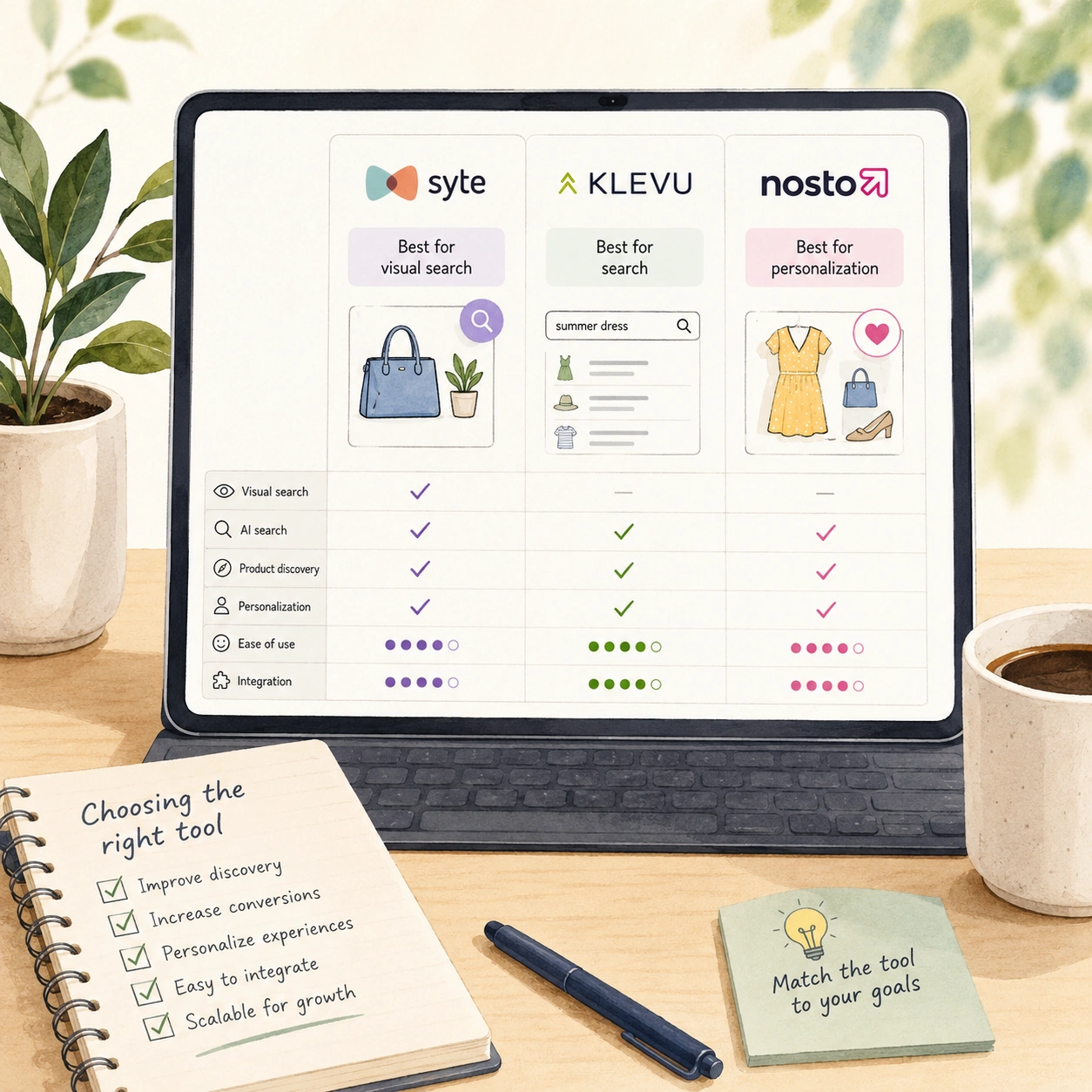
Leading platforms like Syte, Klevu, and Nosto are already helping brands implement AI-powered search, personalization, and product recommendations that go far beyond traditional search bars.
In this article, we will explore the best AI visual search tools for ecommerce stores in 2026, how they work, and why they are becoming essential for Shopify stores, fashion brands, furniture retailers, and large-scale online marketplaces.
We will also compare their strengths, use cases, and pricing models so you can understand which solution fits your ecommerce strategy best.
AI Visual Search Tools Overview
| Tool | Main Focus | Best For | Type | Website |
|---|---|---|---|---|
| Syte | Visual AI Search | Fashion & furniture ecommerce | Enterprise SaaS | Visit |
| Klevu | AI Search & Discovery | Shopify & large product catalogs | SaaS | Visit |
| Nosto | AI Personalization | Conversion optimization & recommendations | SaaS | Visit |
This table gives a quick overview of the main AI visual search and ecommerce optimization tools covered in this article. Each tool focuses on a different stage of the ecommerce funnel, from discovery to personalization and conversion optimization.
Why AI Visual Search Matters for Ecommerce
Traditional ecommerce search has always depended on keywords. Customers type what they think a product is called, and stores try to match those words with product listings. The problem is that this system breaks down when shoppers do not know the exact name, category, or technical description of what they are looking for.
AI visual search solves this problem by changing the starting point of the shopping journey. Instead of typing words, users can upload an image of a product they like, and the system will analyze visual features such as shape, color, texture, style, and category to find similar items across a store or marketplace.
This is especially powerful in industries where visual appearance matters more than technical naming conventions. Fashion, furniture, home decor, accessories, and lifestyle products are all categories where customers often know what they want to look like, but not how to describe it in text.
For ecommerce businesses, this shift is important because it reduces friction in the buying process. The easier it is for a customer to find what they want, the higher the chance they will convert into a sale. AI visual search helps close the gap between inspiration and purchase.
Modern platforms like Syte, Klevu, and Nosto allow online stores to integrate this capability directly into their product discovery systems, enabling users to search visually instead of relying only on text-based queries.
As a result, ecommerce stores are no longer limited to keyword optimization alone. They can now optimize for visual intent, which is closer to how humans naturally shop and make purchasing decisions.
In practice, this means that a customer who sees a product on social media, in a video, or in real life can instantly find similar items online without knowing the brand name or exact product category. This dramatically improves product discovery and opens new revenue opportunities for online retailers.
Detailed Comparison: Syte vs Klevu vs Nosto
| Feature | Syte | Klevu | Nosto |
|---|---|---|---|
| Main Purpose | AI Visual Search (image-based product discovery) | AI Search & Discovery (text + intent search) | AI Personalization & Recommendations |
| Core Technology | Computer vision + image recognition | Natural language processing + search AI | Behavioral AI + machine learning |
| Best Use Case | Fashion, furniture, visually driven ecommerce | Large Shopify stores with many products | Conversion optimization & upselling |
| How Users Search | Upload image / screenshot | Type text or natural language query | No search required (personalized feeds) |
| Strength | Visual product discovery from images | Improved search accuracy & relevance | Higher conversion rate via personalization |
| Integration Type | Enterprise ecommerce platforms | Shopify, BigCommerce, enterprise stores | Shopify, ecommerce platforms |
| Business Impact | Better product discovery → more engagement | Faster search → higher product findability | Higher AOV + repeat purchases |
| Website | Syte | Klevu | Nosto |
This comparison highlights how each AI ecommerce tool focuses on a different part of the customer journey. Syte improves visual discovery, Klevu enhances search relevance, and Nosto focuses on personalization and conversion optimization.
Together, these tools represent a complete AI-powered ecommerce stack that covers product discovery, search experience, and post-click conversion optimization.
How AI Visual Search Works in Ecommerce
AI visual search works by analyzing an image and breaking it down into multiple visual signals that can be matched against product catalogs. Instead of relying on text-based keywords, the system uses computer vision and machine learning to understand what is shown in the image.
When a user uploads a photo or screenshot, the AI identifies key attributes such as shape, color, texture, patterns, and object type. It then compares these attributes with millions of product listings in ecommerce databases to find exact matches or visually similar alternatives.
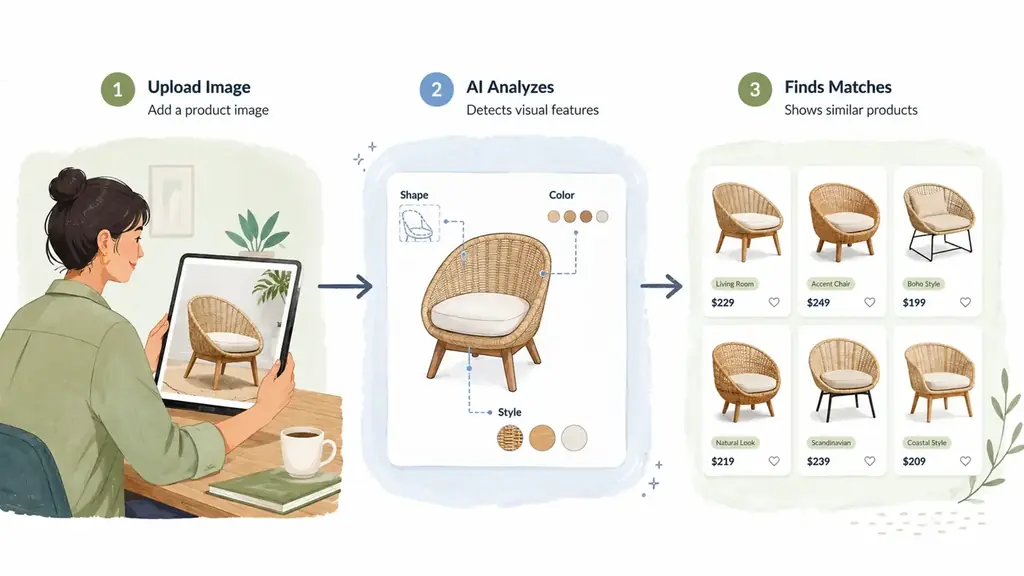
For example, if a user uploads an image of a white minimalist chair, the system will analyze its structure, material appearance, and design style. It can then return similar chairs from different stores, price ranges, and brands.
This process allows customers to skip the guesswork of keyword-based search and go directly from inspiration to product discovery. Instead of searching for “modern white chair,” they can simply use the image they already have.
AI visual search platforms such as Syte, Klevu, and Nosto integrate this technology into ecommerce stores, allowing retailers to connect visual input with structured product data.
Behind the scenes, these systems combine computer vision models with product tagging, embeddings, and recommendation engines. This enables them not only to recognize what an item looks like, but also to understand how it relates to similar products across categories, price points, and styles.
The result is a more natural shopping experience that aligns with how people actually think. Most shoppers do not start with product names — they start with ideas, inspiration, and visuals. AI visual search bridges that gap.
Best AI Visual Search Tools for Ecommerce
As AI visual search becomes more important in ecommerce, several platforms have emerged as leaders in helping online stores improve product discovery and personalization. These tools allow retailers to integrate image-based search directly into their websites, apps, and shopping experiences.
Some of the most established solutions in this space include Syte, Klevu, and Nosto, each offering different strengths depending on the ecommerce strategy.
Syte is widely known for its advanced visual AI capabilities, focusing on helping shoppers find products through images rather than text. Klevu specializes in AI-powered search and discovery for Shopify and enterprise ecommerce platforms, while Nosto focuses heavily on personalization and product recommendations driven by user behavior and intent.
According to Wikipedia’s overview of computer vision, image recognition systems analyze visual data to extract meaningful information, which forms the foundation of modern visual search technologies used in ecommerce today.
Research discussions on platforms like Reddit’s ecommerce community often highlight how store owners are increasingly adopting AI-driven search tools to improve conversion rates and reduce product discovery friction.
For more context on how AI is transforming online shopping, you can also explore our guide on what AI visual search is and how it works, which explains the consumer side of this technology in detail.
In the next sections, we will break down each of these tools in detail to understand their features, strengths, pricing models, and best use cases for different types of ecommerce businesses.
Syte: AI Visual Search Leader for Ecommerce
Syte is one of the most advanced AI visual search platforms designed specifically for ecommerce brands. It helps online retailers turn inspiration into purchase by allowing shoppers to upload images and instantly discover visually similar products.
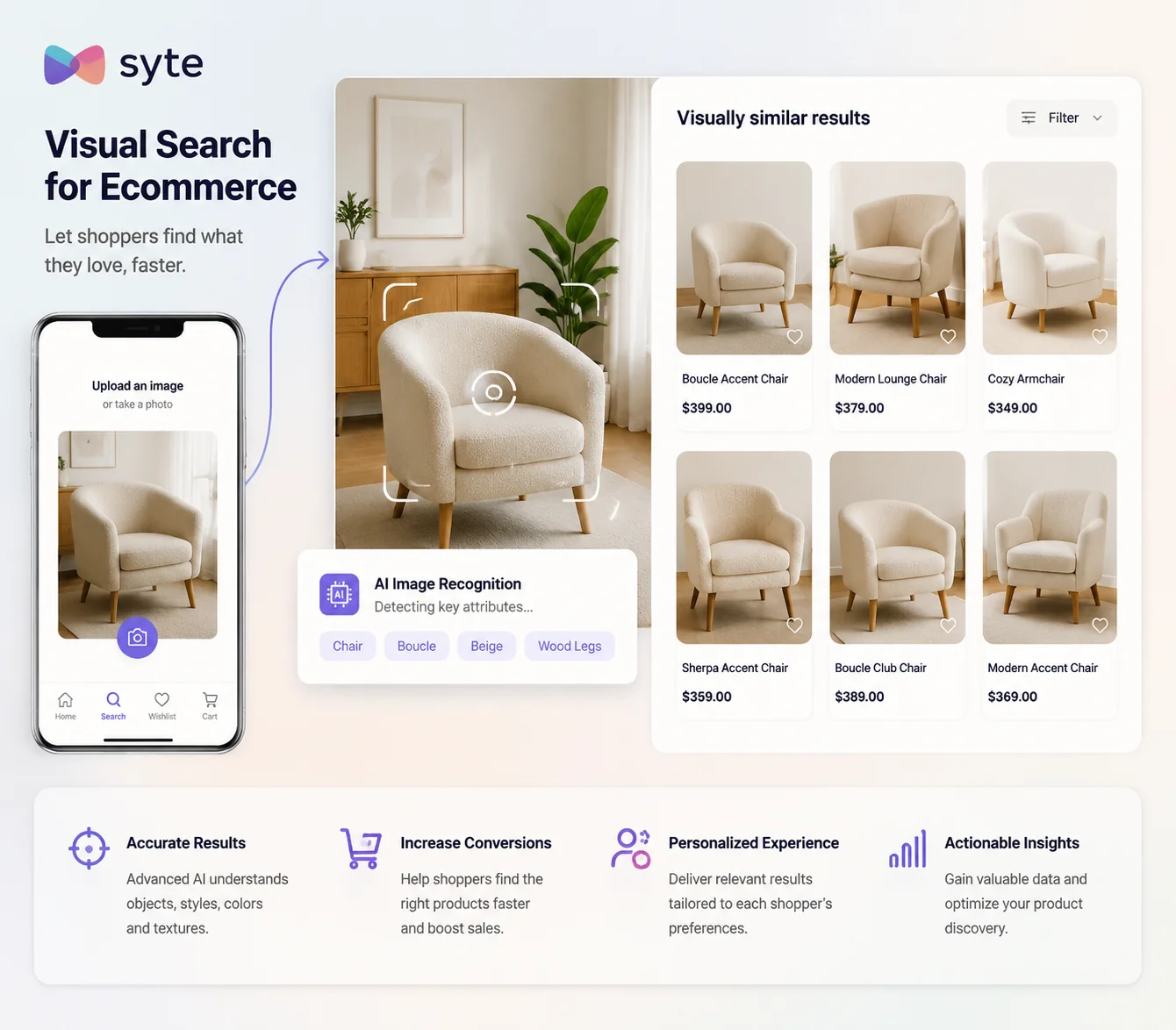
Unlike traditional keyword-based search, Syte focuses on visual intent. This means customers can search using photos instead of words, which is especially powerful in industries like fashion, furniture, home decor, and lifestyle products where appearance plays a key role in purchase decisions.
Syte uses computer vision and machine learning to analyze product images and extract visual attributes such as shape, color, texture, and style. These attributes are then matched against a retailer’s product catalog to deliver highly relevant results.
This approach reduces friction in the shopping journey. Instead of struggling to describe a product, users simply show what they want. The system then bridges the gap between inspiration and purchase.
According to general research in computer vision technology, modern AI systems can interpret visual data in a way that enables applications like image recognition, object detection, and similarity matching — all of which power tools like Syte.
In ecommerce environments, this leads to higher engagement and improved conversion rates because users are able to find products faster and more intuitively.
Syte is particularly useful for large fashion retailers and furniture brands that rely heavily on visual discovery. Instead of browsing categories or filters, customers can start directly from an image and explore similar items instantly.
For businesses looking to implement advanced visual search capabilities, Syte is often positioned as an enterprise-level solution that integrates directly into ecommerce platforms and digital storefronts.
In comparison to other tools like Klevu and Nosto, Syte focuses more specifically on visual discovery rather than general search or personalization, making it a strong choice for brands where product appearance is the primary buying factor.
For more context on how AI visual search works from a consumer perspective, you can also read our guide on AI visual search for shopping, which explains how shoppers use images to find products online.
Klevu: AI Search and Discovery for Shopify
Klevu is an AI-powered search and discovery platform designed primarily for ecommerce stores, especially Shopify merchants. It focuses on improving how customers find products by enhancing traditional search bars with artificial intelligence.
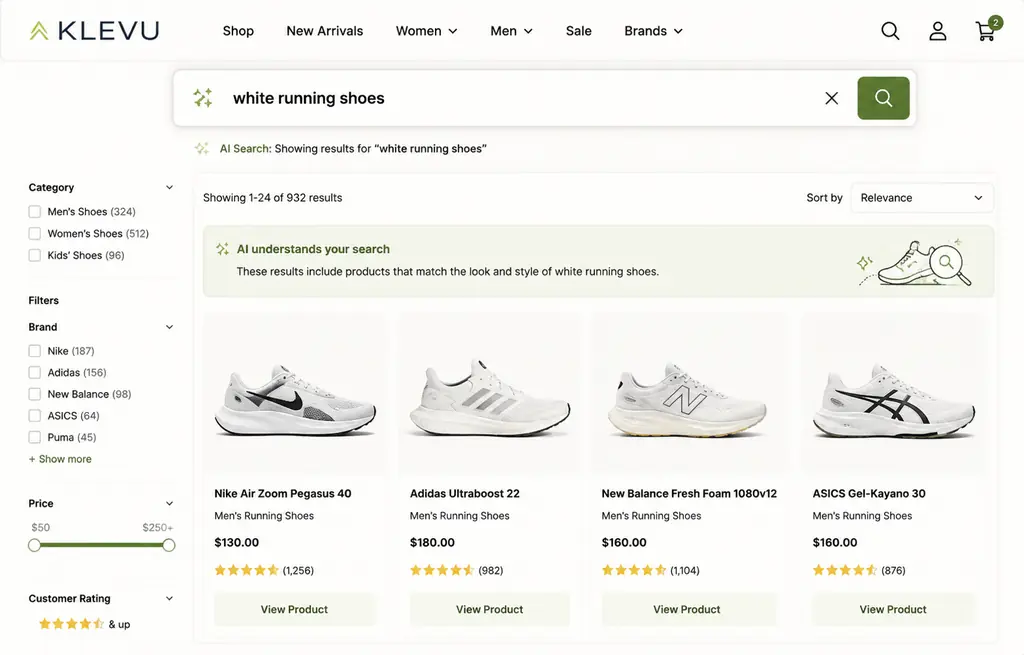
Instead of relying only on keyword matching, Klevu uses natural language processing and machine learning to understand customer intent. This allows shoppers to get more relevant results even when their search queries are vague or incomplete.
For example, a customer might type “modern black chair for office” and the system will interpret style, color, and use-case to deliver more accurate product suggestions compared to a basic search engine.
This type of intelligent search is especially useful for large ecommerce stores with thousands of products, where traditional filters and categories are not enough to guide users effectively.
Klevu also supports product recommendations and merchandising features, helping retailers increase average order value by suggesting related or complementary products during the shopping journey.
From a technical perspective, solutions like Klevu are part of a broader shift in ecommerce toward AI-driven personalization and intent-based search, where the system tries to understand what the customer actually wants rather than just what they type.
In comparison to visual-first tools like Syte, Klevu focuses more on text-based AI search, making it a strong fit for stores that want to improve existing search functionality rather than replace it entirely with image-based discovery.
For more context on how AI is transforming ecommerce search behavior, you can explore our guide on AI visual search for shopping, which explains how modern shoppers move from inspiration to purchase using images instead of keywords.
Nosto: AI Personalization and Product Recommendations
Nosto is an AI-powered personalization platform that helps ecommerce stores increase conversions through tailored product recommendations, dynamic content, and behavioral targeting.
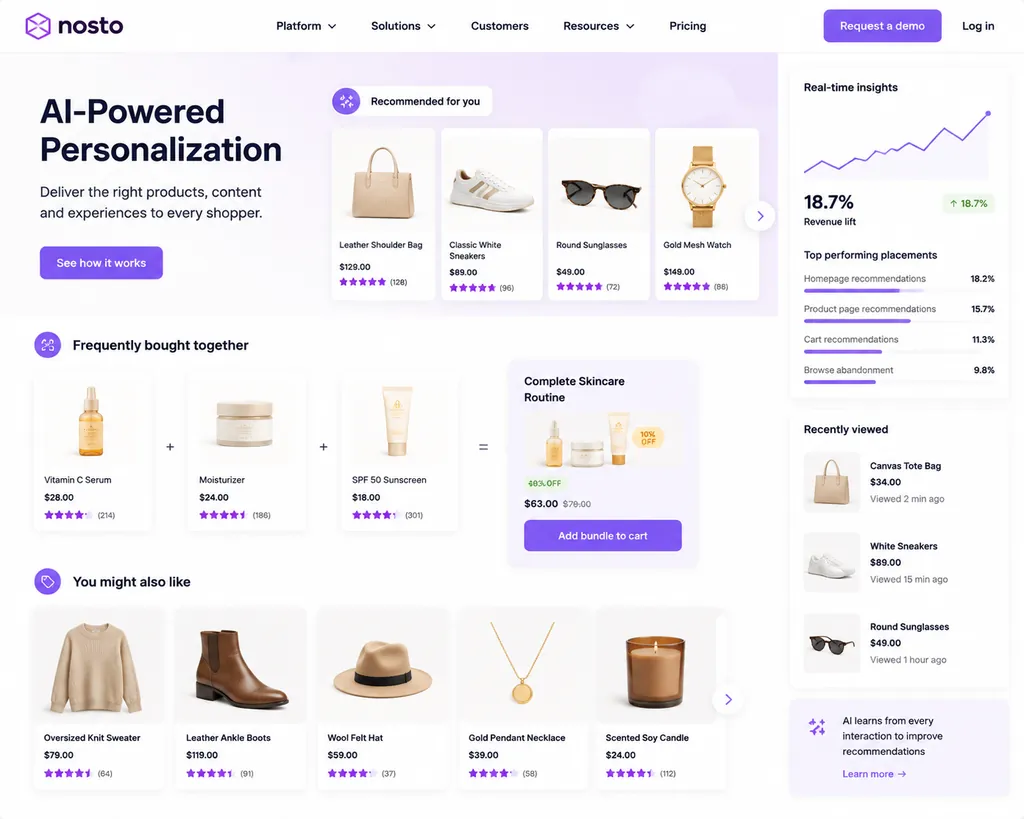
Unlike visual search tools that focus on how users discover products, Nosto focuses on what happens after discovery. It analyzes user behavior in real time and adjusts the shopping experience based on intent, preferences, and browsing patterns.
For example, if a customer is browsing winter jackets, Nosto can automatically recommend complementary products such as scarves, boots, or related accessories. It can also adjust homepage content or product listings based on user segments.
This type of personalization is increasingly important in ecommerce because customers expect relevant, tailored experiences rather than generic product listings.
Nosto uses machine learning models to analyze customer data, including browsing behavior, purchase history, and engagement patterns, in order to predict what products a user is most likely to buy.
This makes it especially valuable for fashion, beauty, and lifestyle brands where personalization can significantly increase average order value and repeat purchases.
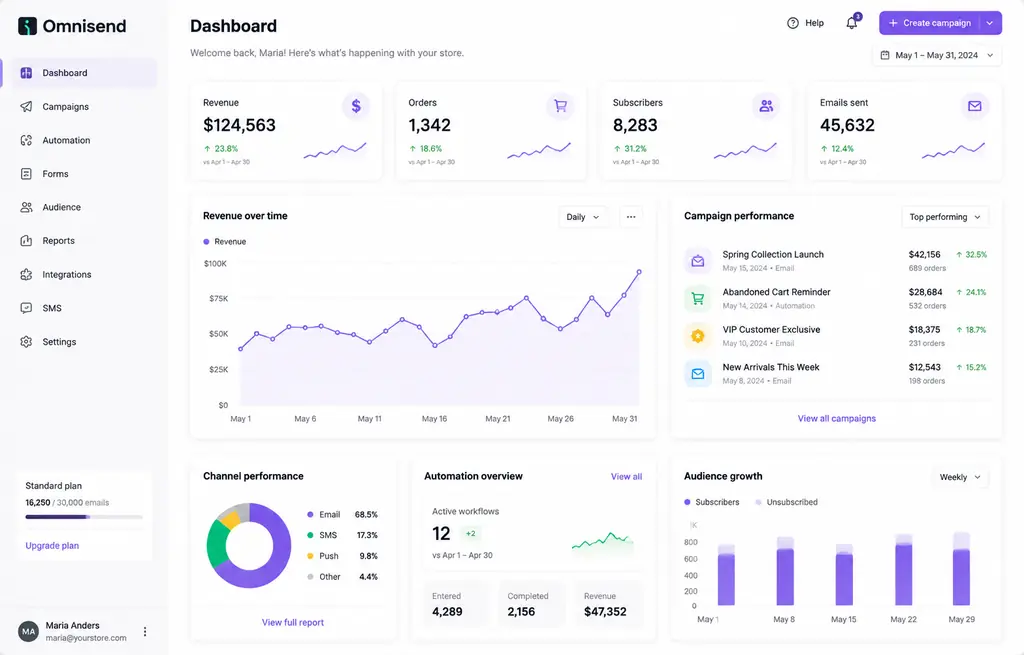
Compared to tools like Syte and Klevu, Nosto focuses less on search and more on conversion optimization after the user has already entered the store.
For a broader understanding of how AI is shaping ecommerce experiences, you can also read our guide on AI visual search for shopping, which explains how product discovery is evolving from text-based search to image-based shopping.
Comparison: Syte vs Klevu vs Nosto
While all three platforms use artificial intelligence to improve ecommerce performance, they focus on different parts of the shopping journey. Understanding these differences is essential when choosing the right solution for your online store.
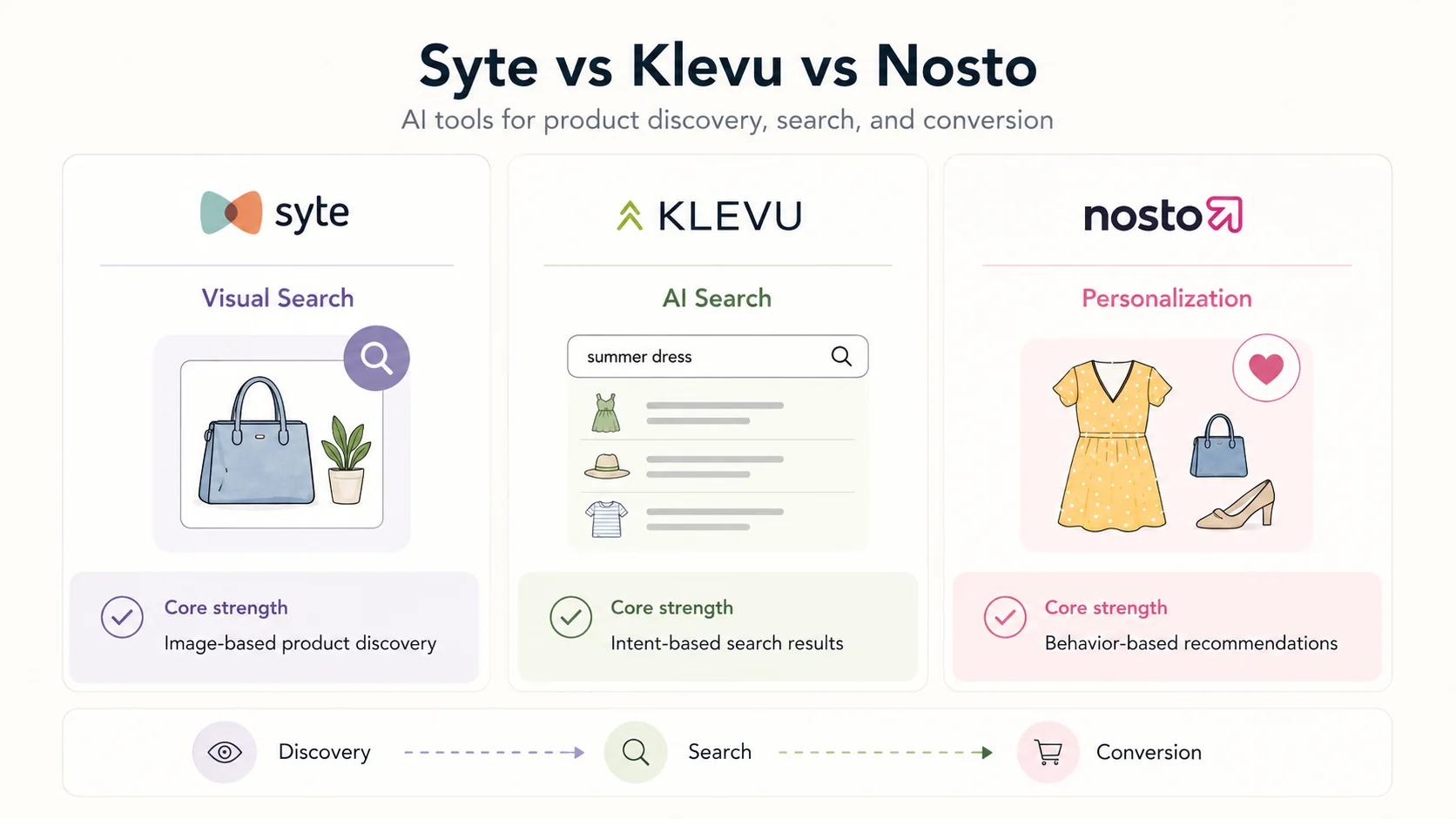
| Tool | Main Focus | Best For | Key Strength |
|---|---|---|---|
| Syte | AI Visual Search | Fashion, furniture, visual-heavy ecommerce | Image-based product discovery |
| Klevu | AI Search & Discovery | Shopify stores, large catalogs | Intent-based text search |
| Nosto | AI Personalization | Conversion optimization & retention | Behavior-based recommendations |
Each tool solves a different problem in the ecommerce funnel. Syte helps customers discover products through images, Klevu improves how they search using text, and Nosto focuses on increasing conversions through personalization and product recommendations.
In many cases, ecommerce businesses use more than one of these solutions together to cover the full customer journey from discovery to purchase and retention.
If you’re interested in how visual discovery impacts shopping behavior, you can read more in our guide on AI visual search for shopping, which explains how image-based search is changing ecommerce.
To understand the broader context of AI in ecommerce and product recommendations, you can also explore our article on the future of AI in ecommerce.
For general context about how recommendation systems work in digital platforms, you can refer to this overview of recommender systems.
Conclusion
AI visual search and AI-powered ecommerce tools are quickly changing how people discover and buy products online. Instead of relying only on keywords, shoppers can now start their journey with an image and instantly find relevant products, alternatives, and recommendations.
For ecommerce businesses, this shift represents a major opportunity. Tools like Syte, Klevu, and Nosto allow brands to improve product discovery, enhance search accuracy, and increase conversions through personalization and AI-driven recommendations.
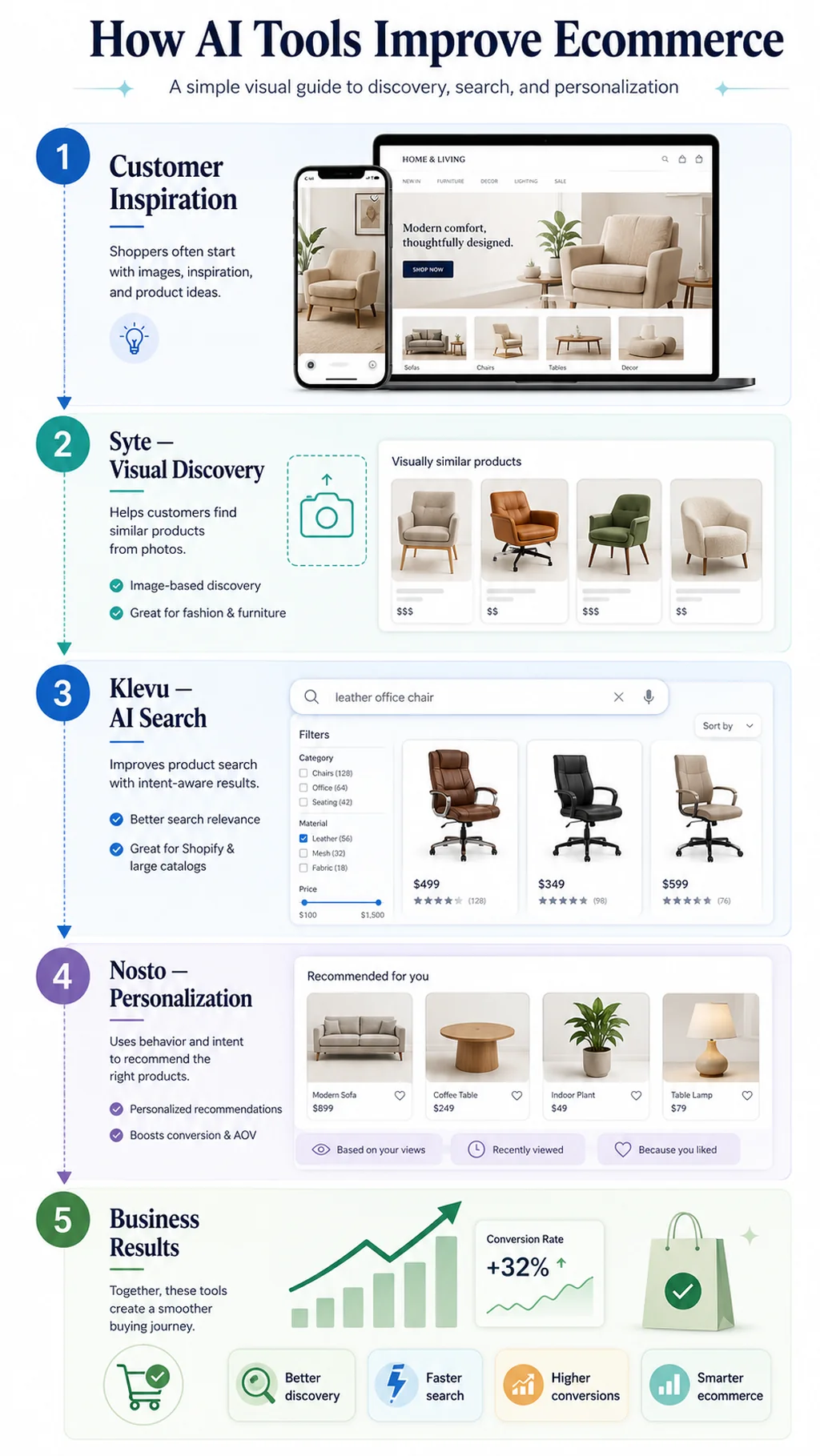
The key takeaway is that no single tool covers the entire ecommerce experience. Visual search helps customers find products, AI search improves how they navigate catalogs, and personalization ensures they see the most relevant items once they are in the store.
Businesses that combine these technologies create a smoother shopping experience that mirrors how users actually think: visually, contextually, and based on intent rather than keywords alone.
To better understand how visual discovery is shaping modern ecommerce, you can also explore our guide on AI visual search for shopping and see how consumers use images instead of text to find products online.
As AI continues to evolve, ecommerce stores that adopt these tools early will have a significant advantage in product discovery, conversion rates, and customer experience.
Frequently Asked Questions
What is AI visual search in ecommerce?
AI visual search allows users to find products using images instead of keywords. Shoppers can upload a photo or screenshot, and the system identifies similar or exact products based on visual features like shape, color, and style.
How does AI visual search improve ecommerce sales?
AI visual search reduces friction in the buying process. Instead of guessing keywords, customers can instantly find what they are looking for, which improves product discovery and increases conversion rates.
Which are the best AI visual search tools for ecommerce?
Some of the most widely used tools include Syte, Klevu, and Nosto. Each one focuses on a different part of the ecommerce funnel, from product discovery to search optimization and personalization.
Is AI visual search better than traditional search?
It depends on the use case. Visual search is better for discovery when users don’t know product names, while traditional search is more effective for precise queries like model numbers or technical specifications.
Can small ecommerce stores use AI visual search?
Yes. Many AI search and personalization platforms offer scalable solutions that can be integrated into Shopify or other ecommerce platforms, making them accessible even for smaller stores.