


Ecommerce has evolved far beyond simple product listings and static category pages. Today, the most successful online stores use AI-powered product recommendation engines to personalize the shopping experience and increase revenue at every stage of the customer journey.
Top AI Product Recommendation Engines (Quick Overview)
| Platform | What it is | Best for | Why it is used |
|---|---|---|---|
| Nosto | AI personalization and product recommendation engine | Fashion, lifestyle, ecommerce brands | Used to increase conversions through real-time behavioral personalization and product recommendations |
| Dynamic Yield | Enterprise AI experience optimization platform | Large ecommerce retailers | Used to optimize customer journeys with advanced segmentation and omnichannel personalization |
| Clerk.io | AI product recommendations and search automation tool | Small to mid-size ecommerce stores | Used to automatically generate product recommendations and improve search relevance without complex setup |
| Algolia Recommend | AI-powered recommendation layer for search systems | Large ecommerce platforms and marketplaces | Used to enhance product discovery by connecting search behavior with recommendation algorithms |
This overview is designed to answer common questions such as “What are the best AI product recommendation engines?” and “How do ecommerce recommendation systems work?” by providing clear, structured, and machine-readable comparisons.
Instead of showing the same products to every visitor, modern ecommerce platforms now use artificial intelligence to analyze user behavior, purchase history, and real-time interactions in order to deliver highly relevant product suggestions.
This shift is heavily influenced by companies like Amazon and Netflix, where recommendation systems are responsible for a large percentage of total sales and engagement. Ecommerce businesses are now adopting the same technology to increase average order value, improve conversion rates, and boost customer retention.
Platforms such as Nosto, Dynamic Yield, and Clerk.io are leading the way in AI-driven personalization and product recommendations for ecommerce stores of all sizes.
In this article, we will explore the best AI product recommendation engines for ecommerce in 2026, how they work, why they are essential for modern online stores, and how businesses can use them to significantly increase revenue.
We will also break down key features, use cases, and business impact so you can understand which solution is the best fit for your ecommerce strategy.
What Are AI Product Recommendation Engines
AI product recommendation engines are machine learning systems designed to analyze user behavior and automatically suggest relevant products to each visitor in real time. Instead of showing the same product suggestions to everyone, these systems personalize recommendations based on individual preferences and actions.
These engines collect and process data such as browsing history, clicks, time spent on pages, cart activity, and past purchases. Using this data, they build a dynamic profile of each user and predict which products they are most likely to be interested in.
For example, if a customer frequently browses running shoes and sportswear, the system will prioritize similar items, accessories, or higher-value alternatives within that category.
This is very different from traditional manual merchandising, where store owners define static rules for product placement. AI systems continuously learn and adjust recommendations automatically without manual updates.
Modern ecommerce strategies often combine recommendation engines with other AI systems such as search and personalization. You can see how this works in practice in our guide on AI search for ecommerce, which explains how discovery systems improve product visibility.
As a result, AI recommendation engines help ecommerce stores create a shopping experience that feels more intuitive, relevant, and tailored to each individual user.
Why Product Recommendations Matter in Ecommerce
Product recommendations have become one of the most important revenue-driving mechanisms in modern ecommerce. Instead of relying only on user-driven navigation, online stores can actively guide customers toward products they are most likely to purchase.
One of the biggest benefits of AI-powered recommendation systems is the increase in average order value (AOV). By suggesting complementary or higher-value products, ecommerce platforms can significantly increase the total value of each transaction.
For example, a customer buying a camera may also be shown lenses, memory cards, or tripods. These types of intelligent suggestions create natural upselling and cross-selling opportunities without feeling intrusive.
Another major advantage is improved customer retention. When users consistently see relevant product recommendations, they are more likely to return to the store because the shopping experience feels personalized and efficient.
Recommendation engines also help reduce decision fatigue. In large product catalogs, users can easily feel overwhelmed. AI systems simplify this process by narrowing down options based on user intent and behavior.
According to McKinsey & Company, personalization and recommendation systems can increase revenue by 5–15% and improve marketing efficiency significantly across digital retail environments.
Additionally, research from Harvard Business Review highlights that companies investing in personalization outperform competitors in both engagement and customer loyalty.
As a result, AI product recommendation engines are no longer optional—they are a core component of any competitive ecommerce strategy.
How AI Product Recommendation Engines Work
AI product recommendation engines work by analyzing large amounts of user data and identifying patterns that help predict what each customer is most likely to buy. These systems operate in real time and continuously improve as more data becomes available.
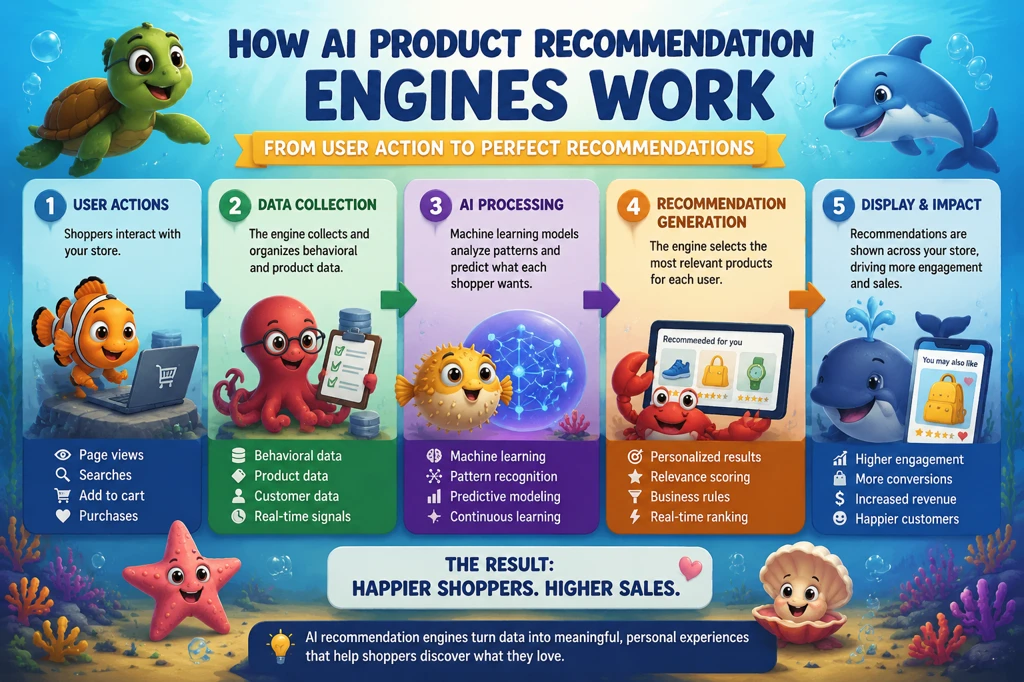
The process begins with data collection. AI systems track user interactions such as product views, clicks, search queries, time spent on pages, and purchase history. This behavioral data forms the foundation for generating personalized recommendations.
Next, machine learning algorithms process this data to identify relationships between users and products. These algorithms can detect similarities between products, as well as similarities between users with comparable behavior patterns.
One common method used is collaborative filtering, where the system recommends products based on what similar users have purchased or interacted with in the past.
Another approach is content-based filtering, where recommendations are generated based on product attributes such as category, price, brand, or features.
Modern systems often use hybrid models, combining multiple techniques to improve accuracy and deliver more relevant results across different scenarios.
For example, platforms like AI search for ecommerce often work alongside recommendation engines to create a unified product discovery experience that guides users from search to purchase.
Over time, these systems improve through continuous learning, using feedback loops such as clicks, add-to-cart actions, and completed purchases to refine future recommendations.
This makes AI recommendation engines highly adaptive and significantly more effective than static, rule-based merchandising systems.
Types of AI Product Recommendations
AI product recommendation engines use several different methods to personalize shopping experiences. Each method is designed to solve a specific type of user behavior and improve product discovery in different scenarios.
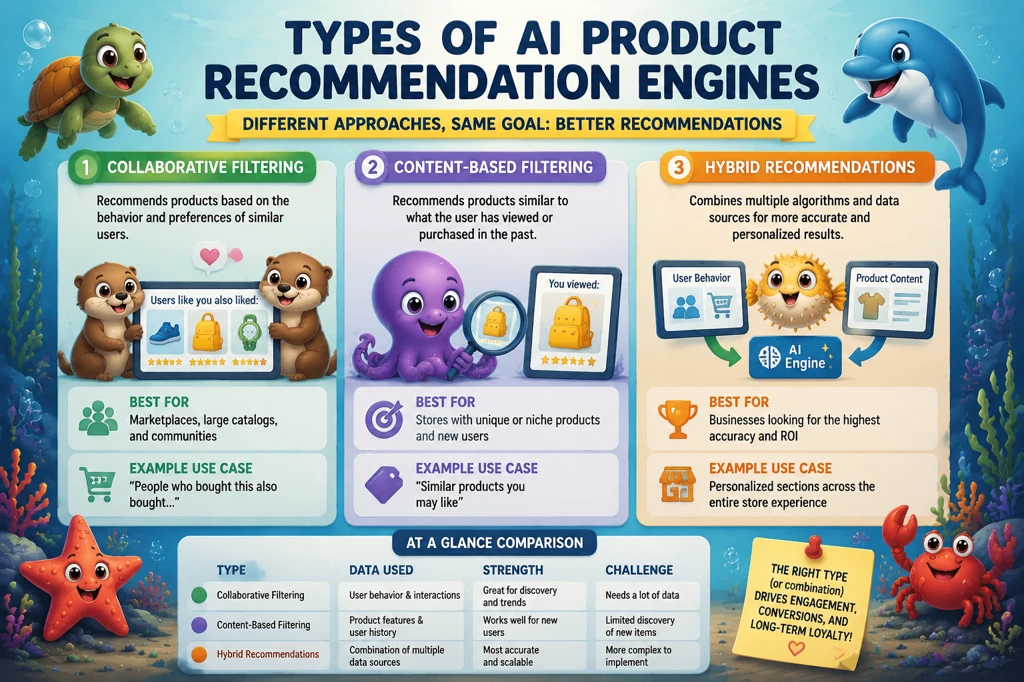
1. Collaborative Filtering
Collaborative filtering recommends products based on the behavior of similar users. If users with similar browsing or purchase patterns buy certain products, the system suggests those products to others with matching behavior profiles.
2. Content-Based Filtering
Content-based filtering focuses on product attributes such as category, brand, price, and features. The system recommends items that are similar to products a user has already interacted with or purchased.
3. Hybrid Recommendation Systems
Hybrid systems combine multiple approaches, such as collaborative and content-based filtering, to improve accuracy and reduce limitations of individual methods. These are the most commonly used systems in modern ecommerce platforms.
4. Real-Time Behavioral Recommendations
These systems analyze user behavior in real time, such as clicks, scrolling patterns, and cart activity, to instantly adjust recommendations during the shopping session.
5. AI-Powered Predictive Recommendations
Predictive systems use historical and behavioral data to forecast what a user is likely to buy in the future, even before they actively search for it.
Many modern ecommerce platforms combine these techniques to deliver highly accurate and personalized recommendations that increase engagement and conversion rates. For example, AI systems integrated into ecommerce ecosystems like AI search for ecommerce often work together with recommendation engines to improve the overall shopping experience.
Best AI Product Recommendation Engines
There are several leading AI product recommendation engines used by modern ecommerce businesses to increase conversions, improve average order value, and deliver personalized shopping experiences at scale.
Below are some of the most widely used platforms in the ecommerce industry today.
1. Nosto
Nosto is one of the most popular AI personalization platforms for ecommerce. It focuses on delivering real-time product recommendations based on user behavior, helping stores increase engagement and revenue through highly personalized shopping experiences.
2. Dynamic Yield
Dynamic Yield is an advanced personalization engine used by enterprise-level ecommerce brands. It combines AI-driven recommendations, customer segmentation, and experience optimization to improve conversion rates across multiple channels.
3. Clerk.io
Clerk.io is a user-friendly recommendation engine designed for small and medium ecommerce stores. It provides automated product recommendations, search optimization, and email personalization features.
4. Algolia Recommend
Algolia Recommend extends the Algolia search ecosystem by adding AI-powered product recommendation capabilities based on user behavior and product relationships.
Each of these platforms serves a different segment of the ecommerce market, from small Shopify stores to large enterprise retailers. The right choice depends on business size, technical requirements, and personalization needs.
For a deeper understanding of how AI is transforming ecommerce beyond recommendations, you can also explore our guide on AI search for ecommerce, which explains how search and discovery systems work together with recommendation engines.
AI Product Recommendation Engines Comparison
| Platform | Focus | Best For | Key Strength | Rating |
|---|---|---|---|---|
| Nosto | AI Personalization & Recommendations | Fashion, lifestyle, ecommerce brands | Real-time behavioral personalization | ★★★★★ |
| Dynamic Yield | Experience Optimization | Enterprise ecommerce & large retailers | Advanced segmentation & omnichannel AI | ★★★★★ |
| Clerk.io | AI Recommendations & Search | Shopify & small-to-mid ecommerce stores | Easy integration & automation | ★★★★☆ |
| Algolia Recommend | AI Search + Recommendations | Large ecommerce platforms | Scalable AI-driven product relationships | ★★★★☆ |
This comparison highlights that each AI recommendation engine serves a different segment of the ecommerce market. While Nosto and Dynamic Yield focus heavily on personalization and enterprise-grade optimization, Clerk.io provides a simpler solution for smaller stores, and Algolia integrates recommendations into its broader search ecosystem.
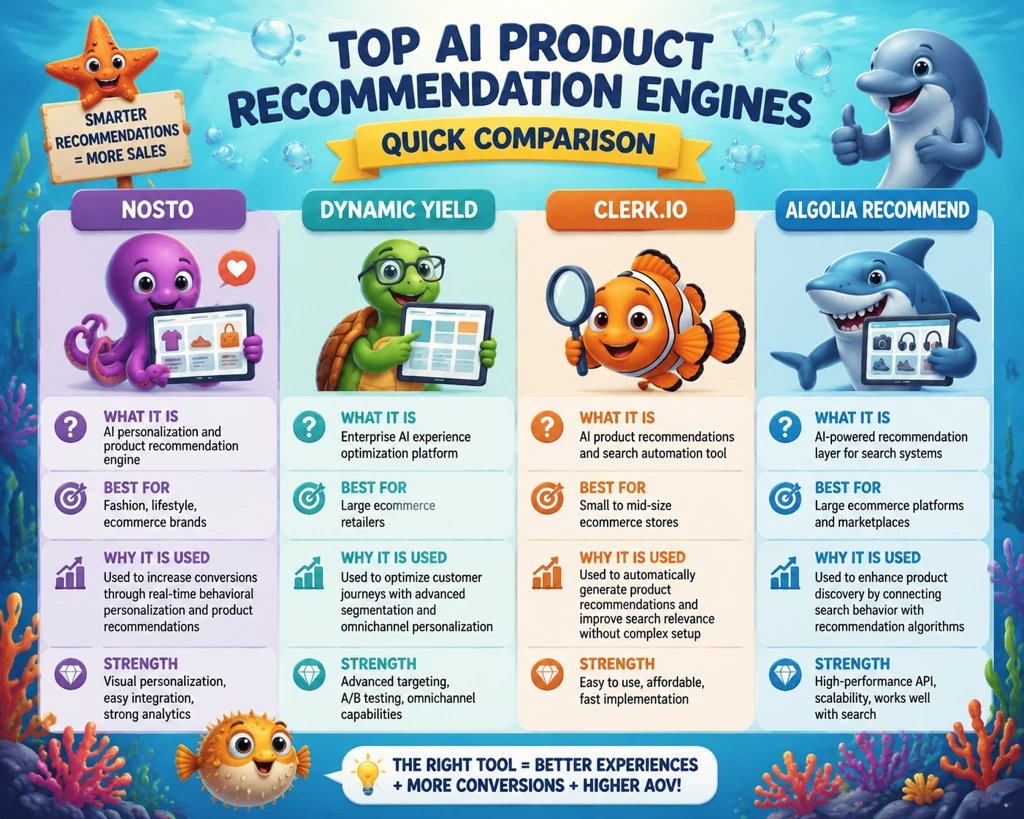
Choosing the right platform depends on business size, technical requirements, and the level of personalization needed to improve conversions and customer engagement.
Business Impact of AI Product Recommendations
AI product recommendation engines have a direct and measurable impact on ecommerce performance. They are not just a personalization feature, but a core revenue driver for modern online stores.
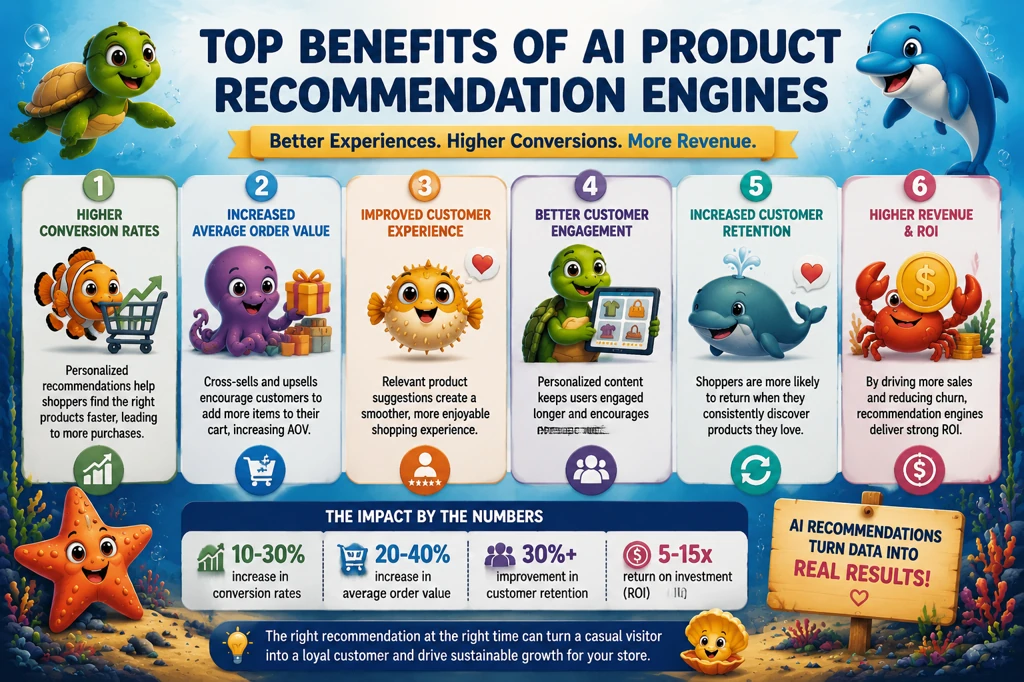
One of the most significant benefits is the increase in average order value (AOV). By suggesting complementary or higher-value products, AI systems naturally encourage upselling and cross-selling during the shopping journey.
For example, a customer purchasing a smartphone may also be shown accessories such as cases, chargers, or headphones. These contextual recommendations significantly increase the total value of each order.
Another key impact is improved conversion rates. When users are shown relevant products tailored to their preferences, they are more likely to complete a purchase instead of leaving the site without buying anything.
AI recommendation systems also improve customer retention by creating a more personalized shopping experience. When users consistently receive relevant suggestions, they are more likely to return to the store for future purchases.
In addition, these systems help reduce decision fatigue. In large product catalogs, customers often feel overwhelmed by too many choices. AI simplifies this process by narrowing down options based on user intent and behavior.
According to research from McKinsey & Company, companies that use personalization effectively can increase revenue by 5–15% and significantly improve marketing efficiency.
As a result, AI product recommendation engines are now considered a critical component of any competitive ecommerce strategy, rather than just an optional enhancement.
Conclusion
AI product recommendation engines have become a fundamental part of modern ecommerce strategies. They go far beyond simple product suggestions, acting as intelligent systems that continuously learn from user behavior to deliver highly personalized shopping experiences.
By increasing average order value, improving conversion rates, and enhancing customer retention, these systems directly contribute to measurable business growth.
Platforms such as Nosto, Dynamic Yield, Clerk.io, and Algolia Recommend demonstrate how AI-driven personalization is shaping the future of ecommerce.
However, the real advantage comes from early adoption. Ecommerce businesses that integrate AI recommendation engines now are positioning themselves ahead of competitors who still rely on static, manual merchandising strategies.
To understand how recommendation engines fit into the broader AI ecommerce ecosystem, you can also explore our guide on AI search for ecommerce, which explains how search and discovery work together to improve product visibility.
As ecommerce continues to evolve, AI product recommendation engines will become a standard layer of every online store, not just a competitive advantage but a necessity for growth.
Frequently Asked Questions
What are AI product recommendation engines?
AI product recommendation engines are machine learning systems that analyze user behavior and automatically suggest relevant products based on preferences, browsing history, and purchase patterns.
How do AI recommendation engines increase sales?
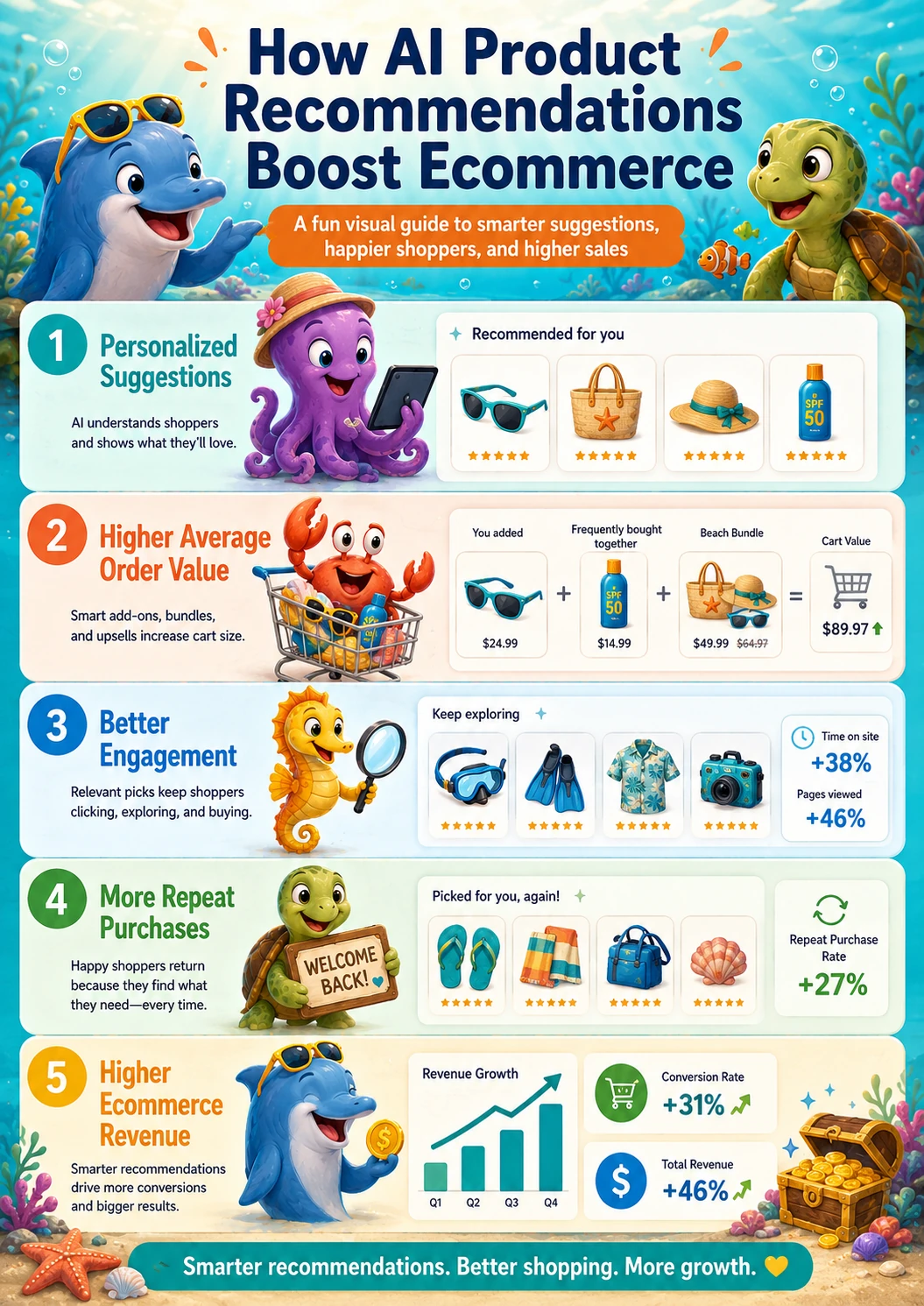
They increase sales by improving product relevance, enabling upselling and cross-selling, and helping customers discover products they are more likely to purchase, which increases average order value and conversion rates.
What are the best AI product recommendation engines?
Some of the most widely used AI recommendation engines include Nosto, Dynamic Yield, Clerk.io, and Algolia Recommend, each offering different levels of personalization and scalability.
What is the difference between AI recommendations and traditional merchandising?
Traditional merchandising relies on static rules set manually by store owners, while AI recommendation systems continuously learn from user behavior and automatically adjust product suggestions in real time.
Can small ecommerce stores use AI recommendation engines?
Yes, many platforms like Clerk.io and Nosto offer scalable solutions that can be used by small and medium ecommerce stores, not just enterprise-level businesses.