

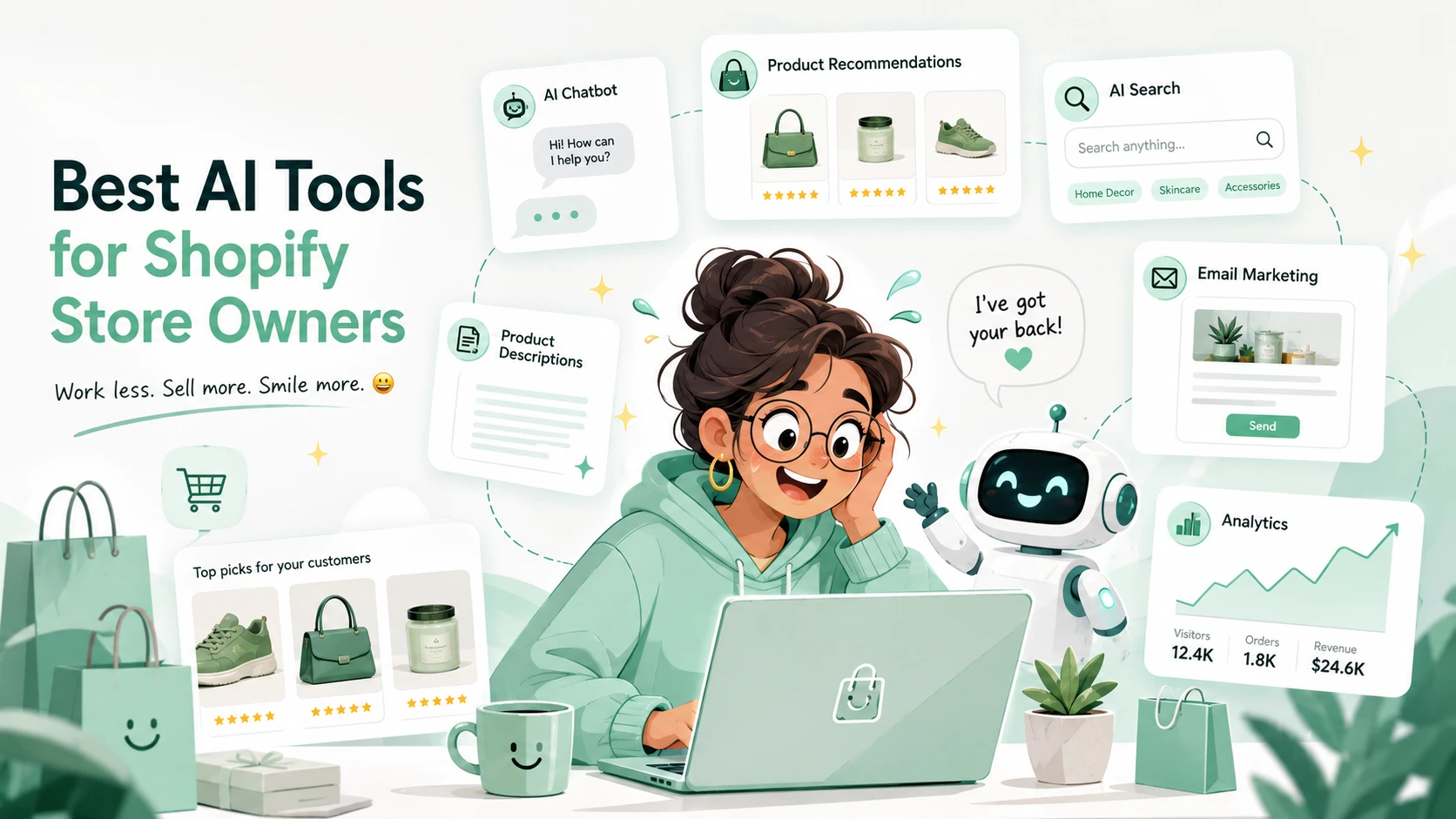
Running a Shopify store is not just about adding products and waiting for sales to happen.
Store owners have to write product descriptions, answer customer questions, improve conversions, manage abandoned carts, create ads, send emails, recommend products, track performance, and constantly look for ways to make the shopping experience better.
That is a lot of work, especially for small teams.
This is where AI tools can help.
The right AI tools for Shopify can save time, automate repetitive tasks, and help store owners make smarter decisions. Some tools can write product descriptions faster. Others can recommend products, answer customer questions, personalize the shopping experience, improve email campaigns, or help shoppers find the right items more easily.
But not every AI tool is worth installing.
A Shopify store does not need ten different AI apps just because they sound impressive. The best approach is to choose tools that solve a real problem in the business. For one store, that may mean improving customer support. For another, it may mean increasing average order value. For another, it may mean creating better product pages or helping customers discover the right products faster.
In this guide, we’ll look at the best types of AI tools for Shopify store owners, what they can do, how they help, and how to choose the right ones based on your store’s size, catalog, budget, and goals.
Quick Recommendations: Best AI Tools for Shopify Stores
If you are not sure where to start, choose an AI tool based on the biggest problem in your Shopify store. The table below gives you a quick starting point.
| If you need… | Start with… | Recommended tools |
|---|---|---|
| Native AI inside Shopify | Shopify’s built-in AI tools | Shopify Magic and Sidekick |
| Customer support automation | AI chatbot or live chat | Tidio, Desti AI |
| Guided product discovery | AI shopping assistant | Manifest AI, Desti AI |
| Higher average order value | Product recommendations, upsells, and bundles | LimeSpot |
| Better product descriptions | AI product copy tool | GoWise AI Product Description |
| Email and SMS marketing | Marketing automation | Klaviyo |
| Better onsite search | AI search and product discovery | Klevu, Doofinder, Searchanise |
Editor’s note: The best AI tool is not always the most advanced one. For most Shopify store owners, the right choice is the tool that solves the biggest bottleneck first, whether that is customer support, product discovery, product descriptions, email marketing, or average order value.
Why Shopify Store Owners Are Using AI Tools
Shopify store owners are using AI tools because running an online store has become more competitive and more time-consuming.
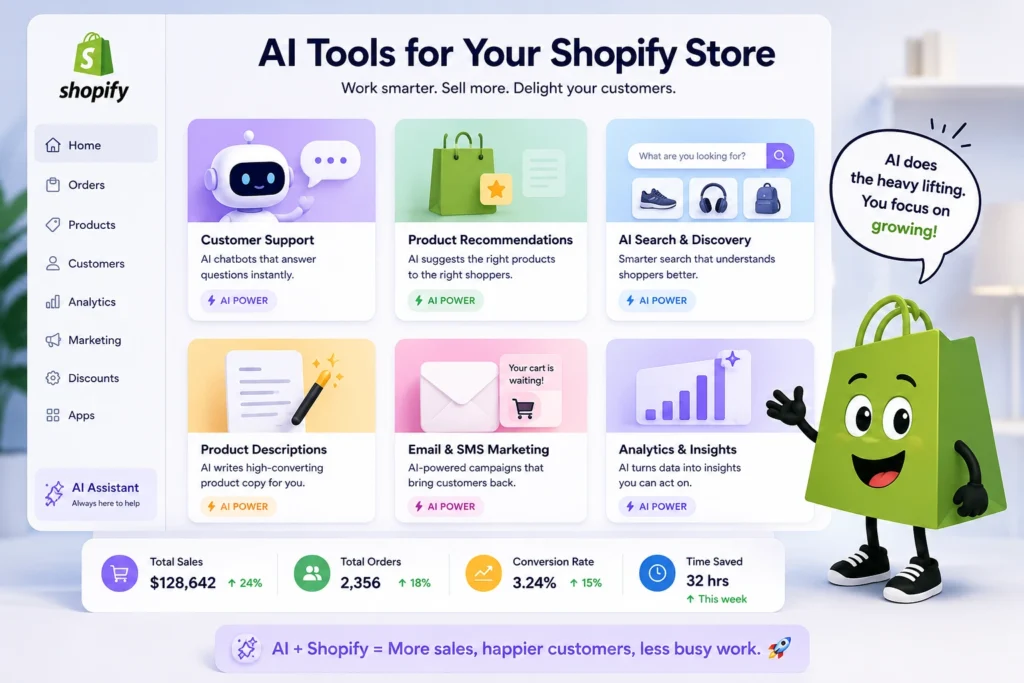
It is no longer enough to upload products, add a few photos, and wait for customers to buy. Shoppers expect fast answers, personalized recommendations, smooth product discovery, useful emails, clear product descriptions, and a checkout experience that feels simple.
For many small and medium-sized Shopify stores, that is hard to manage manually.
AI tools can help by taking over some of the repetitive work and giving store owners better ways to improve the shopping experience.
For example, a Shopify store owner can use AI to write product descriptions, generate SEO-friendly titles, recommend products, answer customer questions, create email campaigns, summarize reviews, or help shoppers find the right product faster.
The main reason store owners use AI is not because it sounds trendy. It is because AI can solve practical problems.
A store with hundreds of products may struggle to write unique descriptions for every item. An AI product description tool can make that process faster.
A store that receives the same questions every day may use an AI chatbot to answer basic support questions about shipping, returns, sizing, and product details.
A store with many similar products may use AI product recommendations or AI search to help customers discover the right items without getting overwhelmed.
A store that gets traffic but has weak conversions may use AI tools for personalization, upsells, cross-sells, or abandoned cart recovery.
In simple terms, Shopify store owners are using AI tools to:
save time
reduce repetitive tasks
improve product pages
answer customer questions faster
personalize product recommendations
improve product discovery
increase average order value
reduce cart abandonment
support email and SMS marketing
make better decisions from customer data
For small teams, this can be especially useful. AI gives store owners access to features that used to require a larger team, more manual work, or expensive custom development.
That does not mean AI will fix every problem in a Shopify store. A bad product, poor pricing, weak branding, or slow shipping cannot be solved by AI alone.
But when the store already has decent products and some customer demand, the right AI tools can help improve the parts of the business that slow growth down: content, support, discovery, personalization, and conversion.
What to Look for in an AI Tool for Shopify
Not every AI tool is a good fit for every Shopify store.
Some apps look impressive at first, but they may be too expensive, too complicated, or not useful for the actual problem the store owner is trying to solve. Before installing any AI tool, it helps to know what to look for.
The best AI tools for Shopify should make the store easier to run, not more complicated.
Easy Shopify integration
The first thing to check is whether the tool works well with Shopify.
A good AI tool should connect easily to the store, product catalog, customer data, or order information, depending on what the tool is supposed to do.
For example, an AI product recommendation tool needs access to products, collections, prices, variants, and inventory. An AI chatbot may need access to FAQs, shipping policies, order tracking, and product details. An AI product description tool may need access to product titles, categories, and attributes.
If the integration is weak, the AI tool may not be very useful.
Clear use case
A Shopify store owner should not install an AI app just because it has “AI” in the name.
The tool should solve a clear problem.
For example:
If customers ask the same questions every day, an AI chatbot may help.
If shoppers cannot find the right products, an AI search or AI shopping assistant may help.
If product pages are weak, an AI product description tool may help.
If the store has traffic but low conversions, product recommendations, personalization, or upsell tools may be a better starting point.
A good AI tool should have a specific job.
Access to product data
For ecommerce, product data is extremely important.
If an AI tool recommends products, answers questions, or helps customers shop, it needs accurate product information. That includes product names, descriptions, prices, images, categories, variants, sizes, colors, stock availability, and shipping details.
Without good data, the tool may give poor recommendations or incomplete answers.
This is especially important for Shopify stores with many SKUs, multiple variants, or products that require explanation.
Simple setup
Many Shopify store owners do not have a large technical team.
That is why setup matters.
A good AI tool should be easy to install, easy to configure, and easy to test. It should not require weeks of development work unless the store is large enough to justify a custom setup.
For smaller stores, the best AI tools are usually the ones that can be launched quickly and adjusted over time.
Customization options
A useful AI tool should allow some level of customization.
For example, a chatbot or shopping assistant should match the store’s tone of voice. A product recommendation tool should allow rules or exclusions. An email marketing tool should let the owner control messaging, offers, segments, and timing.
AI should not feel disconnected from the brand.
A beauty store, a luxury fashion brand, and a funny gift shop should not all sound the same.
Good analytics
The tool should also show whether it is actually helping.
Useful analytics may include:
how many customers use the tool
which products are recommended
which questions customers ask
click-through rate
add-to-cart rate
conversion rate
revenue influenced
support tickets reduced
average order value changes
Without analytics, it is hard to know if the tool is worth keeping.
Pricing that makes sense
AI tools can become expensive quickly, especially when pricing is based on visitors, conversations, orders, contacts, or revenue.
Before choosing a tool, store owners should check:
monthly price
free trial
usage limits
extra fees
pricing after the trial
whether pricing grows with traffic or orders
whether the tool can pay for itself
A tool that costs $300 per month may be reasonable for a store doing strong revenue, but too much for a small store that is still testing product-market fit.
Human support and documentation
Even simple tools can create questions during setup.
A good AI tool should have clear documentation, onboarding guides, tutorials, and responsive customer support.
This matters even more for tools that affect customer experience directly, such as chatbots, shopping assistants, search tools, and recommendation engines.
If the tool breaks, gives bad answers, or slows down the store, the owner needs help quickly.
Speed and store performance
Shopify store speed matters.
Some apps can slow down pages, especially if they add heavy scripts, widgets, popups, or tracking code.
Before keeping an AI tool installed, store owners should check whether it affects load time or creates a poor mobile experience.
A tool that improves recommendations but makes the store slower may hurt more than it helps.
Free trial or demo
Finally, the best AI tools usually offer a free trial, demo, or some way to test the product before committing.
This is important because every Shopify store is different.
A tool may work very well for a fashion brand but not for an electronics store. Another tool may be great for large catalogs but unnecessary for a store with only 20 products.
Testing is the safest way to find out whether the tool actually improves the store.
Best AI Tools for Shopify Store Owners
The best AI tool for a Shopify store depends on what problem the store owner wants to solve. Some tools are better for writing product descriptions, while others are better for customer support, product recommendations, email marketing, search, or guided shopping.
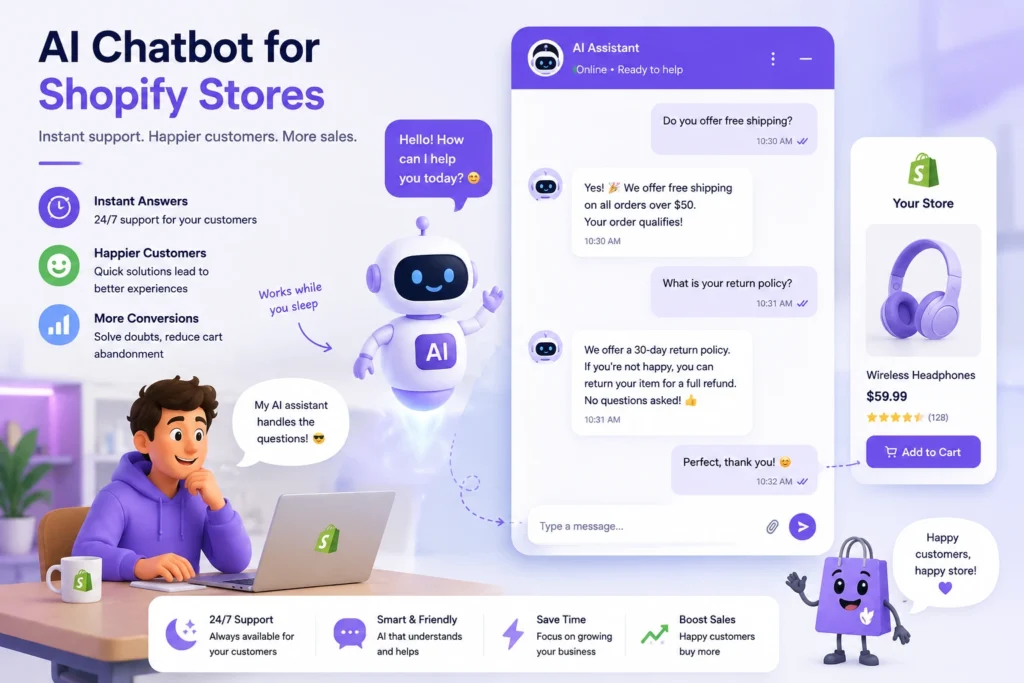
A smart approach is to think in categories, not just individual apps. That makes it easier to choose the right tool based on the actual needs of the store.
1. Shopify Magic and Sidekick
Best for: native Shopify AI, store management, content generation, admin tasks, and merchant guidance.
Shopify Magic and Sidekick are Shopify’s own AI tools built into the Shopify ecosystem. Shopify Magic includes AI-powered features that can help merchants create content, edit images, and complete tasks faster. Sidekick is Shopify’s AI-enabled commerce assistant designed to help merchants get guidance, generate content, and work inside the Shopify admin using everyday language.
These tools are a good starting point because they are native to Shopify. Store owners who want AI help without installing another paid app may want to explore Shopify Magic and Sidekick first.
- Best fit: Any Shopify store owner who wants native AI support.
- Main use case: Store management, content creation, guidance, and productivity.
- Good starting point because: It is built directly into Shopify.
2. Manifest AI
Best for: AI shopping assistant, AI chatbot, product recommendations, upsells, and guided shopping.
Manifest AI is an AI shopping assistant for Shopify stores. It is designed to help shoppers ask questions, receive product recommendations, and move through the buying journey with more guidance.
This type of tool is useful for Shopify stores with larger catalogs, many product variants, or customers who often need help choosing the right product. For example, a customer could ask for a gift recommendation, a product under a certain budget, or help comparing two similar items.
- Best fit: Shopify stores that want conversational product discovery.
- Main use case: Product recommendations, AI chat, guided shopping, upsells, and cross-sells.
- Good for: Fashion, beauty, electronics, gift stores, and stores with many product questions.
3. Desti AI
Best for: AI customer support, real-time product recommendations, live chat, and shopper assistance.
Desti AI is another AI chat agent for Shopify stores. It can help answer customer questions, provide product recommendations, support live conversations, and assist shoppers in real time.
This can be useful for stores that receive many repetitive questions about products, sizing, shipping, returns, or product selection. Instead of forcing customers to search through product pages alone, an AI chat assistant can give them answers while they are still shopping.
- Best fit: Stores that want AI chat plus customer support.
- Main use case: Product questions, customer support, product recommendations, and live chat.
- Good for: Stores where customers often need help before buying.
4. LimeSpot
Best for: AI product recommendations, upsells, cross-sells, bundles, and increasing average order value.
LimeSpot is focused on AI-powered product recommendations, bundles, cart upsells, cross-sells, and related product suggestions. This makes it a strong option for Shopify stores that already have traffic and want to increase revenue per visitor.
For example, if a customer is buying a camera, the store may recommend a memory card, tripod, or camera bag. If someone is buying skincare, the store may suggest a full routine instead of only one product.
- Best fit: Stores focused on increasing average order value.
- Main use case: Personalized recommendations, bundles, upsells, and cross-sells.
- Good for: Stores with complementary products or strong bundle opportunities.
5. GoWise AI Product Description
Best for: AI product descriptions, SEO product copy, meta tags, and faster product page creation.
GoWise AI Product Description helps Shopify store owners generate product descriptions and SEO-focused product content. This can be useful for stores with many SKUs, dropshipping stores, print-on-demand stores, or any store where product pages need better copy.
Product descriptions matter because they help shoppers understand the product and can also support SEO. AI writing tools can save time, but store owners should still review and edit the content so it matches the brand voice and product details accurately.
- Best fit: Stores with many products or weak product descriptions.
- Main use case: Product descriptions, SEO copy, meta tags, and product page content.
- Good for: Dropshipping, print-on-demand, large catalogs, and SEO-focused stores.
6. Klaviyo
Best for: email marketing, SMS marketing, automation, segmentation, and customer retention.
Klaviyo is one of the most popular email and SMS marketing platforms used by ecommerce brands. While it is not only an AI tool, it includes automation, customer segmentation, personalization, and data-driven marketing features that are very useful for Shopify stores.
Shopify store owners can use tools like Klaviyo for welcome flows, abandoned cart emails, post-purchase campaigns, win-back campaigns, product recommendations, and customer retention.
- Best fit: Stores with customer lists and repeat purchase potential.
- Main use case: Email/SMS automation, segmentation, retention, and abandoned cart recovery.
- Good for: Growing Shopify stores that want better lifecycle marketing.
7. Tidio
Best for: AI chatbot, live chat, customer support automation, and real-time shopper engagement.
Tidio combines live chat, chatbot features, and AI customer support tools for Shopify stores. It can help store owners answer customer questions, manage conversations, and engage shoppers while they browse.
This is useful for stores that want customer support automation but still need live chat and human handoff when necessary. It can also support product recommendations and real-time engagement depending on the setup.
- Best fit: Stores with frequent customer questions.
- Main use case: AI chatbot, live chat, support automation, and customer engagement.
- Good for: Stores that want both automation and live support.
8. Klevu
Best for: AI search, product discovery, merchandising, and personalized search results.
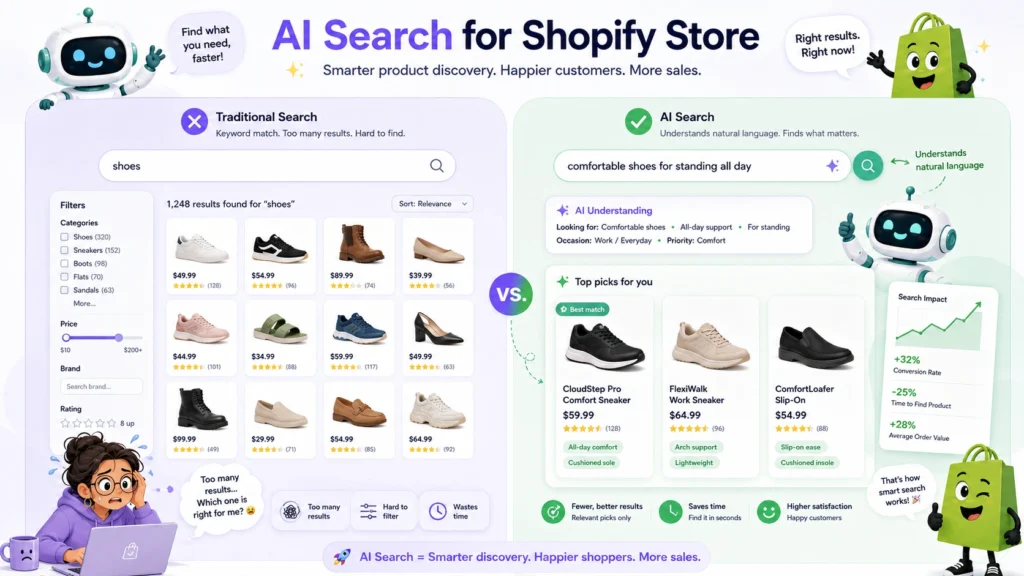
Klevu is an AI search and discovery tool for ecommerce stores. It is designed to help shoppers find the right products faster through better search, merchandising, and product discovery.
This type of tool is especially useful for Shopify stores with large catalogs. If customers often search for products but do not find what they need, an AI search tool can help reduce friction and improve product discovery.
- Best fit: Stores with large or complex catalogs.
- Main use case: AI search, product discovery, merchandising, and recommendations.
- Good for: Stores where search quality directly affects sales.
9. Doofinder
Best for: AI product search, smart filters, searchandising, and product discovery.
Doofinder is another Shopify search and discovery tool that helps shoppers find products more easily. It can be useful for stores where customers rely heavily on search instead of browsing categories manually.
For stores with many products, better search can make a big difference. If shoppers cannot find what they want quickly, they may leave the store without buying.
- Best fit: Stores that need stronger onsite search.
- Main use case: AI product search, filters, and product discovery.
- Good for: Large catalogs, technical products, fashion, electronics, and multi-category stores.
10. Searchanise
Best for: smart search, filters, product discovery, and merchandising.
Searchanise is a search and filtering app for Shopify stores. It helps customers search products, use filters, and discover relevant items more easily.
This can be a good option for Shopify stores that want to improve product discovery without building a custom search system. It is especially useful when customers need to narrow products by size, color, price, category, brand, or product attributes.
- Best fit: Stores that need better search and filtering.
- Main use case: Smart search, filters, merchandising, and product discovery.
- Good for: Stores with many collections, variants, and product attributes.
Quick Comparison Table
| Tool | Best For | Main Use Case | Best Fit |
|---|---|---|---|
| Shopify Magic and Sidekick | Native Shopify AI | Admin tasks, content, guidance | Any Shopify store |
| Manifest AI | AI shopping assistant | Guided shopping, recommendations, chat | Stores that need product guidance |
| Desti AI | AI chat and support | Customer questions and recommendations | Stores with many product questions |
| LimeSpot | Product recommendations | Upsells, cross-sells, bundles | Stores focused on AOV |
| GoWise AI Product Description | Product descriptions | SEO product copy and meta tags | Stores with many SKUs |
| Klaviyo | Email and SMS marketing | Automation, segmentation, retention | Stores with customer lists |
| Tidio | AI chatbot and live chat | Customer support automation | Stores with support volume |
| Klevu | AI search and discovery | Search, merchandising, discovery | Large or complex catalogs |
| Doofinder | AI product search | Search, filters, product discovery | Stores with many products |
| Searchanise | Smart search and filters | Search, filtering, merchandising | Stores with many variants |
How to Choose the Right AI Tool for Your Shopify Store
The right AI tool depends on what your Shopify store actually needs. A new store with 20 products does not need the same tools as a growing brand with thousands of monthly visitors, hundreds of SKUs, and daily customer support questions.
Before installing another app, it is better to look at the biggest bottleneck in your store. If the tool does not solve a real problem, it will probably become just another monthly subscription.
Here is a simple way to choose the right AI tool based on the problem you want to solve.
If customers ask too many repetitive questions
Start with an AI chatbot or customer support tool.
This is useful if shoppers often ask about shipping times, return policies, order tracking, sizing, product availability, exchanges, refunds, or product details.
For this kind of store, a tool like Tidio or Desti AI may be a good first step. The goal is to answer common questions faster and reduce the amount of manual support work.
- Best tool type: AI chatbot or AI customer support assistant
- Recommended tools: Tidio, Desti AI
- Best for: Stores with frequent customer questions
If shoppers struggle to find the right products
Start with an AI shopping assistant or AI search tool.
This is useful for stores with large catalogs, many collections, many product variants, technical products, fashion or beauty products, gift categories, or products that need explanation.
If customers browse but do not find what they need, tools like Manifest AI, Klevu, Doofinder, or Searchanise can help improve product discovery.
An AI shopping assistant is usually better when customers need guidance. An AI search tool is better when customers already know what they are looking for but need better search results.
- Best tool type: AI shopping assistant or AI search tool
- Recommended tools: Manifest AI, Klevu, Doofinder, Searchanise
- Best for: Stores with large catalogs or complex product choices
If your product pages are weak
Start with an AI product description tool.
This is useful if your store has thin product descriptions, duplicate product copy, dropshipping descriptions, many SKUs, poor SEO content, or weak meta titles and descriptions.
A tool like GoWise AI Product Description can help create product copy faster. However, the content should still be reviewed by a human before publishing.
AI can give you a strong first draft, but it should not replace product accuracy, brand voice, and common sense.
- Best tool type: AI product description generator
- Recommended tool: GoWise AI Product Description
- Best for: Stores with many products or weak product copy
If you have traffic but low conversions
Start with personalization, product recommendations, or guided shopping.
If people are visiting your store but not buying, the problem may be product discovery, trust, offer clarity, or decision friction. In this case, AI tools can help by recommending relevant products, suggesting bundles, showing complementary items, answering pre-purchase questions, helping customers compare products, and guiding shoppers toward the right choice.
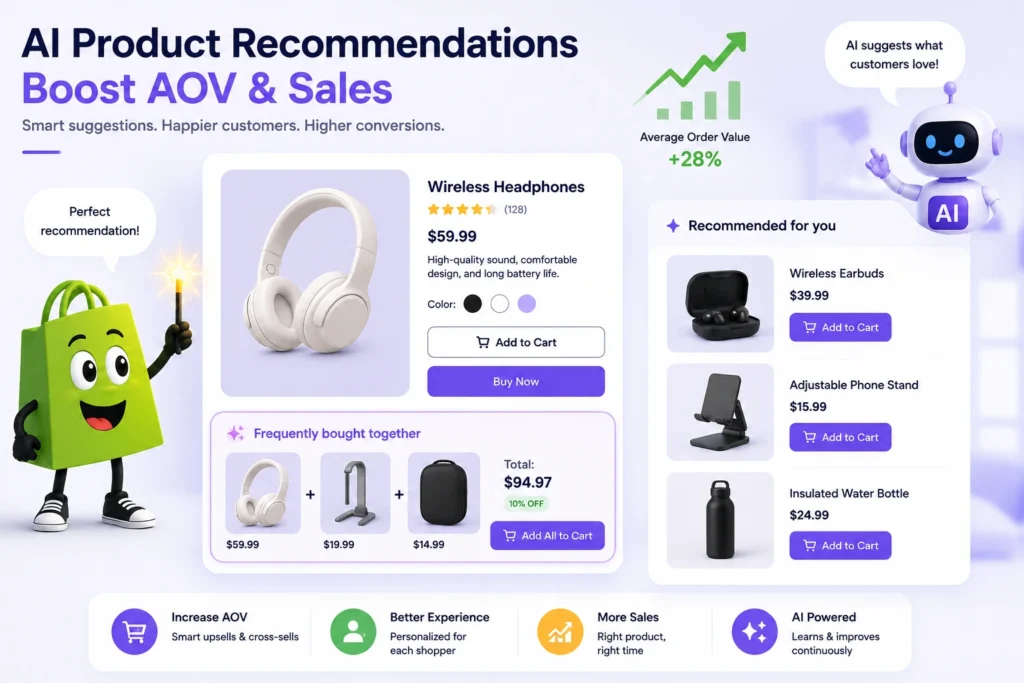
Tools like LimeSpot or Manifest AI may be useful here because they focus more on recommendations, upsells, cross-sells, and shopping guidance.
- Best tool type: AI product recommendations or AI shopping assistant
- Recommended tools: LimeSpot, Manifest AI
- Best for: Stores with traffic but weak conversion rates
If your average order value is too low
Start with AI product recommendations, upsells, cross-sells, or bundles.
This is useful if customers usually buy only one item, even though your store has complementary products.
For example, a skincare store can recommend a full routine, a camera store can recommend accessories, a fashion store can recommend matching items, a pet store can recommend treats or toys, and a home decor store can recommend matching pieces.
A tool like LimeSpot can help Shopify stores create personalized recommendations, bundles, upsells, and cross-sells.
- Best tool type: AI product recommendation tool
- Recommended tool: LimeSpot
- Best for: Stores that sell complementary products
If you want more repeat purchases
Start with email and SMS marketing automation.
For many Shopify stores, the first purchase is only the beginning. The real profit often comes from repeat customers, abandoned cart recovery, post-purchase campaigns, win-back emails, personalized offers, and customer segmentation.
For this use case, Klaviyo is one of the most common email and SMS marketing options for Shopify stores. It can help with automation, segmentation, retention, and personalized marketing campaigns.
- Best tool type: Email and SMS marketing automation
- Recommended tool: Klaviyo
- Best for: Stores with customer lists and repeat purchase potential
If you want native AI inside Shopify
Start with Shopify’s own AI tools before adding extra apps.
Shopify Magic and Sidekick are built into the Shopify ecosystem and can help merchants with content generation, store guidance, productivity, and admin-related tasks.
This is a good starting point for store owners who want to explore AI without immediately adding another third-party app.
- Best tool type: Native Shopify AI
- Recommended tool: Shopify Magic and Sidekick
- Best for: Any Shopify store owner who wants built-in AI help
Do not install too many AI tools at once
One of the biggest mistakes Shopify store owners make is installing too many apps at the same time.
This can create problems such as slower store speed, higher monthly costs, confusing analytics, overlapping features, too many popups or widgets, harder troubleshooting, and a worse customer experience.
A better approach is to start with one tool, test it properly, and measure the result.
Choose one problem first:
- If support is the problem, test an AI chatbot.
- If discovery is the problem, test AI search or an AI shopping assistant.
- If content is the problem, test an AI product description tool.
- If average order value is the problem, test AI product recommendations.
- If retention is the problem, test email and SMS automation.
The best AI tool is not always the most advanced one. It is the one that helps your store solve its most important problem right now.
Are AI Tools Worth It for Small Shopify Stores?
AI tools can be worth it for small Shopify stores, but only when they solve a clear problem.
A small store does not need to install every new AI app in the Shopify App Store. That can quickly become expensive, confusing, and even bad for site performance. The better approach is to choose one tool that helps with the biggest issue in the business right now.
For example, if a store owner spends hours writing product descriptions, an AI product description tool can save time. If customers ask the same questions every day, an AI chatbot can reduce support work. If shoppers are browsing but not buying, an AI shopping assistant or product recommendation tool may help guide them toward better choices.
AI is most useful when it supports something the store already needs.
A small Shopify store may benefit from AI tools if it has:
a growing product catalog
repetitive customer questions
weak product descriptions
many product variants
abandoned carts
low conversion rates
customers who need help choosing products
limited time or a small team
But AI tools may not be the first priority if the store has very little traffic, poor product photos, unclear pricing, slow shipping, or weak branding. In those cases, the owner may get better results by fixing the basics first.
For a small Shopify store, the smartest strategy is to start simple.
Do not install five AI tools at once. Start with one. Test it for a few weeks. Look at whether it saves time, improves customer experience, increases add-to-cart actions, reduces support questions, or helps generate more sales.
For example:
If your product pages are thin, start with an AI product description tool.
If customers keep asking questions, start with an AI chatbot.
If your store has many products and shoppers get lost, start with AI search or an AI shopping assistant.
If you already have traffic but average order value is low, start with AI product recommendations.
If customers buy once and never come back, start with email and SMS automation.
The key is to connect the AI tool to a real business goal.
AI tools are not magic. They will not turn a weak store into a successful brand overnight. But for small Shopify stores that already have decent products and some customer demand, the right AI tool can save time, improve the shopping experience, and help the store look more professional.
In most cases, AI tools are worth testing when the cost is reasonable, the setup is simple, and the tool helps solve one specific problem.
Common Mistakes Shopify Store Owners Make With AI Tools
AI tools can be useful for Shopify stores, but they can also become a waste of money if they are added without a clear plan.
A lot of store owners install AI apps because they sound exciting, not because they solve a specific business problem. The result is often a slower store, higher monthly costs, confusing workflows, and very little improvement in sales.
Here are the most common mistakes to avoid.
Installing too many AI apps at once
One of the biggest mistakes is adding too many AI tools at the same time.
A store owner may install one app for product descriptions, another for chat, another for recommendations, another for search, another for email, and another for reviews. At first, that may feel productive. But very quickly, it can become messy.
Too many apps can create problems such as:
slower page speed
higher monthly costs
overlapping features
confusing analytics
too many widgets on the website
harder troubleshooting
a less professional customer experience
It is better to start with one tool, test it properly, and only add another one when there is a clear reason.
Choosing a tool just because it says “AI”
Not every app with “AI” in the name is automatically useful.
Some tools use AI in a meaningful way. Others use it as a marketing word. Before installing any tool, Shopify store owners should ask:
What problem does this solve?
Will it save time?
Will it improve the customer experience?
Can it help increase conversions, average order value, or retention?
Can I measure the result?
If the answer is unclear, the tool may not be worth adding.
Not checking site speed
Shopify store speed matters, especially on mobile.
Some AI tools add scripts, chat widgets, popups, tracking code, recommendation blocks, or search features that can affect load time. If the store becomes slower, conversion rates can suffer.
Before keeping an AI tool installed, store owners should check how it affects the website experience.
A tool that looks impressive but slows down the store may create more problems than it solves.
Not testing AI answers
For chatbots, shopping assistants, and AI support tools, testing is very important.
Store owners should test common questions before letting the tool interact with real customers.
For example:
What is your return policy?
How long does shipping take?
Which size should I choose?
Is this product in stock?
Can you recommend a gift under $50?
What is the difference between these two products?
If the AI gives vague, wrong, or overconfident answers, it can damage trust. A good AI tool should be tested, adjusted, and monitored regularly.
Using poor product data
AI tools depend on the data they can access.
If product titles are unclear, descriptions are thin, variants are messy, or product tags are missing, the AI may struggle to give good results.
This affects tools like:
AI shopping assistants
AI search tools
AI product recommendations
AI chatbots
AI product description tools
Before expecting AI to improve the store, it is smart to clean up product data first.
Good product data leads to better AI performance.
Ignoring pricing after the free trial
Many AI tools offer free trials, but the real cost starts later.
Some tools charge based on:
monthly visitors
orders
conversations
contacts
email volume
recommendation views
revenue generated
number of products
A tool that feels affordable at first can become expensive as the store grows.
Before installing an app, store owners should check the full pricing page and understand what happens after the trial ends.
Not measuring results
An AI tool should be measured like any other business tool.
Store owners should look at what changed after installing it.
Useful metrics include:
conversion rate
add-to-cart rate
average order value
email revenue
support ticket volume
chat engagement
product clicks
search usage
abandoned cart recovery
time saved
Without measurement, it is hard to know if the tool is actually helping.
Sometimes a tool feels useful because it is new, but the numbers do not show real impact.
Letting AI replace human judgment completely
AI can help with writing, support, recommendations, search, and automation. But it should not replace human judgment completely.
Store owners should still review product descriptions, check chatbot answers, monitor customer feedback, and make sure recommendations make sense.
This is especially important for products where accuracy matters, such as electronics, skincare, supplements, baby products, fitness equipment, or expensive items.
AI should support the business, not run it blindly.
Forgetting the customer experience
The goal of AI is not to show customers that the store uses AI.
The goal is to make shopping easier.
If the AI chatbot is annoying, the recommendations feel pushy, the popups interrupt browsing, or the answers are too generic, customers may ignore the tool or leave the store.
A good AI tool should feel helpful, simple, and natural.
The best setup is usually the one customers barely notice because it fits smoothly into the shopping experience.
Final Recommendation
The best AI tool for a Shopify store is not always the most popular app or the one with the longest feature list. It is the tool that solves the store’s biggest problem right now.
If the store owner is overwhelmed with support questions, an AI chatbot may be the best first choice. If shoppers cannot find the right products, an AI shopping assistant or AI search tool may be more useful. If the store has traffic but low average order value, product recommendations and upsells may create more impact. If product pages are weak, an AI product description tool may be the simplest place to start.
For most Shopify store owners, the smartest approach is to start with one clear use case.
If you want native AI support inside Shopify, start with Shopify Magic and Sidekick. These tools are built into the Shopify ecosystem and can help with content, admin tasks, and general store guidance.
If you want better customer support, start with Tidio or Desti AI. These tools can help answer repetitive questions, support shoppers in real time, and reduce manual support work.
If you want a guided shopping experience, Manifest AI is a strong category fit. It can help shoppers ask questions, discover products, and receive more personalized recommendations.
If you want to increase average order value, LimeSpot is a good option to consider because it focuses on product recommendations, upsells, cross-sells, and bundles.
If you need better product descriptions, GoWise AI Product Description can help create product copy faster, especially for stores with many SKUs.
If you want better email and SMS marketing, Klaviyo is one of the strongest options for Shopify stores focused on retention, abandoned cart recovery, and customer segmentation.
If your store has a large catalog and customers rely heavily on search, tools like Klevu, Doofinder, or Searchanise can help improve product discovery.
The key is to avoid treating AI like a shortcut for everything. AI tools work best when they are connected to a specific business goal.
A good first step is to ask:
What is slowing down the store the most right now?
If the answer is support, start with support automation.
If the answer is product discovery, start with AI search or an AI shopping assistant.
If the answer is weak product content, start with AI product descriptions.
If the answer is low repeat purchases, start with email and SMS automation.
If the answer is low average order value, start with AI recommendations.
Start small, test the tool, measure the results, and only keep it if it improves the store in a clear way.
FAQ
What are the best AI tools for Shopify store owners?
The best AI tools for Shopify store owners depend on the store’s main problem. For native Shopify AI, Shopify Magic and Sidekick are good starting points. For customer support, tools like Tidio or Desti AI can help. For guided shopping and product discovery, Manifest AI is useful. For product recommendations and upsells, LimeSpot is a strong option. For email and SMS marketing, Klaviyo is one of the most popular choices.
Can AI tools increase Shopify sales?
AI tools can help increase Shopify sales when they improve the customer journey. For example, AI product recommendations can help increase average order value, AI chatbots can answer questions before checkout, AI search can help shoppers find products faster, and email automation can recover abandoned carts. However, AI tools do not guarantee sales on their own. They work best when the store already has good products, clear offers, and some traffic.
What is the best AI chatbot for Shopify?
There is no single best AI chatbot for every Shopify store. Tidio can be a good option for stores that want live chat and customer support automation. Desti AI can be useful for stores that want AI chat, product recommendations, and shopper assistance. The best choice depends on whether the store needs support automation, product guidance, live chat, or a combination of these features.
Can AI write Shopify product descriptions?
Yes, AI can write Shopify product descriptions, product titles, meta descriptions, bullet points, and SEO content. Tools like GoWise AI Product Description can help store owners create product copy faster, especially for stores with many products. However, AI-generated descriptions should still be reviewed and edited to make sure they are accurate, useful, and aligned with the brand voice.
Are AI tools worth it for small Shopify stores?
AI tools can be worth it for small Shopify stores if they solve a clear problem. A small store may benefit from AI if it needs better product descriptions, faster customer support, product recommendations, abandoned cart recovery, or better product discovery. But if the store has very little traffic or unclear branding, it may be better to fix the basics first before paying for multiple AI apps.
Do AI tools slow down Shopify stores?
Some AI tools can slow down a Shopify store, especially if they add heavy scripts, chat widgets, popups, tracking code, or recommendation blocks. Store owners should test site speed before and after installing any AI app. A tool may be useful, but if it makes the website slower or hurts the mobile experience, it can reduce conversions.
What AI tool should I install first on Shopify?
The first AI tool should match your biggest problem. If you spend too much time answering customer questions, start with an AI chatbot. If shoppers cannot find products, start with AI search or an AI shopping assistant. If product pages are weak, start with an AI product description tool. If abandoned carts are a problem, start with email and SMS automation. Start with one tool, test it, and measure the result.
Can AI help reduce cart abandonment?
Yes, AI can help reduce cart abandonment by answering last-minute questions, recommending better products, sending personalized abandoned cart emails, and reminding shoppers about items they left behind. AI chatbots and email automation tools are especially useful for this. However, cart abandonment can also be caused by high shipping costs, slow delivery, lack of trust, or a complicated checkout, so AI should be part of a broader strategy.
Can AI tools help with Shopify SEO?
Yes, some AI tools can help with Shopify SEO by generating product descriptions, collection descriptions, meta titles, meta descriptions, blog ideas, and keyword-focused content. AI can save time, but it should not be used blindly. The best SEO content still needs accurate product details, helpful explanations, internal links, and a clear structure for human readers.
How many AI tools should a Shopify store use?
Most Shopify stores should start with one AI tool, not five. Too many apps can increase costs, slow down the store, and create overlapping features. A good approach is to pick one problem, test one tool, measure the results, and only add another tool when there is a clear reason.
Conclusion
AI tools can be very useful for Shopify store owners, but the best tool depends on what your store actually needs.
Some Shopify stores need help with customer support. Others need better product recommendations, stronger product descriptions, smarter search, email automation, or a more guided shopping experience. That is why there is no single AI tool that is perfect for every store.
The smartest approach is to start with the biggest problem in your business.
If you want native AI features inside Shopify, start with Shopify Magic and Sidekick. If you need customer support automation, look at tools like Tidio or Desti AI. If shoppers need help finding the right products, Manifest AI, Klevu, Doofinder, or Searchanise may be useful. If you want to increase average order value, LimeSpot can help with recommendations, upsells, cross-sells, and bundles. If you need better product copy, GoWise AI Product Description can save time. If you want stronger email and SMS marketing, Klaviyo is a strong option for retention and abandoned cart recovery.
The important thing is not to install AI tools just because they are popular. Every app should have a clear purpose.
A good AI tool should help you save time, improve the customer experience, increase conversions, reduce repetitive work, or make your store easier to manage. If it does not do at least one of those things, it may not be worth the monthly cost.
For most Shopify store owners, the best strategy is simple: start with one AI tool, test it properly, measure the results, and only keep it if it improves the store in a clear way.
AI will not fix a weak product, bad pricing, poor branding, or slow shipping. But when your store already has solid products and real customer interest, the right AI tools can help you run the business more efficiently and create a better shopping experience for your customers.