

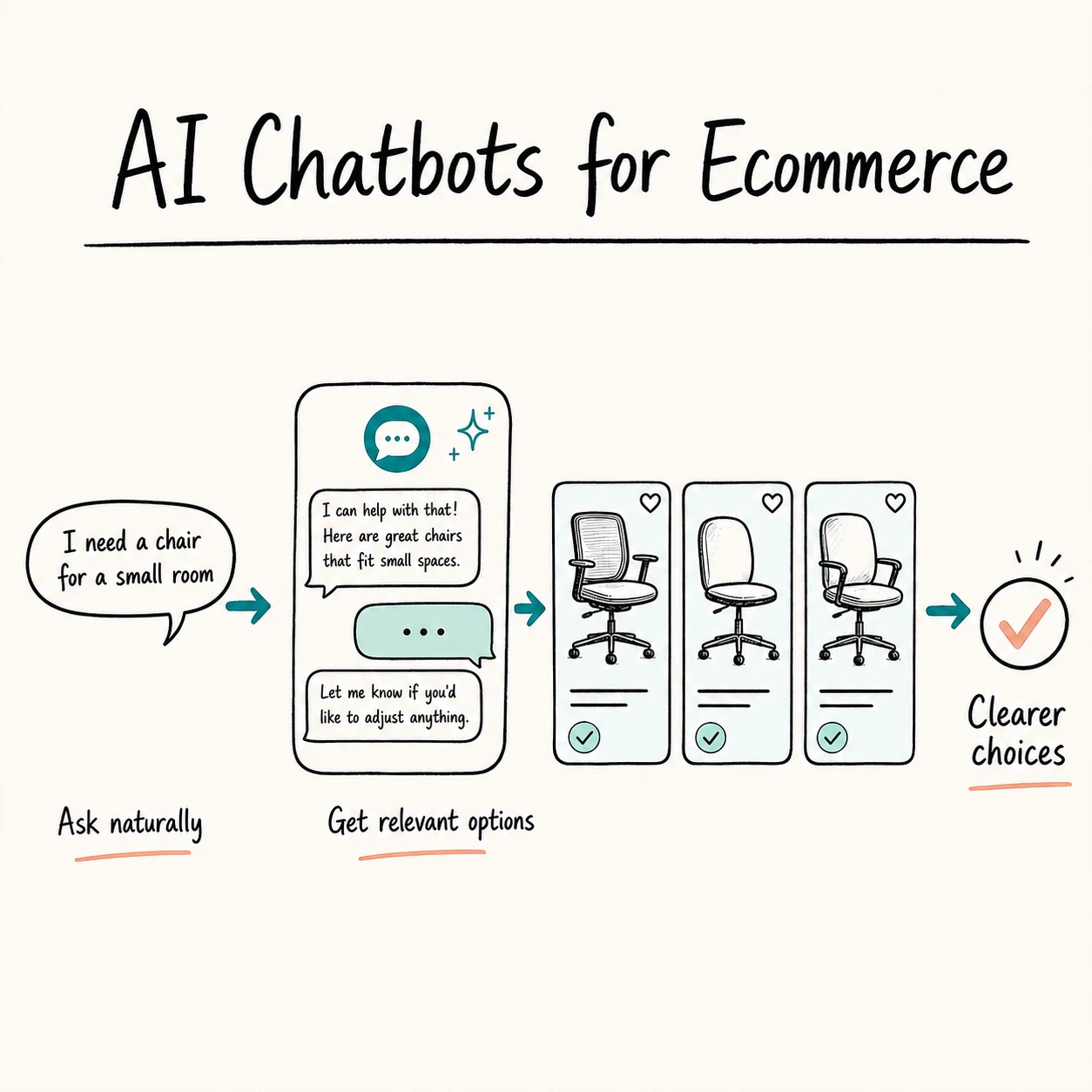
AI chatbots for ecommerce help shoppers choose the right products by turning a vague question into a guided conversation. Instead of scrolling through dozens of listings or guessing which filters to use, shoppers can explain what they need in plain language and receive relevant options, comparisons, and helpful follow-up questions.
This matters because product choice is often the hardest part of online shopping. A customer may know they need a quiet blender for a small kitchen, a laptop for photo editing within a budget, or a skincare product for sensitive skin—but not the exact product name, specifications, or search terms that will lead them to the best option. A well-designed ecommerce chatbot reduces that uncertainty by helping shoppers clarify their needs before recommending products from the store’s catalog.
In this guide, we explain how AI chatbots for ecommerce support product discovery, where they create the most value, what makes their recommendations useful, and how stores can avoid the common mistakes that make chatbots feel generic or unhelpful.
How Do AI Chatbots Help Ecommerce Shoppers?
AI chatbots help ecommerce shoppers choose products by understanding natural-language questions, asking relevant follow-up questions, and matching customer needs with information from a store’s product catalog. Rather than requiring shoppers to search with exact keywords, a chatbot can guide them toward suitable products based on preferences such as budget, use case, size, style, compatibility, or availability.
For example, a shopper can ask, “Which wireless headphones are best for travel under $200?” A useful chatbot can narrow the request by asking whether active noise cancellation, battery life, comfort, or microphone quality matters most. It can then recommend relevant options and explain why each product may fit the shopper’s needs.
| What the shopper needs | How an AI chatbot can help |
|---|---|
| Does not know the right product name | Understands a plain-language description of the need |
| Has too many options to compare | Shortlists relevant products and explains the differences |
| Has specific requirements | Uses details such as budget, size, material, features, or compatibility |
| Needs confidence before buying | Answers product questions using available catalog information |
In short: the best AI chatbots for ecommerce act like a helpful product guide. They reduce decision fatigue, make product discovery easier, and help shoppers move from “I’m not sure what I need” to a more confident purchase decision.
What Is an AI Chatbot for Ecommerce?
An AI chatbot for ecommerce is a conversational tool that helps customers find information, discover products, compare options, and get answers while they shop online. Unlike a basic chatbot that follows a fixed script, an AI-powered chatbot can interpret natural-language questions and respond based on product data, store policies, and the context of the conversation.
For shoppers, the experience should feel closer to asking a helpful store associate for advice than using a rigid support form. They can describe the outcome they want—rather than needing to know the exact product, category, or technical filter in advance. In many cases, the chatbot is one part of a broader AI shopping assistant experience that combines conversation, search, recommendations, and product information.
| Tool | Primary purpose | Typical shopper experience |
|---|---|---|
| Basic rule-based chatbot | Handles predefined questions | Selects buttons or follows a fixed conversation path |
| Live chat | Connects shoppers with a human support agent | Waits for an agent to answer product or support questions |
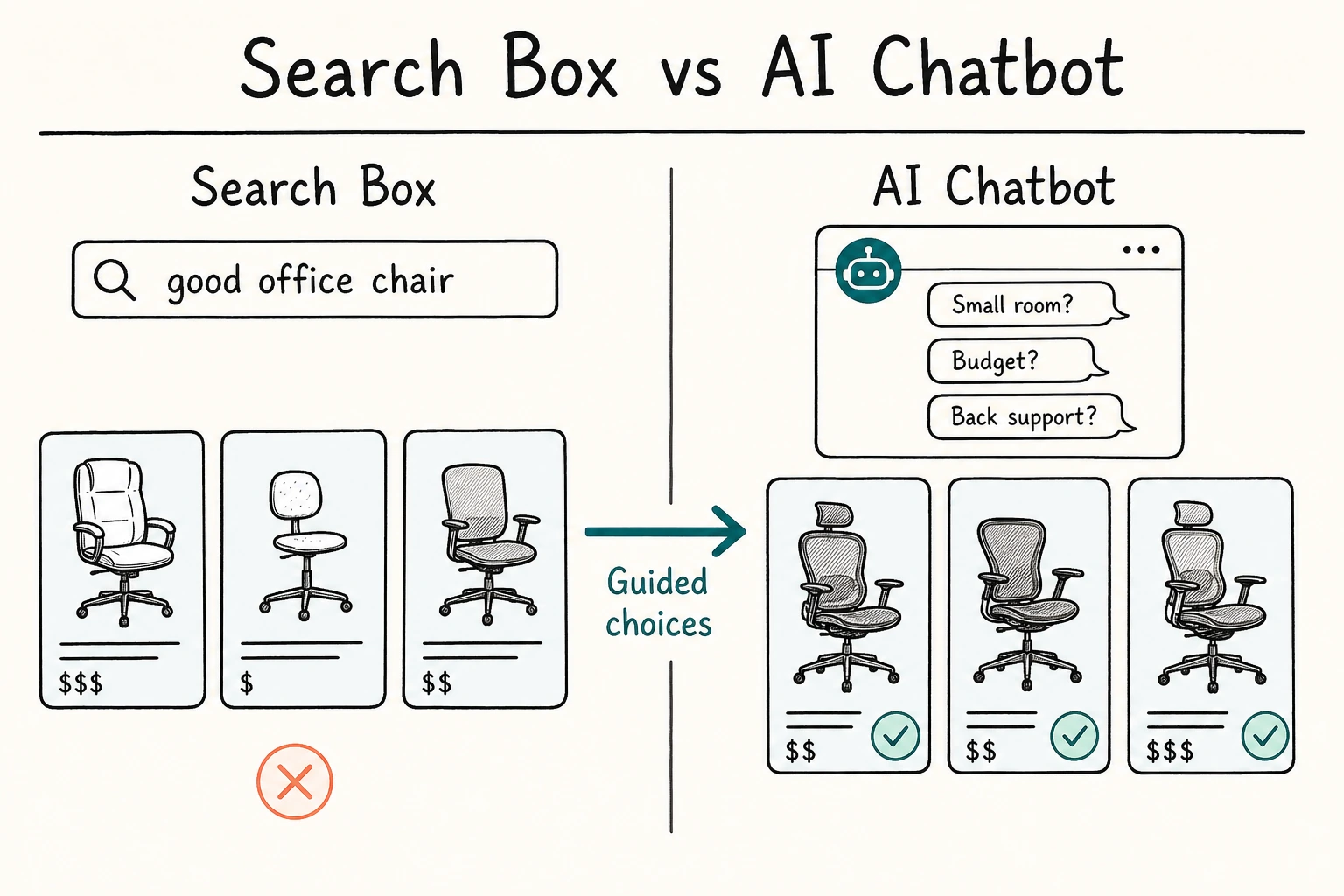
| AI chatbot for ecommerce | Understands questions and guides product decisions | Describes a need, receives follow-up questions, product suggestions, and explanations |
Important: an ecommerce AI chatbot should not invent answers or recommend products it cannot support with accurate catalog information. Its value comes from connecting the shopper’s question to real product details, current availability, pricing, and store policies.
Why Product Choice Is Hard in Ecommerce
Online stores give shoppers access to far more products than a physical shop can display. That choice is useful, but it can also create friction. When dozens of similar products appear in a search result, shoppers must work out which features matter, whether an item fits their situation, and whether a lower-priced option has an important limitation.
Traditional ecommerce search works best when the shopper already knows what to type. In reality, many product needs are incomplete or conversational: “a durable backpack for weekend travel,” “a gift for someone who enjoys cooking,” or “a desk lamp that will not take up much space.” These requests contain intent, preferences, and constraints—not necessarily the precise keywords a search bar expects.
Research from the Baymard Institute shows that product finding remains a major usability problem across ecommerce sites. Search can fail even when the relevant product is in the catalog, forcing shoppers to retry queries, change filters, browse categories, or leave before finding a suitable option.
Too Many Similar Options
Product listings often include items that look alike but differ in quality, compatibility, dimensions, materials, delivery time, or included features. Shoppers must open multiple product pages and compare details manually, especially in categories such as electronics, home products, beauty, and fashion.
Filters Cannot Capture Every Need
Filters are useful for structured requirements such as price, color, size, and brand. They are less effective when a shopper wants an outcome: a coffee machine for a small kitchen, shoes for standing all day, or a beginner-friendly camera for travel. A chatbot can turn that broader need into the product attributes that matter most.
Product Information Can Be Hard to Interpret
Specifications are often written for product experts rather than everyday shoppers. Terms such as “noise reduction,” “lumens,” “compatibility,” or “water resistance rating” may be important, but customers still need help understanding what those details mean for their use case.
This is where conversational guidance complements AI search for ecommerce. Search helps retrieve products from the catalog, while a chatbot helps shoppers explain what they need, understand their options, and make a more informed decision.
How AI Chatbots Help Shoppers Choose the Right Product
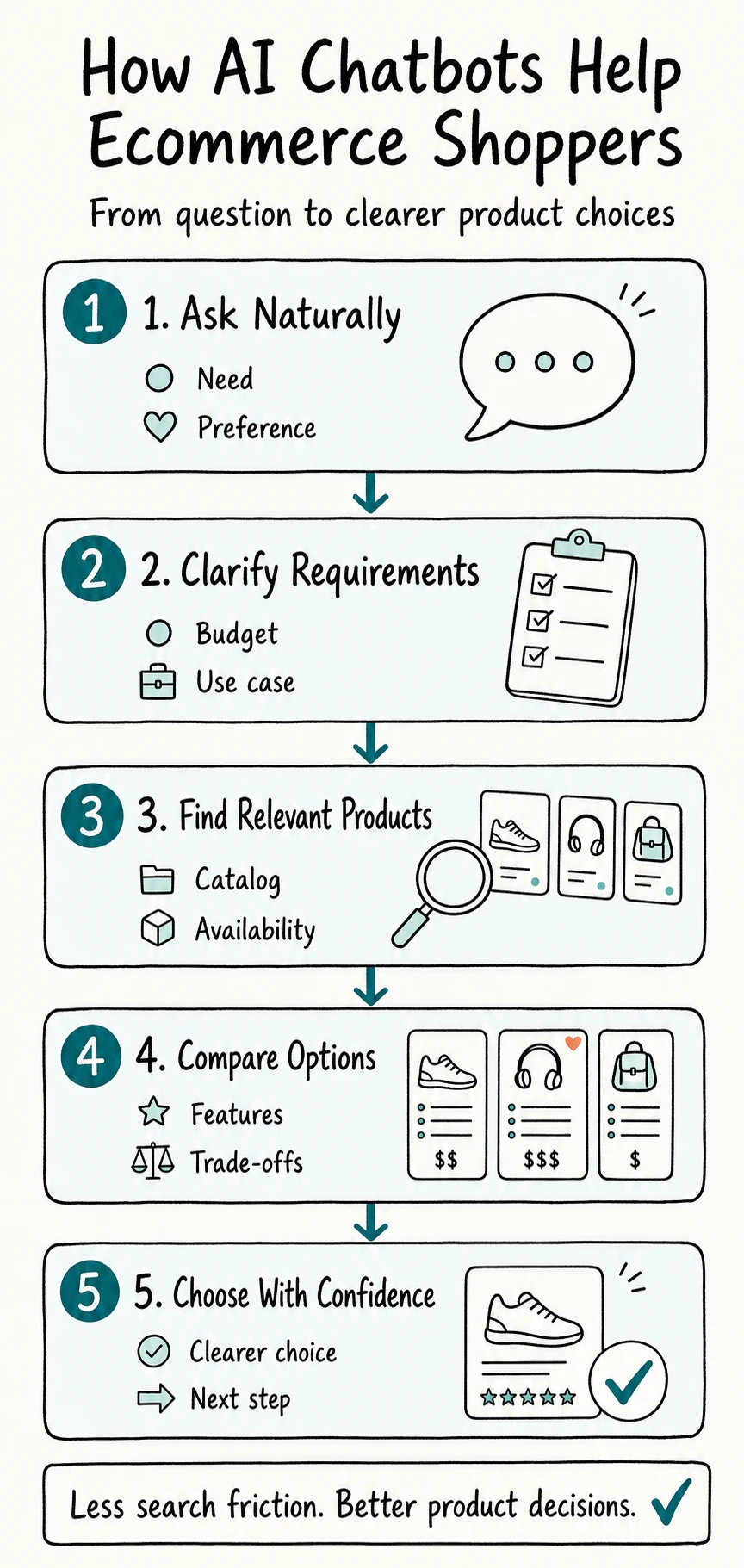
AI chatbots make product selection easier by replacing a one-way search process with a conversation. The shopper explains what they are trying to buy, the chatbot identifies the important details, and the store can present a smaller set of relevant options with useful explanations.
They Understand Natural-Language Questions
Shoppers do not always search with product names. They often describe a problem, a preference, or an intended use. An ecommerce AI chatbot can interpret questions such as “I need a lightweight suitcase for a three-day trip” or “Which tablet is suitable for taking notes at university?” and connect them with relevant product attributes.
This reduces the need for shoppers to translate their real needs into the exact keywords, filters, and categories used by a store.
They Ask Helpful Follow-Up Questions
A good recommendation usually requires more than one detail. If someone asks for running shoes, the chatbot can ask whether they run on roads or trails, whether they need extra cushioning, what size they wear, and what budget they have. Each answer helps narrow the selection without making the shopper search through an entire category.
The goal is not to make the conversation longer. It is to ask only the questions that materially improve the recommendation.
They Turn Preferences Into Product Attributes
Shoppers often use subjective language such as “durable,” “easy to use,” “good for a small space,” or “premium but affordable.” A chatbot can connect those preferences to available product information such as material, dimensions, feature sets, price range, ratings, or compatibility.
For example, “good for a small apartment” may lead the chatbot to prioritize compact dimensions, quiet operation, easy storage, and products designed for smaller rooms.
They Recommend a Manageable Set of Options
Instead of presenting every possible match, an AI chatbot can shortlist a few relevant products and explain why they were selected. This helps shoppers compare options without feeling overwhelmed by choice.
Useful recommendations should include clear product names, prices, key differences, links to the relevant product pages, and an honest explanation of any trade-off. A lower-priced option may have fewer features; a premium option may be more durable or include better support.
They Compare Products in Plain Language
Product comparison is one of the most valuable chatbot use cases. A shopper can ask, “What is the difference between these two models?” rather than opening several tabs and interpreting specifications alone.
The chatbot can summarize the differences that matter for the shopper’s stated need. For example, it can explain that one laptop is better for travel because it is lighter, while another is more suitable for video editing because it has stronger processing power and more memory.
They Answer Questions at the Point of Decision
Questions often appear after a shopper has found a product they like: “Will this fit?”, “Does it work with my device?”, “Is it available in my size?”, or “What is included in the box?” When the chatbot can answer with accurate, current catalog information, it removes uncertainty at the moment it matters most.
In practice: AI chatbots are most helpful when they guide shoppers toward a decision without pretending that one product is perfect for everyone. The best experience makes preferences, trade-offs, and next steps easy to understand.
A Simple Example: From Question to Product Recommendation
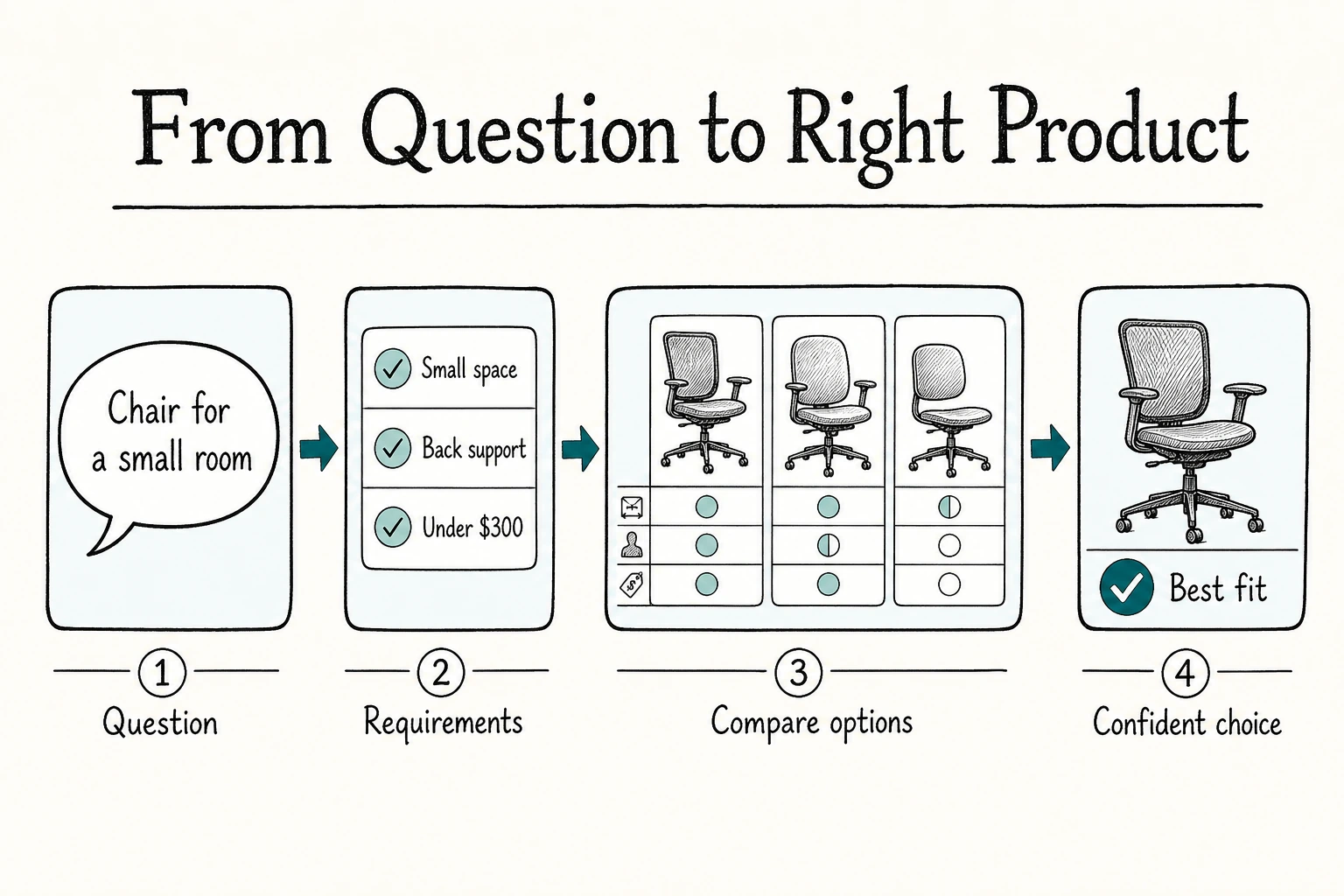
Consider a shopper looking for an office chair. They may not know which features matter or what terminology to use, but they can explain their situation in everyday language:
“I need a comfortable office chair for a small room. I work from home every day, want good back support, and my budget is under $300.”
A useful ecommerce AI chatbot can turn this broad request into a practical product-selection process.
- Identifies the key requirements: small-space suitability, daily use, ergonomic support, and a budget of up to $300.
- Asks only relevant follow-up questions: for example, whether the shopper prefers a mesh or cushioned seat, needs adjustable armrests, or has a height preference.
- Finds matching products: it searches the catalog for chairs that meet the essential requirements and are currently available.
- Explains the trade-offs: one chair may offer better lumbar support, while another may be more compact or less expensive.
- Helps the shopper compare and decide: it presents a short list with clear reasons for each recommendation and links to the relevant product pages.
| Shopper statement | What the chatbot understands | How it can help |
|---|---|---|
| “For a small room” | Limited available space | Prioritizes compact dimensions and a smaller footprint |
| “I work from home every day” | Frequent, long-term use | Prioritizes ergonomic features, adjustability, and comfort |
| “Good back support” | Lumbar support is important | Highlights chairs with relevant support and adjustment features |
| “Under $300” | A firm budget limit | Excludes products above the budget or clearly labels alternatives |
The key point: the chatbot does not need to “sell” the most expensive chair. It should help the shopper understand which available option best matches their priorities—and where they may need to make a trade-off.
Where Ecommerce Chatbots Create the Most Value
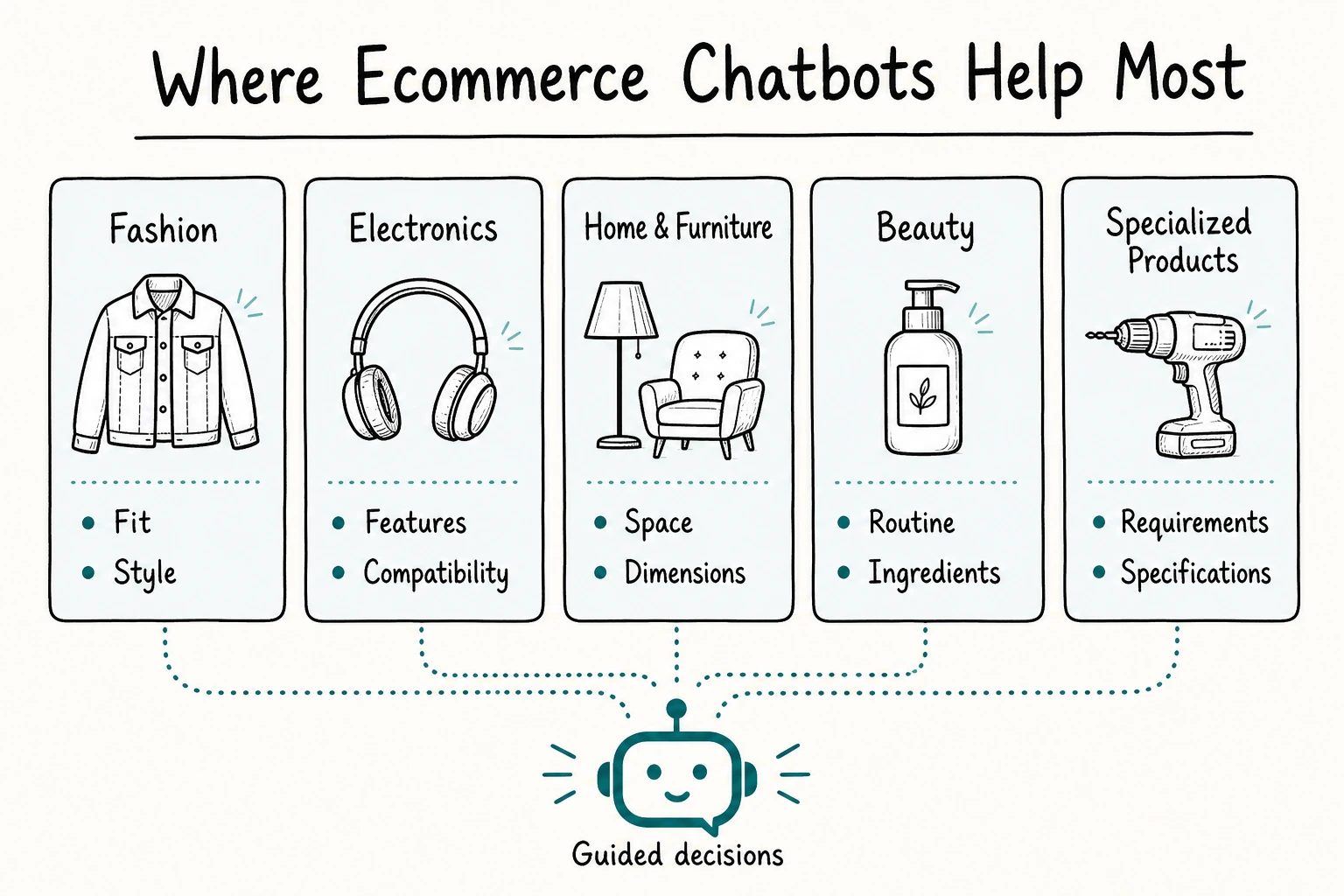
AI chatbots are most valuable when shoppers need help narrowing choices, interpreting product details, or finding an item that fits a specific situation. They can support almost any ecommerce category, but their impact is usually strongest when products have many variations, technical differences, or personal-fit considerations.
Fashion and Apparel
Fashion shoppers often have questions that filters alone cannot answer: “Which jacket works for rainy spring weather?”, “Will this fit a petite frame?”, or “What shoes go with this outfit?” A chatbot can guide customers by discussing style, size, fabric, occasion, color, and budget while linking to suitable products.
Electronics and Technology
Electronics involve compatibility, specifications, and trade-offs that can be difficult to compare. A chatbot can help shoppers understand whether a laptop has enough performance for their work, whether headphones support the features they need, or whether an accessory works with their existing device.
Home, Furniture, and Decor
Home shoppers often buy around dimensions, space limitations, style preferences, and practical use. Conversational guidance can help them find a compact dining table, a durable sofa for a family home, or lighting that suits a small workspace without requiring them to understand every product specification first.
Beauty and Personal Care
In beauty, shoppers may need help navigating product types, ingredients, routines, shades, and usage instructions. A chatbot can help explain the differences between options, although stores should be careful not to present general product information as medical advice or make unsupported claims.
Specialized and B2B Products
Products such as tools, industrial supplies, professional equipment, and replacement parts often require precise compatibility information. An AI chatbot can help buyers identify the correct product by asking about model numbers, dimensions, intended application, materials, or required standards.
| Category | Typical shopper challenge | How a chatbot adds value |
|---|---|---|
| Fashion | Fit, style, occasion, and color choices | Guides shoppers through preferences and product variations |
| Electronics | Technical features and compatibility | Explains specifications in plain language |
| Home and furniture | Dimensions, use case, and room suitability | Matches products to space and lifestyle needs |
| Beauty | Product routine, ingredients, and personal preferences | Helps shoppers compare options with appropriate safeguards |
| B2B and specialized products | Exact requirements and compatibility | Collects essential details before suggesting products |
Rule of thumb: the more difficult a product is to describe, compare, or select, the more useful conversational product guidance can become.
How AI Chatbots, Search, and Product Recommendations Work Together
An ecommerce AI chatbot is not a replacement for search or product recommendations. Each tool solves a different part of the shopping journey. When they work together, shoppers can describe what they need, retrieve relevant products, and receive suggestions that make sense in context.
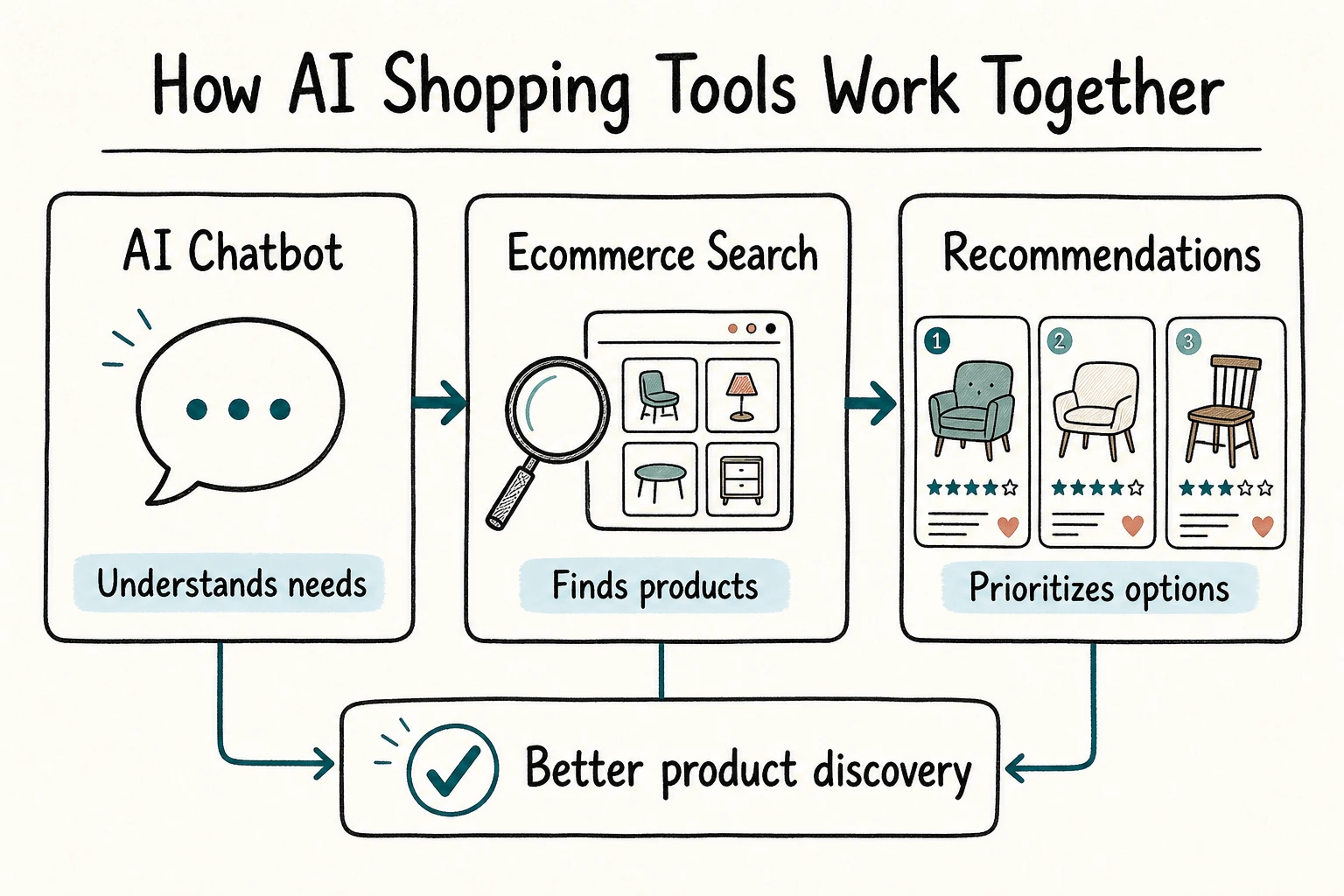
| Capability | Main role | Example shopper action |
|---|---|---|
| AI chatbot | Understands needs through conversation | “I need a durable carry-on suitcase for short business trips.” |
| Ecommerce search | Retrieves relevant products from the catalog | Finds carry-on suitcases that match size, material, price, and availability criteria |
| Product recommendations | Ranks or suggests suitable options | Highlights the best match, lower-priced alternatives, or complementary products |
| Visual search | Uses an image to identify visually similar products | Uploads a photo of a suitcase style and finds similar available products |
The Chatbot Provides the Conversation Layer
The chatbot is the interface where shoppers can explain their intent in their own words. It gathers the details that filters and search bars may not capture, such as whether an item is for everyday use, a gift, a specific room, a particular trip, or an existing device.
Search Connects the Conversation to the Catalog
Once the shopper’s needs are clearer, search retrieves products that match those requirements. This depends on accurate, structured product data: titles, descriptions, categories, specifications, prices, stock status, and product attributes.
Recommendations Help Prioritize the Best Options
Search can return several relevant products. A product recommendation system helps decide which ones should be shown first, based on the conversation, the shopper’s stated priorities, and—where appropriate—relevant behavior signals.
Visual Search Helps When an Image Is the Starting Point
Sometimes shoppers can show what they want more easily than they can describe it. AI visual shopping adds another path to discovery by allowing a customer to use an image, screenshot, or photo to find visually similar products. A chatbot can then help refine those results by discussing price, size, material, availability, and other practical requirements.
Put simply: the chatbot understands the question, search finds possible products, recommendations prioritize the options, and visual search helps when a picture communicates the shopper’s intent better than words.
Benefits of AI Chatbots for Ecommerce Stores
For ecommerce stores, the value of an AI chatbot is not simply that it can answer more messages. Its real value is helping shoppers make progress when they are uncertain, comparing options, or close to leaving without finding what they need.
Improves Product Discovery
A chatbot gives shoppers another way to explore the catalog. Instead of depending only on navigation, filters, and keyword search, customers can describe a need in plain language and receive a focused path toward relevant products.
Reduces Decision Friction
When shoppers have too many options, they may delay or abandon the decision. Conversational guidance can make a large catalog feel more manageable by highlighting the most relevant choices and explaining the differences between them.
Provides Scalable Product Guidance
Store teams cannot personally answer every pre-purchase question at every hour. An AI chatbot can handle common product-discovery questions at scale, while more complex, sensitive, or unresolved cases can be passed to a human support agent.
Creates Better Insight Into Customer Questions
Chat conversations can reveal what shoppers struggle to find, understand, or compare. If many visitors ask the same question about sizing, compatibility, delivery, or materials, that may signal an opportunity to improve product pages, filters, guides, or catalog data.
Supports More Helpful Customer Experiences
When a chatbot gives accurate answers and transparent recommendations, it can make an online store feel easier to use. The goal is not to pressure shoppers into a purchase; it is to help them find the right information and make a decision with more confidence.
| Potential benefit | What it can mean in practice |
|---|---|
| Better product discovery | Shoppers find relevant products even when they do not know the exact search terms |
| Less decision friction | Customers compare a smaller, more relevant set of options |
| More scalable support | Common product questions can be answered outside support-team hours |
| More useful customer insight | Repeated questions identify gaps in product data and site experience |
| Potentially stronger conversion paths | Shoppers receive clearer answers before leaving or delaying a purchase |
A realistic expectation: an AI chatbot is not a guaranteed conversion tool on its own. Results depend on product data quality, recommendation accuracy, user experience, pricing, delivery, and how well the chatbot fits the rest of the shopping journey.
What Makes an Ecommerce AI Chatbot Useful—Not Annoying
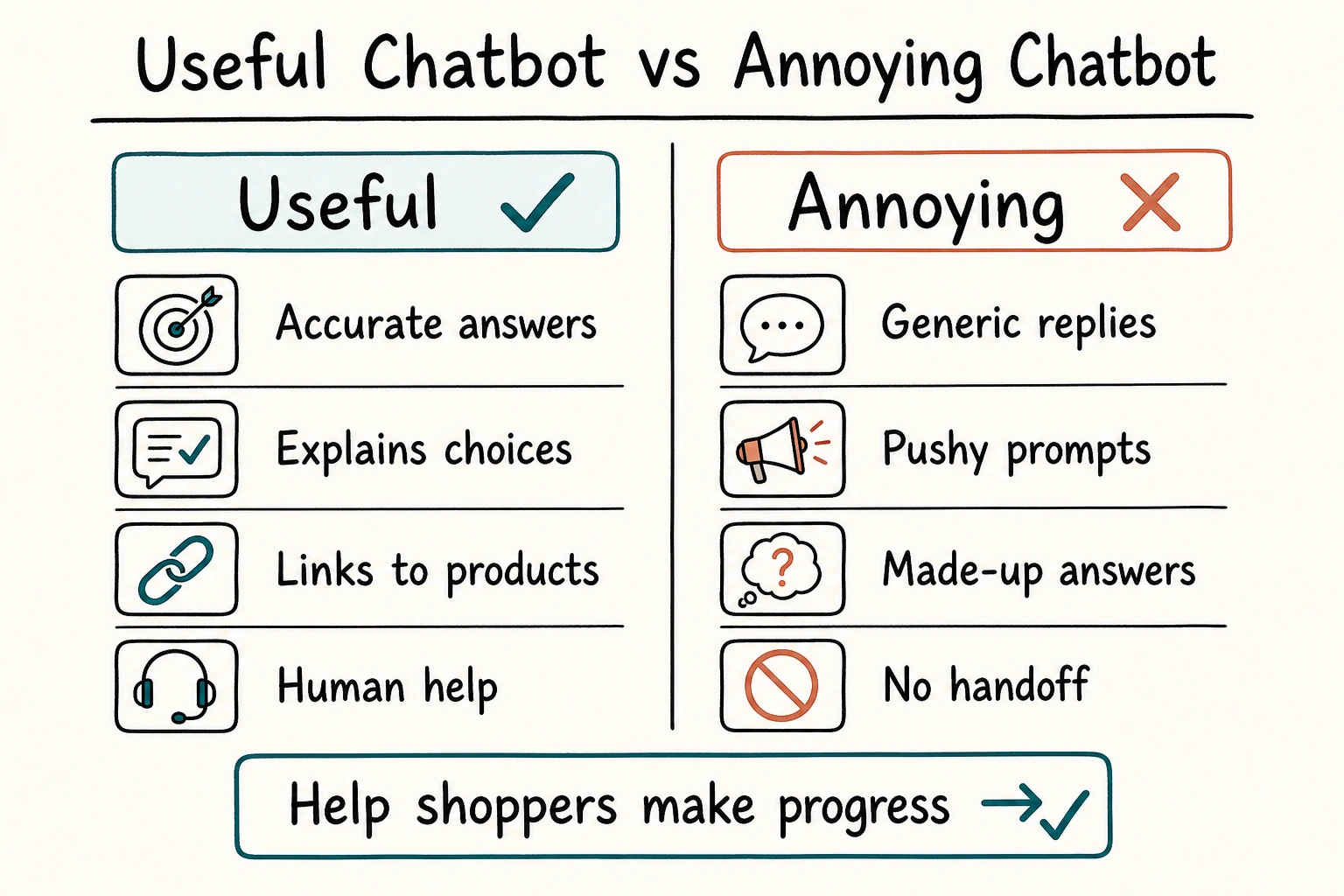
Adding a chatbot to an ecommerce store does not automatically improve the customer experience. A useful chatbot helps shoppers make progress quickly; an annoying one blocks the page, gives vague answers, repeats itself, or pushes products without understanding the question.
It Uses Accurate, Current Product Data
Product recommendations are only as reliable as the information behind them. The chatbot should have access to accurate titles, descriptions, specifications, variants, prices, stock status, delivery details, and store policies. If a product is unavailable or a price has changed, the chatbot should not present outdated information as fact.
It Links Shoppers to the Evidence
Recommendations should lead to the relevant product pages, comparison pages, size guides, shipping information, or policy pages. Shoppers need a clear way to verify a recommendation before they buy.
It Asks Fewer, Better Questions
A chatbot should not turn a simple shopping task into a long interview. It should ask follow-up questions only when the answer changes the recommendations. For a laptop, budget and intended use may be essential; asking for unnecessary personal information is not.
It Explains Recommendations Clearly
“This is the best option” is not a useful answer without context. A better response explains why a product fits the shopper’s requirements, what trade-offs exist, and whether a lower-priced or alternative option may also be suitable.
It Knows When to Hand Off to a Human
Some situations require a person: complex orders, disputed charges, unusual compatibility questions, accessibility needs, or sensitive customer issues. The chatbot should provide a clear route to human support rather than repeating the same answer or pretending it can resolve everything.
It Respects Customer Privacy
Customers should understand when they are interacting with AI, what information is being used, and where they can find the store’s privacy policy. The chatbot should collect only the information needed to assist with the current request and should never ask shoppers to share payment details, passwords, or other sensitive information in chat.
| A useful chatbot | An annoying chatbot |
|---|---|
| Appears when the shopper needs help | Interrupts immediately and covers important page content |
| Answers with specific catalog information | Gives generic replies that do not address the question |
| Explains why a product is relevant | Pushes products with no explanation |
| Admits uncertainty and offers next steps | Invents information or repeats itself |
| Makes human help easy to reach | Creates a dead end when the answer is not available |
The standard to aim for: every chatbot interaction should save the shopper time, improve understanding, or make the next step clearer. If it does none of those things, it is adding friction instead of removing it.
Common Ecommerce Chatbot Mistakes to Avoid
An ecommerce chatbot can undermine trust when it creates more work for shoppers than it removes. Most problems are not caused by the idea of conversational AI itself—they come from poor product data, weak user experience, or unrealistic expectations about what the chatbot can do.
Giving Generic Answers
Replies such as “How can I help you today?” or “Please browse our collection” do not help a shopper who has already explained what they need. The chatbot should use the details in the conversation to provide a meaningful next step, product shortlist, comparison, or clarification question.
Recommending Products Without Explaining Why
Shoppers need context before they trust a recommendation. If a chatbot suggests three products, it should explain why each one is relevant and identify the important differences. A recommendation without reasoning can feel like advertising rather than assistance.
Using Outdated Prices, Stock, or Product Details
Inaccurate information can quickly damage confidence. Ecommerce chatbots should be connected to current catalog data whenever possible, especially for inventory, price, variants, delivery timing, and product compatibility.
Making Up Answers When Information Is Missing
An AI chatbot should never invent product features, guarantees, policies, or compatibility details. When it does not have enough reliable information, the correct response is to say so clearly and direct the shopper to a product page, help resource, or human support representative.
Forcing the Chatbot on Every Visitor
A chatbot should be easy to find without blocking navigation, product images, filters, or checkout controls. Some shoppers prefer to browse independently, so the tool should offer help rather than demand attention.
Ignoring Privacy and Sensitive Information
Chatbot conversations may include personal preferences, order questions, or contact details. Stores should be transparent about how chat data is used and avoid asking customers to enter sensitive information such as passwords, full payment-card details, or government identification in the chat window. For a broader look at responsible AI shopping experiences, see our guide on AI shopping safety and privacy.
| Mistake | Why it hurts the experience | Better approach |
|---|---|---|
| Generic replies | Does not move the shopper toward a decision | Use the shopper’s stated need and catalog information |
| Unexplained recommendations | Feels promotional and difficult to trust | Explain fit, differences, and trade-offs |
| Outdated data | Creates frustration and broken expectations | Connect to current product, price, and stock data |
| Invented answers | Can mislead customers and damage trust | State uncertainty and offer a verifiable next step |
| No human handoff | Leaves complex questions unresolved | Make support escalation clear and accessible |
How to Evaluate an AI Chatbot for Your Ecommerce Store
The best ecommerce chatbot is not necessarily the one with the most features. It is the one that can give shoppers accurate, useful guidance within the store’s real catalog, policies, and support process. Before choosing a platform, evaluate how well it supports the customer experience you want to create.
| What to evaluate | Why it matters | Question to ask |
|---|---|---|
| Catalog integration | Recommendations depend on accurate product information | Can it access current titles, variants, specifications, prices, and availability? |
| Answer accuracy | Incorrect answers reduce customer trust | Does it provide product-page links and avoid unsupported claims? |
| Recommendation quality | Shoppers need relevant options, not a random product list | Can it use preferences such as budget, use case, size, and compatibility? |
| Human handoff | Some questions require a support specialist | Can the conversation be transferred to a person with useful context? |
| Privacy and data controls | Customer conversations may include personal information | What data is stored, who can access it, and how can shoppers find the privacy policy? |
| Analytics and reporting | Store teams need to improve the experience over time | Can you see common questions, unresolved requests, and product-discovery gaps? |
| Platform integration | The chatbot must fit the existing ecommerce stack | Does it integrate with your ecommerce platform, help desk, product feed, and inventory system? |
Test It With Real Customer Questions
Before launching, prepare a set of realistic questions based on customer emails, support tickets, site-search queries, and sales conversations. Include vague product requests, comparison questions, compatibility questions, out-of-stock scenarios, return-policy questions, and cases where the chatbot should hand off to a human.
Review the Answers, Not Just the Demo
A polished demo can look impressive while still failing on real catalog questions. Test whether the chatbot gives accurate answers, links to the correct pages, respects stated budgets and constraints, and communicates uncertainty when the information is unavailable.
Start With One High-Value Use Case
Many stores get better results by beginning with a focused goal, such as helping shoppers compare products, answer compatibility questions, or find products in a complex category. Once the chatbot performs well in that use case, the store can expand it to more parts of the customer journey.
Practical takeaway: treat an AI chatbot as an ongoing product-discovery system, not a set-it-and-forget-it website widget. It needs accurate data, regular testing, and review of the questions shoppers ask most often.
The Future of AI Chatbots in Ecommerce
The next generation of ecommerce chatbots will be less like isolated support widgets and more like shopping interfaces that combine conversation, search, product recommendations, images, and real-time catalog information. Shoppers will be able to move naturally between typing a question, uploading an image, comparing products, and refining their preferences in one experience.
More Conversational Product Discovery
Instead of starting with a category page or exact search term, shoppers will increasingly begin with intent: what they need, where they will use it, who it is for, and what matters most. The chatbot can then guide them through the relevant questions and present options that match those priorities.
Multimodal Shopping Experiences
Text will not be the only input. A shopper may upload a screenshot of a product they like, share a photo of a room, or select an item from a previous purchase. This combines conversational help with visual search ecommerce, making it easier to find products when an image communicates intent better than a keyword.
More Transparent Recommendations
Useful AI shopping experiences should become clearer about why a product is being recommended. Instead of simply saying “recommended for you,” a chatbot can explain that an item matches the shopper’s budget, preferred size, intended use, or stated feature requirements.
Better Connections Between Online and Human Support
AI will handle more routine product-discovery questions, while store teams can focus on complex cases that need expertise, empathy, or account-level support. The most effective systems will preserve conversation context when a customer moves from chatbot assistance to a human agent.
Greater Focus on Trust and Control
As AI becomes more present in ecommerce, shoppers will expect clear information about how recommendations are created, what data is used, and when they are interacting with an automated system. Stores that prioritize accuracy, transparency, and user control will be better positioned to earn long-term trust.
The likely direction: ecommerce chatbots will not replace browsing, search, or human support. They will connect these experiences, making it easier for shoppers to move from a broad need to a product decision with less effort and more confidence.
Frequently Asked Questions About AI Chatbots for Ecommerce
What is an AI chatbot for ecommerce?
An AI chatbot for ecommerce is a conversational tool that helps shoppers find products, understand product details, compare options, and get answers while shopping online. It uses product data and natural-language understanding to respond to customer questions in a more flexible way than a basic scripted chatbot.
Can an ecommerce chatbot recommend products?
Yes. An ecommerce chatbot can recommend products when it has access to accurate catalog data. It can use details such as budget, intended use, product features, size, color, compatibility, and availability to narrow the options and explain why a product may be suitable.
Do AI chatbots replace customer support teams?
No. AI chatbots can handle common questions and product-discovery tasks at scale, but human support remains important for complex cases, complaints, account issues, unusual product requirements, and situations where empathy or specialist knowledge is needed.
Are AI chatbot recommendations accurate?
Accuracy depends on the quality and freshness of the product data, the chatbot’s integration with the store catalog, and how well the system is tested. A trustworthy chatbot should link to product pages, explain its reasoning, and clearly state when it does not have enough reliable information.
What data does an ecommerce chatbot use?
It may use product titles, descriptions, specifications, prices, stock status, variants, store policies, and the details a shopper shares during the conversation. Stores should explain how chat data is handled and collect only the information necessary to assist the customer.
How are AI chatbots different from ecommerce search?
Ecommerce search helps retrieve products from the catalog, usually through keywords and filters. An AI chatbot adds a conversational layer: it can understand a broader request, ask follow-up questions, explain product differences, and guide the shopper toward a decision.
Conclusion: AI Chatbots Should Help Shoppers Decide, Not Just Sell
AI chatbots for ecommerce can make online shopping easier when they help customers describe what they need, understand product differences, and compare relevant options with less effort. They are especially useful when a catalog is large, products are difficult to compare, or shoppers do not know the exact terms they need to search for.
The most effective chatbot is not the one that talks the most. It is the one that provides accurate product information, asks useful follow-up questions, explains trade-offs clearly, respects privacy, and makes human help available when needed. In other words, it should behave like a helpful product guide—not a pushy sales script.
As ecommerce search, recommendations, and visual discovery become more connected, conversational AI will play a larger role in helping shoppers move from a broad need to a confident product decision. Explore more practical guides on AI Shopping Assistant to understand how AI is changing product discovery and online shopping.