

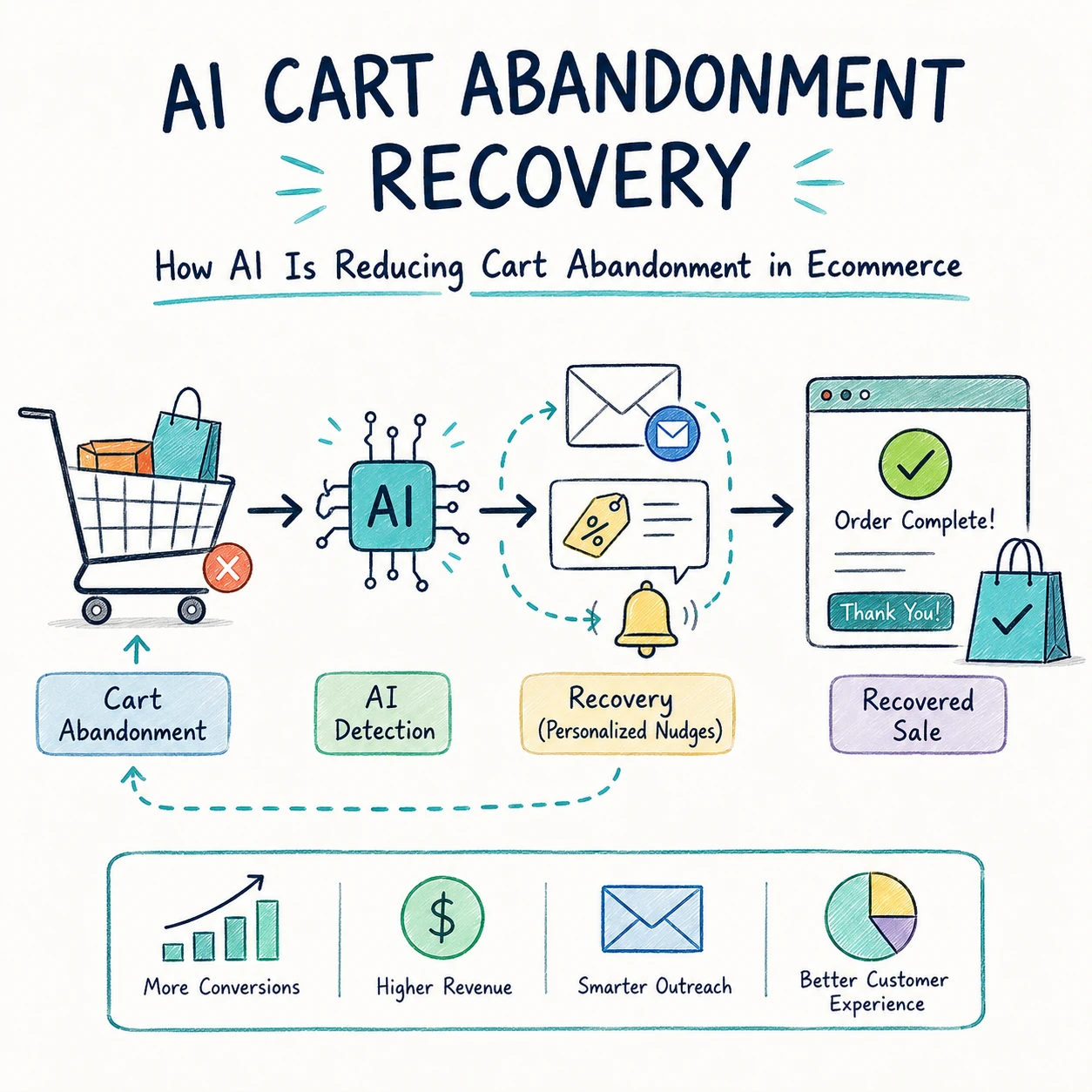
Cart abandonment is one of the biggest and most expensive problems in ecommerce. Almost every online store faces it, regardless of size, traffic, or industry. A customer finds a product, adds it to the cart, and then leaves without completing the purchase.
In most cases, this doesn’t happen because the customer is not interested. It happens because something interrupts the buying process — unexpected costs, distractions, comparison shopping, or a complicated checkout flow.
Industry data consistently shows that more than 60–80% of ecommerce carts are abandoned, which means the majority of potential revenue is never converted.
This is where artificial intelligence is starting to change the game. Instead of treating cart abandonment as a lost sale, AI systems now analyze user behavior in real time and try to predict, prevent, or recover those lost purchases.
From smart email timing and behavioral triggers to personalized offers and predictive analytics, AI is turning abandoned carts into recoverable revenue opportunities.
Platforms like Nosto and other ecommerce AI systems are already helping stores reduce abandonment rates and improve conversions at scale.
In this article, we’ll break down exactly how AI detects cart abandonment, what strategies it uses to recover lost sales, and which tools are leading the space today.
What Is Cart Abandonment
Cart abandonment happens when a user adds products to their shopping cart but leaves the website before completing the purchase. In simple terms, it means the customer shows buying intent but does not finish the checkout process.
This is one of the most common behaviors in ecommerce and it affects almost every online store, regardless of industry or product type.
There are many reasons why this happens. Some users get distracted while shopping, others leave to compare prices on different websites, and some abandon the purchase because of unexpected costs like shipping fees or taxes.
In other cases, the checkout process itself is too long or complicated, which leads users to drop off before completing the transaction.
For ecommerce businesses, cart abandonment is not just a behavioral pattern — it represents a direct loss of potential revenue that could otherwise have been converted.
Why Cart Abandonment Is a Big Problem
Cart abandonment is not just a small optimization issue in ecommerce — it is a direct revenue leak that affects the entire business model.
Most ecommerce stores spend significant money on ads, SEO, and social media to bring users to their website. When those users abandon their carts, that marketing spend does not generate a return, which lowers overall profitability.
Industry benchmarks consistently show that average cart abandonment rates are above 70%, meaning that the majority of potential customers leave without completing a purchase.
This creates a major challenge for scaling ecommerce businesses because increasing traffic alone is not enough. If conversion rates remain low, growth becomes expensive and inefficient.
Another important factor is competition. In most industries, customers compare multiple stores before making a final decision. If one website offers a smoother checkout experience or better timing in follow-ups, the sale is often lost permanently.
For this reason, cart abandonment is now considered one of the most important performance metrics in ecommerce, because even small improvements in recovery can significantly increase revenue.
How AI Detects Cart Abandonment Behavior
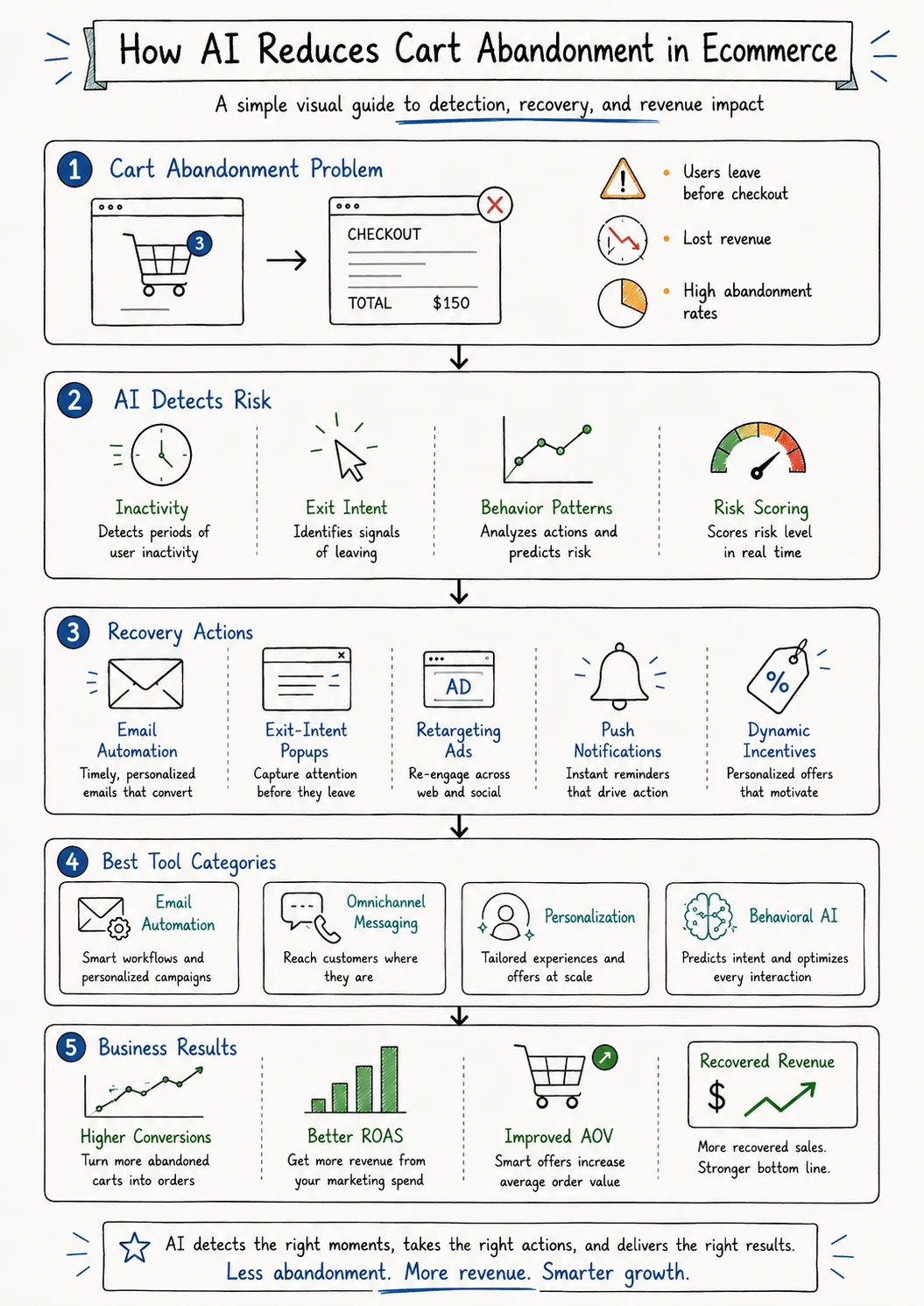
AI systems do not wait until a customer fully leaves the website before identifying cart abandonment. Instead, they analyze real-time behavioral signals to understand when a user is likely to abandon the purchase.
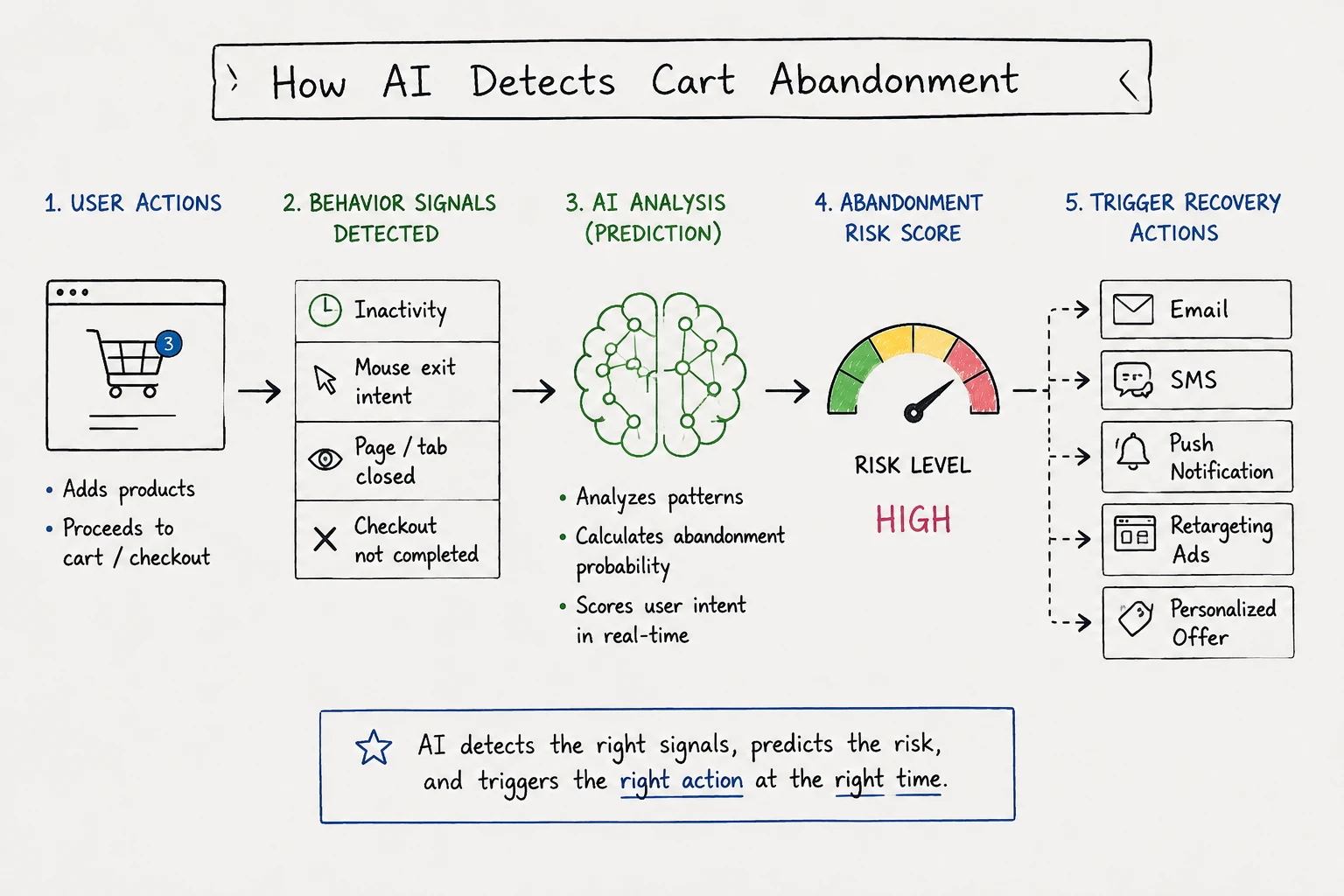
These signals include mouse movement, scrolling patterns, time spent on checkout pages, and inactivity during the final steps of the buying process. If a user becomes inactive for too long, the system can interpret this as a strong sign of hesitation.
Another important signal is exit intent, which occurs when a user moves their cursor toward the browser’s close button or navigates away from the checkout page. This is one of the strongest indicators that a purchase may not be completed.
AI also uses historical behavioral data to improve prediction accuracy. By analyzing patterns from previous users who abandoned their carts, machine learning models can identify similar behaviors in real time and trigger recovery actions.
This combination of real-time tracking and predictive modeling allows ecommerce platforms to react at the exact moment when a sale is at risk of being lost.
AI Strategies to Recover Abandoned Carts
Once AI systems detect that a user is likely to abandon their cart, the next step is to trigger recovery strategies designed to bring the customer back and complete the purchase.
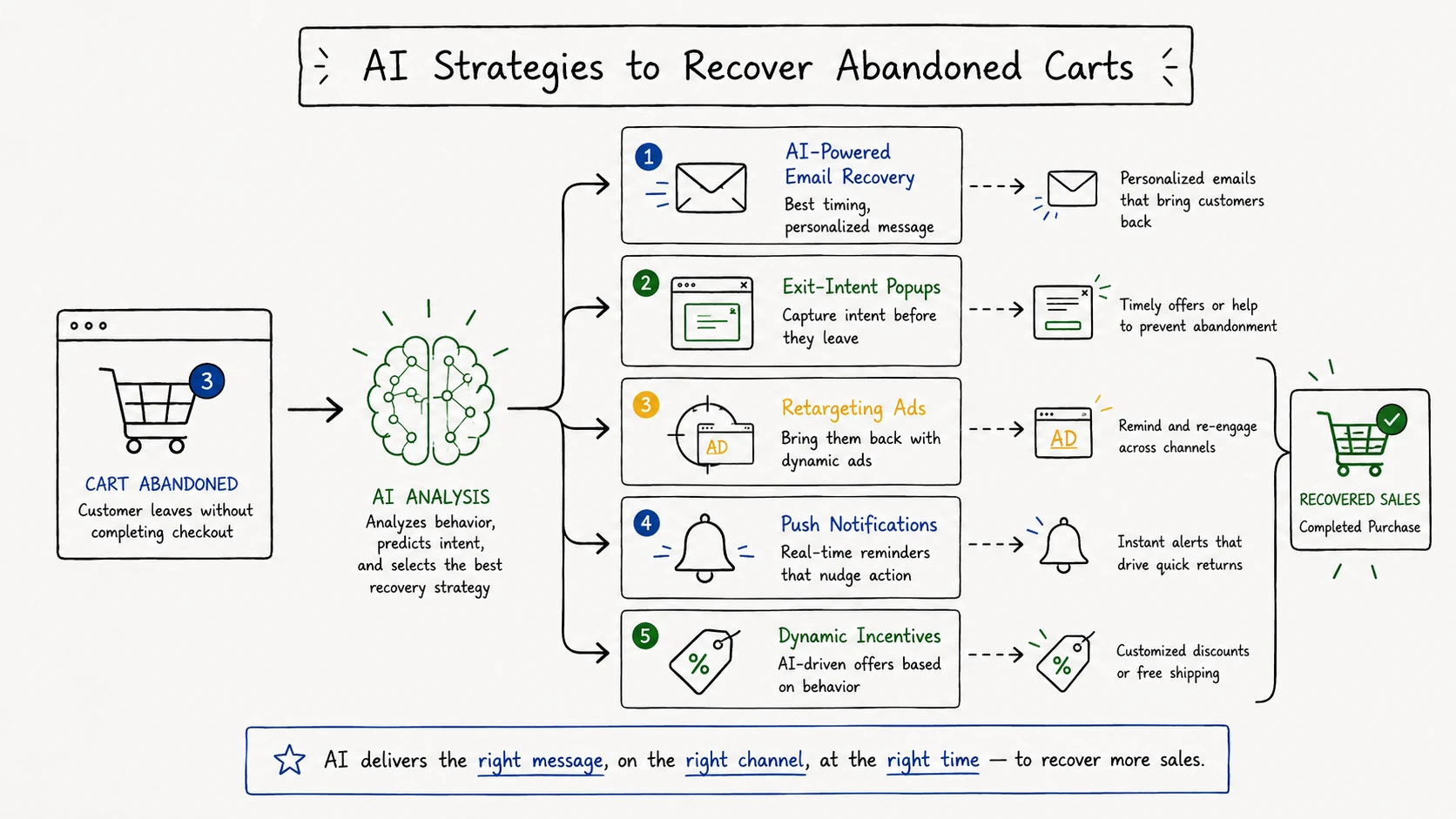
These strategies are highly automated and rely on timing, personalization, and behavioral context to increase the chances of conversion.
1. AI-Powered Email Recovery
One of the most common methods is automated email recovery. AI determines the optimal time to send follow-up emails and personalizes the content based on user behavior, such as viewed products or past purchases.
2. Exit-Intent Popups
AI can trigger smart popups when a user is about to leave the checkout page. These messages often include reminders, personalized offers, or incentives designed to reduce hesitation and encourage completion of the purchase.
3. Retargeting Ads
AI-powered advertising systems automatically show abandoned products to users across platforms like social media and search engines. These ads are dynamically optimized based on user intent and likelihood to convert.
4. Push Notifications
For users who allow browser or mobile notifications, AI can send real-time reminders directly to their devices, often timed based on user activity patterns.
5. Dynamic Incentives
In some cases, AI decides whether to offer discounts or free shipping. Instead of applying the same incentive to everyone, the system evaluates whether an offer is needed to recover the sale without reducing profit unnecessarily.
Best AI Cart Abandonment Tools
There are several AI-powered tools that help ecommerce businesses recover abandoned carts automatically. These platforms focus on automation, personalization, and timing optimization to improve recovery rates and increase revenue.
Each tool works slightly differently, but the goal is the same — bringing users back to complete their purchase with the highest possible conversion probability.
1. Klaviyo
Klaviyo is one of the most popular email automation platforms for ecommerce. It uses AI-driven segmentation and behavioral triggers to send highly personalized abandoned cart emails.
2. Omnisend
Omnisend combines email, SMS, and push notifications into a single automation system designed specifically for ecommerce recovery workflows.
3. Shopify AI Apps
Shopify offers multiple AI-powered apps that help store owners recover abandoned carts using automated reminders, discount triggers, and behavioral segmentation directly inside the platform.
4. Dynamic Yield
Dynamic Yield provides advanced personalization and real-time experience optimization, allowing brands to trigger recovery messages based on user intent and behavior.
5. Nosto
Nosto uses behavioral AI to personalize recovery messages and product recommendations across the entire customer journey.
These tools are used across both small ecommerce stores and enterprise-level brands, and the right choice depends on business size, budget, and level of automation required.
AI vs Traditional Cart Recovery
Before AI became widely used in ecommerce, cart recovery was mostly handled through manual email campaigns and fixed marketing rules. While these methods still exist today, they are far less effective compared to modern AI-driven systems.
The key difference is flexibility. Traditional systems follow static rules, while AI systems adapt in real time based on user behavior and intent signals.
Traditional Cart Recovery
Traditional methods usually rely on sending generic reminder emails after a fixed time period. These messages are often the same for all users, regardless of what products they viewed or how they behaved on the website.
AI-Powered Cart Recovery
AI systems analyze user behavior in real time and adjust recovery strategies dynamically. They can change timing, personalize messaging, and even decide whether an incentive is needed based on the likelihood of conversion.
For example, a high-value customer might receive a different recovery strategy compared to a first-time visitor. This level of personalization significantly increases conversion rates compared to static approaches.
To understand how AI personalization works across ecommerce systems, you can also explore our guide on AI product recommendations in ecommerce, which shows how behavior-based systems improve overall revenue.
Business Impact of Cart Recovery
AI-powered cart abandonment recovery has a direct impact on ecommerce revenue and overall business performance. Even small improvements in recovery rates can translate into significant revenue gains at scale.
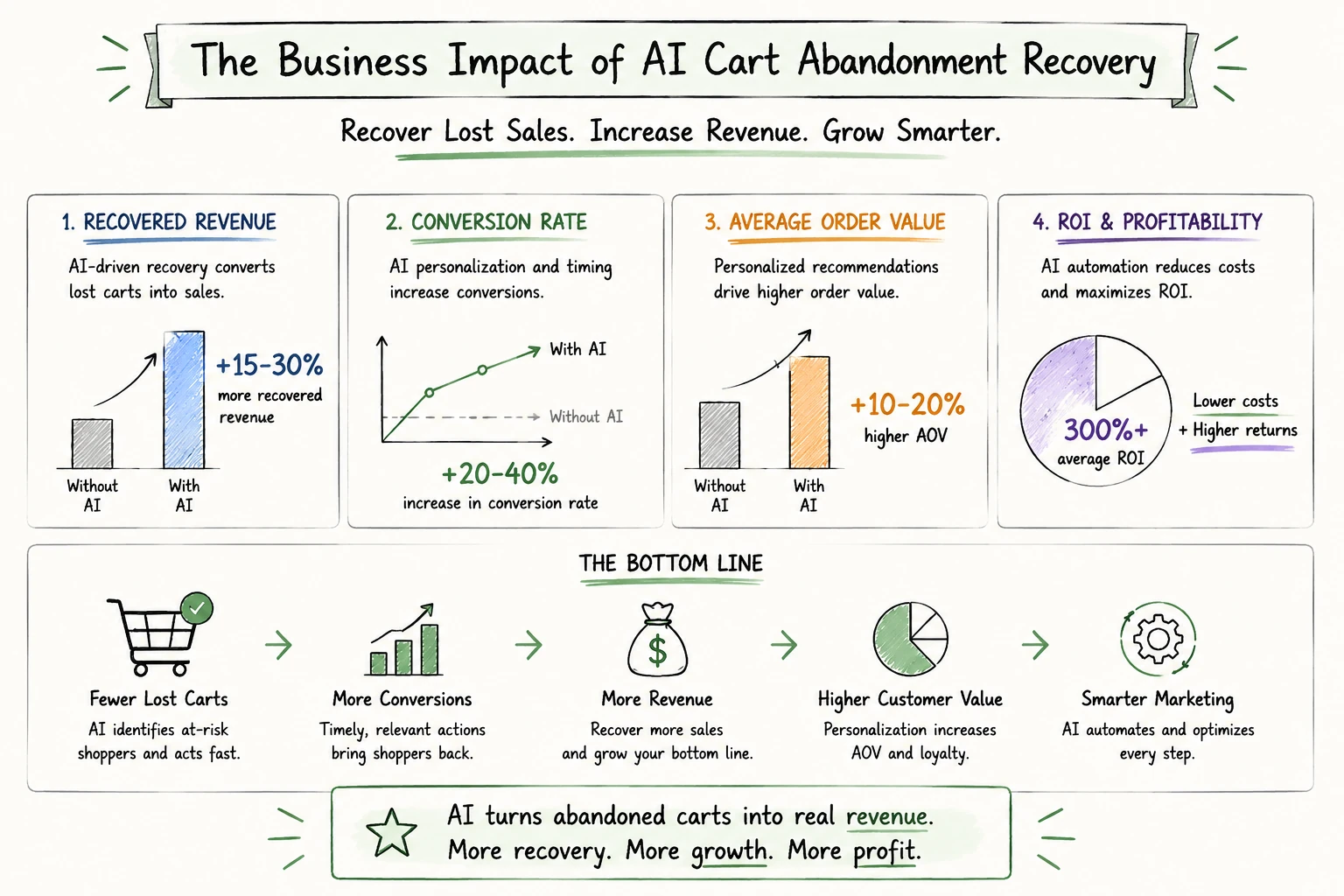
One of the biggest benefits is increased conversion rates. By targeting users at the right moment with personalized and relevant messages, businesses can turn potential lost sales into completed purchases.
Another important impact is improved return on ad spend (ROAS). Since a large portion of abandoned carts comes from paid traffic, recovering even a small percentage of these users helps maximize marketing efficiency and reduce wasted acquisition costs.
AI systems also help increase average order value (AOV) by intelligently suggesting products or applying dynamic incentives only when necessary. This ensures that recovery efforts remain profitable while still being effective.
In addition, automation reduces the need for manual campaign management. Instead of building static workflows, AI continuously optimizes timing, messaging, and channel selection based on real user behavior.
Research from McKinsey & Company shows that effective personalization strategies can increase revenue by up to 15%, highlighting the financial importance of AI-driven optimization in ecommerce.
As a result, cart recovery is no longer just a marketing tactic — it has become a core revenue optimization system for modern ecommerce businesses.
Future of AI in Cart Recovery
The future of cart abandonment recovery is moving far beyond simple reminders and discount emails. Instead of reacting after a user leaves the website, AI systems are becoming increasingly predictive and proactive.
In the near future, ecommerce platforms will be able to detect purchase hesitation much earlier in the user journey and adjust the shopping experience in real time to prevent abandonment before it even happens.
For example, if AI detects uncertainty during checkout, it may simplify the process, surface alternative payment options, or adjust shipping information dynamically to reduce friction.
Another important trend is hyper-personalization. AI will not only decide when to send a message, but also adapt the tone, content, and offer type based on individual user behavior and intent signals.
We are also seeing deeper integration between cart recovery systems and other AI layers such as product recommendations and search systems, creating a fully connected ecommerce optimization ecosystem.
To better understand how these systems connect, you can explore our guide on AI product recommendations in ecommerce, which shows how personalization drives conversions across the entire shopping journey.
As AI continues to evolve, cart recovery will shift from being a reactive tool into a predictive revenue optimization system that actively prevents lost sales before they happen.
Conclusion
Cart abandonment is one of the most expensive problems in ecommerce, but it is no longer a problem without a solution. With the help of AI, businesses can now detect, predict, and recover abandoned carts in a much more intelligent and scalable way.
Instead of relying on generic email campaigns or static rules, AI systems use real-time behavioral data to understand user intent and trigger personalized recovery actions at exactly the right moment.
From automated email flows and exit-intent popups to predictive analytics and dynamic incentives, AI transforms cart recovery into a continuous optimization process that directly impacts revenue.
Platforms like Klaviyo, Omnisend, and Nosto show how automation and personalization can be used effectively to recover lost sales and improve conversion rates.
To understand how cart recovery fits into the broader ecommerce AI ecosystem, you can also explore our guide on AI product recommendations in ecommerce, which explains how personalization improves performance across the entire shopping journey.
As ecommerce continues to evolve, AI-driven cart abandonment recovery will become a standard layer of every high-performing online store, turning lost traffic into predictable revenue.
Frequently Asked Questions
What is cart abandonment in ecommerce?
Cart abandonment happens when a customer adds products to their shopping cart but leaves the website before completing the purchase. It is one of the most common challenges in ecommerce.
Why do customers abandon their carts?
Customers abandon carts for many reasons, including unexpected costs, distractions, price comparison, or a complicated checkout process. In many cases, it is not a lack of interest, but friction during the buying process.
How does AI help reduce cart abandonment?
AI helps reduce cart abandonment by analyzing user behavior in real time and triggering personalized recovery actions such as emails, notifications, or dynamic offers at the right moment.
What is the average cart abandonment rate?
The average cart abandonment rate in ecommerce is typically above 60–80%, depending on the industry. This makes it one of the biggest sources of lost revenue for online stores.
What are the best tools for cart abandonment recovery?
Some of the most widely used tools include Klaviyo, Omnisend, Nosto, and Dynamic Yield, each offering different levels of automation, personalization, and recovery strategies.