

Ecommerce has changed more in the last few years than in the previous decade combined. What used to be simple online stores with basic search and static product pages has now become a highly intelligent ecosystem powered by artificial intelligence.
Today, AI tools are deeply integrated into almost every part of online shopping — from product recommendations and search optimization to pricing strategies, customer support, and even cart recovery systems.
But with so many tools available, a simple question appears: which AI tools for ecommerce actually work in 2026, and which ones are just hype?
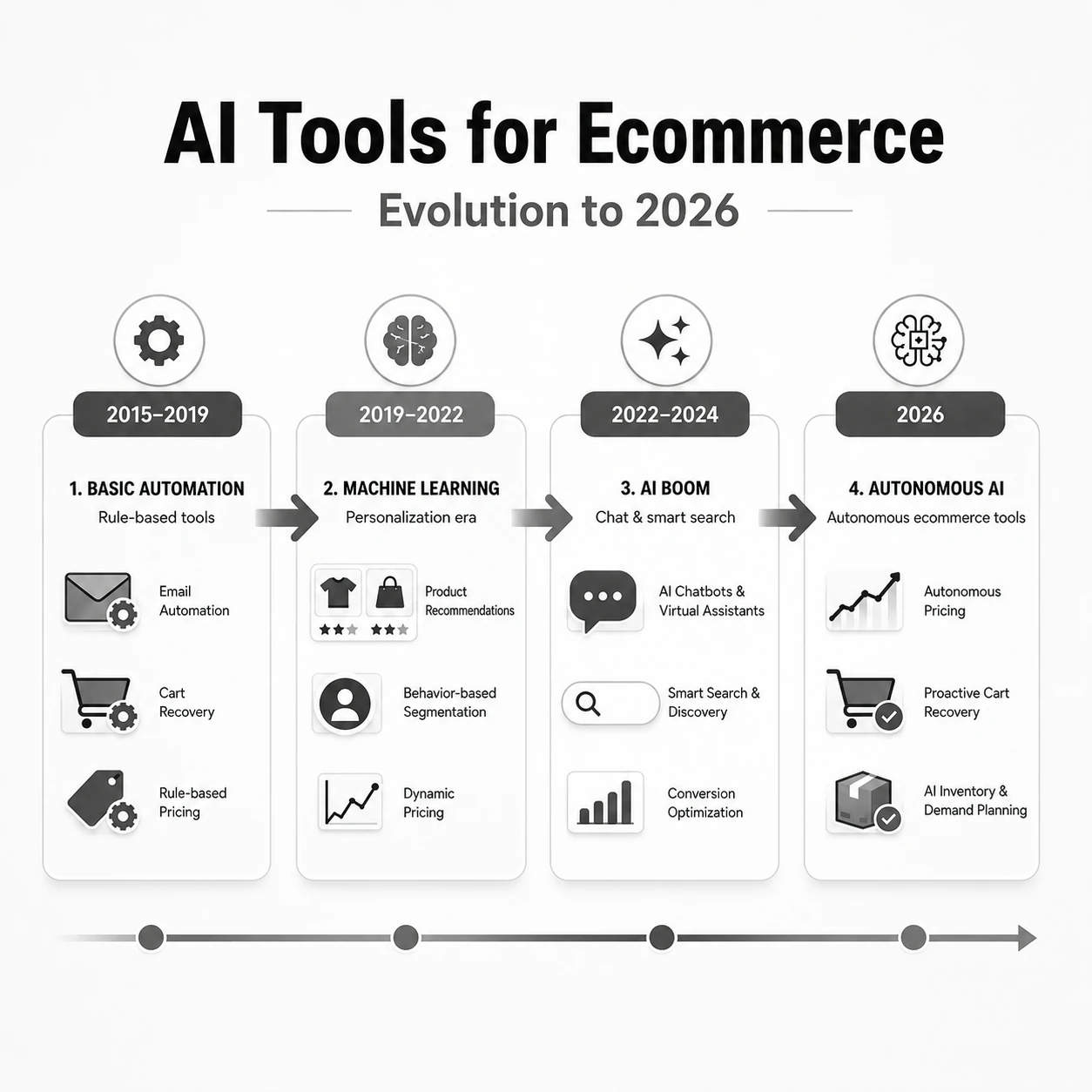
To answer this, it’s important to understand how these tools evolved over time. Early systems were basic and rule-based, while modern AI platforms now use machine learning and large language models to understand user behavior in real time and deliver highly personalized shopping experiences.
In this article, we’ll break down the evolution of AI tools in ecommerce, compare the most important categories, and look at real-world tools that businesses are using today to increase conversions, improve customer experience, and scale their operations.
What Are AI Tools for Ecommerce
AI tools for ecommerce are software solutions that use artificial intelligence to improve how online stores operate, sell products, and interact with customers.
Instead of relying on manual processes or simple automation rules, these tools analyze large amounts of data such as user behavior, purchase history, and search patterns to make smarter decisions in real time.
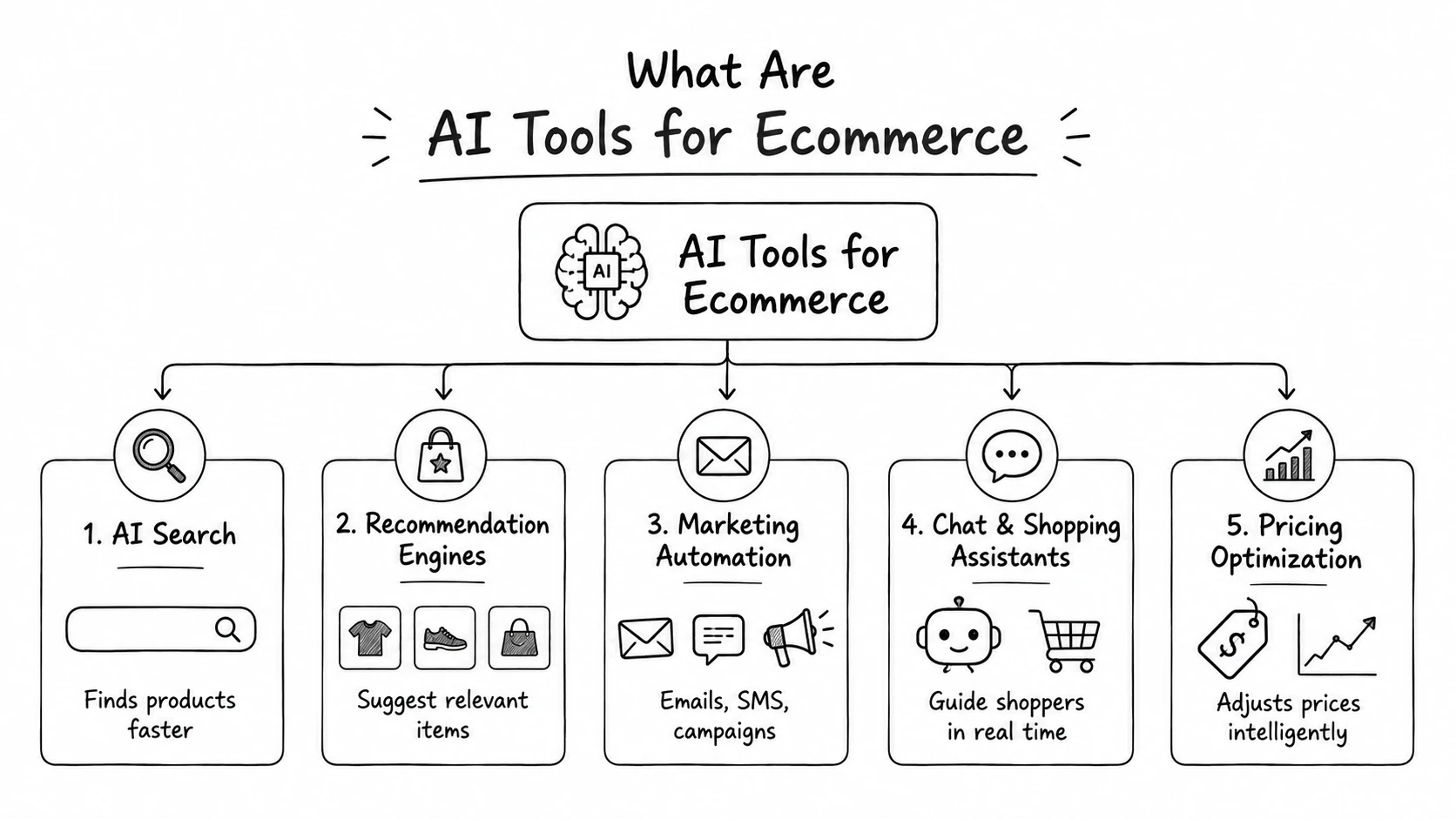
In practice, AI tools are used to optimize nearly every part of the ecommerce journey. This includes helping customers find products faster, recommending items they are more likely to buy, adjusting pricing dynamically, and even recovering abandoned carts automatically.
There are several major categories of AI tools in ecommerce:
- AI search systems – improve product discovery and relevance
- Recommendation engines – suggest personalized products
- Marketing automation tools – automate emails and customer journeys
- Chat and shopping assistants – provide real-time customer support
- Pricing optimization tools – adjust prices based on demand and behavior
To better understand how these systems work in real ecommerce environments, you can also explore our guide on what an AI shopping assistant is and how it works.
The Early AI Tools Era (2015–2019)
The first generation of AI tools in ecommerce was relatively simple compared to what we see today. During this period, most systems were not truly “intelligent” in the modern sense, but rather rule-based automation tools designed to improve efficiency.
At this stage, ecommerce platforms focused mainly on automating repetitive tasks such as email marketing, basic product recommendations, and simple customer segmentation. These systems relied heavily on predefined rules instead of learning from user behavior in real time.
For example, recommendation engines would often suggest products based on basic patterns like “customers who bought this also bought that,” without deeper personalization or contextual understanding.
Email marketing platforms also started introducing automation features, allowing stores to send triggered messages based on simple actions such as cart abandonment or product views.
To understand how early automation evolved into today’s intelligent systems, you can explore more about ecommerce automation concepts through IBM’s explanation of recommendation engines.
Although limited in intelligence, these early tools laid the foundation for the more advanced machine learning systems that followed in the next stage of AI development in ecommerce.
The Machine Learning Era (2019–2022)
Between 2019 and 2022, ecommerce entered a new phase driven by machine learning. Unlike earlier rule-based systems, machine learning models could learn from large amounts of user data and continuously improve their predictions over time.
This shift allowed AI tools to move beyond simple automation and start delivering more accurate personalization, better product recommendations, and improved customer segmentation.
During this period, ecommerce platforms began analyzing user behavior at scale, including clicks, browsing patterns, time spent on pages, and purchase history. These signals were used to predict what customers were most likely to buy next.
One of the biggest improvements was the introduction of predictive analytics, which helped businesses forecast demand, optimize inventory, and improve marketing performance.
Companies like Amazon, Shopify, and other large ecommerce platforms heavily invested in machine learning systems during this period, making personalization a core part of the shopping experience.
To better understand how machine learning powers modern ecommerce systems, you can explore NVIDIA’s explanation of machine learning.
This era marked the transition from basic automation to truly intelligent ecommerce systems that adapt in real time based on user behavior.
The AI Boom Era (2022–2024)
Between 2022 and 2024, ecommerce experienced a major transformation driven by the rise of large language models (LLMs) and generative AI systems. This period marked the moment when AI moved from behind-the-scenes optimization to becoming a visible part of the shopping experience.
Tools started to evolve from simple recommendation engines into conversational systems capable of understanding natural language queries. Customers could now search for products using full sentences, ask questions, and receive personalized answers in real time.
This era also introduced AI-powered chat assistants in ecommerce, helping users find products faster, compare options, and get support without interacting with human agents.
At the same time, platforms like Shopify and other major ecommerce ecosystems began integrating AI features directly into their systems, making it easier for businesses to adopt advanced automation without complex setups.
Another major development was the rise of AI-driven search and discovery tools, which replaced traditional keyword-based search with semantic understanding of user intent.
To understand how conversational AI is changing ecommerce interactions, you can explore OpenAI’s research on language models.
This period represents the point where AI stopped being just an optimization layer and became a core interface between users and ecommerce platforms.
The 2026 Era: Autonomous AI Ecommerce Tools
By 2026, AI tools for ecommerce have evolved from simple assistants into fully autonomous systems capable of making decisions, optimizing performance, and improving sales without constant human input.
Unlike earlier generations of AI, modern systems can now act as “agents” that manage entire parts of the ecommerce funnel — from product discovery and pricing to customer engagement and cart recovery.
These AI systems are not just reactive anymore. They are predictive and proactive, meaning they can anticipate user behavior and adjust the shopping experience in real time before a customer even makes a decision.
For example, AI-powered recommendation engines can now adjust product listings dynamically based on intent signals, while AI search systems understand complex queries and deliver highly relevant results instantly.
In parallel, AI marketing tools can automatically optimize campaigns, segment audiences, and personalize messaging across email, SMS, and on-site experiences.
To understand how personalization drives modern ecommerce performance, you can explore how AI product recommendations increase ecommerce sales.
This new era represents a shift from “using AI tools” to operating within AI-driven ecommerce ecosystems where much of the optimization happens automatically in the background.
Comparison: What Actually Works in 2026
With so many AI tools available in ecommerce today, the real challenge is not finding tools, but understanding which ones actually deliver measurable results in 2026.
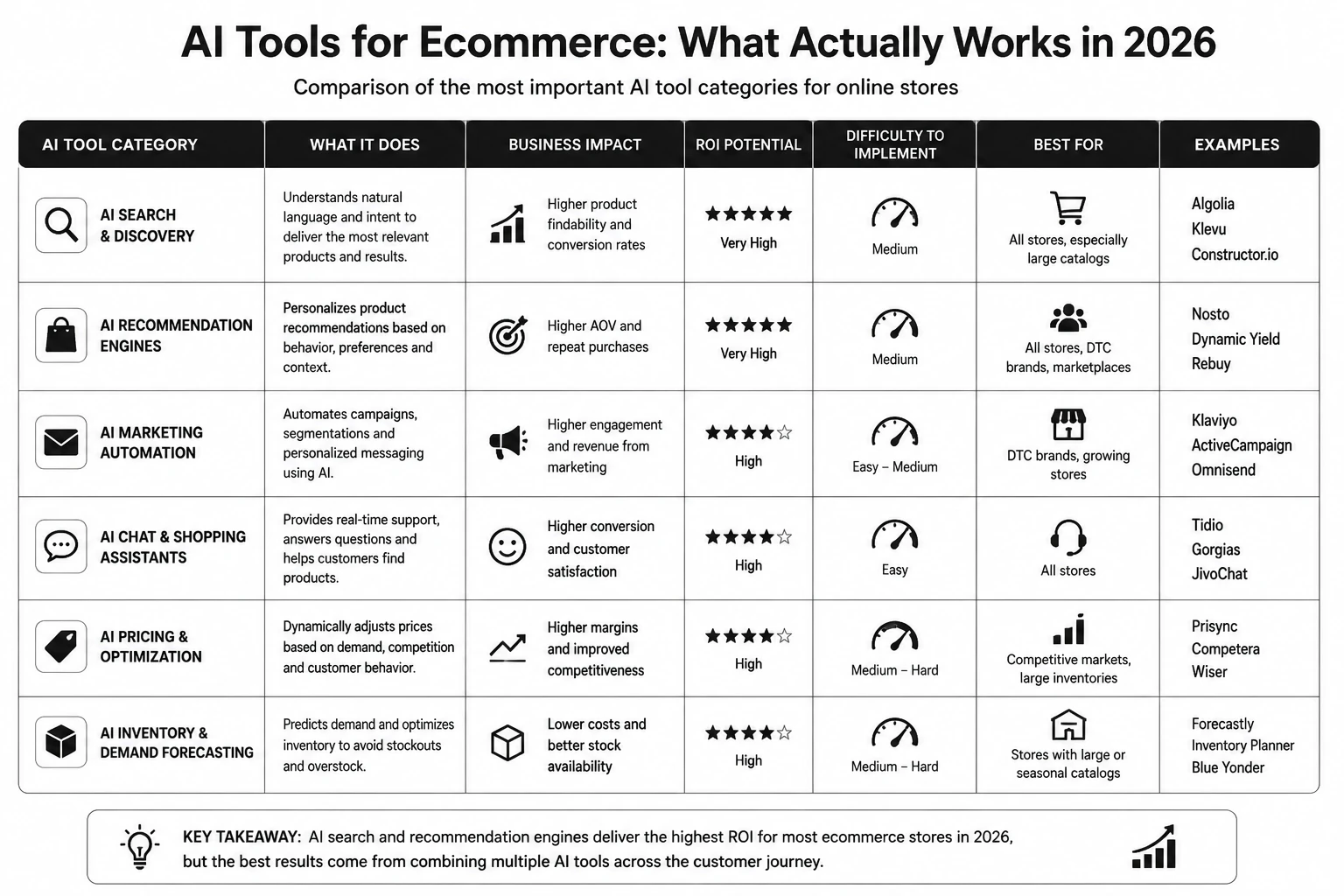
While many platforms promise full automation and advanced intelligence, only a few categories consistently show strong performance across conversion rate, customer experience, and return on investment.
AI Search Tools
AI search systems are among the most effective tools in modern ecommerce. They improve product discovery by understanding user intent instead of relying on exact keyword matches.
Tools like Algolia AI Search are widely used because they significantly reduce friction in the buying journey and help users find products faster.
Recommendation Engines
AI recommendation systems remain one of the highest ROI tools in ecommerce. They analyze user behavior and suggest relevant products that increase average order value and conversion rates.
Platforms like Nosto and Dynamic Yield are commonly used in both mid-size and enterprise ecommerce businesses.
AI Marketing Automation
Marketing automation tools powered by AI help ecommerce brands personalize communication across email, SMS, and on-site messaging.
Klaviyo is one of the most popular platforms in this category due to its strong ecommerce integrations and behavioral targeting capabilities.
AI Pricing & Optimization Tools
Dynamic pricing and optimization tools use AI to adjust prices based on demand, competition, and user behavior. These systems are mostly used by large-scale ecommerce platforms.
Salesforce Einstein is one example of a system that integrates AI-driven optimization across multiple ecommerce functions.
Overall, the most effective AI tools in 2026 are those that are deeply integrated into the ecommerce funnel rather than standalone features.
Real User Reviews & Opinions
Beyond technical features and marketing claims, one of the most important ways to evaluate AI tools for ecommerce is to look at real user feedback. Store owners, marketers, and developers often share their experiences on platforms like Reddit, G2, and YouTube, providing valuable insights into what actually works in practice.
In many cases, users highlight that the biggest difference between AI tools is not the technology itself, but how well it integrates into existing ecommerce workflows and how easy it is to implement without technical complexity.
Community feedback from ecommerce users
Discussions on Reddit ecommerce communities often show that tools like AI recommendation engines and automation platforms perform best when properly configured, while poorly implemented systems tend to deliver underwhelming results.
Professional reviews and ratings
Platforms such as G2 and Capterra provide structured reviews from verified users, helping businesses compare tools based on usability, features, and return on investment.
Video-based tool testing
Many ecommerce professionals also rely on YouTube reviews and case studies to see how AI tools perform in real environments before making a decision.
To explore how AI tools are applied in real ecommerce scenarios, you can also review our guide on AI tools for Amazon sellers, which includes practical use cases and tool comparisons.
Overall, real-world feedback shows that AI tools are most effective when they are not just adopted, but properly integrated into a complete ecommerce strategy.
Best AI Tools by Business Type
Not all AI tools for ecommerce are suitable for every type of business. The effectiveness of a tool often depends on the size of the store, the business model, and the level of technical complexity it can support.
To help make better decisions, it’s useful to break down AI tools based on different ecommerce business types.
Small Ecommerce Stores
Small stores usually need easy-to-use AI tools that require minimal setup and deliver fast results. The focus is typically on automation and quick improvements in conversion rates.
Tools like Klaviyo are popular in this segment because they offer powerful email automation and behavioral targeting without requiring advanced technical knowledge.
Shopify Brands
Shopify-based businesses benefit the most from integrated AI apps that improve product discovery, search, and personalization.
Platforms like Nosto and Shopify’s own AI features help merchants increase conversion rates through real-time personalization and smart recommendations.
Enterprise Ecommerce
Larger ecommerce companies require advanced AI systems that can handle large-scale data processing, dynamic pricing, and omnichannel personalization.
Salesforce Einstein is often used in enterprise environments due to its deep integration with CRM, marketing, and analytics systems.
Amazon Sellers
Amazon sellers rely heavily on AI tools for product research, listing optimization, and market analysis to stay competitive in a highly saturated marketplace.
To explore this category further, you can check our guide on AI tools for Amazon sellers.
Overall, choosing the right AI tool depends less on popularity and more on how well it fits the specific needs of the business model.
Common Mistakes With AI Tools
Even though AI tools for ecommerce can significantly improve performance, many businesses fail to get results because they use them incorrectly or without a clear strategy.
One of the most common mistakes is adopting too many tools at once without proper integration. This often leads to fragmented systems that do not communicate effectively with each other.
1. Using AI without clean data
AI systems rely heavily on data quality. If the input data is incomplete, inconsistent, or poorly structured, the output will also be unreliable and less effective.
2. Over-automation without strategy
Many businesses try to automate everything at once, which can lead to poor customer experiences. AI should support decision-making, not replace strategic thinking.
3. Ignoring proper setup and optimization
Even powerful tools like recommendation engines or AI search systems require proper configuration. Without optimization, their performance is often far below potential.
4. Focusing only on tools, not outcomes
Some businesses focus too much on the tool itself instead of measuring actual business results such as conversion rate, average order value, and customer retention.
To understand how properly implemented AI systems can improve performance, you can explore our guide on AI product recommendations in ecommerce.
Ultimately, success with AI tools depends more on implementation strategy than on the tools themselves.
Future of AI Ecommerce Tools (2026–2030)
The future of AI tools for ecommerce is moving beyond automation and optimization toward fully autonomous systems that can manage large parts of the shopping experience without human intervention.
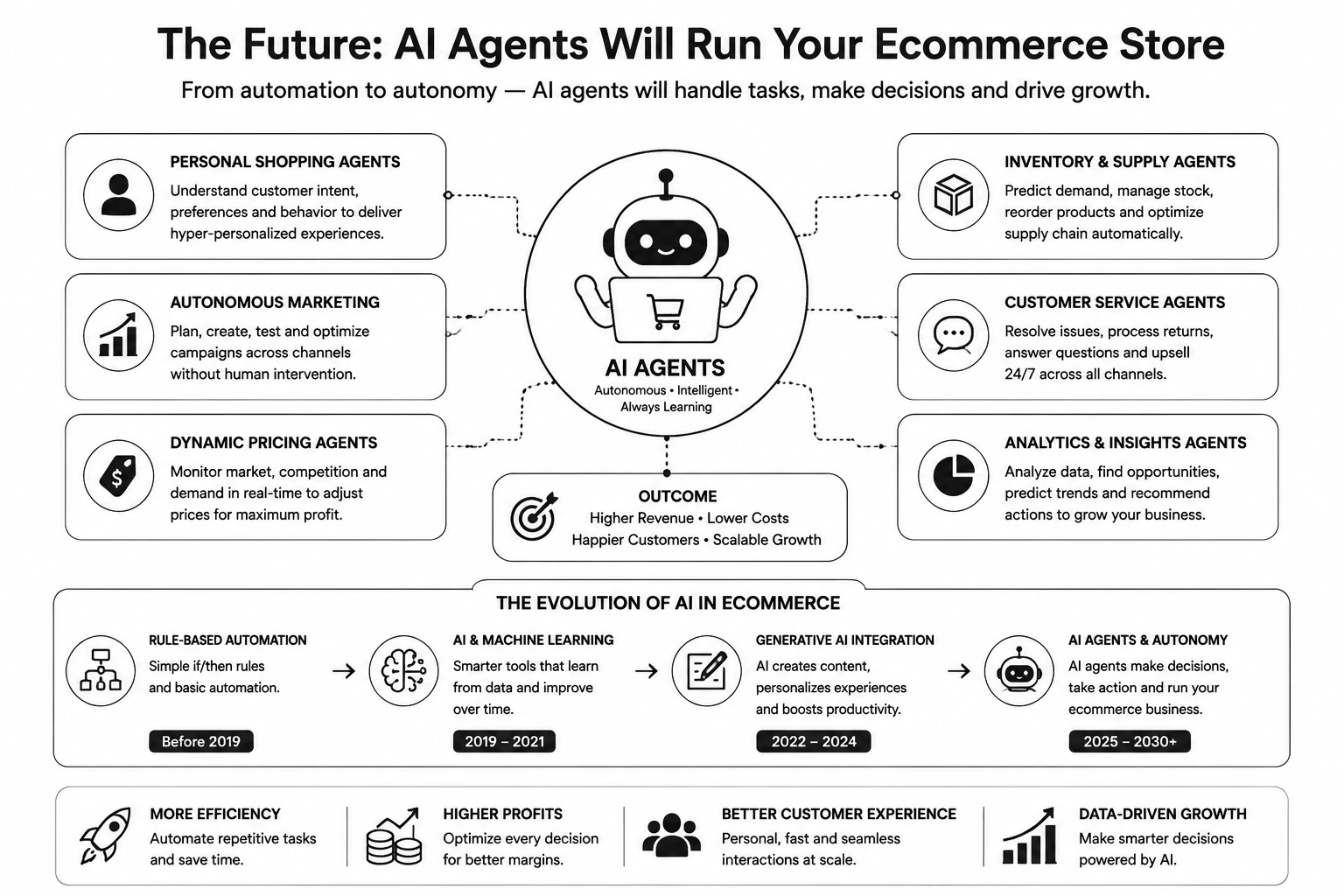
Instead of simply supporting ecommerce operations, AI systems are evolving into intelligent agents that can independently optimize product discovery, pricing, marketing, and customer engagement in real time.
1. AI agents in ecommerce
One of the biggest trends is the rise of AI agents that can perform complex tasks such as managing campaigns, adjusting product listings, and optimizing conversions based on live data.
2. Fully autonomous shopping experiences
Future ecommerce platforms may allow AI to handle entire customer journeys, from discovery to purchase, with minimal user input required.
3. Hyper-personalization at scale
AI will continue to evolve toward deeper personalization, where every user sees a completely unique version of a store based on behavior, intent, and context.
4. Zero-click commerce
Another emerging trend is zero-click commerce, where AI predicts user needs and completes transactions automatically or with very few interactions.
To understand how AI is already shaping this transformation, you can explore our guide on the future of AI in ecommerce.
Overall, the next generation of AI ecommerce tools will not just assist online stores — they will actively run and optimize them.
Conclusion: What Actually Matters
AI tools for ecommerce have evolved from simple automation systems into highly advanced platforms that can influence almost every part of the online shopping journey. From early rule-based systems to modern AI agents, the transformation has been both fast and significant.
However, despite all the technological progress, one key truth remains the same: success with AI tools depends less on the tools themselves and more on how they are implemented and integrated into a real ecommerce strategy.
Businesses that focus only on adopting the latest tools without understanding data quality, customer behavior, and proper optimization often fail to see meaningful results.
On the other hand, companies that combine the right AI tools with strong strategy and clean data can significantly improve conversion rates, customer experience, and long-term revenue growth.
Ultimately, AI in ecommerce is not about replacing human decision-making, but about enhancing it with better insights, automation, and predictive capabilities.
To explore more about how AI is shaping the future of online shopping, you can visit our homepage at AI Shopping Assistant.
Frequently Asked Questions
What are AI tools for ecommerce?
AI tools for ecommerce are software solutions that use artificial intelligence to improve online stores through automation, personalization, search optimization, and customer engagement.
Which AI tools work best for ecommerce in 2026?
The most effective tools in 2026 are AI search systems, recommendation engines, marketing automation platforms, and AI-driven personalization tools that directly impact conversion rates and revenue.
Are AI ecommerce tools worth it for small businesses?
Yes, many AI tools are designed for small businesses and can help improve sales, automate marketing, and enhance product discovery without requiring complex technical setup.
What is the most important AI tool for ecommerce?
There is no single “best” tool, but AI recommendation engines and AI search systems are often considered the most impactful because they directly improve user experience and conversions.
Do AI tools replace human work in ecommerce?
No, AI tools are designed to assist and enhance human decision-making, not replace it. They help automate repetitive tasks and provide better insights for strategic decisions.
How do AI tools improve ecommerce sales?
AI tools improve sales by personalizing product recommendations, optimizing search results, automating marketing campaigns, and reducing cart abandonment rates.