

Finding profitable products to sell on Amazon is rarely about discovering one “secret” item before everyone else. Strong product research is usually a process of checking demand, competition, pricing, fees, review quality, seasonality, sourcing options, and operational risk before money is committed to inventory.
That process can become difficult very quickly. Amazon sellers may need to compare thousands of listings, estimate demand, identify competitors, track price history, calculate FBA fees, check restrictions, review customer complaints, and decide whether a product opportunity is realistic for their business model.
This is where AI product research tools can help. They do not guarantee a winning product, but they can reduce the time required to analyze large amounts of marketplace data and highlight opportunities that deserve closer investigation.
For example, an Amazon seller may want to find products that meet several conditions at the same time:
“Products selling consistently between $25 and $60, with manageable competition, room for profit after FBA fees, and clear opportunities for product improvement.”
Instead of manually reviewing hundreds of listings, AI-assisted research platforms can help filter opportunities using sales estimates, keyword demand, review patterns, price history, market share, seller activity, and product-level profitability data.
Amazon itself provides Product Opportunity Explorer, a Seller Central tool designed to help sellers analyze customer search trends, purchases, reviews, pricing, and product demand. It can be useful for identifying niches where customers are actively searching but the available offers may not fully satisfy demand.
However, most serious Amazon sellers use additional software because each tool approaches product research differently. Some are better for private-label research, others are stronger for wholesale sourcing, online arbitrage, competitor analysis, keyword research, price tracking, or validating a product before purchase.
In this guide from AI Shopping Assistant, we compare the best AI product research tools for Amazon sellers, including platforms designed for private label, wholesale, online arbitrage, retail arbitrage, and broader market analysis. We will look at what each tool does well, who it is best for, and where it may fall short.
Before choosing any platform, it is important to understand one thing: AI can accelerate research, but it cannot remove the need for judgment. A tool may identify demand or estimate sales, yet it cannot guarantee supplier quality, protect you from intellectual-property risks, or ensure that your final margins remain profitable after shipping, returns, advertising, and Amazon fees.
For a broader look at how AI supports ecommerce decision-making, see our guide on how AI product recommendations increase ecommerce sales and our overview of what an AI shopping assistant is and how it works.
Quick Comparison: Best AI Product Research Tools for Amazon Sellers
Not every Amazon research platform uses AI in the same way. Some tools use machine learning, trend detection, or AI-assisted analysis, while others provide essential marketplace data such as price history, sales estimates, fees, and competitor information.
For most sellers, the best approach is not to rely on one “magic” tool. It is to combine product-discovery software with historical data, profitability checks, and the same type of demand analysis discussed in our guide to AI search for ecommerce.
| Tool | Best For | Main Research Strength | Best Selling Model | Free Option or Trial | Starting Price* |
|---|---|---|---|---|---|
| Helium 10 | All-around Amazon product research | Black Box filters, keyword research, product validation, listing tools, and profitability analysis | Private label, wholesale, growing sellers | Free plan available | From $39/month on annual billing |
| Jungle Scout | Product opportunity and competitor research | Opportunity discovery, ASIN analysis, sales estimates, category insights, and market intelligence | Private label, brands, agencies | Plan availability varies | From $49/month |
| SmartScout | Brand, seller, and wholesale research | Brand databases, seller intelligence, product discovery, market mapping, and sales estimates | Wholesale, online arbitrage, brand research | Check current offer | From $25/month on annual billing |
| SellerAmp SAS | Fast sourcing decisions | ROI, profit, fees, restrictions, IP alerts, Buy Box data, and sourcing analysis | Online arbitrage, retail arbitrage, wholesale | Free trial available | See marketplace-specific pricing |
| Keepa | Price and demand validation | Price history, Buy Box history, sales-rank charts, stock tracking, and alerts | All Amazon business models | Free charts; paid data access available | Varies by subscription |
| AMZScout | Beginner-friendly product research | Product database, sales estimates, product tracking, keyword tools, and extension-based research | Beginners, private label, arbitrage | Free product-database access available | See current plans |
| SellerSprite | Keyword, market, and competitor data | Product database, category analysis, keyword research, competitor tracking, and profitability tools | Private label, FBA, international sellers | Free trial may be available | From about $19/month |
| Exploding Topics | Finding emerging demand before it peaks | Trend discovery, product-topic monitoring, forecasts, and early-market signals | Private label, product development, trend research | Free browsing plus trial options | From $39/month |
*Pricing, plans, and trial conditions can change. Always verify the current offer directly on the provider’s official website before subscribing.
The table also shows why Amazon sellers often use more than one platform. Helium 10 or Jungle Scout may help identify a potential market, SmartScout may reveal the brands and sellers already dominating it, SellerAmp can support a quick sourcing decision, and Keepa can validate whether the product has stable price and demand history.
What Makes an Amazon Product Research Tool AI-Powered?
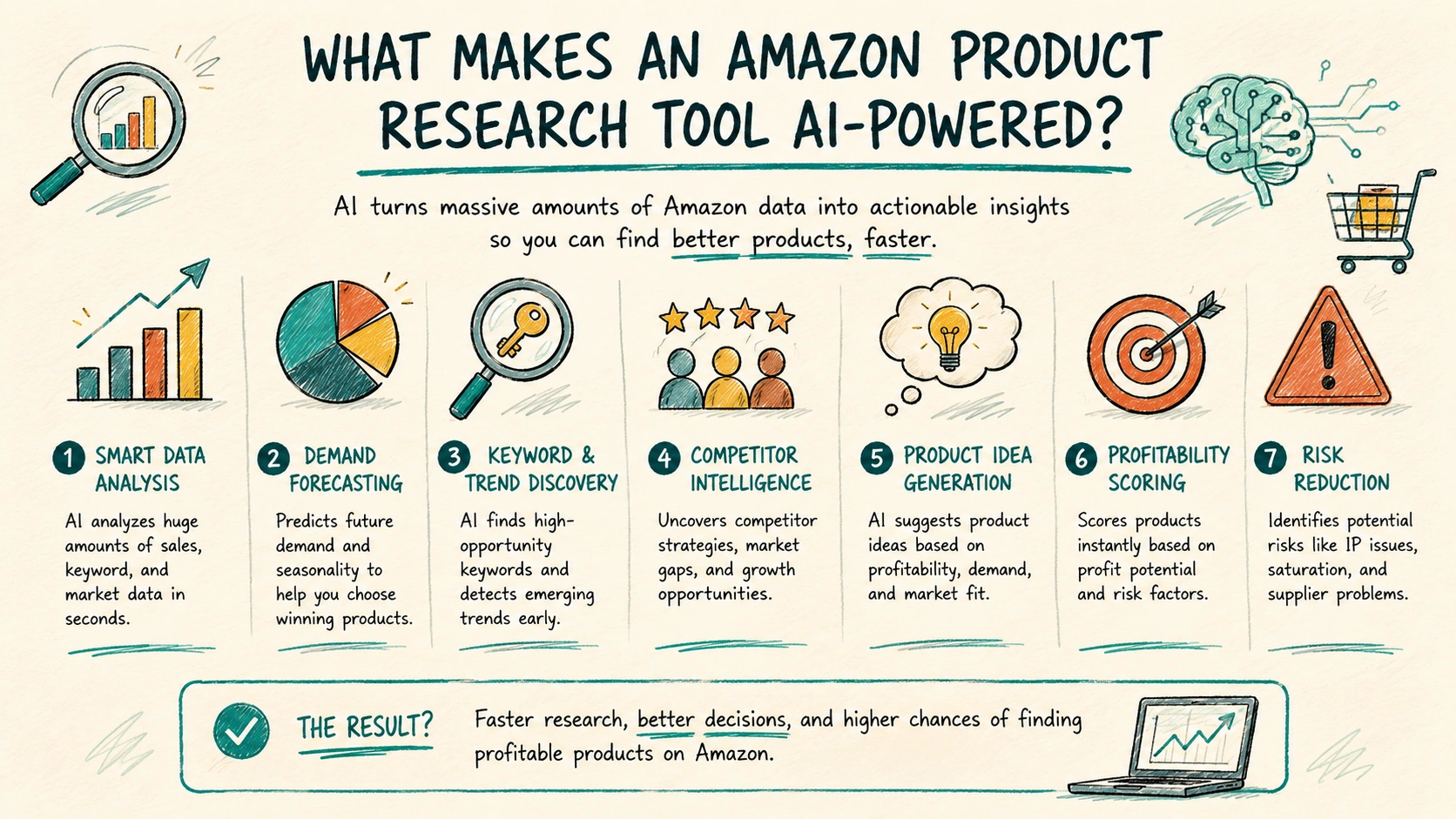
Not every Amazon research platform is truly AI-powered in the same way. Some tools use artificial intelligence to summarize review patterns, generate listing ideas, detect market opportunities, or explain performance data. Others mainly provide structured marketplace data such as price history, sales estimates, search volume, fees, and seller activity.
Both types of tools can be useful. The important question is whether the platform helps you make better sourcing decisions faster, not whether it simply adds the word “AI” to its marketing.
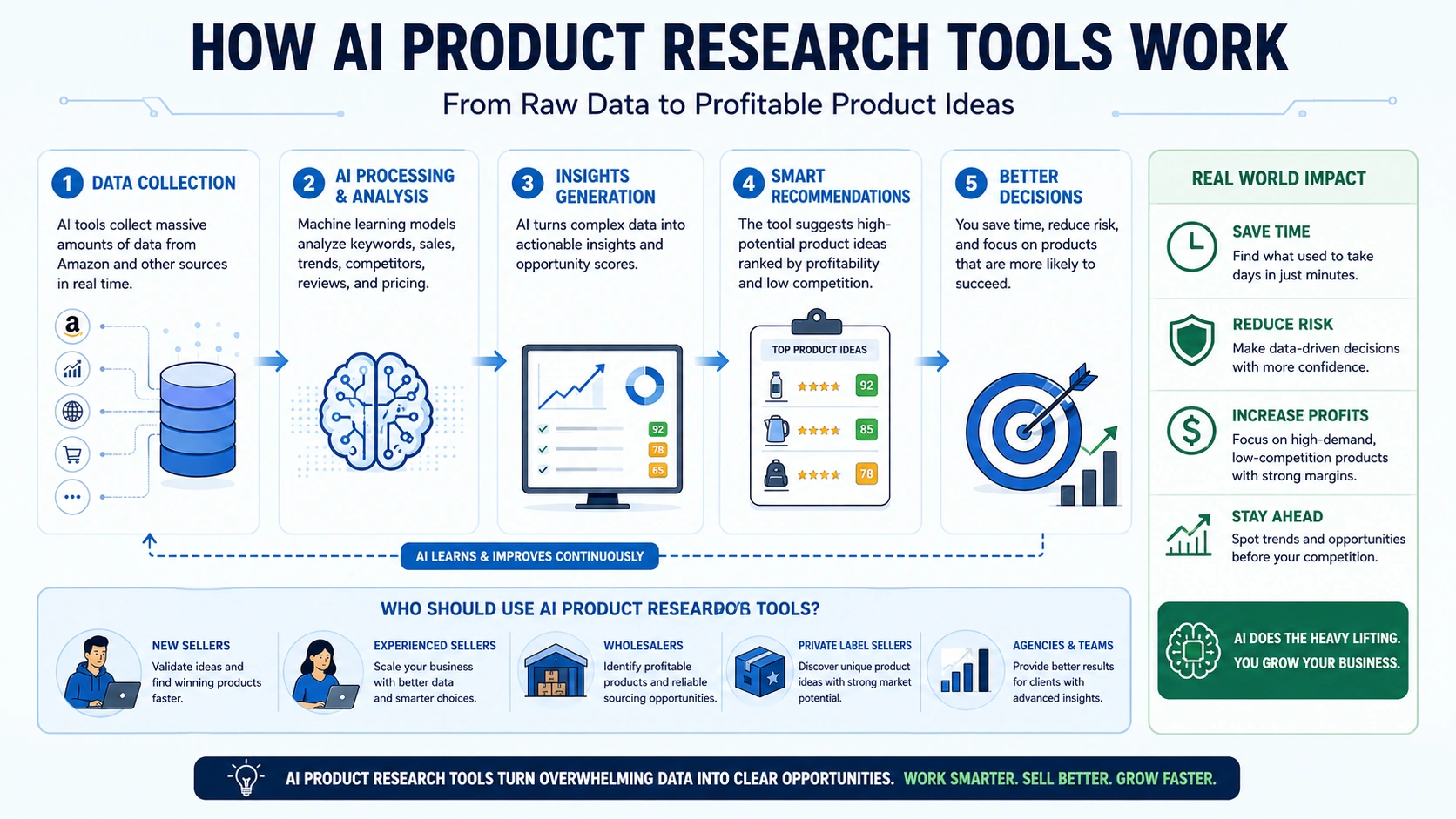
AI Can Help Sellers Process More Data Faster
Amazon product research can involve thousands of listings, search terms, reviews, pricing changes, and competitor signals. AI-assisted platforms can reduce the time needed to identify patterns and narrow a large dataset into a shortlist worth reviewing.
For example, Helium 10’s Black Box tool is designed to filter large Amazon datasets using criteria such as price, margin, competition, and operational limits. Instead of manually browsing category after category, sellers can set conditions that fit their business model and review a smaller number of potential opportunities.
That does not mean the tool has found a guaranteed winner. It means it has reduced the amount of manual filtering required before the seller begins deeper validation.
Common AI-Assisted Product Research Capabilities
An AI-powered or AI-assisted Amazon research tool may help with:
- Finding product ideas based on selected filters
- Identifying category and keyword trends
- Analyzing review patterns and recurring complaints
- Grouping similar products or competitor listings
- Estimating demand and sales potential
- Highlighting products with unusual growth or declining demand
- Summarizing market data for faster decision-making
- Generating listing, keyword, or product-improvement ideas
Jungle Scout, for example, offers AI-assisted features that can analyze customer-review themes and help sellers identify recurring pain points in competitor products. Its AI Review Analysis is designed to surface common themes from reviews for a specific ASIN, which can be useful when evaluating how a new product could be improved.
AI Is Most Useful When It Supports a Clear Decision
The best use of AI is not to replace research completely. It is to help answer practical questions faster:
- Is demand stable, growing, or falling?
- Are customers unhappy with the existing products?
- Is competition concentrated around a few dominant brands?
- Does the price leave enough room for FBA fees, advertising, and profit?
- Are shoppers searching for something the current listings do not provide?
Amazon’s own Product Opportunity Explorer helps sellers analyze customer search trends, purchases, reviews, and pricing before deciding what to sell. That is a good example of how research technology should support a real decision rather than simply produce more charts.
AI Does Not Replace Historical Data
AI can summarize signals and identify patterns, but it still needs reliable underlying data. Sellers should continue checking price history, sales-rank changes, Buy Box behavior, estimated fees, inventory risk, and category restrictions.
A product can look attractive in an AI-generated opportunity list but still be risky because of:
- Unstable pricing
- Seasonal demand
- High return rates
- Heavy competition from Amazon itself
- Patent or trademark risk
- Hazmat restrictions
- Low margins after advertising and FBA fees
This is why many experienced sellers combine an AI-assisted discovery tool with validation tools such as Keepa, SellerAmp, or Amazon’s own Seller Central data.
AI Can Help Identify Product Improvement Opportunities
For private-label sellers, AI becomes especially useful when it helps turn competitor weaknesses into product opportunities.
For example, if repeated reviews mention weak handles, confusing instructions, poor packaging, or missing accessories, the seller may have an opportunity to create a better offer rather than simply copying an existing listing.
This is closely related to the same customer-intent analysis discussed in our article on AI search for ecommerce. In both cases, the value comes from understanding what customers are actually looking for and where current products fail to meet expectations.
What AI Cannot Tell You With Certainty
AI can speed up research, but it cannot guarantee success. No tool can fully predict future demand, supplier reliability, Amazon policy changes, advertising costs, competitor reactions, or intellectual-property disputes.
Use AI to reduce research time and uncover stronger questions. Then validate every promising product with real marketplace data, profitability calculations, sourcing checks, and risk analysis before placing an order.
Best Overall AI Product Research Tool: Helium 10
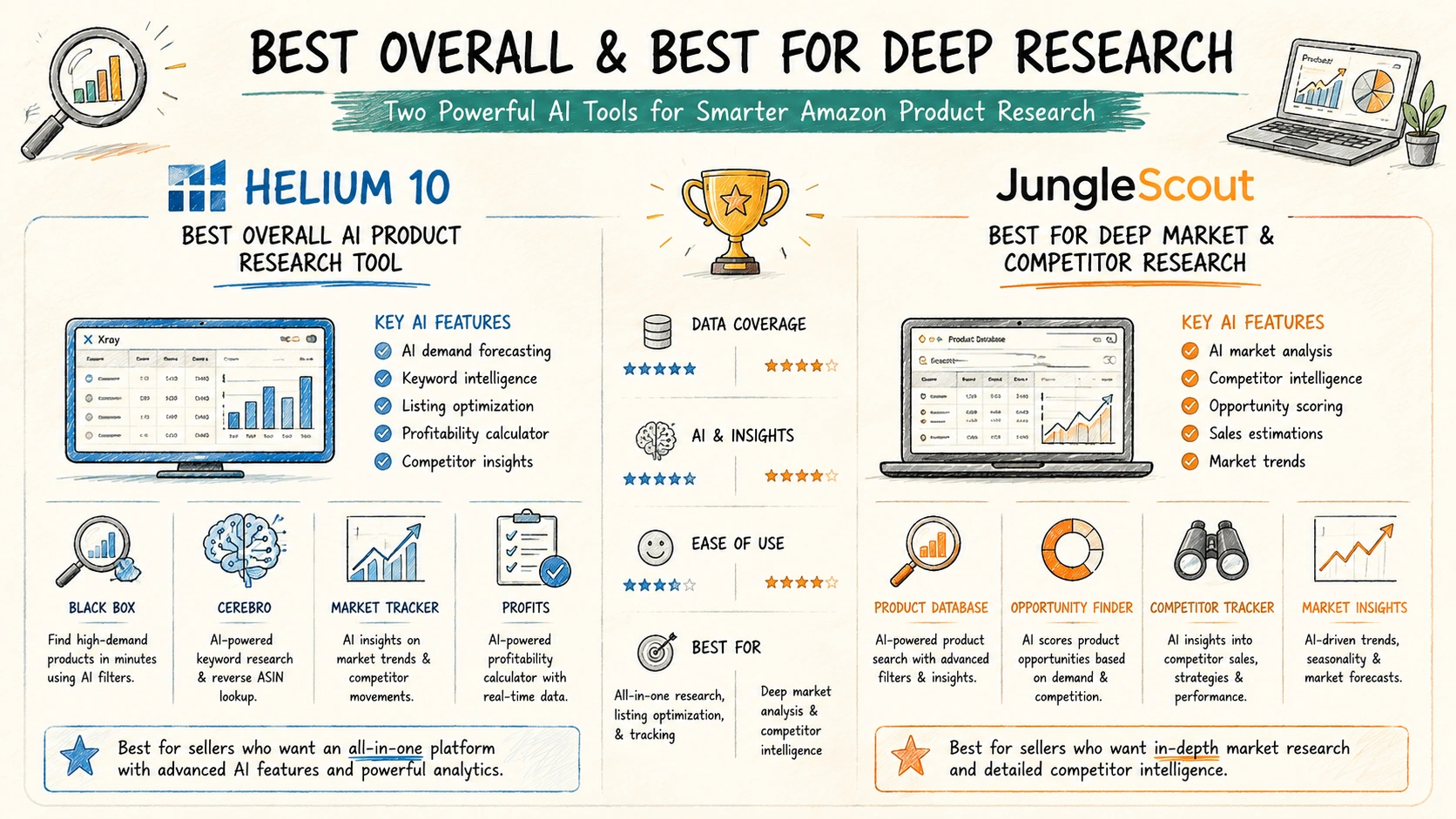
Helium 10 is one of the most complete product-research platforms for Amazon sellers because it combines product discovery, keyword research, competitor analysis, profitability checks, and listing tools in one ecosystem.
It is especially useful for private-label sellers, growing FBA businesses, and sellers who want to research products without switching constantly between separate tools.
Why Helium 10 Stands Out
Helium 10’s main product-research tool is Black Box. It allows sellers to filter Amazon opportunities using criteria such as price, estimated sales, review count, category, weight, dimensions, competition, and revenue potential.
Instead of browsing Amazon manually for hours, a seller can search for products that match a defined opportunity profile.
For example, a private-label seller might filter for products with:
- A selling price between $25 and $60
- Consistent monthly demand
- Moderate review competition
- Low product weight
- Enough margin after Amazon fees
Helium 10 states that Black Box lets sellers combine more than 20 filters to narrow a large product dataset into opportunities that fit their specific requirements. The platform also includes price-history and sales-trend validation to help sellers avoid obvious seasonal spikes or short-lived fads.
Useful Helium 10 Tools for Product Research
- Black Box: Product opportunity discovery using custom filters
- Xray Chrome Extension: Product-level sales estimates, revenue data, reviews, fees, and competitor details while browsing Amazon
- Cerebro: Reverse-ASIN keyword research to see which keywords competitors rank for
- Magnet: Amazon keyword discovery and search-volume research
- Trendster: Historical trend and seasonality analysis
- Profitability Calculator: Basic FBA fee and margin validation
- Listing Builder: AI-assisted listing optimization after a product is selected
The Helium 10 Chrome Extension is particularly useful for validating individual listings. It can show estimated sales, pricing, fees, demand signals, and competitor information directly while you browse Amazon.
Best Use Cases
Helium 10 is strongest for:
- Private-label product research
- Amazon FBA sellers launching new products
- Keyword-driven market research
- Competitor listing analysis
- Validating sales potential before sourcing
- Sellers who want one broader Amazon toolkit
It can also help wholesale sellers, but platforms such as SmartScout and SellerAmp are often more specialized for brand analysis, supplier sourcing, and quick sourcing decisions.
Strengths
- Large ecosystem of Amazon seller tools
- Strong product-discovery filters in Black Box
- Useful Chrome extension for fast listing analysis
- Good combination of product, keyword, and competitor research
- Supports validation beyond initial product discovery
- Free tools and limited free access are available
Limitations
- The platform can feel overwhelming for complete beginners
- Many useful features are spread across separate tools
- Sales estimates should still be validated with historical data
- It is more expensive than simple single-purpose tools
- It does not remove the need to check IP risks, supplier quality, or real landed costs
Pricing and Value
Helium 10 offers free tools and paid plans. Its official pricing page currently lists paid plans starting from around $99 per month when billed annually, with higher tiers for sellers who need broader access, more usage limits, or additional features.
Pricing changes regularly, so always check the current offer directly on the official Helium 10 pricing page before subscribing.
Verdict
Helium 10 is the best overall option for Amazon sellers who want an all-in-one research platform rather than a single product-finder tool. It is particularly strong for private-label research because it helps sellers move from product discovery to keyword validation, competitor analysis, profitability checks, and listing creation.
For sellers who are still building their workflow, Helium 10 can also fit naturally alongside the broader AI tools covered in our guide to best AI tools for Shopify store owners, especially if they sell across multiple ecommerce channels.
Best for Deep Market and Competitor Research: Jungle Scout
Jungle Scout is a strong option for Amazon sellers who want to evaluate a market before committing to a product. It is particularly useful for private-label sellers, brands, and agencies that need to look beyond one listing and understand demand, competition, category movement, and customer feedback.
Its product-research workflow is built around identifying opportunities, validating estimated sales, tracking products over time, and analyzing competing ASINs.
Why Jungle Scout Stands Out
Jungle Scout’s Opportunity Finder helps sellers search for niches and product opportunities using data such as keyword demand, competition, search trends, and estimated market performance.
For example, a seller could look for product ideas with:
- Growing search demand
- Moderate competition
- Manageable review counts
- Stable pricing
- Clear customer complaints that could be solved
The goal is not simply to identify a product with sales. It is to find a market where customer demand exists and the current offers leave room for a better product, listing, bundle, or positioning strategy.
Useful Jungle Scout Tools for Product Research
- Opportunity Finder: Finds niches, keywords, product ideas, and emerging demand patterns.
- Product Database: Lets sellers filter Amazon products by price, sales, revenue, reviews, category, dimensions, and other criteria.
- Product Tracker: Tracks selected products over time to validate sales, revenue, and pricing trends.
- Sales Estimator: Provides estimated monthly sales for Amazon categories and products.
- Chrome Extension: Shows listing-level data while browsing Amazon, including sales estimates, revenue, reviews, and seller information.
- AI Review Analysis: Summarizes customer-review themes and recurring complaints for a selected ASIN.
- Listing Analyzer: Helps identify listing-quality and customer-feedback patterns that may create an improvement opportunity.
Jungle Scout’s official Opportunity Finder is positioned as a tool for discovering emerging keyword trends, profitable niches, and in-demand products. Its Chrome extension also includes AI review analysis to help sellers identify recurring customer pain points in competing listings.
AI Review Analysis Is Especially Useful for Private Label
Review analysis can be one of the most useful AI-assisted features in product research because it helps sellers move beyond generic sales estimates.
A listing may sell well while still receiving repeated complaints about:
- Weak materials
- Confusing instructions
- Missing accessories
- Poor packaging
- Incorrect sizing
- Low durability
These patterns can reveal an opportunity to launch a better version of the product rather than entering the market with an almost identical offer.
Jungle Scout states that its AI review analysis can identify common themes in seller and competitor reviews for a given ASIN, helping sellers understand customer needs and possible improvement areas.
Best Use Cases
Jungle Scout is strongest for:
- Private-label product research
- Amazon FBA market validation
- Keyword and niche research
- Competitor analysis
- Review-based product improvement ideas
- Brands and agencies monitoring market movement
It is less specialized for quick retail-arbitrage or online-arbitrage sourcing decisions. Sellers focused on scanning individual products for immediate ROI, restrictions, and resale risk may prefer SellerAmp SAS alongside Keepa.
Strengths
- Strong market and niche research workflow
- Useful opportunity-discovery and product-tracking tools
- AI-assisted review analysis for customer insights
- Clear focus on demand, competition, and product improvement
- Useful Chrome extension for validating listings while browsing Amazon
- Suitable for more strategic private-label research
Limitations
- Can be more than a beginner needs for simple sourcing decisions
- Estimated sales should always be checked against historical signals
- It does not replace direct supplier validation or landed-cost calculations
- Review analysis can identify patterns, but sellers still need to read key reviews manually
- Its value is highest when used consistently rather than for a one-time product search
Pricing and Value
Jungle Scout’s product lineup and pricing structure have changed over time, so it is better to verify current plans directly rather than rely on older comparison articles. The company currently positions Catalyst as its seller-focused platform, with AI-assisted tools for review analysis, listings, and strategy refinement.
For sellers launching private-label products or researching categories in depth, Jungle Scout can justify its cost because it helps combine opportunity discovery, competitor research, product tracking, and customer-feedback analysis in one workflow.
Verdict
Jungle Scout is one of the best AI-assisted product research platforms for Amazon sellers who want to study a market before investing in inventory. It is especially valuable for private-label sellers who need to understand keyword demand, competitor strength, sales potential, and the customer complaints that may reveal a product-improvement opportunity.
It works best when paired with historical validation tools and real profit calculations. AI can summarize a market quickly, but the seller still needs to confirm price stability, fees, sourcing costs, restrictions, and risk before placing an order.
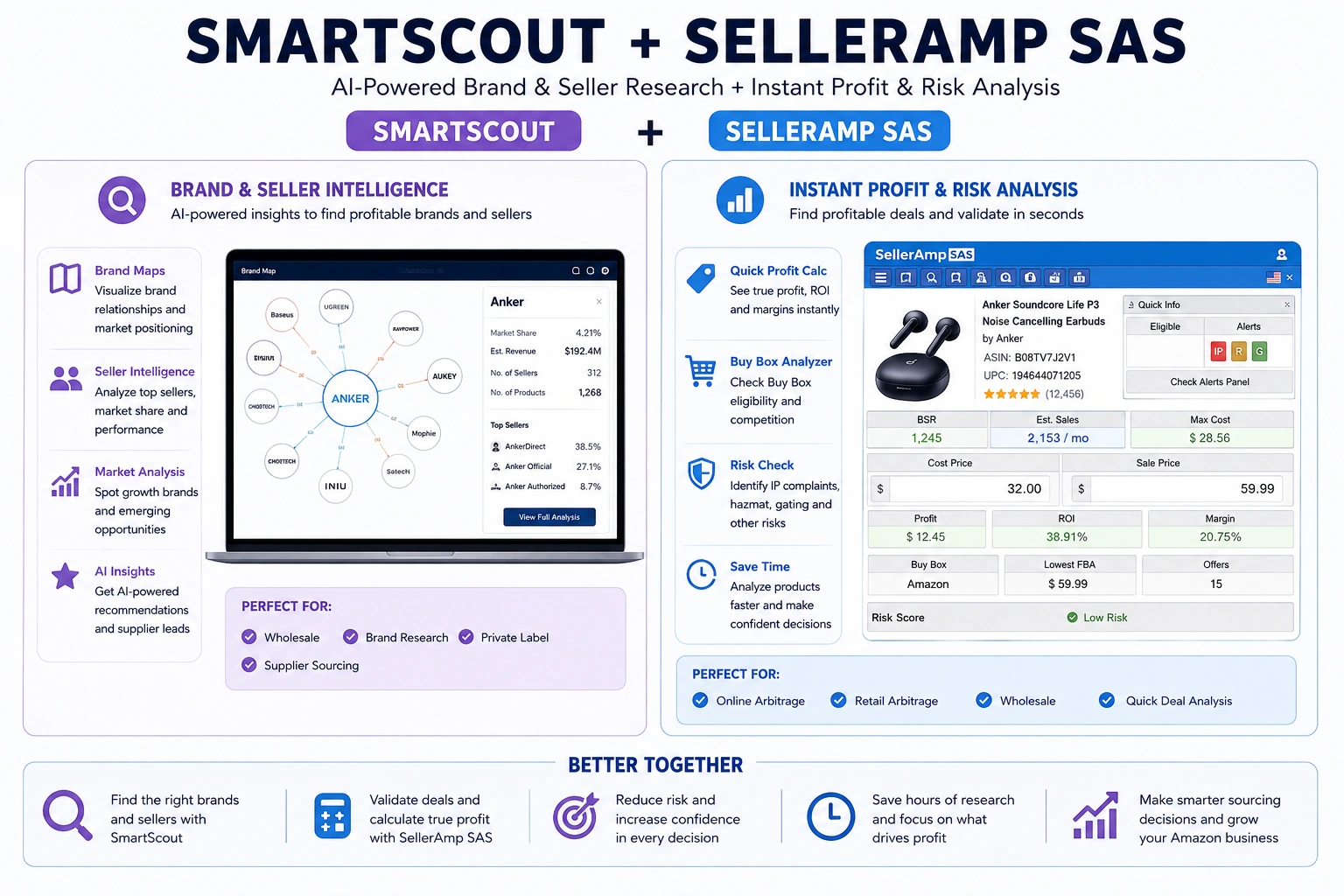
Best for Wholesale, Brand Research, and Market Mapping: SmartScout
SmartScout is one of the strongest Amazon research tools for sellers who want to understand the marketplace at a brand, seller, and category level. It is especially useful for wholesale sellers, online arbitrage sellers, agencies, and anyone trying to identify which brands, sellers, or subcategories are worth investigating.
Unlike tools that focus mainly on finding individual product ideas, SmartScout is built around market mapping. It helps sellers see who is selling, which brands dominate, how crowded a category is, and where there may be room to compete.
Why SmartScout Stands Out
SmartScout’s product database allows sellers to search a large number of Amazon listings using filters such as revenue, seller count, competition, category, and estimated demand.
Its official product-research page says the platform can search more than 20 million Amazon products and help sellers review revenue, seller count, competition, traffic data, and trends without opening large numbers of listings manually.
That makes it especially useful when you are not looking for one random product, but rather trying to answer questions such as:
- Which brands are doing well in this category?
- Who is the dominant seller for a product line?
- Does Amazon itself sell this brand?
- Is a market controlled by a small number of strong sellers?
- Which subcategories have strong revenue but lower competition?
- Are there brands that may be suitable for wholesale outreach?
Useful SmartScout Tools for Amazon Research
- Product Database: Searches Amazon listings by revenue, seller count, competition, and category data.
- Brand Database: Helps sellers research brand size, category presence, estimated revenue, and seller relationships.
- Seller Database: Shows seller activity, catalog size, estimated performance, and marketplace presence.
- Subcategory Research: Helps private-label and wholesale sellers focus on smaller market segments rather than broad categories.
- Traffic Graph: Visualizes product relationships and “frequently bought together” connections.
- Seller Map: Helps users identify Amazon businesses and sellers by region.
- Brand Reports: Generates detailed performance reports for brands and competitors.
SmartScout’s official product-research tool highlights product-level revenue, competition, seller count, traffic graphs, and trends. Its Brand Reports feature is designed for reviewing detailed brand performance and competitor data.
Best for Wholesale Sellers
SmartScout is particularly useful for wholesale sellers because wholesale research is often about finding brands that are worth contacting, not just individual ASINs with good sales.
A wholesale seller may use SmartScout to identify brands with:
- Strong estimated sales volume
- Multiple active third-party sellers
- Limited Amazon Retail involvement
- Stable pricing
- Healthy catalog depth
- Room for another authorized seller
SmartScout also provides data around whether Amazon itself appears to be active on a brand. That matters because competing directly against Amazon Retail can make wholesale sourcing more difficult.
The company explains that its brand and seller tools can help users analyze market leaders, dominant sellers, competitive share, and brand-level performance across Amazon categories.
Useful for Private Label and Online Arbitrage Too
Although SmartScout is especially popular with wholesale sellers, it can also help private-label sellers study subcategories and competitors before launching a product.
For example, a private-label seller may use it to:
- Find subcategories with meaningful revenue
- Identify products with lower seller concentration
- Study dominant brands and pricing patterns
- Analyze how traffic moves between related products
- Look for gaps in product bundles or positioning
Online arbitrage sellers can also benefit from the broader market data, but they will still need a faster product-level sourcing tool for checking immediate ROI, fees, restrictions, and resale eligibility.
Strengths
- Excellent brand and seller research capabilities
- Useful for wholesale sourcing and brand outreach
- Strong market-mapping and subcategory analysis
- Helps identify dominant sellers and competition concentration
- Traffic Graph can reveal related-product and advertising opportunities
- Useful for agencies, investors, brands, and larger sellers
Limitations
- Less beginner-friendly than basic product finder tools
- Can feel overwhelming if you only need a quick product validation
- Does not replace Keepa for detailed historical price validation
- Does not replace SellerAmp for rapid online-arbitrage sourcing decisions
- Brand and seller intelligence still needs manual verification before outreach or purchasing inventory
Pricing and Value
SmartScout offers several plans depending on the level of marketplace data and features required. Because pricing and plan structure can change, sellers should verify current pricing directly through the official SmartScout website.
For sellers focused on wholesale, brand research, market share, and competitive mapping, SmartScout can offer more value than a generic product finder because it helps answer a more strategic question: not only “what sells?” but also “who controls this market and can I realistically compete?”
Verdict
SmartScout is one of the best Amazon product research tools for wholesale sellers, agencies, and experienced sellers who want deep insight into brands, sellers, categories, and competition.
It is less about finding one quick product idea and more about understanding the structure of a market before you invest time in sourcing or outreach. For wholesale sellers, it can work particularly well alongside SellerAmp for product-level validation and Keepa for historical price and demand checks.
Best for Online Arbitrage and Retail Arbitrage: SellerAmp SAS
SellerAmp SAS is one of the most practical tools for Amazon sellers who source products one at a time and need to make fast buying decisions. It is built for online arbitrage, retail arbitrage, and some wholesale workflows where the main question is simple:
“Can I sell this product profitably on Amazon?”
Rather than helping you discover broad private-label opportunities, SellerAmp focuses on evaluating a specific ASIN or product listing. It combines estimated profit, ROI, fees, price history, restrictions, Buy Box data, seller offers, and alerts in one sourcing screen.
Why SellerAmp SAS Stands Out
SellerAmp is designed to turn product research into a fast buy-or-skip decision. A seller can paste an ASIN, product URL, or title into the web app, Chrome extension, or mobile app and review the core data before purchasing inventory.
SellerAmp explains that its web app loads panels for profit calculation, ranks and prices, offers, alerts, quick product information, and Keepa-powered charts when analyzing a product.
This is useful when sourcing from a retailer, distributor, clearance sale, or online store because sellers can quickly check:
- Estimated profit after Amazon fees
- Return on investment
- Maximum buy cost
- FBA or FBM profitability
- Current Buy Box price
- Number of competing offers
- Historical price and sales-rank behavior
- Potential restrictions, hazmat issues, or other warnings
Useful SellerAmp Features for Product Research
- Profit Calculator: Calculates estimated profit, ROI, taxes, fees, and maximum buy cost based on your sourcing criteria.
- Keepa-Powered Charts: Shows historical price, Buy Box, and sales-rank information inside the analysis workflow.
- Buy Box Analysis: Helps sellers see who is winning the Buy Box and at what price.
- Alerts Panel: Highlights eligibility, hazmat, dangerous-goods, oversized-product, IP, and private-label warnings where available.
- Offers and Stock Counts: Shows competing sellers and offer activity.
- Discount Calculator: Lets users apply retailer discounts and immediately see how the lower sourcing cost affects profit and ROI.
- Google Sheets Integration: Helps teams save, export, and manage sourcing leads.
- Chrome Extension and Mobile App: Makes it easier to analyze products while shopping online or sourcing in stores.
SellerAmp’s official features page explains that the platform can calculate the effect of discounts on cost, profit, and ROI, while its US pricing page lists tools such as profit calculations, historical charts, IP and private-label alerts, Buy Box analysis, and offer data.
Best for Fast Sourcing Decisions
SellerAmp is especially useful for sellers who are reviewing many products in a short period of time.
For example, an online-arbitrage seller might find a discounted product at a retailer and then use SellerAmp to check:
- Whether they are eligible to sell the ASIN.
- Whether the product has a stable enough price history.
- Whether Amazon itself dominates the Buy Box.
- Whether FBA fees leave enough profit after the retailer discount.
- Whether the product has risky alerts or too much competition.
This is a very different workflow from private-label research. The goal is not to study a market for weeks. It is to avoid buying products that look profitable at first glance but fail after fees, competition, restrictions, or price history are considered.
Why Keepa Data Matters Inside SellerAmp
SellerAmp and Keepa are often used together because they serve different purposes.
Keepa focuses heavily on historical marketplace behavior, including price and sales-rank changes. SellerAmp turns that information into a sourcing decision by combining it with profit calculations, eligibility checks, and configurable alerts.
SellerAmp itself describes the difference clearly: Keepa tracks price history, while SellerAmp helps turn that data into a buy-or-skip decision.
For arbitrage sellers, this combination is valuable because an attractive current price does not always mean the product has stable resale potential.
Best Use Cases
SellerAmp SAS is strongest for:
- Online arbitrage
- Retail arbitrage
- Wholesale replenishable-product sourcing
- Quick ASIN-level profitability checks
- Evaluating clearance and discount opportunities
- Sellers who source products from many websites or stores
It can still be useful for private-label sellers, but it is not primarily built for broad market discovery, niche analysis, or product-development research. For those tasks, Helium 10, Jungle Scout, or SmartScout are usually more suitable starting points.
Strengths
- Very fast product-level analysis
- Built around practical buy-or-skip decisions
- Strong profit, ROI, and maximum-cost calculations
- Useful alerts for sourcing risk
- Includes Keepa-powered historical charts
- Available through web, mobile, and Chrome extension workflows
- Helpful for sellers managing high volumes of sourcing leads
Limitations
- Less useful for finding broad private-label opportunities
- Historical data still needs human interpretation
- Alerts are helpful, but they do not guarantee a product is risk-free
- It cannot validate supplier authenticity or invoice quality
- It does not eliminate the need to check Amazon policies and intellectual-property risk manually
Pricing and Value
SellerAmp offers multiple plans for US sellers, and the company currently offers a 14-day free trial according to its support documentation. Plan pricing varies by region, usage level, and included app installs, so sellers should verify the current offer directly on the official US pricing page.
For online and retail arbitrage sellers, SellerAmp can be worth the subscription cost because it helps avoid the expensive mistake of buying products that appear profitable before all fees, restrictions, competition, and price-history signals are checked.
Verdict
SellerAmp SAS is one of the best Amazon product research tools for online arbitrage, retail arbitrage, and fast wholesale sourcing. It is not a product-idea generator in the same way as Helium 10 or Jungle Scout. Instead, it excels at helping sellers decide whether a specific product is worth buying right now.
For sourcing-focused sellers, SellerAmp plus Keepa is one of the most practical combinations available. SellerAmp helps calculate the opportunity, while Keepa helps validate whether the product’s price and demand history support the decision.
Best for Price History and Demand Validation: Keepa
Keepa is not an AI product-research tool in the same sense as Helium 10 or Jungle Scout, but it is one of the most important validation tools for Amazon sellers. Its main strength is historical data.
Before buying inventory, sellers need to know whether a product’s current price and sales performance are stable or whether they are being distorted by a temporary discount, seasonal spike, stock shortage, or short-lived demand trend. Keepa helps answer those questions through detailed Amazon price-history charts and tracking alerts.
Why Keepa Is Essential for Amazon Research
A product may look profitable today but become unprofitable once the Buy Box price falls back to its normal level. It may also appear to sell quickly because Amazon was temporarily out of stock or because demand surged during a short seasonal period.
Keepa allows sellers to review historical signals before treating a product as a real opportunity.
Its charts can help sellers analyze:
- Buy Box price history
- Amazon price history
- Third-party seller prices
- Sales Rank movement
- Offer-count changes
- Amazon stock behavior
- Price drops and temporary spikes
Keepa states that it tracks more than 5 billion Amazon products and provides price-history charts and price-drop alerts. That historical view is why many experienced sellers use it as a final validation layer before sourcing a product. Keepa’s official website also provides free chart access for many listings, while additional data and tools are available through paid subscriptions.
How Sellers Use Keepa Before Buying Inventory
For a specific ASIN, a seller may use Keepa to answer practical questions such as:
- Has the Buy Box price been stable for several months?
- Does the product sell consistently or only during certain periods?
- Does Amazon frequently enter and leave the listing?
- Are more sellers joining the listing over time?
- Was the current high price caused by a temporary stock shortage?
- Has the product’s sales rank improved, remained stable, or declined?
For example, a product may appear profitable at a $45 Buy Box price. However, the chart may show that it normally sells for $29 and only reached $45 because all major sellers temporarily ran out of stock. In that situation, calculating profit from the current price could lead to a bad sourcing decision.
Keepa Is Especially Important for Arbitrage and Wholesale
Online-arbitrage, retail-arbitrage, and wholesale sellers often make decisions at the individual-ASIN level. For these models, historical price data can matter as much as current sales estimates.
Keepa is useful for checking whether a product is likely to remain profitable after you receive and send inventory to Amazon.
It is particularly valuable for:
- Evaluating discounted retail products
- Checking replenishable wholesale ASINs
- Monitoring Buy Box volatility
- Tracking Amazon Retail competition
- Reviewing seasonal demand patterns
- Setting price and stock alerts
For sellers who source quickly, Keepa often works best alongside a decision tool such as SellerAmp SAS. SellerAmp can calculate estimated profit and ROI, while Keepa helps confirm whether the price and demand history justify that calculation.
Why Historical Data Still Matters in an AI Workflow
AI tools can filter opportunities, summarize reviews, identify trends, and help sellers process marketplace data faster. But they cannot reliably predict the future without looking at the past.
Historical data can reveal warning signs that an AI-generated opportunity list may not immediately show:
- A product sells well only during one season.
- The current price is unusually high.
- Amazon frequently takes the Buy Box.
- Competition has increased sharply.
- Sales-rank movement is becoming weaker.
- The listing has unstable pricing because of frequent seller wars.
That makes Keepa an important complement to broader research platforms. AI may help you find a product worth examining, but Keepa can help determine whether the opportunity has enough historical stability to deserve investment.
Strengths
- Detailed Amazon price-history charts
- Useful Buy Box and sales-rank tracking
- Strong for validating current prices against historical behavior
- Helpful for arbitrage, wholesale, and replenishable sourcing
- Price-drop and product-tracking alerts
- Useful across multiple Amazon selling models
Limitations
- It does not find broad product opportunities by itself
- Charts require experience to interpret correctly
- It does not calculate complete profit, sourcing cost, or supplier risk
- Historical demand does not guarantee future demand
- It should be used with fee calculators, restriction checks, and profitability tools
Verdict
Keepa is one of the best Amazon research tools for validating whether a product’s price and demand are historically stable. It is not a replacement for Helium 10, Jungle Scout, SmartScout, or SellerAmp. Instead, it strengthens those tools by adding the historical context needed to avoid decisions based only on a snapshot of today’s marketplace.
For many Amazon sellers, especially those doing arbitrage or wholesale, a workflow that combines product discovery, profitability analysis, and Keepa validation is far safer than relying on any single AI-powered tool.
Best for Beginners: AMZScout
AMZScout is a practical option for newer Amazon sellers who want product-research tools without starting with a large and complex software suite. Its workflow is built around product discovery, estimated sales, competition checks, profitability signals, and browser-based analysis.
It is particularly suitable for beginners who want help moving from a broad idea to a shortlist of products worth investigating.
Why AMZScout Stands Out
AMZScout combines a Product Database with its PRO AI Extension. The database helps sellers filter potential opportunities by factors such as price, weight, estimated sales, keywords, and product performance. The extension then lets users analyze listings directly while browsing Amazon.
For example, a seller could look for products with:
- A manageable selling price
- Consistent estimated sales
- Low-to-moderate competition
- Reasonable FBA fees
- Enough margin for a beginner-level launch
AMZScout states that its Product Database includes more than 550 million items, while its PRO AI Extension provides product and niche data including sales volume, price history, competition scores, and estimated FBA costs. :contentReference[oaicite:0]{index=0}
Useful AMZScout Tools for Product Research
- Product Database: Filters a large product catalog to generate potential product ideas.
- PRO AI Extension: Shows estimated sales, revenue, margins, price history, and competition data on Amazon pages.
- Niche Score: Provides a quick assessment of market potential using demand, competition, and profitability signals.
- AI Product Insights: Summarizes possible product strengths, weaknesses, risks, and improvement opportunities.
- Product Tracker: Helps sellers monitor selected products before committing to inventory.
- Sales Estimator: Estimates monthly sales using a product’s category and Best Sellers Rank.
- AI Review Analyzer: Helps identify themes in customer feedback for product-improvement research.
The AMZScout PRO AI Extension is designed to help sellers review product demand, competition, price history, and profitability signals directly on Amazon. Its built-in AI chatbot can also be used to ask questions about niches, pricing, competition, and keywords. :contentReference[oaicite:1]{index=1}
Best Use Cases
AMZScout is strongest for:
- New Amazon sellers learning product research
- Private-label product ideas
- Basic arbitrage and wholesale validation
- Chrome-extension research while browsing Amazon
- Sellers who want AI-assisted summaries rather than raw data alone
It may also appeal to sellers who want one accessible research platform before investing in a more advanced tool such as Helium 10, Jungle Scout, or SmartScout.
Strengths
- More beginner-friendly than many larger Amazon tool suites
- Combines database research with an AI-enabled browser extension
- Useful product and niche scoring for quick evaluation
- Includes sales, revenue, margin, price-history, and competition signals
- Offers a free trial without requiring a credit card, according to AMZScout
Limitations
- Scores and estimates should never replace independent validation
- Less suitable than SmartScout for deep brand and seller research
- Less specialized than SellerAmp for high-volume arbitrage sourcing
- Historical price trends should still be checked carefully before buying inventory
- AI insights can highlight questions, but they cannot guarantee a profitable launch
Pricing and Value
AMZScout offers several plans and occasional bundles, with pricing that can change depending on subscription length and included tools. Its official site currently advertises a free trial for the PRO AI Extension, while paid plans include access to product research, keyword tools, and AI features. :contentReference[oaicite:2]{index=2}
For beginners, AMZScout can offer good value because it makes key research data easier to understand before sellers move into more advanced workflows. The same principle applies across ecommerce: better product decisions start with clear data, which is also why AI-assisted analysis is becoming more important across the tools covered in our guide to the future of AI in ecommerce.
Verdict
AMZScout is one of the better AI-assisted product research tools for beginners who want an approachable way to evaluate demand, competition, pricing, and product potential on Amazon.
It is not a shortcut to finding guaranteed winners. But for a new seller who needs structured guidance, estimated marketplace data, and browser-based product analysis, it can be a useful first research platform.
Best for Keyword, Market, and Competitor Data: SellerSprite
SellerSprite is a useful option for Amazon sellers who want to connect product research with keyword demand, competitor monitoring, and listing optimization. It is particularly relevant for private-label sellers and FBA brands that need to understand not only what products sell, but also how shoppers search for them.
The platform combines product research, keyword mining, reverse-ASIN analysis, market research, competitor tracking, and browser-based listing analysis. That makes it a practical choice for sellers who want one workflow for both opportunity discovery and Amazon SEO research.
Why SellerSprite Stands Out
Many Amazon research tools begin with products. SellerSprite places more emphasis on the relationship between products, keywords, and competitor visibility.
For example, a seller can start with a keyword such as “portable blender,” then investigate:
- Estimated search demand
- Related and long-tail search terms
- Leading ASINs for the keyword
- Competitor pricing and sales signals
- Category trends and seasonality
- Potential gaps in customer intent
SellerSprite’s official platform describes its core workflow as combining market discovery, keyword intelligence, competitor insights, and listing optimization. Its market-discovery tools include more than 30 filters and trend signals, while its keyword tools support seed-keyword expansion and reverse-ASIN research.
Useful SellerSprite Tools for Product Research
- Product Research: Filters products and categories using demand, competition, price, and trend signals.
- Keyword Mining: Finds relevant search terms and long-tail keywords for a niche.
- Reverse ASIN: Shows the keywords competing products rank for.
- Market Research: Helps sellers analyze category demand, pricing, competition, and market structure.
- Competitor Lookup: Reviews competitor listings, estimated sales, pricing, and inventory-related signals.
- Product Tracker: Monitors selected products and changes in price, rank, and market activity.
- Chrome Extension: Displays product and keyword data while browsing Amazon listings.
- FBA Profit Calculator: Estimates fees, costs, margins, and break-even pricing.
The SellerSprite platform states that it helps sellers find viable niches, map keyword demand, analyze competitors, and optimize listings. Its keyword research tool is designed to turn market signals into actions for product research, keyword discovery, and listing improvement.
Best for Sellers Who Research Through Keywords
SellerSprite is especially useful when the research process starts with customer search behavior rather than a product idea.
For example, a seller might notice growing interest around a product-related query, then use keyword and reverse-ASIN data to determine:
- Whether multiple products are already competing for the term
- Whether demand appears concentrated around a few major brands
- Which features shoppers mention most often
- Whether a specific keyword is too competitive for a new listing
- Which related search terms may reveal a narrower opportunity
This is useful for private-label sellers because a product can have demand but still be difficult to launch if a small number of established brands dominate all high-intent search terms.
Understanding the language customers use can also improve product pages, support content, and shopping journeys. That same principle appears in our guide on how AI chatbots help ecommerce stores sell more, where better interpretation of customer questions can reduce friction before purchase.
Strong for Competitor and Listing Analysis
SellerSprite can help sellers examine the visible strengths and weaknesses of competing listings. This may include keyword coverage, pricing, estimated sales, reviews, ranking positions, and product attributes.
That makes it useful for questions such as:
- Which keywords are competitors using successfully?
- Are top listings competing mainly on price, reviews, or brand strength?
- Is there an underserved keyword cluster?
- Are customer complaints pointing to a product-improvement opportunity?
- Could a better listing, bundle, or product variation compete in the niche?
SellerSprite’s browser extension is designed to make this analysis faster by displaying product signals directly on Amazon pages instead of requiring sellers to move constantly between dashboards and listings.
Best Use Cases
SellerSprite is strongest for:
- Private-label product and keyword research
- Amazon SEO and listing planning
- Competitor and reverse-ASIN analysis
- FBA sellers who want market and keyword data in one platform
- International sellers researching multiple Amazon marketplaces
- Sellers who want browser-based product validation
Strengths
- Strong connection between product research and keyword research
- Useful reverse-ASIN and competitor-analysis tools
- Market discovery tools with trend and filtering capabilities
- Browser extension for faster Amazon-page research
- Includes product tracking and profitability tools
- Free trial options are available, according to SellerSprite’s pricing page
Limitations
- Can feel data-heavy for complete beginners
- Keyword demand alone does not prove a product is profitable
- Sales and revenue figures are estimates, not Amazon-confirmed numbers
- It does not replace Keepa for detailed historical price validation
- It does not replace supplier, compliance, trademark, or IP due diligence
Pricing and Value
SellerSprite offers free access with limits and paid plans with broader product, keyword, market, and competitor-research features. The company’s official pricing information also states that users can start with a free trial without entering a credit card.
Because plans and usage limits can change, check the official SellerSprite pricing page before choosing a subscription.
Verdict
SellerSprite is one of the better choices for Amazon sellers who want to connect product opportunity research with keyword demand and competitor analysis. It is particularly useful for private-label sellers who need to understand how shoppers search, which ASINs dominate key terms, and where a new listing may have room to compete.
It works best as part of a broader workflow: use SellerSprite to investigate demand and competitor positioning, then validate price history, profit, sourcing costs, and risks before committing to inventory.
Best for Spotting Emerging Trends Before They Reach Amazon: Exploding Topics
Exploding Topics is not an Amazon-specific product database like Helium 10 or Jungle Scout. Instead, it helps sellers identify rising consumer interests, product categories, and search trends before they become obvious inside a crowded Amazon marketplace.
That makes it particularly useful for private-label sellers, product developers, and brands that want to research demand earlier in the product-selection process.
Why Exploding Topics Stands Out
Most Amazon research tools start with products that are already listed on Amazon. Exploding Topics starts earlier by tracking growth in online interest around products, categories, and consumer topics.
Its trend-detection system combines data analytics, machine learning, and human analysis to identify topics that are gaining momentum. The platform says it monitors millions of unstructured data points and aims to surface emerging trends before they become mainstream.
For an Amazon seller, this can help answer questions such as:
- Is consumer interest in this product category growing?
- Is this a long-term trend or a short-lived spike?
- Which related products are gaining attention?
- Are there new product variations entering the market?
- Could this category become more competitive in the next 12 months?
Useful Exploding Topics Features for Amazon Sellers
- Trending Products: Identifies emerging products and categories with rising demand signals.
- Trend Analysis: Shows historical growth data and projected trend direction.
- Related Topics: Helps sellers discover adjacent product ideas, features, and niche variations.
- Trend Tracking: Lets users monitor selected product categories or topics over time.
- Channel Breakdowns: Shows where a trend is gaining attention across social and content platforms.
- Forecasting: Provides growth projections based on historical patterns and related data.
Exploding Topics states that its Trending Products feature tracks more than 3,500 emerging products and uses real-time growth signals, Amazon metrics, and forecasts intended to help businesses evaluate inventory opportunities before a trend reaches its peak.
How Amazon Sellers Can Use It
A seller might begin with a broader category such as home fitness, pet products, sleep accessories, or kitchen tools. From there, they can identify smaller trends that may deserve deeper Amazon validation.
For example, a rising trend is not automatically a product opportunity. The seller should still check:
- Amazon search volume
- Existing competitors
- Review counts and listing quality
- Price history
- FBA fees and margins
- Supplier availability
- Trademark, patent, and compliance risks
This makes Exploding Topics most useful at the idea-discovery stage. It can help sellers find a direction worth investigating, but it should be paired with Amazon-specific tools before inventory is purchased.
Best for Private Label and Product Development
Private-label sellers may get the most value from Exploding Topics because they often need to identify consumer demand before choosing a product to develop or source.
It can help uncover opportunities such as:
- A growing feature within an existing product category
- A new material, format, or use case attracting attention
- A product niche gaining momentum outside Amazon
- Related products that could become bundle opportunities
- Content and keyword themes that may support a product launch
This is also closely connected to the broader use of AI in ecommerce strategy. Trend data is more useful when it is combined with customer-intent signals, product feedback, and market validation rather than treated as a shortcut to a “winning product.”
Strengths
- Useful for finding demand before it becomes obvious on Amazon
- Helps sellers explore emerging categories and product variations
- Supports longer-term product-development research
- Provides trend tracking and forecasting tools
- Can reveal related topics and adjacent opportunities
- Useful beyond Amazon for Shopify, retail, content, and brand research
Limitations
- It does not replace Amazon product-level research tools
- It does not provide complete FBA fee, restriction, or profitability analysis
- A growing trend can still be too competitive or difficult to source
- Trend growth does not guarantee Amazon demand or long-term profit
- It should be paired with tools such as Helium 10, Jungle Scout, SmartScout, Keepa, or SellerAmp
Pricing and Value
Exploding Topics offers free browsing features and paid plans with deeper trend data, tracking, forecasts, and advanced product research capabilities. Pricing and feature access can change, so sellers should verify the latest plans on the official Exploding Topics website.
It is most valuable for sellers who want to identify product opportunities before they become saturated. For sellers who only need to validate a discounted item or calculate immediate ROI, SellerAmp and Keepa are usually more practical.
Verdict
Exploding Topics is one of the best tools for Amazon sellers who want to spot emerging demand before it becomes visible in standard marketplace data. It is not a replacement for Amazon research software, but it can be a powerful early-stage discovery tool for private-label sellers, brands, and product developers.
The best workflow is to use Exploding Topics to find a promising trend, then validate it with Amazon-specific demand, competition, profitability, and price-history data before placing an order.

How to Choose the Right AI Product Research Tool for Your Amazon Business Model
The best Amazon product research tool depends less on which platform has the most features and more on how you source products. Private-label sellers, wholesale sellers, and arbitrage sellers need different data at different stages of the decision.
Amazon itself distinguishes between resale models such as retail arbitrage and online arbitrage, where sellers source existing products from stores or websites, and brand-led models where sellers create or develop their own offers. Your research stack should match that workflow.
| Amazon Business Model | Best Tools to Start With | What You Need to Validate |
|---|---|---|
| Private Label | Helium 10, Jungle Scout, SellerSprite, Exploding Topics | Demand, keyword opportunity, competition, review complaints, differentiation, sourcing costs, and launch potential |
| Wholesale | SmartScout, SellerAmp SAS, Keepa | Brand potential, seller count, Amazon competition, price stability, restrictions, supplier terms, and replenishment potential |
| Online Arbitrage | SellerAmp SAS, Keepa, SmartScout | Current profit, historical Buy Box price, sales-rank movement, eligibility, seller competition, and maximum buy cost |
| Retail Arbitrage | SellerAmp SAS, Keepa | Fast ASIN-level profitability, restrictions, historical pricing, demand stability, and resale risk |
| Amazon Brand or Agency | Jungle Scout, Helium 10, SmartScout, SellerSprite | Category movement, competitor share, keyword visibility, listing performance, and market expansion opportunities |
Best Tool Stack for Private-Label Sellers
Private-label sellers usually need the broadest research process because they are deciding whether to create or source a new product. They need to identify demand, analyze competitor weaknesses, validate keywords, calculate margins, and determine whether the product can be meaningfully differentiated.
A practical combination is:
- Helium 10 or Jungle Scout for initial product and niche discovery
- SellerSprite for deeper keyword and competitor research
- Exploding Topics for early trend discovery outside Amazon
- Keepa for checking historical pricing and demand stability
Private-label sellers should not choose a product solely because it has good estimated sales. The better question is whether customers have an unresolved problem that a new version, bundle, feature, or positioning angle can solve.
Best Tool Stack for Wholesale Sellers
Wholesale research is more focused on brands, sellers, catalog depth, and repeatable replenishment opportunities. A wholesale seller may care less about inventing a product and more about whether a brand has strong demand, stable pricing, manageable competition, and room for another authorized seller.
A practical combination is:
- SmartScout for brand, seller, and category intelligence
- Keepa for Buy Box, price, seller-count, and sales-rank history
- SellerAmp SAS for product-level ROI, fee, restriction, and sourcing checks
For this model, supplier approval and invoice quality matter just as much as marketplace data. A profitable-looking ASIN is useless if the seller cannot source it from a legitimate supplier or cannot meet Amazon’s documentation requirements.
Best Tool Stack for Online and Retail Arbitrage
Arbitrage sellers need speed. They often evaluate large numbers of individual products while shopping online or in physical stores, so the key question is whether an item is worth buying at the current cost.
A practical combination is:
- SellerAmp SAS for immediate profit, ROI, restrictions, and maximum-buy-cost analysis
- Keepa for historical validation before buying inventory
- SmartScout when deeper seller or brand research is needed
Amazon’s Revenue Calculator can also help compare estimated fulfillment costs and revenue under different fulfillment methods. It is worth checking when a product has thin margins or unusual size and weight characteristics.
Choose One Main Tool Before Adding More Subscriptions
New sellers often subscribe to several platforms before they have a consistent research process. That can create more dashboards without improving decision quality.
A simpler approach is to start with one main tool that fits your business model:
- Private label: Helium 10 or Jungle Scout
- Wholesale: SmartScout
- Online or retail arbitrage: SellerAmp SAS
- Beginner exploring several models: AMZScout or Helium 10’s free tools
Then add Keepa as a validation layer when you need historical price and demand context. Add specialized tools only after you understand what information your current workflow is missing.
Do Not Choose a Tool Based Only on Sales Estimates
Sales estimates are useful, but they are not enough to prove that a product is profitable. Every serious sourcing decision should also account for referral fees, fulfillment costs, storage, returns, advertising, shipping, prep costs, taxes, and inventory risk.
Amazon notes that its Revenue Calculator is designed to compare revenue and cost estimates based on different fulfillment methods. Use it as a cross-check when tool estimates and real fee structures appear unclear.
Simple Recommendation
If you are launching a private-label product, start with Helium 10 or Jungle Scout. If you are sourcing wholesale brands, start with SmartScout and add Keepa. If you are doing online or retail arbitrage, SellerAmp SAS plus Keepa is usually the most practical starting combination.
The right tool should help you eliminate weak opportunities faster. It should not convince you to buy inventory before you have checked demand, price history, fees, sourcing, eligibility, and risk.
How to Use AI Tools to Validate an Amazon Product Opportunity
AI tools can help sellers find product ideas faster, but a product idea is not the same as a validated opportunity. Before buying inventory, you need to check whether demand is real, competition is manageable, pricing is stable, and profit remains after every cost.
A practical validation process combines AI-assisted discovery with Amazon data, historical pricing, fee calculations, and manual risk checks.
1. Start With a Product Idea or Search Trend
Begin with a product, niche, keyword, customer problem, or emerging trend. Tools such as Helium 10, Jungle Scout, SellerSprite, and Exploding Topics can help generate a shortlist of opportunities.
At this stage, avoid falling in love with the first promising idea. The goal is to create several options that can be compared objectively.
Amazon’s Product Opportunity Explorer can also help sellers review customer search behavior, purchases, reviews, pricing, and category demand before selecting a product to investigate further.
2. Check Whether Demand Is Stable
Estimated monthly sales are useful, but they should not be treated as proof of long-term demand.
Check whether the opportunity has:
- Consistent sales over several months
- Growing or stable keyword demand
- Demand outside a short holiday or seasonal period
- More than one successful competitor
- Evidence that customers actively search for the product
A product that sells well only during one short period may still be profitable, but it requires a different inventory strategy than a year-round product.
3. Study the Competition, Not Just the Review Count
Low review counts can look attractive, but they do not automatically mean a market is easy to enter.
Review:
- How many strong brands dominate the first page
- Whether Amazon Retail is competing on the listing
- How many sellers share the Buy Box
- Whether top listings have strong images, A+ Content, and thousands of reviews
- Whether competing products are frequently discounted
- Whether the category relies heavily on paid advertising
SmartScout and SellerSprite can help with brand, seller, keyword, and market-level research. The question is not simply whether competition exists. It is whether there is a realistic path for your offer to earn visibility and sales.
4. Read Reviews to Find Real Product Gaps
AI review-analysis tools can help summarize recurring customer complaints, but sellers should still read the most useful reviews manually.
Look for repeated issues involving:
- Weak materials or poor durability
- Confusing instructions
- Bad packaging
- Missing accessories
- Incorrect sizing or dimensions
- Features customers expected but did not receive
The strongest private-label opportunities often come from improving an existing product, not copying it. A better bundle, clearer instructions, stronger packaging, or a useful feature may create a more defensible offer.
5. Validate Historical Price and Demand Data
Before sourcing inventory, review price history and sales-rank behavior with Keepa or another historical-data tool.
Check whether:
- The Buy Box price is stable
- Current pricing is unusually high because of a stock shortage
- More sellers are entering the listing over time
- Amazon frequently wins the Buy Box
- Sales rank appears consistent rather than erratic
- The product has obvious seasonal spikes
A product that looks profitable at today’s price may become unprofitable once the Buy Box returns to its usual level.
6. Calculate Real Profit, Not Just Revenue
Revenue estimates are not enough. Sellers need to calculate their likely profit after all relevant costs.
Include:
- Amazon referral fees
- FBA fulfillment fees
- Storage fees
- Product cost
- Shipping and prep costs
- Customs duties where relevant
- Advertising costs
- Returns and refunds
- Discounts or coupons
Amazon’s official Revenue Calculator lets sellers estimate fees, costs, and revenue for current or future products and compare FBA with seller-fulfilled options.
SellerAmp SAS is especially useful for arbitrage and wholesale sellers because it can combine product cost, fees, ROI, and maximum buy cost into a faster sourcing decision.
7. Check Restrictions, Compliance, and Risk
A product can have demand and healthy margins but still be a poor opportunity because of eligibility, compliance, safety, or intellectual-property risk.
Before buying inventory, verify:
- Whether you are eligible to sell the product or brand
- Whether the item is hazmat or dangerous goods
- Whether the category has additional requirements
- Whether a trademark or patent risk exists
- Whether the product requires certifications or testing
- Whether the supplier can provide legitimate invoices
AI tools can flag some risks, but they cannot replace proper due diligence. For a broader view of how AI should support, rather than replace, seller judgment, see our guide on what an AI shopping assistant is and how it works.
A Simple Product Validation Checklist
Before committing to inventory, you should be able to answer “yes” to most of these questions:
- Is demand consistent or growing?
- Can I realistically compete against the current listings?
- Is there a clear product, bundle, pricing, or positioning advantage?
- Is the Buy Box price historically stable?
- Does the product remain profitable after all costs?
- Can I sell it without restrictions or compliance problems?
- Can I source it reliably from a legitimate supplier?
AI can help sellers research faster, but the final decision should be based on a complete validation process. The best product opportunities are not simply products with strong sales. They are products with sustainable demand, realistic competition, stable economics, and manageable risk.
What AI Product Research Tools Cannot Tell You
AI product research tools can save time, organize marketplace data, and highlight opportunities worth investigating. But they cannot guarantee that a product will sell profitably or protect you from every risk involved in selling on Amazon.
The best sellers use AI as a research assistant, not as a replacement for due diligence.
They Cannot Guarantee Future Sales
Sales estimates, trend charts, search volume, and historical demand can help you understand what has happened in a market. They cannot predict exactly what will happen after you buy inventory.
Demand may change because of:
- New competitors entering the category
- Amazon changing ranking or advertising conditions
- Price wars and Buy Box volatility
- Seasonality
- Consumer trends fading
- Supply shortages or stockouts
- New product variations entering the market
A product with strong sales today may become much harder to sell by the time inventory reaches Amazon.
They Cannot Validate Your Supplier
Research tools can estimate demand and profit, but they cannot confirm whether your supplier is reliable, whether inventory is authentic, or whether invoices will meet Amazon’s requirements.
Before placing a large order, sellers still need to check:
- Supplier legitimacy
- Product authenticity
- Invoice quality
- Minimum order quantities
- Lead times
- Shipping costs
- Return policies
- Compliance documents where required
This matters especially for wholesale sellers. A profitable ASIN is not useful if you cannot source it from a legitimate supplier or prove the supply chain when Amazon requests documentation.
They Cannot Eliminate Intellectual Property Risk
AI tools may flag potential private-label or intellectual-property concerns, but they cannot provide legal certainty. A product can still create trademark, patent, copyright, or design-related problems even if a research tool does not show a warning.
Amazon’s Intellectual Property Policy explains that sellers are responsible for ensuring that the products they list do not infringe the rights of others.
Before launching or reselling a product, sellers should consider:
- Trademark conflicts
- Design patents
- Utility patents
- Copyrighted packaging or images
- Unauthorized use of a brand name
- Restricted or gated brands
For private-label products, this may require professional legal advice. For wholesale and arbitrage sellers, it means verifying that the product is authentic and sourced through legitimate channels.
They Cannot Calculate Your Exact Final Profit
Most tools can estimate profit based on a product cost, Amazon fees, and a current or historical selling price. Your actual profit can change after additional costs are included.
Examples include:
- Freight and shipping charges
- Customs duties
- Prep-center costs
- Storage fees
- Returns and refunds
- Advertising spend
- Coupon discounts
- Damage and lost inventory
- Currency conversion costs
Use tool estimates as a starting point, then build your own realistic profit model. This is especially important for low-margin products, where one unexpected cost can erase the entire opportunity.
They Cannot Fully Explain Customer Behavior
AI can summarize review themes and keyword patterns, but it cannot always explain why customers choose one product over another.
For example, a competitor may have strong sales because of:
- Brand recognition
- External traffic
- Influencer marketing
- Large advertising budgets
- Retail distribution outside Amazon
- Repeat customer behavior
Marketplace data can show that a product sells. It may not reveal the full business advantage behind those sales.
They Cannot Replace Manual Listing Review
Before entering a product niche, sellers should still inspect the first page of results manually.
Look at:
- Image quality
- Brand strength
- Review volume and review quality
- Price range
- Bundles and product variations
- Sponsored placements
- Listing content and A+ Content
- Customer questions and complaints
A market may look attractive in a dashboard but be far more competitive when you see the actual listings competing for customer attention.
They Cannot Remove the Need for Human Judgment
The strongest Amazon research workflow combines automation with manual checks. AI can narrow thousands of products into a shortlist, but the final decision still requires a seller to evaluate sourcing, risk, competition, product quality, and realistic margin.
This is similar to how AI supports ecommerce more broadly. Tools can improve research and decision-making, but they work best when a business remains in control of the final judgment. Our guide on how AI helps reduce cart abandonment in ecommerce shows the same principle: AI can remove friction, but it cannot fix every underlying business problem on its own.
Use AI to ask better questions, find stronger opportunities, and save time. Do not use it as a reason to skip supplier checks, financial calculations, policy review, or product-level due diligence.
Are AI Product Research Tools Worth It for Amazon Sellers?
AI product research tools can be worth the cost when they help you avoid bad inventory decisions, identify stronger opportunities faster, or reduce the time spent checking products manually. Their value is highest for sellers who research consistently rather than occasionally.
The right question is not, “Which tool has the most features?” It is, “Will this tool help me make better sourcing or launch decisions than I could make without it?”
When AI Product Research Tools Are Worth Paying For
A paid research tool is usually worth considering when you:
- Research products every week or every day
- Sell through private label, wholesale, or arbitrage
- Need to analyze many ASINs quickly
- Want to reduce the risk of buying unprofitable inventory
- Need better visibility into competition, keywords, pricing, or demand
- Manage a growing catalog or several Amazon marketplaces
For example, an online-arbitrage seller who evaluates 100 products per week may recover the cost of SellerAmp or Keepa by avoiding only one or two bad purchases. A private-label seller may justify Helium 10 or Jungle Scout if the tools help them avoid launching a product into an overcrowded market.
When Free Tools May Be Enough
New sellers do not always need several subscriptions immediately. Free tools, trial versions, Amazon Seller Central data, and a simple spreadsheet can be enough while learning the basics of demand, fees, competition, and sourcing.
Amazon’s Seller Central includes tools such as Product Opportunity Explorer, Growth Opportunities, FBA Analytics, and Marketplace Product Guidance. These can help sellers understand demand and product opportunities before adding paid third-party software.
A beginner may only need:
- Amazon Product Opportunity Explorer
- Keepa free charts
- Amazon’s Revenue Calculator
- A basic profit spreadsheet
- One paid tool after choosing a clear selling model
Recommended Tool Combinations by Seller Type
| Seller Type | Recommended Starting Stack | Why It Works |
|---|---|---|
| Private Label Seller | Helium 10 or Jungle Scout + Keepa | Helps with product discovery, keyword demand, competitor analysis, review research, and historical validation. |
| Wholesale Seller | SmartScout + Keepa + SellerAmp SAS | Supports brand research, seller analysis, price history, Buy Box checks, and product-level profitability. |
| Online Arbitrage Seller | SellerAmp SAS + Keepa | Designed for fast ROI, fee, restriction, price-history, and buy-or-skip decisions. |
| Retail Arbitrage Seller | SellerAmp SAS + Keepa mobile workflow | Helps evaluate products quickly while sourcing in physical stores. |
| Beginner Seller | AMZScout or Helium 10 free tools + Amazon tools | Provides a simpler introduction to product research without several expensive subscriptions. |
Do Not Subscribe to Every Tool at Once
It is easy to spend hundreds of dollars per month on Amazon software before making a single sale. More subscriptions do not automatically produce better research.
Start with one primary tool that matches your business model, then add a second tool only when you identify a clear gap in your workflow.
For example:
- A private-label seller may start with Helium 10 and add Keepa later.
- A wholesale seller may start with SmartScout and add SellerAmp for faster ASIN checks.
- An arbitrage seller may begin with SellerAmp and Keepa without needing a full private-label suite.
Think About Return on Decision Quality
The biggest value of research software is often not finding more products. It is rejecting weak opportunities before they cost money.
A tool may save you from:
- Buying inventory at an unstable Buy Box price
- Entering a category dominated by major brands
- Choosing a product with weak margins after fees
- Missing a restriction or hazmat warning
- Launching into a seasonal trend at the wrong time
- Ignoring recurring customer complaints in competitor reviews
That makes AI-assisted research especially useful for sellers who already understand the basics of Amazon economics and want to make faster, more informed decisions.
Final Verdict
AI product research tools are worth using when they fit your selling model and solve a real research problem. Helium 10 and Jungle Scout are stronger for private-label product discovery, SmartScout is better for wholesale and market mapping, SellerAmp SAS is ideal for fast sourcing decisions, and Keepa remains essential for historical validation.
The best sellers do not rely on one dashboard or one AI score. They combine data, historical analysis, realistic profit calculations, supplier checks, and manual judgment before committing to inventory.
For a broader look at where AI is moving in online retail, see our guide to the future of AI in ecommerce.
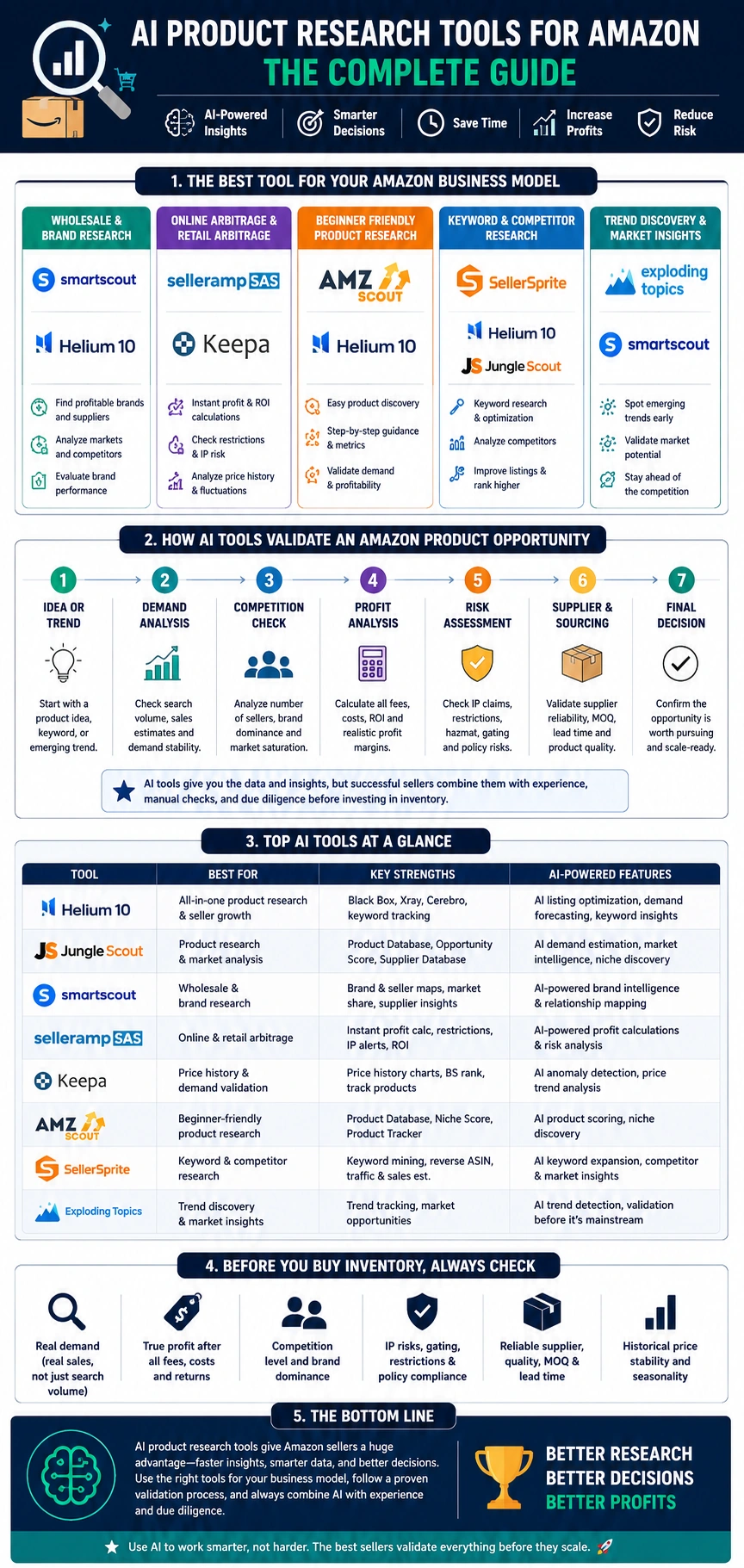
Conclusion
The best AI product research tool for Amazon sellers depends on how you source products and what decisions you need to make. There is no single platform that is perfect for private label, wholesale, online arbitrage, retail arbitrage, keyword research, trend discovery, and historical validation at the same time.
For private-label sellers, Helium 10 and Jungle Scout are strong starting points because they combine product discovery, keyword research, competitor analysis, and review-based insights. SmartScout is especially useful for wholesale sellers who need to research brands, seller activity, and category structure. SellerAmp SAS is one of the most practical options for online and retail arbitrage, while Keepa remains essential for checking whether current prices and demand are stable over time.
AMZScout can be a good entry point for beginners who want a simpler product-research workflow, while SellerSprite is useful for sellers who want to connect product opportunity research with keyword and competitor data. Exploding Topics adds a different type of value by helping private-label sellers spot emerging demand before it becomes obvious inside Amazon’s marketplace.
AI can make Amazon research faster, but it cannot guarantee a profitable product. A promising opportunity still needs to be checked against real costs, Amazon fees, price history, competition, supplier reliability, restrictions, compliance requirements, and intellectual-property risk.
The strongest workflow is usually simple: use one main tool to discover opportunities, use Keepa or another historical-data source to validate them, calculate realistic margins, and make the final decision based on evidence rather than a single AI score or sales estimate.
In other words, the right tool is not the one with the largest feature list. It is the one that helps you reject weak opportunities faster and spend more time on products that have real demand, sustainable margins, and manageable risk.
Frequently Asked Questions
What is the best AI product research tool for Amazon sellers?
Helium 10 is one of the best overall options for private-label sellers because it combines product discovery, keyword research, competitor analysis, and profitability tools. The best choice still depends on your business model: SmartScout is stronger for wholesale, while SellerAmp SAS is better for online and retail arbitrage.
Can AI find winning products for Amazon?
AI can help sellers find product ideas, analyze demand, identify trends, summarize reviews, and compare competition. It cannot guarantee that a product will be profitable or successful after inventory is purchased.
Is Helium 10 better than Jungle Scout for product research?
Helium 10 is often better for sellers who want a broader all-in-one Amazon toolkit with keyword, listing, and research features. Jungle Scout is especially strong for deeper market research, product tracking, competitor analysis, and review-based product-improvement ideas.
Do Amazon sellers still need Keepa?
Yes. Keepa remains one of the best tools for validating price history, Buy Box behavior, sales-rank changes, seller competition, and seasonal demand. AI research tools can find opportunities, but Keepa helps sellers determine whether a current price is historically stable.
Is SellerAmp worth it for online arbitrage?
SellerAmp SAS can be worth it for online arbitrage sellers because it helps evaluate individual products quickly. It combines estimated profit, ROI, Amazon fees, restrictions, Buy Box data, alerts, and Keepa-powered charts to support fast buy-or-skip decisions.
Which Amazon research tool is best for beginners?
AMZScout can be a good option for beginners because it provides product research, estimated sales, competition scores, browser-based analysis, and AI-assisted insights in a simpler workflow. Helium 10’s free tools can also be useful while learning the basics.
What is the best Amazon research tool for wholesale sellers?
SmartScout is one of the best options for wholesale sellers because it provides brand, seller, category, and market-mapping data. Many wholesale sellers also use Keepa for historical validation and SellerAmp SAS for ASIN-level profitability and restriction checks.
Can AI predict Amazon product demand?
AI can identify demand patterns, sales estimates, keyword trends, and emerging consumer interests. It cannot predict future demand with certainty because competition, seasonality, pricing, advertising costs, Amazon policy changes, and consumer behavior can all change.
How much should Amazon sellers spend on product research tools?
New sellers should usually start with one main tool and add more only when a clear gap appears in their workflow. A private-label seller may begin with Helium 10 or Jungle Scout, while an arbitrage seller may start with SellerAmp SAS plus Keepa.
What should sellers check before buying inventory?
Sellers should validate demand, competition, price history, Amazon fees, profit margins, supplier reliability, eligibility, compliance requirements, intellectual-property risks, and realistic shipping or prep costs before placing an order.
Are AI product research tools accurate?
They can provide useful estimates and market signals, but they are not perfect. Sales figures, revenue estimates, demand forecasts, and profitability calculations should be treated as starting points and checked against historical data, Amazon fees, and real sourcing costs.
Can AI product research tools check Amazon restrictions?
Some tools can flag possible restrictions, hazmat issues, private-label warnings, or eligibility concerns. Sellers should still verify restrictions directly in Seller Central before purchasing inventory because tool alerts may not capture every policy, brand, or account-specific limitation.